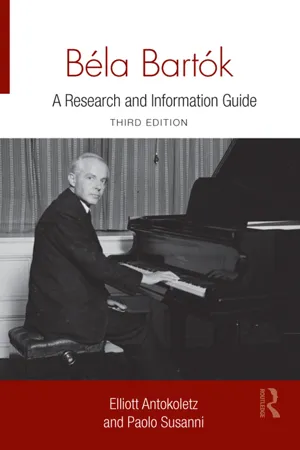
This research guide is an annotated bibliography of primary and secondary sources and catalogue of Bartók's compositions. Since the publication of the second edition, a wealth of information has been proliferating in the field of Bartók research. The third edition of this research guide provides an update in this field and represents the multidisciplinary research areas in the growing Bartók literature.
- 500 pages
- English
- ePUB (mobile friendly)
- Available on iOS & Android
eBook - ePub
About this book
Information
IV
Studies of Bartók’s musical compositions
1. Analytical and theoretical studies of Bartók’s works
570. Abraham, Gerald. “Bartók: String Quartet No. 6.” The Music Review 3/1 (1942): 72–73. 780.5 M9733 ISSN 0027-4445
In review of the score, states that String Quartet No. 6 is the latest of the most important series of string quartets since Beethoven. Gives brief summary of quartet composers since Beethoven and then discusses the significance of this quartet in terms of Bartók’s evolution. Presents brief analysis of its form and texture as well as certain technical devices.
571. Agawu, V. Kofi. “Analytical Issues Raised by Bartók’s Improvisations for Piano, Op. 20.” Journal of Musicological Research 5 (1984): 131–163. ML5 M6415 780.7 ISSN 0141-1896
Study of pitch organization in Bartók’s music. Emphasis is not on the compositions themselves but rather on the analytical issues that result from their study. Prefers a historically based approach, with a balance between the historical information and the theoretical discussions.
572. Albrecht, Jan. “Das Variations- und Imitationsprinzip in der Tektonik von Bartóks Bratschenkonzert” [The variation and imitation principle in the construction of Bartók’s Viola Concerto]. Studia musicologica 14 (1972): 317–327. 781.05 St92 ISSN 0039-3266
Detailed discussion of how Bartók applies the variation principle to the whole structural system of the piece, emphasizing the system in the inversion of the facture.
573. Antokoletz, Elliott. “ ‘At last something truly new’: Bagatelles.” The Bartók Companion, ed. Malcolm Gillies. London: Faber and Faber, 1993; Portland, Oregon: Amadeus Press (an imprint of Timber Press, Inc.), 1994, pp. 110–123. ISBN 0-931340-74-8 (HB) ISBN 0-931340-75-6 (PB) ML410 B26 B28
Discusses the history and reception of these early pieces and how they represent Bartók’s first major attempt to absorb and transform both Eastern European folk sources and elements of Debussy’s music into a new, anti-Romantic idiom. Outlines the basic principles of Bartók’s musical language as contained in these early pieces of 1908. Study of the individual pieces reflects in microcosm the various stages of Bartók’s entire evolution. Includes exploration of harmonic and linear derivations from authentic folk songs and original modal constructions, fusion of traditional and symmetrical concepts of tonal centricity, diatonic, octatonic, and whole-tone interactions, and generation of the interval cycles from intervallic cells.
574. ——. “Concerto for Orchestra.” The Bartók Companion, ed. Malcolm Gillies. London: Faber and Faber, 1993; Portland, Oregon: Amadeus Press (an imprint of Timber Press, Inc.), 1994, pp. 526–537. ISBN 0-931340-74-8 (HB) ISBN 0-931340-75-6 (PB) ML410 B26 B28
Discusses the political, professional, and unhappy personal circumstances surrounding the composition of the Concerto during Bartók’s final residence in the United States. Refers to Bartók’s performance reception during this period and discusses the culminating position of the Concerto in Bartók’s oeuvre as part of the tendency toward synthesis of divergent Eastern European folk-music sources and abstract contemporary art-music techniques, which are set within the five-movement framework of traditional Classical forms and procedures as outlined by the composer himself. Provides in-depth analysis of the traditional folk-like themes and overall harmonic fabric based on the interaction and transformations between traditional (diatonic) and non-traditional (octatonic, whole-tone, and other cyclic-interval) pitch formations.
575. ——. “Diatonic Extension and Chromatic Compression as a Basic Unifying Principle in Bartók’s Music for Strings, Percussion and Celesta.” International Journal of Musicology, 9 (2000): 303–328. ISSN 0941-9535 ISBN 3-631-52508-7, in Bartók International Congress 2000
Explores the integrative process of the work, in which “a hidden unity” lies just beneath the surface of Bartók’s varied melodic and harmonic constructions. May be understood by the composer’s own reference in his Harvard lectures to the principle of diatonic “extension in range” of chromatic themes and the reverse, chromatic “compression” of diatonic themes. It is in this interplay of opposites that we find one of the main sources from which the organic vitality of the work springs. Reveals that these opposites can be translated into two contrasting principles based on the modal constructions of Eastern European folk music and the symmetrical pitch constructions of contemporary Western European art music. Symmetrical cell formations are shown to serve as intermediary (pivotal) stages between the expanded and compressed materials.
576. —— “A Discrepancy Between Editions of Béla Bartók’s Fifth String Quartet: Resolved by a Comparative Study of Primary Sources and Analysis.” For the Love of Music: Festschrift in Honor of Theodore Front on his 90th Birthday. Lucca: Lim Antiqua, 2002, pp. 165–185. ISBN 88-88326-01-4
The increased availability of Bartók’s MSS has made it possible to produce the first complete critical edition of his works. The edition, however, must be overseen by an editor who is not only fully capable of dealing with the MSS sources, but is also knowledgeable of the composer’s musical language. Even the composer commented generally on the many errors in the published versions of his music. A case in point is the discrepancy between two editions of the fifth string quartet, one produced by Universal Edition and the other by Boosey and Hawkes. In the cello part four measures from the end, the former has an F-sharp while the latter has an F-natural. A comparative study of the quartet drafts and related material at the Peter Bartók Archive (formerly New York Bartók Archive) in Homosassa, Florida, as well as analysis of the pitch relations are essential in resolving the discrepancy.
577. ——. “Middle-period String Quartets.” The Bartók Companion, ed. Malcolm Gillies. London: Faber and Faber, 1993; Portland, Oregon: Amadeus Press (an imprint of Timber Press, Inc.), 1994, pp. 257–277. ISBN 0-931340-74-8 (HB) ISBN 0-931340-75-6 (PB) ML410 B26 B28
Points to the Third and Fourth String Quartets as the most intensive stage of Bartók’s evolution toward increasing synthesis of divergent folk-music and art-music sources. Provides a brief history of the political and cultural circumstances as well as Bartók’s own professional activities in the 1920s that contributed to the expansion of the basic principles of pitch organization, texture, and instrumental writing in these two middle-period quartets. After discussing the new sources of influence on Bartók’s style during this period and the events leading to the composition of these quartets, in-depth analyses are provided to reveal insight into Bartók’s aesthetic bases, theoretical principles, and musical language in terms of both pitch and rhythmic organization. Structural principles of these quartets are shown to be based on the infusion of traditional forms with Bartók’s own notion of expansions and contractions between diatonic and chromatic themes. Focuses on generation of the larger structure and design by means of special transformational links between Eastern European folk modes (diatonic and non-diatonic) and abstract symmetrical, or cyclic-interval constructions. In the Fourth Quartet, especially, shows how the interaction of symmetrical cells underlies a new concept of tonal centricity based on “axes of symmetry.”
578. ——. “Modal Transformation and Musical Symbolism in Bartók’s Cantata Profana.” Bartók Perspectives: Man, Composer, and Ethnomusicologist, eds. Elliott Antokoletz, Victoria Fischer, and Benjamin Suchoff. New York: Oxford University Press, 2000, pp. 61–76.
Discusses the Cantata Profana (1930) as the most explicit embodiment of Bartók’s philosophy, based on the composer’s ideal concerning the brotherhood of neighboring nations—Romania, Slovakia, and Hungary. Demonstrates that the conjoining of Bartók’s social concerns during the period of increasing political repression in the 1930s with his lifelong musical endeavors to synthesize divergent Eastern folk modalities and Western art-music sources came to full fruition in the Cantata. Analyzes the work as an exemplar of Bartók’s ability to transform both diatonic and nondiatonic folk modes into octatonic, whole-tone, and other abstract pitch constructions of contemporary art music in correspondence with dramatic symbolization of the text. The music paraphrase from the opening of Bach’s St. Matthew Passion is pivotal in these transformations and appears to serve a deeper level of symbolization in the manifestation of Bartók’s philosophical statement. Contains music examples. (Annotation based on the author’s abstract of the original lecture; see item no. 1292.)
579. ——. “The Music of Bartók: Some Theoretical Approaches in the U.S.A.” Studia musicologica 24/4 (1982): 67–74. 781.05 St92 ISSN 0039-3266
Lecture given at the IMC of UNESCO Conference on Bartók in Budapest (1981). Illustrates the diversity of analytical/theoretical approaches to Bartók’s music in the United States, discussing the concepts of such theorists as Roy Travis (Schenkerian), Allen Forte (serial scheme), Tibor and Peter Bachmann and Hilda Gervers (as followers of Ernő Lendvai’s “Golden Section” and “Fibonacci” principles), George Perle (concepts of the interval cycle and inversional symmetry), and Elliott Antokoletz (transformation of the folk modes to the system of the interval cycles and inversional symmetry). Explores these varied approaches by moving from the more traditional concepts to those that can only belong to the present century. This high degree of individuality and divergence among theorists, which is particularly prominent in the United States, may partly be due to the versatility and complexity of Bartók’s musical language.
580. ——. The Music of Béla Bartók: A Study of Tonality and Progression in Twentieth-Century Music. Berkeley and Los Angeles: University of California Press, 1984. xviii, 342p. ISBN 0520046048 ML410.B26A8 780.92 4
In-depth study of Bartók’s musical language, showing stages of transformation from the folk-music sources to a highly abstract set of art-music principles. These stages include the harmonization of authentic folk tunes, symmetrical transformation of the diatonic folk modes, the construction, development, and interaction of intervallic cells, tonal centricity based on axes of symmetry and traditional modal-tonal centers, interactions of diatonic, octatonic, and whole-tone formations, and generation of the interval cycles. Many compositions spanning Bartók’s lifetime are explored and placed in the historical context of the musical developments and activities of Bartók’s contemporaries. Bartók’s own activities in connection with his folk-music investigations and compositions are explored in-depth to shed light on the development of his own personal musical language. Includes discussion of a number of Bartók’s sketches to support the theoretical conclusions. Conclusion introduces a study of the use of folk-music sources and symmetrical pitch relations in music of the nineteenth century. Contains 390 music examples, 14 holographic excerpts, 3 indexes, and a bibliography. See reviews by: Arnold Whittall in The Times Literary Supplement (London) (August 16, 1985): 904; Péter Halász in Magyar zene 26/3 (September 1985): 327–330; Jim Samson in Tempo 155 (December 1985): 54–55; Mitchell Morris in Current Musicology 47 (1986): 71–76; Paul Wilson in Journal of Music Theory 30/1 (Spring 1986): 113–121; Douglas Jarman in Music and Letters 67/3 (July 1986): 321–322; Pieter C. van den Toorn in Music Theory Spectrum 9 (1987): 215–222.
581. ——. “The Musical Language of Bartók’s 14 Bagatelles for Piano.” Tempo 137 (June 1981): 8–16. 780.5 T249 ISSN 004...
Table of contents
- Cover Page
- Half-Title Page
- Series Page
- Title Page
- Copyright Page
- Table of Contents
- Preface to the third edition
- Preface to the second edition
- Preface to the first edition
- History of Bartók’s musical development: an introduction
- I. Published compositions according to genre: with publishers, archives, collections, and catalogues
- II. Primary sources: Bartók’s writings and other documents
- III. Biographical and historical studies
- IV. Studies of Bartók’s musical compositions
- V. Discussions of institutional sources for Bartók research and essays in collected volumes
- Author-title index
- Index of Bartók’s compositions, keyboard editions, and transcriptions
- Index of proper names
- Subject index
Trusted by 375,005 students
Access to over 1.5 million titles for a fair monthly price.
Study more efficiently using our study tools.
Frequently asked questions
Yes, you can cancel anytime from the Subscription tab in your account settings on the Perlego website. Your subscription will stay active until the end of your current billing period. Learn how to cancel your subscription
No, books cannot be downloaded as external files, such as PDFs, for use outside of Perlego. However, you can download books within the Perlego app for offline reading on mobile or tablet. Learn how to download books offline
Perlego offers two plans: Essential and Complete
- Essential is ideal for learners and professionals who enjoy exploring a wide range of subjects. Access the Essential Library with 800,000+ trusted titles and best-sellers across business, personal growth, and the humanities. Includes unlimited reading time and Standard Read Aloud voice.
- Complete: Perfect for advanced learners and researchers needing full, unrestricted access. Unlock 1.5M+ books across hundreds of subjects, including academic and specialized titles. The Complete Plan also includes advanced features like Premium Read Aloud and Research Assistant.
We are an online textbook subscription service, where you can get access to an entire online library for less than the price of a single book per month. With over 1.5 million books across 990+ topics, we’ve got you covered! Learn about our mission
Look out for the read-aloud symbol on your next book to see if you can listen to it. The read-aloud tool reads text aloud for you, highlighting the text as it is being read. You can pause it, speed it up and slow it down. Learn more about Read Aloud
Yes! You can use the Perlego app on both iOS and Android devices to read anytime, anywhere — even offline. Perfect for commutes or when you’re on the go.
Please note we cannot support devices running on iOS 13 and Android 7 or earlier. Learn more about using the app
Please note we cannot support devices running on iOS 13 and Android 7 or earlier. Learn more about using the app
Yes, you can access Béla Bartók by Elliott Antokoletz,Paolo Susanni in PDF and/or ePUB format, as well as other popular books in Media & Performing Arts & Music. We have over 1.5 million books available in our catalogue for you to explore.