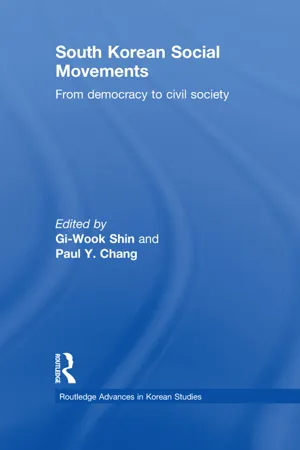
South Korean Social Movements
eBook - ePub

South Korean Social Movements

From Democracy to Civil Society

  1. 306 pages
  2. English
  3. ePUB (mobile friendly)
  4. Available on iOS & Android
eBook - ePub

South Korean Social Movements

From Democracy to Civil Society

About this book

This book explores the evolution of social movements in South Korea by focusing on how they have become institutionalized and diffused in the democratic period. The contributors explore the transformation of Korean social movements from the democracy campaigns of the 1970s and 1980s to the rise of civil society struggles after 1987. South Korea was ruled by successive authoritarian regimes from 1948 to 1987 when the government decided to re-establish direct presidential elections. The book contends that the transition to a democratic government was motivated, in part, by the pressure from social movement groups that fought the state to bring about such democracy. After the transition, however, the movement groups found themselves in a qualitatively different political context which in turn galvanized the evolution of the social movement sector.

Including an impressive array of case studies ranging from the women's movement, to environmental NGOs, and from cultural production to law, the contributors to this book enrich our understanding of the democratization process in Korea, and show that the social movement sector remains an important player in Korean politics today.

This book will appeal to students and scholars of Korean studies, Asian politics, political history and social movements.

Frequently asked questions

Yes, you can cancel anytime from the Subscription tab in your account settings on the Perlego website. Your subscription will stay active until the end of your current billing period. Learn how to cancel your subscription.
No, books cannot be downloaded as external files, such as PDFs, for use outside of Perlego. However, you can download books within the Perlego app for offline reading on mobile or tablet. Learn more here.
Perlego offers two plans: Essential and Complete
  • Essential is ideal for learners and professionals who enjoy exploring a wide range of subjects. Access the Essential Library with 800,000+ trusted titles and best-sellers across business, personal growth, and the humanities. Includes unlimited reading time and Standard Read Aloud voice.
  • Complete: Perfect for advanced learners and researchers needing full, unrestricted access. Unlock 1.4M+ books across hundreds of subjects, including academic and specialized titles. The Complete Plan also includes advanced features like Premium Read Aloud and Research Assistant.
Both plans are available with monthly, semester, or annual billing cycles.
We are an online textbook subscription service, where you can get access to an entire online library for less than the price of a single book per month. With over 1 million books across 1000+ topics, we’ve got you covered! Learn more here.
Look out for the read-aloud symbol on your next book to see if you can listen to it. The read-aloud tool reads text aloud for you, highlighting the text as it is being read. You can pause it, speed it up and slow it down. Learn more here.
Yes! You can use the Perlego app on both iOS or Android devices to read anytime, anywhere — even offline. Perfect for commutes or when you’re on the go.
Please note we cannot support devices running on iOS 13 and Android 7 or earlier. Learn more about using the app.
Yes, you can access South Korean Social Movements by Gi-Wook Shin, Paul Y Chang, Gi-Wook Shin,Paul Y Chang,Paul Chang in PDF and/or ePUB format, as well as other popular books in Politics & International Relations & Civics & Citizenship. We have over one million books available in our catalogue for you to explore.

Table of contents

  1. Cover
  2. Title
  3. Copyright
  4. Contents
  5. Figures
  6. Tables
  7. Contributors
  8. Acknowledgments
  9. Introduction
  10. 1. Democratization and the evolution of social movements in Korea: Institutionalization and diffusion
  11. PART I. Social movements and democratic transition
  12. PART II. Institutionalization of social movements
  13. PART III. Spin-off movements and diffusion processes
  14. Appendix
  15. Bibliography
  16. Index