This book combines management theory with ethical theory on a chapter by chapter, topic by topic basis. The volume bridges the theoretical, empirical and practical gap between management and ethics. It will be of interest to a cross disciplinary group of students, researchers and managers in business, management, organizational behavior, IO psychology and business ethics.
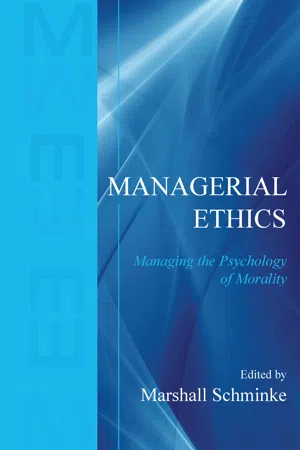
- 334 pages
- English
- ePUB (mobile friendly)
- Available on iOS & Android
eBook - ePub
1
Management and Ethics: Revisiting Distant Neighbors
Marshall Schminke
Manuela Priesemuth
University of Central Florida
University of Central Florida
In the year 2000, Enron was firmly entrenched as one of the most admired firms in America. Fortune magazine had consistently named it the most innovative company in the U.S. as well as one of the 100 best companies to work for. Similarly impressive honors surrounded firms like WorldCom, Tyco, Arthur Andersen, Adelphia, and AIG as well. All were highly respected companies delivering quality, innovative products and services across a variety of markets. Ten short years later, the ethical, financial, and legal scandals that devastated these and other firms demonstrate that this has been perhaps the most turbulent decade for business ethics ever.
Shortly before this epidemic of ethical failure began, the first edition of Managerial Ethics went to press (Schminke, 1998). (Of course, we caution the reader to avoid the “post hoc ergo propter hoc” fallacy of false cause!) The goal of the first edition was to initiate conversations among researchers from a variety of backgrounds who shared an interest in business ethics. The authors who contributed to it addressed the theoretical, empirical, and practical implications of ethical issues including privacy, performance monitoring, selection, punishment, quality, politics, manipulation, technology, and decision making. In all, it was a very strong collection. Many of these authors, and the work they produced, laid the foundation for considerable improvements in our understanding of managerial ethics.
Now, just over a decade later, the need for continued attention to the challenges of business ethics remains clear. This second edition of Managerial Ethics derives from that need. Its goal is to press further into the theoretical and practical problems posed by modern business ethics. In doing so, this new edition reiterates and updates some of the foundational material provided in the first edition. However, it probes important new areas as well. It does so by blending the perspectives of authors from the previous edition with a set of new voices. The result is a compilation of theoretical, empirical, and practical insights that span a broad spectrum of ethical issues important to managers and researchers alike.
The relationship between business and ethics continues to be a stormy one, in both theory and practice. This opening chapter seeks to shed light on the core causes of that sometimes uneasy association. It aims to improve ties between the two by reiterating and then extending some of the basic themes presented in the opening chapter of the first edition.
We begin with a brief recap of the most fundamental challenges facing business ethics research. We then outline an agenda for overcoming these challenges. Finally, we provide brief overviews of the remaining chapters in the volume, each of which expands our thinking about business ethics research in a manner consistent with this agenda. In all, our objective is to set the stage for the terrific collection of thoughts about managerial ethics that follows.
Recurring Challenges in Business Ethics Research
Throughout its history, research in business ethics has faced a consistent set of challenges. Many of these emanate from the nature of relationships among business ethics issues and the scholars interested in those issues.
Popper’s (1972) observations on the structure of social systems provides some insight about the nature of these relationships. Popper (1972) distinguished between social systems that are like clocks and those that are like clouds (Cropanzano & Schminke, 1997; Guzzo & Shea, 1990). Clocks are rational, orderly, machines. Their parts move in predictable ways and in predictable relationships to the other parts. Alternatively, clouds are neither predictable nor orderly. To the extent that they have “parts,” they do not move in clearly defined or predictable ways in relation to the other parts. From a distance, they may appear to be substantial objects with clear boundaries. However, up close they are fuzzy, flexible, organic creations. This metaphor for social systems also describes research systems; some are like clocks and others are like clouds. Business ethics research is more cloudlike than clocklike. From a distance, it appears to be a singular, solid, substantial thing. But up close it is fuzzy, flexible, and organic.
One of the greatest strengths of business ethics research lies in the diversity of those interested in knowing more about it. Where else could we find moral philosophers, industrial psychologists, political scientists, management scholars, organizational sociologists, and behavioral economists, all exploring the same issues? Scholars from these and other disciplines bring to the table an intriguing mix of skills and perspectives. In doing so, they reflect a common interest in questions regarding business, ethics, and the relationship between the two. However, with this strength also comes a weakness. Researchers from such diverse backgrounds often find it difficult to communicate with one another in meaningful ways. Nowhere has this been truer than with business ethics.
Over the years, scholars have addressed the natural conflicts that arise between those with different perspectives on the field of business ethics. Much of this work echoes two central challenges facing business ethics scholars. First, how might we best integrate the two very different areas—business and ethics—that provide the scholarly foundation for the field? Second, how might we create closer ties between business ethics research and real business settings? Helping to overcome those challenges is the central agenda for this volume.
The First Challenge: Integrating Business and Ethics Scholarship
Business ethics research consists of two distinct subdisciplines. Scholarship in business, which is primarily descriptive and based in the social sciences, addresses the question of “what is.” Scholarship in ethics, which is primarily normative or prescriptive and based in moral philosophy, addresses the question of “what ought to be.” Historically, these two approaches represented distinct areas of inquiry, and the literature points to a number of issues that inhibit efforts to integrate them.
One roadblock to integration is fear. For example, Victor and Stephens (1994) note that historically, philosophy and social science have exhibited a sort of division of labor with respect to business ethics. Philosophers address normative issues and social scientists, descriptive ones. However, forces in each area impede attempts to integrate the two. For example, philosophers fear a creeping “naturalistic fallacy” in the face of advancing empiricism. That is, they fear that discoveries of “what is” may come to define our thinking of “what ought to be.” Similarly, social scientists express concern over breaking ranks with a positivist tradition, which asserts that facts are distinct from values. If “truth” cannot carry with it any value judgments, how can empiricists consider addressing questions regarding “what ought to be?”
A second roadblock to integration is differences in purpose. For example, Fleming (1987) notes that there is “an almost complete lack of integration between normative and descriptive research efforts” (1987, p. 21) in business ethics. He predicts the two may eventually converge by developing distinctive contributions to practicing managers. That is, the normative approach would evolve into an instructive tool, identifying what constitutes moral behavior, how it is learned, and how it may be converted into business practices. The descriptive approach would develop predictive competence, to be implemented into practical business decision making.
A third roadblock to integration lies in the background of scholars in each area. For example, Treviño and Weaver (1994) distinguish between business schools’ concentration on the business perspective of business ethics, and philosophy and theology departments’ focus on the ethics perspective. They point out that researchers from each area differ in a number of important ways, including academic background, language, and underlying assumptions, as well as how they use, apply, and evaluate theory. Although Treviño and Weaver reiterate previous calls for unity, they note that these calls for integration have, for the most part, failed to provide clear guidance as to what an integrated field would look like or how it might be accomplished.
The challenges presented by these roadblocks continue to play out in business ethics research. Consider several recent attempts to understand business ethics at a more global level via literature reviews. O’Fallon and Butterfield’s (2005) review of the ethical decision making literature, Treviño, Weaver, and Reynolds’ (2006) review of the behavioral ethics literature, and McClaren’s (2000) review of the sales management literature each represent well-crafted reviews of substantial bodies of work. However, each embraces only the social science side of the mix. (For an exception, see Nill and Shibrowski’s (2007) review of the marketing ethics literature, which includes both normative and positive aspects of the literature.)
Of course, decisions to limit reviews in this way are understandable. Space limitations often require that attention be focused on specific subsets of relevant literatures, and in this sense, business ethics research may be a victim of its own success. An ABI/Inform database seach (limited to scholarly journals in business and economics only) reveals more than 3500 articles in which the word “ethics” appears in the title, and this is for work published just in the the past decade! Thus, creating a manageable subset of the literature requires that authors make some coarse initial cuts on that literature. For better or worse, that cut often entails separating the philosophical or normative from the social science or descriptive and addressing only one or the other. However, such decisions influence how (and how often) business ethics scholars successfully integrate sound philosophy and social science in their work.
Toward a More Integrated Field
Kahn’s (1990) essay on creating an agenda for business ethics research may help to address the question of how to facilitate greater integration in the business ethics literature. Like others, he distinguishes between the normative (prescriptive) and contextual (descriptive) traditions in the field. He argues that at present the two areas resemble distinct circles in a Venn diagram that overlap little, if at all. Because the two areas rise from relatively distinct underlying disciplines, little shared ground exists between them. Further, individuals possess strong theoretical and methodological ties to their primary disciplines. As scholars attempt to reinforce their own areas, those areas may become even more impenetrable to others. Researchers continue to be inadequately grounded in at least one of the two disciplines, often differing significantly in how they identify ethical issues in business. Therefore, the shared ground is not likely to grow and may even shrink! He relates one author’s comments regarding the dilemma facing business ethics researchers:
[Researchers] in applied ethics are in the inherently comic position of carrying water from wells they haven’t dug to fight fires they can’t quite find. (1990, p. 313)
Kahn (1990) sketches four images—conversation, history, vision, and community—that he believes outline an ideal ethical system. Members of such a system would talk to each other. They would respect and understand each others’ historical roots. They would provide clear and imaginative ideas. Finally, they would work within the larger community toward shared goals. These images provide a sound basis for integrating business ethics researchers. That is, they would be an interactive comm...
Table of contents
- Contents
- Preface
- Acknowledgments
- About the Editor
- Contributors
- 1 Management and Ethics: Revisiting Distant Neighbors
- Section I Ethics From the Top Down
- Section II Unethical Behavior
- Section III New Theoretical Perspectives
- Author Index
- Subject Index
Trusted by 375,005 students
Access to over 1.5 million titles for a fair monthly price.
Study more efficiently using our study tools.
Frequently asked questions
Yes, you can cancel anytime from the Subscription tab in your account settings on the Perlego website. Your subscription will stay active until the end of your current billing period. Learn how to cancel your subscription
No, books cannot be downloaded as external files, such as PDFs, for use outside of Perlego. However, you can download books within the Perlego app for offline reading on mobile or tablet. Learn how to download books offline
Perlego offers two plans: Essential and Complete
- Essential is ideal for learners and professionals who enjoy exploring a wide range of subjects. Access the Essential Library with 800,000+ trusted titles and best-sellers across business, personal growth, and the humanities. Includes unlimited reading time and Standard Read Aloud voice.
- Complete: Perfect for advanced learners and researchers needing full, unrestricted access. Unlock 1.5M+ books across hundreds of subjects, including academic and specialized titles. The Complete Plan also includes advanced features like Premium Read Aloud and Research Assistant.
We are an online textbook subscription service, where you can get access to an entire online library for less than the price of a single book per month. With over 1.5 million books across 990+ topics, we’ve got you covered! Learn about our mission
Look out for the read-aloud symbol on your next book to see if you can listen to it. The read-aloud tool reads text aloud for you, highlighting the text as it is being read. You can pause it, speed it up and slow it down. Learn more about Read Aloud
Yes! You can use the Perlego app on both iOS and Android devices to read anytime, anywhere — even offline. Perfect for commutes or when you’re on the go.
Please note we cannot support devices running on iOS 13 and Android 7 or earlier. Learn more about using the app
Please note we cannot support devices running on iOS 13 and Android 7 or earlier. Learn more about using the app
Yes, you can access Managerial Ethics by Marshall Schminke in PDF and/or ePUB format, as well as other popular books in Business & Business Ethics. We have over 1.5 million books available in our catalogue for you to explore.