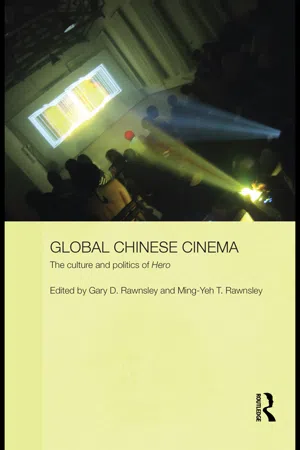
The film Hero, directed by Zhang Yimou and released in 2002, is widely regarded as the first globally successful indigenous Chinese blockbuster. A big expensive film with multiple stars, spectacular scenery, and astonishing action sequences, it touched on key questions of Chinese culture, nation and politics, and was both a domestic sensation and an international hit. This book explores the reasons for the film's popularity with its audiences, discussing the factors which so resonated with those who watched the film. It examines questions such as Chinese national unity, the search for cultural identity and role models from China's illustrious pre-communist past, and the portrayal of political and aesthetic values, and attitudes to gender, sex, love, and violence which are relatively new to China. The book demonstrates how the film, and China's growing film industry more generally, have in fact very strong international connections, with Western as well as Chinese financing, stars recruited from the East Asian region more widely, and extensive interactions between Hollywood and Asian artists and technicians. Overall, the book provides fascinating insights into recent developments in Chinese society, popular culture and cultural production.
eBook - ePub
Global Chinese Cinema
The Culture and Politics of 'Hero'
- 256 pages
- English
- ePUB (mobile friendly)
- Available on iOS & Android
eBook - ePub
Global Chinese Cinema
The Culture and Politics of 'Hero'
About this book
Information
Part I
Changing discourses of national identities and heroism
1
The political narrative(s) of Hero
Gary D. Rawnsley
“Who controls the past controls the future. Who controls the future controls the past.”
— George Orwell, Nineteen Eighty-Four
Deliberately or not, Zhang Yimou layered his 2002 martial arts (wuxia) masterpiece, Hero, with multiple political discourses. The film addresses and interrogates themes that resonate with political meaning and imagery, and which are as relevant to an exploration of contemporary China as to any attempt to understand the ancient period of the Warring States (c.475–221 BCE) that forms the backdrop to the movie.
The first discourse is the most transparent and the most intentional: nationalism, through the discourse of ‘our land’ (a term used in the English version of the movie) or tian xia (literally ‘all under heaven’), provides the film’s milieu and its satisfactory dénouement. This theme need not detain us here for nationalism is addressed in more depth by other contributors to this volume (for example, see Guo and Wang). However, from the perspective of political narrative we should note that Hero represents an implicit intervention in a post-communist discussion about the importance and role of ideology in modern China. The power and consequences of nationalist policy and discourse are subjects of concern to many observers of contemporary Chinese politics, most of whom refer to the ancient dream of national unification as an instrument of popular political mobilization and legitimation.1 Other discourses in Hero inform and are informed by this main theme of nationalism. The organization of political processes and institutions, for example, is framed through a study of Legalist approaches that promote narratives of stability over rebellion to serve the nationalist agenda; while I also suggest utilitarian discourses provide the means of interpreting the choices made by both
Nameless the assassin and the King of Qin at the film’s conclusion.2 This chapter offers a brief analysis of the most significant political themes that are embedded within the film. It questions the relevance and utility of the historical narrative, and therefore raises the vital issue of the power of and over discourses in modern China. Moreover, I examine the underlying political philosophy of Hero that challenges accepted codes of Confucian morality and which gives the dominant nationalist narrative its strength.
Narratives and their narrators
At the core of Hero is a juxtaposition of narratives recounted by storytellers with varying degrees of knowledge and power. Audiences are gradually exposed to multiple versions of the same story, all weaving a complex plot of conspiracies, betrayal, sexual infidelity and ultimately, misinformation. In its structure the film therefore poses elementary political questions that are directly appropriate to modern China: who is allowed to tell the real story? Whose voice is heard? Whose version of history is legitimate and accepted as such? How do the powerful deal with narratives that challenge the official version of a story?
Audiences with experience of living or working in China will find this theme familiar; mutiple narratives are carefully controlled and any attempt to offer a record of events that deviates from or challenges the official version soon faces the might of the Chinese censor. Under Hu Jintao (General Secretary of the Communist Party since 2002, President of China since 2003 and Chairman of the Central Military Commission since 2004), the government is extending its surveillance and management of the media, a situation I explore in depth elsewhere (Rawnsley, 2006). For example, preventing access to forbidden websites is common, while content on government approved websites can often present a sanitized version of Chinese history. A websearch for Tiananmen Square from within China, for example, will yield photographs of posing tourists, not the lone male facing down the PLA tanks in 1989.
Yet despite the ever tightening political control of the media under Hu Jintao there are grounds for optimism. Chinese Internet users are both circumventing restrictions and forcing the government to follow discourses that are determined and shaped by popular opinion expressed online, thus conceiving new political narratives. This was demonstrated most noticeably in April 2001 when the Chinese airforce shot down an American spy plane over Hainan island (Gries, 2004: 120).3 Moreover, the death of Zhao Ziyang4 in January 2005 affirmed the Internet user’s ability to search for and discover forbidden information, and express grievances with government-controlled censorship: the Internet “has only endowed citizens with a heightened awareness of the amount of information that is being blocked” (Parker, 26 January 2005), while the growth of the blogger culture, in which ordinary Internet users can become simultaneously author, publisher and audience, encourages the creation of ‘bottom-up’ narratives:
[T]oday […] my grandmother said, ‘Zhao Ziyang died, why isn’t the news or the papers reporting it?’ I was curious, so I went searching on the Internet, but I found I couldn’t open many Web sites, which made me think something was strange …
This morning, I couldn’t connect to any overseas web sites, and I realized that something had happened …
Putting aside Zhao’s merits and faults for the time being, we have already completely lost the right to speak, and to hear about him! What kind of world is this?
(Ibid.)
The dominant political and historical narratives are increasingly challenged by a progressively curious, vocal and Internet-friendly population that is able to harness the power of new technology to give form and voice to their questioning. This confronts the very basis of how the Communist Party retains control of information through centralization and vertical (top to bottom, i.e. a simple model of government to people) communication. The Internet, however, and the architecture of the World Wide Web facilitate decentralized dissemination based on horizontal communications (the most significant being person to person, non-governmental communications). Increasingly we can observe how the Internet is a communications system that is incompatible with communist political and social organization. The connectivity associated with the Internet has the capacity to break down spatial and temporal relevance while undermining existing hierarchies (Castells, 1996, 1997, 1998, 2002; Norris, 2001; Stevens and O’Hara, 2006). Predictably, these tensions worry governments, such as the Chinese Communist Party (CCP), that are determined to maintain a grip, however tenuous, on political narratives.
These themes are represented in Hero in which the principal narrator is arguably the director himself. Audiences are familiar with political imagery in Zhang Yimou’s films, though in interviews the director has repeatedly denied deliberately following a political agenda or using overt political imagery. Interviewing Zhang, Tan (1999–2000: 10) noted: “Yellow Earth … and all other Fifth Generation films have been overly interpreted. Raise the Red Lantern, for instance, has been treated as an allegory of the Gang of Four.” Zhang replied: “Some people’s interpretations of our works overshadow the works themselves. It has been common for interpretations to impose themselves on art works.” Furthermore, film commentators and scholars have subscribed to the idea that the so-called Fifth Generation of directors, with Zhang arguably its most famous member, are less concerned with politics than their predecessors and are more interested in the ascetic and experimenting with the medium (Chen, Liu and Shi, 1997; Zhang, 2004).
While one sympathizes with Zhang, his claim is defensive, if not a little disingenuous for it is impossible to watch his films, especially this author’s favourites, To Live (Huozhe, 1994) and The Story of Qiuju (Qiuju da guansi, 1992), without sensing their political undercurrents. Zhang’s movies, including Hero, provide a contested narrative, one version of Chinese history. The official response to Zhang’s films suggests that, intentionally political or not, the Chinese government perceives a direct challenge to their own narrative5; in other words that there is a competition between the state and artist for the authority and legitimacy to tell China’s story. One might propose that the Communist Party has politicized art through its own interpretation and, by challenging certain artists’ right to perform or compose, has drawn audience attention to the possibly subversive content in their output.
The biographical focus of Hero, the King of Qin (259–210 BCE) has long been the subject of Chinese historiography, and the narrative of this history changes to suit the interests and prevailing political agendas of the time. Conventional accounts of Chinese history chronicle the contribution of the Qin Dynasty (221–206 BCE) to the formation of political society. According to these the First August Emperor, Shi huangdi (the assassins’ intended target in Hero), was responsible for introducing the characteristics of government, economics, commerce and culture that we today associate with modern China: a meritocratic bureaucracy; administrative efficiency; the centralization of state power; the standardization of language, currency, weights and measures. He is best remembered, however, as the first Chinese ruler to attempt the unification of China and for expanding its territory.6 The historian Rayne Kruger has recounted how under the First Emperor China
extended for a thousand miles westward of the Pacific shore and from the deserts of the north to the lush lands south of the Yangtze. This was the core China which despite periodic fragmentation and with substantial accretions of territory has subsisted as a country and a nation these two and a quarter millennia – one of the major political entities on earth – while innumerable other imperial entities have risen and fallen …
(Kruger, 2004: 90–91)
… in 210 BC he [the First Emperor] suddenly fell ill and died. He was forty-nine, having reigned for thirty-seven years, of which only for the last twelve had he been Emperor. But the imprint of his rule remained on the Chinese state for two thousand years or more.
(Ibid.: 96–97)
Another historian, Partricia Buckley Ebrey (1996: 61), describes how later Chinese narratives “castigated” the First Emperor “as a cruel, arbitrary, impetuous, suspicious, and superstitious megalomaniac”. This is more consistent with the Confucian reaction to Qin rule, which is hardly surprising given that Qin Legalism (fajia) challenged the Confucian moral and political order. As early as 266 BCE Confucian scholars began to censure the Qin, alleging that the emperor was responsible for China’s first ‘Cultural Revolution’: in response to Confucian criticism of his style of government he is said to have ordered the burning of any classical texts and books about philosophy that did not serve a practical purpose.7 Anyone discussing or advocating these competing schools of thought were executed, as were their families. This ‘Cultural Revolution’ demonstrates that the Qin were not only concerned with controlling (or abolishing) competing schools of thought, but also with controlling narrative. One purpose of this wanton destruction was to abolish the tendency to disparage the present by praising the past, a method that successive Chinese governments have used (most recently during Mao Zedong’s Cultural Revolution, 1966–1975). The Qin destroyed competing histories to prevent access to alternative versions (De Bary and Bloom, 2000: 141).
The story of this ‘Cultural Revolution’ is a familiar theme in all the histories of the Qin and is entirely consistent with the dominant narrative of the dynasty’s brutality that began with the Confucians. Their Ten Crimes of Qin, for example, was an inventory of the emperor’s cruel actions and was followed by Jia Yi’s essay, The Faults of Qin (Guo qin lun).8 In all such critical accounts the fall of the dynasty was ascribed to the harsh nature of its rule and the challenge it presented to the Confucian code of virtuous conduct that an emperor should show towards his subjects. However, there is need for caution in accepting these narratives, for
the historical accounts have a strong anti-Qin bias and must be used with great care. We cannot really know, for example, whether 460 scholars were bur...
Table of contents
- Routledge Media, Culture and Social Change in Asia
- Contents
- Figures
- Contributors
- Editorial note
- About Hero
- Acknowledgements
- Foreword
- Introduction
- Part I Changing discourses of national identities and heroism
- Part II Transformations of cultural perception, genre and stardom
- Part III Local vs. global
- Filmography
- Chinese glossary
- Chinese dynasties at a glance
- Index
Trusted by 375,005 students
Access to over 1.5 million titles for a fair monthly price.
Study more efficiently using our study tools.
Frequently asked questions
Yes, you can cancel anytime from the Subscription tab in your account settings on the Perlego website. Your subscription will stay active until the end of your current billing period. Learn how to cancel your subscription
No, books cannot be downloaded as external files, such as PDFs, for use outside of Perlego. However, you can download books within the Perlego app for offline reading on mobile or tablet. Learn how to download books offline
Perlego offers two plans: Essential and Complete
- Essential is ideal for learners and professionals who enjoy exploring a wide range of subjects. Access the Essential Library with 800,000+ trusted titles and best-sellers across business, personal growth, and the humanities. Includes unlimited reading time and Standard Read Aloud voice.
- Complete: Perfect for advanced learners and researchers needing full, unrestricted access. Unlock 1.5M+ books across hundreds of subjects, including academic and specialized titles. The Complete Plan also includes advanced features like Premium Read Aloud and Research Assistant.
We are an online textbook subscription service, where you can get access to an entire online library for less than the price of a single book per month. With over 1.5 million books across 990+ topics, we’ve got you covered! Learn about our mission
Look out for the read-aloud symbol on your next book to see if you can listen to it. The read-aloud tool reads text aloud for you, highlighting the text as it is being read. You can pause it, speed it up and slow it down. Learn more about Read Aloud
Yes! You can use the Perlego app on both iOS and Android devices to read anytime, anywhere — even offline. Perfect for commutes or when you’re on the go.
Please note we cannot support devices running on iOS 13 and Android 7 or earlier. Learn more about using the app
Please note we cannot support devices running on iOS 13 and Android 7 or earlier. Learn more about using the app
Yes, you can access Global Chinese Cinema by Gary D. Rawnsley, Ming-Yeh T. Rawnsley, Gary D. Rawnsley,Ming-Yeh T. Rawnsley in PDF and/or ePUB format, as well as other popular books in Media & Performing Arts & Film & Video. We have over 1.5 million books available in our catalogue for you to explore.