- 238 pages
- English
- ePUB (mobile friendly)
- Available on iOS & Android
eBook - ePub
About this book
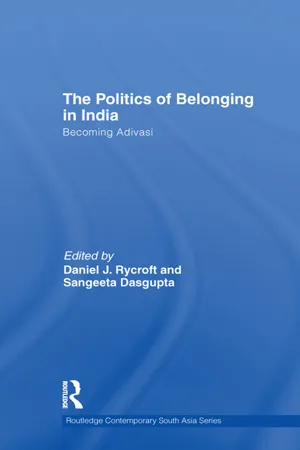
Since the 1990s, the Indigenous movement worldwide has become increasingly relevant to research in India, re-shaping the terms of engagement with Adivasi (Indigenous/tribal) peoples and their pasts. This book responds to the growing need for an inter-disciplinary re-assessment of Tribal studies in postcolonial India and defines a new agenda for Adivasi studies. It considers the existing conceptual and historical parameters of Tribal studies, as a means of addressing new approaches to histories of de-colonization and patterns of identity-formation that have become visible since national independence. Contributors address a number of important concerns, including the meaning of Indigenous studies in the context of globalised academic and political imaginaries, and the possibilities and pitfalls of constructions of indigeneity as both a foundational and a relational concept. A series of short editorial essays provide theoretical clarity to issues of representation, resistance, agency, recognition and marginality. The book is an essential read for students and scholars of Indian Sociology, Anthropology, History, Cultural Studies and Indigenous studies.
Information
Table of contents
- Cover
- Title
- Copyright
- Dedication
- Contents
- Maps
- Contributors
- Preface
- Hul Johar/Acknowledgements
- 1. Indigenous pasts and the politics of belonging
- PART I. Contesting categories, blurring boundaries
- PART II. Revisiting resistance
- PART III. Landscape and Adivasi agency
- PART IV. Politics, participation and recognition
- PART V. Mainstreams and margins
- Index
Trusted by 375,005 students
Access to over 1.5 million titles for a fair monthly price.
Study more efficiently using our study tools.
Frequently asked questions
Yes, you can cancel anytime from the Subscription tab in your account settings on the Perlego website. Your subscription will stay active until the end of your current billing period. Learn how to cancel your subscription
No, books cannot be downloaded as external files, such as PDFs, for use outside of Perlego. However, you can download books within the Perlego app for offline reading on mobile or tablet. Learn how to download books offline
Perlego offers two plans: Essential and Complete
- Essential is ideal for learners and professionals who enjoy exploring a wide range of subjects. Access the Essential Library with 800,000+ trusted titles and best-sellers across business, personal growth, and the humanities. Includes unlimited reading time and Standard Read Aloud voice.
- Complete: Perfect for advanced learners and researchers needing full, unrestricted access. Unlock 1.5M+ books across hundreds of subjects, including academic and specialized titles. The Complete Plan also includes advanced features like Premium Read Aloud and Research Assistant.
We are an online textbook subscription service, where you can get access to an entire online library for less than the price of a single book per month. With over 1.5 million books across 990+ topics, we’ve got you covered! Learn about our mission
Look out for the read-aloud symbol on your next book to see if you can listen to it. The read-aloud tool reads text aloud for you, highlighting the text as it is being read. You can pause it, speed it up and slow it down. Learn more about Read Aloud
Yes! You can use the Perlego app on both iOS and Android devices to read anytime, anywhere — even offline. Perfect for commutes or when you’re on the go.
Please note we cannot support devices running on iOS 13 and Android 7 or earlier. Learn more about using the app
Please note we cannot support devices running on iOS 13 and Android 7 or earlier. Learn more about using the app
Yes, you can access The Politics of Belonging in India by Daniel J. Rycroft,Sangeeta Dasgupta in PDF and/or ePUB format, as well as other popular books in Politics & International Relations & Politics. We have over 1.5 million books available in our catalogue for you to explore.