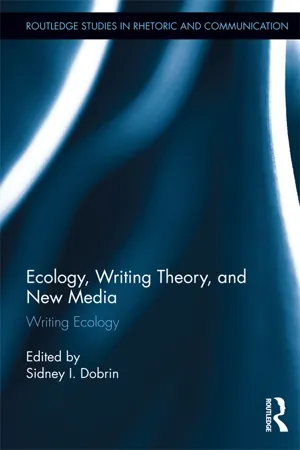
Moving beyond ecocomposition, this book galvanizes conversations in ecology and writing not with an eye toward homogenization, but with an agenda of firmly establishing the significance of writing research that intersects with ecology. It looks to establish ecological writing studies not just as a legitimate or important form of writing research, but as paramount to the future of writing studies and writing theory. Complex ecologies, writing studies, and new-media/post-media converge to highlight network theories, systems theories, and posthumanist theories as central in the shaping of writing theory, and this study embraces work in these areas as essential to the development of ecological theories of writing. Contributors address ecological theories of writing by way of diverse and promising avenues, united by the underlying commitment to better understand how ecological methodologies might help better inform our understanding of writing and might provoke new theories of writing. Ecology, Writing Theory, and New Media fuels future theoretical conversations about ecology and writing and will be of interest to those who are interested in theories of writing and the function of writing.
- 220 pages
- English
- ePUB (mobile friendly)
- Available on iOS & Android
eBook - ePub
About this book
Information
Table of contents
- Front Cover
- Half Title
- Routledge Studies in Rhetoric and Communication
- Title Page
- Copyright
- Dedication
- Contents
- Introduction: Ecology and a Future of Writing Studies
- 1 In Terms of Writing As Such
- 2 Rhetorics of (Non)Symbolic Cultivation
- 3 Writing Ecologies, Rhetorical Epidemics
- 4 Agential Matters: Tumbleweed, Women-Pens, Citizens-Hope, and Rhetorical Actancy
- 5 Discipline and Publish: Reading and Writing the Scholarly Network
- 6 Digital Ecologies
- 7 Post-Media Occupations for Writing Theory: From Augmentation to Autopoiesis
- 8 Quale Morphics: Strategic Wisdom
- 9 Curating Ecologies, Circulating Musics: From the Public Sphere to Sphere Publics
- 10 The Ecology of the Question: Reading Austin’s Public Housing Debates, 1937-1938
- 11 Ecology, Ecologies, and Institutions: Eco and Composition
- Contributors
- Index
Trusted by 375,005 students
Access to over 1.5 million titles for a fair monthly price.
Study more efficiently using our study tools.
Frequently asked questions
Yes, you can cancel anytime from the Subscription tab in your account settings on the Perlego website. Your subscription will stay active until the end of your current billing period. Learn how to cancel your subscription
No, books cannot be downloaded as external files, such as PDFs, for use outside of Perlego. However, you can download books within the Perlego app for offline reading on mobile or tablet. Learn how to download books offline
Perlego offers two plans: Essential and Complete
- Essential is ideal for learners and professionals who enjoy exploring a wide range of subjects. Access the Essential Library with 800,000+ trusted titles and best-sellers across business, personal growth, and the humanities. Includes unlimited reading time and Standard Read Aloud voice.
- Complete: Perfect for advanced learners and researchers needing full, unrestricted access. Unlock 1.5M+ books across hundreds of subjects, including academic and specialized titles. The Complete Plan also includes advanced features like Premium Read Aloud and Research Assistant.
We are an online textbook subscription service, where you can get access to an entire online library for less than the price of a single book per month. With over 1.5 million books across 990+ topics, we’ve got you covered! Learn about our mission
Look out for the read-aloud symbol on your next book to see if you can listen to it. The read-aloud tool reads text aloud for you, highlighting the text as it is being read. You can pause it, speed it up and slow it down. Learn more about Read Aloud
Yes! You can use the Perlego app on both iOS and Android devices to read anytime, anywhere — even offline. Perfect for commutes or when you’re on the go.
Please note we cannot support devices running on iOS 13 and Android 7 or earlier. Learn more about using the app
Please note we cannot support devices running on iOS 13 and Android 7 or earlier. Learn more about using the app
Yes, you can access Ecology, Writing Theory, and New Media by Sidney Dobrin in PDF and/or ePUB format, as well as other popular books in Langues et linguistique & Études sur la communication. We have over 1.5 million books available in our catalogue for you to explore.