Alberto Ginastera: A Research and Information Guide is the first bio-bibliographic study of the composer and the only published book on the subject in English. This work fills a critical gap in contemporary music studies by enriching our knowledge of one of the most compelling creative voices of the Americas. Given the lack of prior systematic attention to Ginastera, this book establishes a firm foundation for future scholarship. It includes a detailed biographical sketch of the composer that quotes extensively from his letters. It summarizes the defining features of his style and encompasses his infrequently explored late works. It offers the most comprehensive catalogue of Ginastera's music to date and provides an annotated list of his published writings. This book contains over 400 annotated bibliographic entries that refer to critically selected sources in English, Spanish, French, German, and Italian. The last chapter offers new information about archival holdings and internet resources that facilitates research on this composer. An appendix featuring a detailed chronology of Ginastera's career completes this work.
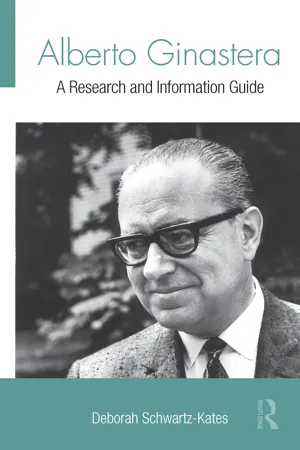
- 224 pages
- English
- ePUB (mobile friendly)
- Available on iOS & Android
eBook - ePub
About this book
Information
1
Alberto Ginastera: Introduction to his Life and Work
Art is first perceived by our senses, it then affects our sentiments and in the end awakens our intelligence … Without sensibility, the work of art is only a cold, mathematical study, and without intelligence or technique, it is only chaos.
(Alberto Ginastera, correspondence with Robert W. Holton, 1964, New York)
The author of these words is acknowledged as one of the most original creative voices of Latin America, whose works are praised for their perfect balance between architectural structure and expressive content to which the composer aspired. This chapter reviews the major life events and works identified with Ginastera’s singular achievement.1
The Formative Years
The composer was born on 11 April 1916 in Buenos Aires, Argentina, as the younger of two children. His father, also Alberto Ginastera, was of Catalan descent, and his mother, Luisa Bossi, was of Italian parentage. There was no prior musical background in the Ginastera family. The young composer’s ancestors worked in agriculture, commerce, and crafts. As a young boy, Ginastera recalled listening to recordings of tangos and waltzes and hearing street musicians perform the same repertoire. Although he began taking music lessons at the age of 7, his early progress was neither exceptional nor precocious. Rather, it predicted the path of a composer whose meticulously crafted works would result from painstaking labor. After Ginastera’s death, the conductor Mario di Bonaventura recalled receiving “the touching gift of the many harmony and counterpoint exercise notebooks which Ginastera had completed as a student.” Through them, Bonaventura understood the obstacles the aspiring composer “had been forced to conquer before musical composition could even begin.”2
In 1928, Ginastera entered the Conservatorio Williams of Buenos Aires, where he studied theory and solfège with Torcuato Rodríguez Castro, harmony with Celestino Piaggio, piano with Cayetano Argenziani, and composition with José Gil. Two years later, he enrolled in secondary school at the Escuela Superior de Comercio de la Nación, where he specialized in business to fulfill his parents’ wishes. During this period, Ginastera attended concerts in Buenos Aires and came under the spell of the contemporary orchestral repertoire that Ernest Ansermet and Juan José Castro introduced into Buenos Aires. At the age of 14, he witnessed his first performance of the Rite of Spring, recalling years later that: “La Sacre was like a shock—something new and unexpected. The primitivism of the music, its dynamic impulse and the novelty of its language impressed me as the work of a genius.”3 This compelling experience played a formative role in shaping Ginastera’s early compositions.
The young musician resolved to become a creative actor in the dynamic musical scene. He entered his works in competitions and achieved some notable success. In 1934, El Unísono awarded him a prize for the piano work, Piezas infantiles, and four years later the Comisión Nacional de Bellas Artes honored his Impresiones de la puna for flute and string quartet.4 In December 1935, Ginastera graduated from the Conservatorio Williams with a Gold Medal in composition. The following year, with the support of his family, he enrolled in the Conservatorio Nacional de Música of Buenos Aires, where he perfected his musical technique.
At the Conservatorio Nacional, Ginastera studied counterpoint with Gil, harmony with Athos Palma, and composition with José André. Under the guidance of both André and Carlos López Buchardo, who headed the conservatory, he absorbed a traditional approach to the composition of national art music. This perspective drew upon vernacular sources rooted in the folk-music heritage and emphasized the figure of the gaucho (or native horseman), whose idealized features of bravery, strength, and independence could be extolled as national virtues. Musically, this approach combined the stylization of such elements with the musical language of Debussy, as well as with characteristics drawn from Wagnerian opera and Italian verismo.5
At the same time, Ginastera modeled his early style on the modernist approach of a younger generation of Argentine musicians. This group included Juan José Castro, José María Castro, Jacobo Ficher, Luis Gianneo, Gilardo Gilardi, Juan Carlos Paz, and Honorio Siccardi. Collectively known as the Grupo Renovación, these composers aimed to revitalize Argentine music by applying international techniques derived from dodecaphony, neoclassicism, and jazz. Both the Argentine traditional and modernist schools served as meaningful points of departure for Ginastera, whose own early works combined national music elements with a full range of contemporary techniques.6
European compositional models likewise shaped the composer’s early development. A dominant influence came from Debussy, whose La mer and Préludes for the piano Ginastera greatly admired. Another model was Manuel de Falla, whose integration of Hispanic and international elements shaped the young composer’s creative trajectory. In addition, Arthur Honegger’s Le Roi David and Pacific 231 significantly affected Ginastera’s works. Meanwhile, in 1936, Stravinsky traveled for the first time to Buenos Aires, reinforcing the original impact that his Rite of Spring had made on Ginastera years earlier. Finally, the works of Bartók profoundly affected the developing Argentine musician. Years after he heard Arthur Rubinstein play the Allegro barbaro in Buenos Aires, he recalled: “I felt then the impact of the discovery, the bewilderment of a revelation.” Until that time, Ginastera had wanted to compose Argentine music, but lacked a clear direction. Now, after hearing Bartók’s work, he resolved: “The Allegro barbaro filled in all the gaps I felt in my conception of forging a national music.”7
Early Successes
Ginastera’s music first came to the attention of the public through Juan José Castro, who was a renowned conductor and champion of contemporary music, as well as an Argentine modernist composer. At the time, Castro was searching for a new orchestral work to premiere at the Teatro Colón. Buried in the archives of the theater, he discovered an exceptional ballet, composed by an unknown young musician. Yet when Castro tried to contact the reticent young man, it took months to forge a connection. When the two musicians finally did meet, Castro asked if Ginastera had any orchestral works suitable for a concert performance. When the young composer replied that he did not, Castro suggested that he arrange excerpts from his ballet into an independent orchestral suite.8 The resulting work, the suite Panambí, received an auspicious premiere at the Teatro Colón on 27 November 1937, initiating the young composer’s career. The original ballet music was based on an ancient legend of the Guaraní, an indigenous South American tribe whose territory extended into northern Argentina. The work revealed an unabashed resemblance to Stravinsky’s Rite of Spring in its “primitive” subject, pulsating ostinatos, and overlapping accentual patterns, which the composer imbued with Argentine rhythmic characteristics. Panambí had a large percussion section that included native instruments. From this point forward, Ginastera would exploit the brilliant use of percussion as a signature feature.
In 1938, the year following the premiere, Ginastera graduated from the Conservatorio Nacional, receiving a professor’s diploma upon submission of his Psalm 150, a large-scale choral work modeled after Honegger’s Le roi David. Shortly following graduation, he embarked on a career as a teacher, and he would ultimately emerge as one of the most distinguished music educators in Latin America. In 1941, Ginastera joined the faculties of the Liceo Militar General San Martín (General San Martín National Military Academy) and the Conservatorio Nacional, where he had graduated three years earlier. At the latter institution, he taught solfège (1941–43) and harmony (1942–58), later receiving faculty appointments in orchestration, form, and analysis (1955–58).
These years were a time of great contentment as the composer took pride in his developing career and found personal happiness in his relationship with Mercedes de Toro, whom he had met as a student. In 1941, the couple married, and they had two children, Alexander (b. 1942) and Georgina (b. 1944). The composer’s joyous sentiments overflowed into his music of the period. He inscribed passionate poetic verses above the second theme of his piano piece “Criolla” from the Tres piezas (1940), which he had dedicated to Mercedes. Three years later, his “Chacarera” from the Cinco canciones populares argentinas (1943) employed a text with a clever double meaning. Although the word “ñata” literally means “snub-nosed girl,” it also was Ginastera’s nickname for his wife.9 Interpreted in this way, the lyrics would read:
A mí me gustan las ñatas,
y una ñata me ha tocado.
Ñata será el casamiento
y más ñato el resultado.
I like Ñatas,
and a Ñata I got.
I will marry a Ñata
and all our children will be Ñatas.10
By this time, Ginastera had already married his Ñata, who had just given birth to the couple’s first child. The composer’s joyful tenderness could not be more apparent than in the verses of the “Arrorró” (Lullaby) from the song cycle:
Arrorró mi nene,
arrorró mi sol,
arrorró pedazo
de mi corazón.
Lullaby my baby,
lullaby my sun,
lullaby little piece
of my heart.
As a quiet and reserved young man, Ginastera found it difficult to divulge his inner feelings, but often felt more comfortable projecting such sentiments in his musical compositions.
His career now progressed rapidly, with each new work enhancing his presence as a dynamic young composer on the national music scene. In 1940, the ballet version of Panambí had its successful premiere, leading Lincoln Kirstein of the American Ballet Caravan to commission a second choreographic work from him. Kirstein’s offer represented a marvelous opportunity for the 25-year-old Ginastera. It was the Argentine composer’s first major commission and a chance to present his music before a broad international public. Most significantly, it gave him the chance to collaborate with an innovative dance company that shared his ideal of creating a new choreographic art form that reflected the distinctive experience of the Americas.
In response to this commission, Ginastera produced the ballet Estancia (1941), “based on scenes from Argentine life.” His work evoked the changing times of day on an Argentine estancia (or ranch). It drew richly upon the gauchesco tradition (i.e., the tendency to represent the gaucho in the arts) that was embraced by earlier generations of Argentine composers. In this ballet, Ginastera interpolated sung and spoken passages from the gauchesco epic Martín Fierro, sensitively rendering some of its most eloquent texts. Although he made rapid progress on the ballet and completed the work in 1941, Kirstein’s troupe disbanded the following year. Ginastera responded by arranging Estancia as an orchestral suite, as he had done previously with Panambí. The resulting four-movement composition achieved immediate success upon its 1943 premiere, and it remains among Ginastera’s most popular works. Yet, unlike the concert version of Panambí, which closely resembled the corresponding ballet, the Estancia suite eliminated almost two-thirds of its original music (including all the Martín Fierro excerpts). Indeed, many scholars and musicians believe that some of the best music of Estancia lies buried within its ill-fated and infrequently heard ballet score.11
In 1941, when Ginastera was working on Estancia, Aaron Copland traveled to South America, where he spent over a month in Buenos Aires. The Committee for Inter-American Artistic and Intellectual Relations sent him as a cultural ambassador, and the Guggenheim Foundation sponsored his visit. The purpose of Copland’s trip was to evaluate the talent of Latin American musicians and supply the Foundation with the names of individuals who would benefit from study in the United States. In 1941 Ginastera first met Copland and immediately felt drawn to his musical aesthetic. Both composers shared similar goals of constructing American musical landscapes and balancing modernist techniques with broad appeals to popular audiences. Copland’s interest in composing for the radio, cinema, and theater greatly attracted Ginastera. Tellingly, the Argentine composer created his first film score in 1942, one year after he heard Copland present a lecture on the subject, illustrated with excerpts from his own motion-picture music. Yet, despite Copland’s inevitable influence on Ginastera, the artistic relationship between the two composers remained reciprocal and complex. Estancia owes a tremendous debt to Copland’s ballets in its harmonic construction, instrumental sonority, and aesthetic orientation. Yet Copland’s Rodeo of the following year derives from his South American experience and suggests the influence of composers such as Ginastera. Particularly suggestive is Copland’s use of a folklike orchestration (that includes instruments such as a harp, evocative of the guitar) and a cowboy theme (that parallels Ginastera’s representation of the gaucho). The dramatic release of tension in Copland’s concluding “Hoe-down” from Rodeo, moreover, parallels the climactic discharge of kinetic energy in the final movements of Ginastera works, which stylize the malambo—a virile Argentine dance.12
With Copland’s encouragement, Ginastera applied for a Guggenheim Fellowship to travel to the United States. In his grant application, he articulated the goal of exploring music for the theater, cinema, and radio under Copland’s direction. Ginastera also proposed studying U.S. systems of music education as models for Argentina. The final purpose of his visit was to promote Inter-American exchange by increasing the awareness of Argentine composers in the United States and by spreading knowledge of his North American colleagues after he returned to Buenos Aires.13 In 1942, Ginastera received word that the Guggenheim Foundation had accepted his application. Yet he was forced to postpone travel to the United States due to the outbreak of World War II. He remained in Argentina, but, in 1945, experienced conflicts with the Perón government, which discharged him from his official position at the Liceo Militar. After the war ended, Ginastera took advantage of his Guggenheim Fellowship to travel to the United States. On 30 November 1945, he eagerly wrote to Copland aboard the Río Jachal as he headed for New York. A new phase of his life had begun.14
The Guggenheim Period
Ginastera installed himself at the Hotel Jefferson on 208 W. 56th Street, an establishment that boasted “200 Rooms and Baths—Just Forty Steps from Broadway.”15 From there, he immersed himself in the rich cultural life of the city, which had experienced a resurgence since the end of the war. Originally, he had hoped to meet Bartók, but the Hungarian composer’s death just a few months earlier prevented what could have been a most auspicious exchange. Nevertheless, Ginastera benefitted from the renewed interest in Bartók’s music in the years immediately following his death. He also developed considerable knowledge of the music of Stravinsky, Schoenberg, and Hindemith—all of whom now lived in the United States. Additionally, he learned a great deal about the works of his North Ame...
Table of contents
- Cover
- Half Title
- Title Page
- Copyright
- Contents
- Preface
- Acknowledgments
- List of Abbreviations
- Timeline
- 1. Alberto Ginastera: Introduction to his Life and Work
- 2. Introduction to Ginastera’s Musical Style
- 3. Catalog of Works
- 4. The Published Writings of Alberto Ginastera
- 5. Select Bibliography of Secondary Sources
- 6. Archives and Internet Sources
- Notes
- Author Index
- Subject Index
- Title Index
Trusted by 375,005 students
Access to over 1.5 million titles for a fair monthly price.
Study more efficiently using our study tools.
Frequently asked questions
Yes, you can cancel anytime from the Subscription tab in your account settings on the Perlego website. Your subscription will stay active until the end of your current billing period. Learn how to cancel your subscription
No, books cannot be downloaded as external files, such as PDFs, for use outside of Perlego. However, you can download books within the Perlego app for offline reading on mobile or tablet. Learn how to download books offline
Perlego offers two plans: Essential and Complete
- Essential is ideal for learners and professionals who enjoy exploring a wide range of subjects. Access the Essential Library with 800,000+ trusted titles and best-sellers across business, personal growth, and the humanities. Includes unlimited reading time and Standard Read Aloud voice.
- Complete: Perfect for advanced learners and researchers needing full, unrestricted access. Unlock 1.5M+ books across hundreds of subjects, including academic and specialized titles. The Complete Plan also includes advanced features like Premium Read Aloud and Research Assistant.
We are an online textbook subscription service, where you can get access to an entire online library for less than the price of a single book per month. With over 1.5 million books across 990+ topics, we’ve got you covered! Learn about our mission
Look out for the read-aloud symbol on your next book to see if you can listen to it. The read-aloud tool reads text aloud for you, highlighting the text as it is being read. You can pause it, speed it up and slow it down. Learn more about Read Aloud
Yes! You can use the Perlego app on both iOS and Android devices to read anytime, anywhere — even offline. Perfect for commutes or when you’re on the go.
Please note we cannot support devices running on iOS 13 and Android 7 or earlier. Learn more about using the app
Please note we cannot support devices running on iOS 13 and Android 7 or earlier. Learn more about using the app
Yes, you can access Alberto Ginastera by Deborah Schwartz-Kates in PDF and/or ePUB format, as well as other popular books in Media & Performing Arts & Music. We have over 1.5 million books available in our catalogue for you to explore.