eBook - ePub
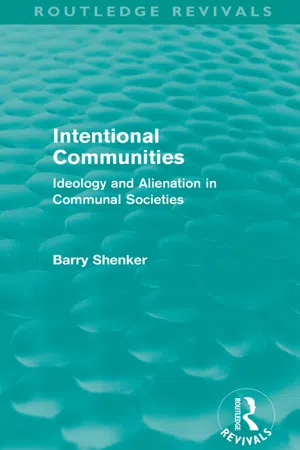
Intentional Communities (Routledge Revivals)
Ideology and Alienation in Communal Societies
- 284 pages
- English
- ePUB (mobile friendly)
- Available on iOS & Android
eBook - ePub
Intentional Communities (Routledge Revivals)
Ideology and Alienation in Communal Societies
About this book
Some communities exist for tens, even hundreds, of years. Others short-lived. What, then, makes for communal 'success'? Bary Shenker, who lived on a Kibbutz for a number of years, compares the Hutterites, the Kibbutzim and therapeutic communities – and argues that there is no simple formula. Through historical and sociological analysis, combined with personal experience and insight, the author provides fresh thoughts on a form of a social life which fascinates us all. First published in 1986.
Information
Part B
Chapter 4
Origins and development
Struggle against the odds: the development of Hutterite life
The Reformation had its origins in complex circumstances. While the motives of the Reformers were ostensibly and primarily religious, their activities and proposals could clearly not be limited to theological dispute.
The Protestants called for a return to the origins of Christianity and invoked the idea of man’s fundamental sinfulness. Yet the fact that ideological revolt itself was now legitimate, together with one of its key concepts, namely ‘justification by faith’ (i.e. that the basis of religious belief was not membership of the Church per se, but having the right personal relationship with God), meant that the beliefs held by the Reformers could themselves be questioned. Certain groups began to take the principles and aims of the Reformers to extreme conclusions. They expressed these in a variety of political, social and religious beliefs and practices. This is known as the Radical Reformation, consisting chiefly of three broad groupings: the Maccabeans, the Spiritualists or Mystics, and (the largest grouping) the Anabaptists. The Radicals all rejected the links Luther, Calvin and Zwingli made between Church and state; they demanded a return to the apostolic age (the days of the early Church), a religion based on inward authority and not on external coercion, no compromises with Rome, and the radical reorganization of social life. The Maccabeans expressed this by turning to military activity and emphasized the imminent End of Days; the Mystics, for their part, engaged in theological speculation and attempted to divorce man from society and history.
The Anabaptists rejected both these positions. There were six main Anabaptist groups. They were linked by the following ideas: adult baptism, rejection of the unity of Church and state, a literal acceptance of the New Testament, discipleship, pacifism, excommunication, non-swearing of oaths, freedom of conscience (for the community, not for the individual in it), no theocracy, and glorification of the simple person leading a simple life.
Among the Anabaptists was one group, the Hutterites. The Catholic and Protestant authorities and the Hapsburg monarchy all attempted to suppress the Anabaptists on both doctrinal and political grounds. A group led by Balthasar Hubmaier took refuge at Nikolsburg in Moravia. After his execution (1528) the group was led by Jakob Wiedemann to Austerlitz. On the way they began to practise community of goods and this is regarded by the Hutterites as their founding. Meanwhile Jakob Hutter became leader of a South Tyrolean group. When they too faced persecution Hutter joined the Austerlitz group.
Power struggles developed between Hutter and Wiedemann. Eventually Hutter triumphed (1533) and with great ability succeeded in organizing the group into a cohesive, disciplined and devoted community. These qualities served them well in the years to come. At first great persecution followed them and the Brethren were required to live in forests and caves. Nevertheless, they did much successful missionary work and, especially through the writings of Ridemann, developed a more articulate doctrine.
In the 1540s the Moravian lords were having their own troubles with the Vienna monarchy. They saw in the Hutterites a means both of showing their political independence and of improving their own economic status (owing to the Brethren’s great skill and efficiency as artisans). So they granted refuge to the Hutterites who began to set up communities in Moravia called Bruderhofe. In 1548, however, the Emperor Ferdinand pressed hard enough for the lords to expel them, although they soon returned. This heralded their ‘Golden Age’ (1553–92). Conversion proceeded (but began to dwindle towards the end of the century), economic stability was strengthened, the forms of social organization crystallized and religious doctrine became increasingly articulated. At the height of this period they had forty to fifty communities numbering 12,000 to 20,000 souls.1
The Hutterites differed from the other Anabaptist groups in the extremity of their views. The other groups were prepared to compromise on some principles, the Hutterites on virtually none. The Brethren were also the only ones to establish total communities. At times the Anabaptist groups helped each other; at other times hostility was intense. What was the appeal of the Anabaptists in general and of the Hutterites in particular? They had greater success in areas of religious diversity and in areas where persecution was milder. They could offer economic security at a time of hardship and especially in areas where inheritance laws left people with little land. Their ideas on simplicity, pacifism and rejection of the state were appealing: to the converts war, property and the state helped the rich and powerful only. Hutterite communities provided material security—but for this reason preachers (fearing that people might join for that end more than for doctrinal reasons) often discouraged converts and could afford to accept only the most dedicated. Naturally their economic success made it easier for the Hutterites to send out missionaries; it also helped the Brethren to save for future migrations. We should also note that the sixteenth century was a highly religious age. In rejecting one system of belief people were not rejecting belief altogether; on the contrary, many sought an alternative which was intense and binding and held hope for the future.
Around the beginning of the seventeenth century the position of the lords vis-à-vis the Emperor was weakening: affluence had led to a degree of internal decline among the Brethren themselves; the Turkish invasion of the Empire (1593) and the Hutterite refusal to be conscripted seriously jeopardized their position; and in 1618 the outbreak of the Thirty Years War further eroded their position (their patrons backed the wrong side) leading to their expulsion from Moravia (1621–2).
The Hutterites began migrating eastwards and southwards, finding refuge in (what is now) Hungary and Romania. They suffered decline and even abandoned communal living (1686); but at other times strong leaders emerged to revitalize discipline and adherence to faith and the prescribed social forms. Towards the end of the eighteenth century they began to settle on estates in Russia where the lords once again exchanged freedom of conscience (pacifism, autonomous education) for economic returns. Despite political security and freedom from conscription (or perhaps because of them), internal decline set in and in 1820 communal living was again abandoned. In the 1840s and 1850s attempts were made to resuscitate it and different leaders appeared around whom communality was re-established. Three such groups (named after leaders) emerged called Leute (people) and persist to this day. They are called the Schmiedeleut, the Dariusleut and the Lehrerleut respectively. At the beginning of the 1870s conscription was imposed, so the Hutterites migrated to America where they settled primarily in South Dakota (from 1874). They were helped at this stage by other groups of Anabaptist origins, e.g. the Rappites and Mennonites. Some abandoned communalism and joined the Mennonites.
At the turn of the century fear of conscription made them investigate the possibility of refuge in Canada, where the federal government was interested in opening up the Prairies, and would grant them freedom of conscience. Nothing came of it then but in the First World War they were persecuted for being pacifists (among other things) and took advantage of the earlier Canadian offer. As the pacifism issue receded in importance and the Hutterites themselves began to seek compromise solutions, some were able to return to the USA but most stayed on in Canada. They are now concentrated in Alberta, Manitoba and Saskatchewan. While at first largely welcomed (because they helped open up the Prairies), attitudes towards them shifted here too and various accusations, resentments and fears were expressed by the surrounding population: this led to restrictions on land acquisition and expansion. Their total rejection of the state has also had to be compromised, e.g. regarding their desire for autonomous education. Signs are now that there is a move towards greater local tolerance of the Hutterites through recognition of their economic success and of their contribution to slowing down the depopulation of rural areas; there has also been increasing sensitivity towards civil liberties. This also stems partly from the Hutterites’ readiness to adjust to prevailing needs and thought patterns.
In 1981 the Hutterites numbered 31,200 souls in 230 colonies.2 A colony consists of up to 150–170 souls. On average, Hutterites have over ten children per completed family, the highest birth rate in the world. The rate of natural increase is 41.5 per 1,000 head of population: this means that the population doubles every sixteen to eighteen years.3 Wives are taken from other colonies, usually from the same Leut, and join their husband’s colony. A colony is headed by a preacher who is appointed through election and by lot (to emphasize that the final choice is God’s will). He is elected for life but undergoes a lengthy probation before finally being confirmed in his post. Other senior positions are the Wirt or Haushalter who is overall treasurer-colony manager. Then there are the various branch managers. The German teacher (see section on education) is also a senior member of the colony. The colony has a Council of Elders, usually men who have retired (officially) from active work (at about 45 years of age). They decide on matters of policy and oversee the community’s morality. Important matters are discussed and voted on by the adult male congregation.
There is a strict status hierarchy in the colony—older over younger, male over female, baptized over unbaptized, married over unmarried. Only baptized men can hold responsible positions for the colony as a whole. Women’s work is confined to their own or the colony’s domestic duties (cooking, child care). The head cook is usually the head woman of the colony. The chief seam-stress is also an important figure. The women sometimes do gardening or painting but always under male supervision.
The colony economy is strictly agricultural. It maintains its own agricultural services and tries to be self-sufficient (carpentry, welding, building). Their agriculture is mixed and most men can work in a number of places.
When a colony reaches 150 to 170 members it splits in two. Already land has been acquired and buildings set up for a new colony—if possible, nearby. The colony is then divided into two lists; these are equal numerically and in terms of age, sex, occupation and personal compatibility. The night before the split the entire colony packs its bags. The following day the lists are drawn by lot because the decision must be in the hands of God. The list that is drawn gets on the lorries and goes; the others unpack their bags and continue on the same colony.
The colony is part of a network called a Leut (people). The Hutterites have three Leute. There are few formal links between them. Each Leut has its own Council of Elders whose task it is to decide on policy for the Leut as a whole (ranging from dress style to relations with the government) and to keep an eye on all the colonies in their jurisdiction.
The need for ideology: the Kibbutz movement’s growth
Towards the end of the last century the Jews of eastern and central Europe faced certain threats to their existence. In eastern Europe persecution was on the upsurge, culminating in pogroms and actual plans for extermination. In central and western Europe the very opposite process, namely assimilation, equally threatened the continued existence of the Jews. Various responses emerged to these situations, one of which, influenced by political trends among European countries, was Jewish political nationalism.
The idea of an independent Jewish state emerged, the corollary to which was the need for Jews to migrate to Palestine, settle the land, build cities and create their own politicaleconomic institutions. Only a very small proportion of Jews actually executed these plans and among them were the founders of the Kibbutz movement.
Settlement on the land had begun systematically during the first ‘wave of settlement’ (Aliyah), from the early 1880s until about 1904. The Second Aliyah (1904–14) saw a new generation who had been influenced in eastern Europe by socialist ideas and had rejected the colonial nature of the earlier settlement. At first these immigrants worked individually but, having had little agricultural or manual experience, found it difficult to find work, especially since there was a labour surplus and contractors preferred cheaper Arab labour. Illness, loneliness and poverty generated disillusionment and frustration. Gradually, the immigrants began to form small groups and contracted themselves out as such, thus giving themselves as a group greater bargaining power than as individuals, while personally they now had greater material and psychological security.
Primarily they wanted to settle the land, albeit in non-colonial fashion. Labour on the land, and Jewish self-labour at that, became cardinal principles of faith. They gained some experience of the contract system but still not enough to convince the appropriate Jewish authorities to hand over tracts of land to them. Eventually the authorities, whose aim was to settle the land quickly, efficiently and profitably, changed their attitude somewhat. A group of women working at Sedjera were given some land to work autonomously—and showed a profit. At the same time the dominant agricultural system—experimental farms with hired Jewish labour—was not proving effective. Some of the immigrants, particularly a group from a town in the Ukraine called Romni, revolted against this system and demanded their own land. The authorities had little choice and handed a tract at Um Juni on the banks of Lake Tiberias to the Romni group in 1910. This became Kibbutz Deganya. Earlier attempts (during the First Aliyah) to do the same thing had failed because the settlers had had no backing for it. The official Zionist movement, with its political and economic backing, had not yet been established; there was then no trend towards co-operative ventures; religious groups, who viewed collective agricultural undertakings with great suspicion, were strong enough to upset the plans of the settlers; there was as yet no concept of settling the land or of Jewish labour on it as ends in themselves. Only during the Second Aliyah did these trends develop and only in that context could the Kibbutz movement be founded and have the necessary support and appeal to develop.
Initially the group worked together with a number of others at Um Juni. They were paid individually but pooled everything, including the profits that were eventually shown. The group had little conception of what type of society it wanted. They knew they were rejecting the life-style of the ghetto, the patriarchal family, the hierarchy of status, wealth and learning, the estrangement from life on the land, the narrow religiosity and the intense emotionality of the family. They knew they wanted to be ‘natural’ people—intimate, close to the land, simple and equal, and that their relations were to be governed by honesty, mutual aid and love. If they rejected the structure of the ghetto, then at least they wanted its communality, intimacy, warmth and intensity—but not in the forms they had grown up in. They knew too that in the long run they wanted a regenerated Jewish people and an independent Jewish state, but precisely what this meant in terms of institutions or political activity was undefined and even seldom contemplated. The initial experience of living on the land, a small undifferentiated group at that, was a source of intrinsic satisfaction.
Gradually, however, basic questions had to be answered. Couples wanted to marry and have children; the Kibbutzim then grew larger; as the number of Kibbutzim grew their relationship to each other and to the wider Jewish community had to be examined; the Jewish authorities had to be influenced regarding Kibbutz interests; from 1919 the British Mandate had to be tolerated, then fought, then ended; the Jewish community had to be developed, immigrants absorbed and defence against Arabs maintained. How was all this to be done?
The first few years were difficult. Inexperience, climatic conditions, marauders, hostility from Jewish officials and the exigencies of the First World War all proved difficult to surmount, but surmount them they did. The Zionist authorities for many years had an ambivalent attitude towards the Kibbutzim. They saw the way of life as infantile: eventually the youngsters would live ‘naturally’ in semi-co-operative and more individualistic settlements. They were also wary of their atheism and communism (which was in some cases Soviet-orientated and was a constant source of friction within the Kibbutz movement until the 1950s). There was also a fair amount of opposition to the Kibbutz from the political labour movements of the time who saw the Kibbutz as a quasi-mystical flight from reality, whose energies would be better directed at mobilizing the proletariat into political activity.
The 1920s were a period of great expansion and saw the emergence of various trends among the Kibbutzim. The difficulties of maintaining a small Kibbutz had encouraged some to develop the idea of the large Kibbutz, up to as many as 3,000 people (although it is rare for any to come near this size). The protagonists saw in the large Kibbutz the source of economic success, individual development, service to the nation. The protagonists of the small Kibbutz favoured intimate relations and minimal formalization of personal relations or social institutions. Another level of division emerged regarding the wider purpose of the Kibbutzim. Some saw it as a kind of spiritual élite, educating and leading the people to socialist values; others saw it as the spearhead of the class struggle in Palestine; still others (the influential Gedudei HaAvodah, ‘Labour Battalions’) saw its purpose as service to the nation (road building, defence, immigrant absorption, etc.), whatever the nation’s needs.
So both to protect their own interests and to promote their various views, the Kibbutzim in the 1920s began to establish formal links, with three groupings emerging: Hever Hakvutzot, Hakibbutz Hameuchad, Hakibbutz Haartzi. In the 1930s the religious Kibbutz movement (Hakibbutz Hadati) was formed, basing its principles on the socialist-humanist (as opposed to the socialist-Marxist) principles of the other movements and on various trends in Jewish tradition. At the same time the formal institutions of Kibbutz began to emerge, such as systems of education, consumption, decision-making and allocation of rights and duties.
Although the Kibbutzim remained only a small proportion of the Jewish population (a maximum of 7.9 per cent in 1947) their influence began to be felt. Many of the best immigrants went to Kibbutzim because the latter appeared to express the aims of Zionism most dramatically. The continued labour surplus in Kibbutzim, due to lack of land and means of production, meant sending members outside to work, and inevitably some (because of the education and motivation of the Kibbutz members) went into public service—Histadrut (Trade Union), underground defence or political activity. The Kibbutz also played a key role in absorbing immigrants (illegal or otherwise), in defence and in economic development. The Kibbutzim could most easily absorb immigrants, provide defence against Arab attacks, hide arms caches and train underground fighters against the British. The enthusiasm of the Kibbutz members meant they would undertake any task, while the quota system of (legal) immigration meant that it was mainly the most able immigrants who came, and they naturally gravitated to the Kibbutzim. For all these reasons the 1930s and 1940s saw the height of the Kibbutz’s status and influence in the community, even though the Kibbutzim felt that they were discriminated against by official institutions. They frequently felt that the capitalist society they were rejecting was ready to ditch them as soon as it was convenient.
With the establishment of the State of Israel in 1948 the Kibbutz’s status dropped somewhat. The main tangible goal of the Jewish community had been achieved, and in the Kibbutzim, who had sacrificed so much to this end, tiredness crept in, a certain desire to look after themselves. At the same time various factors militated against the Kibbutz’s central role. Defence was now taken over by the army; new immigrants from oriental countries or war-torn Europe did not want to go to the Kibbutz; many of the best people now looked to the state’s institutions for personal opportunities. To make matters worse, political splits which had been developing in the 1940s now reached a head, with the largest movement (Meuchad) splitting up, some going to Hakibbutz Haartzi and some to the Hever (renamed Ichud Hakvutzot Vehakibbutzim). Some Kibbutzim even split right down the middle. The image of the Kibbutz hero began to wane drastically.
Ironically, this was in numerical terms the period of greatest expansion of the Kibbutz movement (seventy founded 1947–52). The new state’s lands were much larger than originally planned and many groups hitherto unable to settle because of Mandate policy were now needed to settle land, defend the new borders and provide food for the increased population. Hence the 1950s and 1960s saw an expansion in the number of Kibbutzim (despite a net population decline 1952–7), a partial withdrawal from wider Israeli life, a demand for increase in living standards and a further formalization in institutions. Many Kibbutzim faced economic difficulties but economic reorganization—especially the mechanization of agriculture and the introduction of industry—plus help from public authorities helped them overcome this. The period also saw a change in Kibbutzim to greater emphasis on the family and on personal career development. Inevitably, this, together with the economic changes, led to shifts in institutional patterns.
The period preceding the Six Day War (1967) saw the Kibbutzim bear the brunt of enemy attack. Following the war the Kibbutzim began to play a central role in new settlement policies and generally a more outward-looking orientation began to emerge. The Kibbutzim became more involved in politics and in various forms of social work, especially in the immigrant development towns near which many are situated. At the same time there has been a reassessment of the meaning of basic values, and particularly attitudes towards Jewish religion and tradition, although it is still too early to indi...
Table of contents
- Cover Page
- Title Page
- Copyright Page
- Preface
- Part A
- Part B
- Part C
- Notes
- Select bibliography
Trusted by 375,005 students
Access to over 1.5 million titles for a fair monthly price.
Study more efficiently using our study tools.
Frequently asked questions
Yes, you can cancel anytime from the Subscription tab in your account settings on the Perlego website. Your subscription will stay active until the end of your current billing period. Learn how to cancel your subscription
No, books cannot be downloaded as external files, such as PDFs, for use outside of Perlego. However, you can download books within the Perlego app for offline reading on mobile or tablet. Learn how to download books offline
We are an online textbook subscription service, where you can get access to an entire online library for less than the price of a single book per month. With over 1.5 million books across 990+ topics, we’ve got you covered! Learn about our mission
Look out for the read-aloud symbol on your next book to see if you can listen to it. The read-aloud tool reads text aloud for you, highlighting the text as it is being read. You can pause it, speed it up and slow it down. Learn more about Read Aloud
Yes! You can use the Perlego app on both iOS and Android devices to read anytime, anywhere — even offline. Perfect for commutes or when you’re on the go.
Please note we cannot support devices running on iOS 13 and Android 7 or earlier. Learn more about using the app
Please note we cannot support devices running on iOS 13 and Android 7 or earlier. Learn more about using the app
Yes, you can access Intentional Communities (Routledge Revivals) by Barry Shenker in PDF and/or ePUB format, as well as other popular books in Social Sciences & Sociology. We have over 1.5 million books available in our catalogue for you to explore.