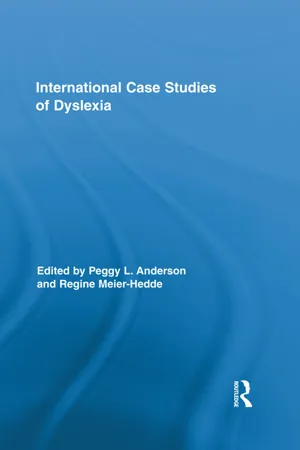
Dyslexia is a disability that exists in all countries that have high expectations for literacy. The inability to read in spite of normal intellectual potential represents one of the most puzzling educational challenges for literate societies, regardless of the culture or language. This book examines medical, psychological, educational, and sociological data from comprehensive case studies of preteen dyslexic children, in order to profile the disability as it occurs in seventeen different nations. Interviews with the children and their parents reveal how children with dyslexia are identified and treated around the world, and provide a look at various perceptions of dyslexia and its challenges. Researchers and practitioners in education, psychology, and health-related professions will find this case book to be an excellent reference. Parents of children with dyslexia will find the advocacy recommendations helpful.
eBook - ePub
International Case Studies of Dyslexia
- 328 pages
- English
- ePUB (mobile friendly)
- Available on iOS & Android
eBook - ePub
International Case Studies of Dyslexia
About this book
Information
1 Introduction to the Study
“We are interested in them for both their uniqueness and commonality. We seek to understand them. We would like to hear their stories. We may have reservations about some things the people … tell us, just as they will question some of the things we will tell about them.”
(Stake, 1995, p. 1).
Early Case Reports of Dyslexia
The earliest research devoted to children with dyslexia was based on case reports that were published in medical journals. There are probably few professionals in this field who are unfamiliar with the case of Percy F., the 14-year-old who could not read in spite of the fact that he was “always a bright and intelligent boy, quick at games, and in no way inferior to others of his own age” (Morgan, 1896, p. 1378). These early case reports of dyslexia proliferated in Europe and quickly spread to America (Anderson & Meier-Hedde, 2001) where the method was eventually supplanted with case study collections based on the clinical work of Fernald, Monroe, and Orton as well as many others (see Hallahan & Mercer, 2002). The shift from single case reports to case study collections was a logical progression that fostered the evolution of dyslexia research. These single and collective case reports are of particular interest as they provide an historical link between our present understanding of dyslexia and the scientific foundation of this disorder. Although today the large-scale group comparison method that relies on statistical analysis of data is the predominant research method for studying characteristics and treatments for dyslexia, case studies continue to have legitimacy especially for areas in which there is a limited knowledge base. As Miles and Miles (1999) suggested, there is particular value in examining individual case histories as a starting point, which is certainly where we currently stand with respect to international dyslexia research. Although there is a growing body of literature devoted to crosslinguistic orthographic aspects of dyslexia, there is a paucity of international research that focuses on the lives of children with this condition and their families. The goal of the current study is to attempt to bridge this gap in the literature and to provide some understanding of how dyslexia variously impacts children and families around the globe.
Case Study Research
Qualitative research focuses on listening to people and describing experiences and phenomena. It “seeks to understand the world from the perspectives of those living in it” (Hatch, 2002, p. 7), which is an undervalued agenda in the study of individual differences, particularly those involving exceptionality. All too often individuals with exceptional needs or disabilities are involved in research that depersonalizes them to the extent that participants are made to feel more like specimens than individuals (Roach, 2003). This has been particularly true for children whose voices have been ignored or neglected by academic research even though the right for children to be heard is considered to be so fundamental that it is recognized by a special set of United Nations Convention articles (i.e., the Rights of the Child). These articles speak to the importance of respecting children’s voices in many different contexts including school settings (Hart, 2002) and have far reaching implications for research. Qualitative research methods, such as ethnographies and case studies, have the potential to support these rights and lend credibility to the views of all children, including those whose disabilities or individual differences may have left them feeling marginalized.
There are varied perceptions about the case study approach to research, perhaps due to the fact that they have been implemented in different ways across disciplines. For example, a case study in science bears little resemblance to a case study in the social sciences. In the social sciences, this method has often been misunderstood by researchers and underrepresented in the literature, which reflects a strong preference for statistical studies (Chima, 2005). Not too long ago, conventional wisdom among experts relegated case study research to the “methodological trash heap” (Flyvbjerg, 2004, p. 420). Thus, it is not surprising that many of the earlier social science research texts failed to provide consideration to the case study as a formal method (Yin, 2009). In the past 20 years, there has been a gradual movement toward acceptance of case study methodology and general recanting of previous criticism by experts now turned advocates of this research method. Case study research today can be conceptualized as an approach that is based on a core of acceptable (and usually) clearly defined procedures that can be defended as well as any other research methodology. As space does not provide the opportunity to review all of the merits of this research method, the reader is referred to other resources for extensive discussion (see Merriam, 1998, 2009; Stake, 1995; Yin, 1994, 2009).
In spite of the vast differences in case study methodology, according to Hatch (2002) consensus can generally be reached on a few important characteristics that define this type of research, which are explained in reference to the current study. First, most case study research focuses on individuals representing specific groups or a phenomenon. In the case of the current study, the phenomenon is dyslexia and the groups are the children and their mothers. Second, Hatch noted that the phenomenon is studied within its natural context that is defined by space and time (i.e., the age range of the children, their school and social experiences and the countries they represent). In other words, the researcher is allowed to demarcate or as Merriam (1998) stated “fence-in” what will and will not be studied, thereby providing natural boundaries. And finally, the case study provides a depth of description that is typically not possible with other types of research. Using multiple interview tools with the children and their mothers provided researchers with ample data to construct meaningful interpretive narratives. The perspectives of the children, mothers and researchers provided the triangulation to enhance authenticity of the case studies.
The Study Design
In an effort to understand the experiences of those living with dyslexia, a constructivist paradigm (Hatch, 2002) that explored the realities of the child, mother, and researcher was used as the foundation for the study. This study relied on a multiple-case design with a cross-case analysis (Yin, 2009), which is also referred to as a collective case study approach (Stake, 1995). Although all prominent case researchers have varying ideas about the conceptual development of the case design, there seems to be agreement with regard to the importance of establishing a rigorous protocol that is not to be confused with a survey technique. As Yin (2009) suggested, a case study protocol has only one commonality with a survey questionnaire (i.e., both begin with a single data point). A case study protocol clearly defines exactly what will be researched and how it will be accomplished. It is the ultimate road map that will guide the research effort; therefore, it must be followed with minimal deviation. In order to increase the reliability of case study research, it is important that investigators are carefully guided in their data collection and analysis efforts (Yin, 2009). This was particularly important for the current research project because most of the researchers did not use English as a first language. The potential for misunderstanding and miscommunication was, in effect, multiplied by the number of different languages involved in this project. This study followed Yin’s (1994; 2009) recommendations for study protocol requirements, which included the development of the following: (1) overview of the case study project with objectives; (2) field procedures (explanation of human subject requirements/guidelines, specific instructions for data collection); (3) case study instruments and procedures (questionnaires, scales, data collection scripts, and translation requirements); and (4) a case study report guide (sample case study report developed from pilot study).
Overview of Case Study Project with Objective
Researchers were provided with an abstract of the study that contained the rationale as well as the objective. This abstract emphasized the importance of dyslexia as a world-wide concern for children, parents and professionals in the educational, psychological and medical communities as well as the need for information that focused on the child and family’s social, emotional, and cultural perceptions of this condition. The general objective of the study was to research the influence of dyslexia on children and their families from various countries around the world, to be addressed through the collection and analysis of the following data:
- Medical and developmental history (birth, health, and early development);
- Educational history (school achievement, dyslexia diagnosis and treatment);
- Child perceptions of dyslexia (structured interview);
- Parent perceptions of dyslexia (structured interview).
Eighteen dyslexic children between the ages of 10 and 12 years of age, representing 15 languages and 18 countries were selected for this research project. The principal investigators were researchers for their respective countries (i.e., the United States and Germany). Sixteen additional researchers from selected countries were invited to participate. The decision to limit the number of cases to 18 was based on practical considerations, primarily length of the study results. Country selection was influenced by several factors including the desire to provide wide global coverage. Consideration was also given to areas of the world that have higher prevalence of dyslexia and more research, which is why there was heavy emphasis on European countries. The major criterion for selecting researchers from respective countries was that the individuals had a record of research and publication in the area of dyslexia. A secondary criterion was that the individuals had published in the area of social and emotional aspects of dyslexia. However, given the fact that social and emotional aspects of dyslexia are not well represented in the literature, only approximately half of the investigators had this type of background. These researchers were identified either through recommendations by international dyslexia experts and/or a literature review. Of the final cohort, researchers from only one country did not complete the project; thus, the current study includes 17 cases.
The research population for this study included males between 10 to 12 years of age. Although age of identification varies around the world, the majority of children are diagnosed by 10 years of age. In the past, dyslexia case study literature has favored males over females (Riddick, 2010; Edwards, 1994), reflecting the overrepresentation of boys with this condition. Historically there has been a general consensus that a disproportionate number of males are affected by dyslexia while some research has found fewer gender differences (Shaywitz, Shaywitz, Fletcher, & Escobar, 1990) and other research has confirmed the higher prevalence of boys with this condition (Hawke, Olson, Willcut, Wadsworth, & DeFries, 2009; Rutter et al., 2004). As this study focused on sociocultural perspectives of dyslexia, it was decided that including both males and females would complicate the interpretation of case data. Thus, the variable of gender was controlled by interviewing only males. From a broad cultural perspective, there are vast differences with regard to achievement expectations for males and females. It would be beyond the scope of this study to attempt to analyze these with any degree of confidence. However, it should be noted that the absence of case study research on girls with dyslexia represents a significant need in this field.
There was no attempt to control for socioeconomic status of the subjects for this study. Admittedly, most research that has examined dyslexia has a socioeconomic bias in favor of the middle class and the current study is no exception. In the United States, vocal parent advocacy groups led the charge to establish the category of learning disabilities so their children would be served in special education programs (Hallahan & Mercer, 2002). Political clout that results in legislative educational change is rarely associated with low socioeconomic status. In fact it has been suggested that the category of learning disabilities in the U.S. was developed for purposes of allowing middle class parents to protect their underachieving children from lower class children (Sleeter, 1987). Though this conjecture was considered highly controversial, it helps to explain the influence of class on this disability category. Although the sample for the current study includes children from the lower socioeconomic class (e.g., one family could not afford child care, which necessitated sending the boy to live with relatives for many years) and upper class (e.g., one child had a chauffeur to drive him to tutoring classes), the majority of cases are from the middle class.
Other than age and sex, subject selection for this research was based on the single criterion of dyslexia diagnosis as verified by the researcher from that particular country. Obviously, there is little agreement and considerable discord regarding a preferable term to describe reading problems in children. In most cases, the various researchers for this study explained dyslexia as referring to unexpected reading underachievement in light of average to above average cognitive potential. Although IQ data were collected when available, it was not a subject requirement for this study as it is questionable whether examination of a child’s intellect as measured by a test is beneficial for dyslexia diagnosis (Vellutino, Fletcher, Snowling & Scanlon, 2004). In fact, as far as discrepancy identification is concerned, it may be detrimental as characteristics associated with dyslexia, such as slower rate of processing visual information and/ or memory problems may depress the IQ and thereby decrease the difference between potential and achievement. Dyslexia is a term that is more commonly used in Europe, but less so in North America where the condition is frequently referred to as a learning disability or reading disability as in the United States and Canada. Yet, even though these terms may be more common, the International Dyslexia Association headquartered in the United States is one of the largest dyslexia organizations in the world. In Germany, where the term dyslexia was originally coined by Rudolph Berlin in 1877, it is more likely that the term Lese-Rechtschreibstörung would be used to describe this condition. In other countries, there are variants of these terms and politico-cultural influences that largely determine their use. As the current research project sought to connect children by studying the common thread of reading failure, it was considered unnecessary to impose arbitrary diagnostic criteria, which would likely be culturally biased. It was a necessary and sufficient condition that these dyslexia experts from their respective countries identified the subjects as having this condition.
Field Procedures, Instrumentation Requirements and Report Guide
The Assessment Protocol included five instruments: Parent Interview, Parent Perception Scale, Child Perception Scale, Sentence Completion and Elaboration, (see Appendix) and the Child Interview, the latter of which is reported at the end of each case study chapter. The instrumentation was developed for this study and pilot tested prior to establishing the final materials for the protocol. Initially, a Picture Perception instrument was included in the protocol. This instrument included 20 pictures that children were asked to interpret (e.g., “can you tell me what is happening in the picture?”). However, after the pilot study it was concluded that the pictures were too leading, and therefore subject to bias and misinterpretation. Extensive study was devoted to the development of the questions for the protocol. With regard to the Child Interview, many references were consulted to determine how to approach children in an interview situation. In particular, the work of Garbarino and Stott (1989) from the Erickson Institute, Graue and Walsh (1998) and Greenspan (1981) was extremely helpful in terms of providing background knowledge for developmentally appropriate techniques for eliciting information from children.
In addition to the five instruments, all researchers...
Table of contents
- Cover
- Half Title
- Title Page
- Copyright
- Dedication
- Contents
- List of Tables
- Foreword
- Preface
- Acknowledgments
- 1. Introduction to the Study
- 2. Felix, a Case Study of Dyslexia in France
- 3. Hassan, a Case Study of Dyslexia in Egypt
- 4. Ka-ho, a Case Study of Dyslexia in China
- 5. Percy, a Case Study of Dyslexia in India
- 6. Johan, a Case Study of Dyslexia in Sweden
- 7. Alon, a Case Study of Dyslexia in Israel
- 8. Jacob, a Case Study of Dyslexia in Canada
- 9. Christian, a Case Study of Dyslexia in Germany
- 10. Jankó, a Case Study of Dyslexia in Hungary
- 11. Xavi, a Case Study of Dyslexia in Spain
- 12. João, a Case Study of Dyslexia in Brazil
- 13. Yiannis, a Case Study of Dyslexia in Greece
- 14. Taku, a Case Study of Dyslexia in Japan
- 15. Vicente, a Case Study of Dyslexia in Chile
- 16. Gwyn, a Case Study of Dyslexia in Australia
- 17. Valeriy, a Case Study of Dyslexia in Russia
- 18. Jim, a Case Study of Dyslexia in the United States
- 19. Cross-Case Analysis and Reflections
- Appendix: Interview Protocol
- International Case Studies Contributor Biographies
- Index
Trusted by 375,005 students
Access to over 1.5 million titles for a fair monthly price.
Study more efficiently using our study tools.
Frequently asked questions
Yes, you can cancel anytime from the Subscription tab in your account settings on the Perlego website. Your subscription will stay active until the end of your current billing period. Learn how to cancel your subscription
No, books cannot be downloaded as external files, such as PDFs, for use outside of Perlego. However, you can download books within the Perlego app for offline reading on mobile or tablet. Learn how to download books offline
Perlego offers two plans: Essential and Complete
- Essential is ideal for learners and professionals who enjoy exploring a wide range of subjects. Access the Essential Library with 800,000+ trusted titles and best-sellers across business, personal growth, and the humanities. Includes unlimited reading time and Standard Read Aloud voice.
- Complete: Perfect for advanced learners and researchers needing full, unrestricted access. Unlock 1.5M+ books across hundreds of subjects, including academic and specialized titles. The Complete Plan also includes advanced features like Premium Read Aloud and Research Assistant.
We are an online textbook subscription service, where you can get access to an entire online library for less than the price of a single book per month. With over 1.5 million books across 990+ topics, we’ve got you covered! Learn about our mission
Look out for the read-aloud symbol on your next book to see if you can listen to it. The read-aloud tool reads text aloud for you, highlighting the text as it is being read. You can pause it, speed it up and slow it down. Learn more about Read Aloud
Yes! You can use the Perlego app on both iOS and Android devices to read anytime, anywhere — even offline. Perfect for commutes or when you’re on the go.
Please note we cannot support devices running on iOS 13 and Android 7 or earlier. Learn more about using the app
Please note we cannot support devices running on iOS 13 and Android 7 or earlier. Learn more about using the app
Yes, you can access International Case Studies of Dyslexia by Peggy L. Anderson, Regine Meier-Hedde, Peggy L. Anderson,Regine Meier-Hedde in PDF and/or ePUB format, as well as other popular books in Pedagogía & Educación general. We have over 1.5 million books available in our catalogue for you to explore.