- 390 pages
- English
- ePUB (mobile friendly)
- Available on iOS & Android
eBook - ePub
About this book
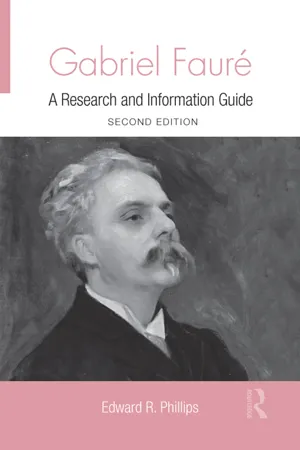
First published in 2011, this research study includes a biography section as well as the works of Gabriel Urbain Fauré born on 12 May 1845. Much of Fauré's music, especially the late pieces, remain little played and little known—as a result, his reputation as a salon composer of pleasant music continues even among educated musicians. The author suggests that it is more likely that the difficulty of much of Fauré's music for the listener and the demands it places upon him or her are the principal reasons for its omission from concert programs and for a misunderstanding of Fauré's place in the history of French music
Information
IV
Bibliography
With a few limitations, this bibliography is intended to include reference to everything of significance written about Fauré and his music from the late nineteenth century through mid-2009; in addition, items published after that date and those forthcoming, as they have been discovered, are also annotated. Included here, then, are monographs, articles in periodicals, dissertations, published pamphlets, and the like. The few book reviews that were included in the first edition remain—those which have been cited elsewhere, which review an important work, or which are written by a well-known scholar; book reviews after 1994 are not included as annotated items but may be mentioned in footnotes.
No systematic attempt has been made to document Fauré’s treatment in daily or weekly newspapers, and articles and other items found in such publications are listed if they have been included in the checklists of other authors, if they deal with issues important to Fauré’s career (such as discussions of the scandale Ravel or reports of his funeral), or if, in the case of review of pieces or performances, they are authored by people important to the history of music and music criticism. Reviews of Pénélope are an exception, and quite a few are annotated below. Often, articles which appeared in daily or weekly papers were published in collections by their authors; where the original source is known, it is cited together with the republication. Theses for masters’ degrees are not annotated, but a checklist of those known is provided in Appendix D. Liner notes for recordings and compact discs are not included.
Authors are cited by the name under which they published an item. If that name is a pseudonym, the author’s real name, if known, is indicated in square brackets.
Items have been assigned to sections of the bibliography by subject. That part of the bibliography dealing with Fauré’s compositions is divided by genre and by piece within a genre. No item is cited more than once, and when one item treats more than one piece or genre (or both biography and compositional style), it is assigned to the section judged most appropriate. Cross-references are then provided which, together with the author index, should eliminate any confusion.
Articles which form part of special issues of periodicals devoted to Fauré or which are part of a collection of essays are annotated separately; however, Appendix C lists such collections of material and their contents. An exception to this is the treatment of a number of special issues of daily papers at the time of Fauré’s death and funeral, which receive only one citation each.
Appendix B lists the contents of the annual issues of the only periodical devoted to Fauré and his works, the Association des amis de Gabriel Fauré: Bulletin, later retitled Études fauréennes.
For items which could not be located (or which are forthcoming), often the only information available was to be found in abstracts published with the work itself (in the case of dissertations), in RILM, or in Dissertations Abstracts. Such cases are cited in footnotes with the indication, “from the author’s abstract”; full citations for the abstracts are not provided as they can be easily determined from the publication information of the item being described.
The reader should be aware that certain items are not easily located. Articles in the more obscure French periodicals and in French newspapers are often found only in the Bibliothèque Nationale, Paris. And, certainly, others have eluded detection completely.
Life
Monographs
92. Alexandrescu, Romeo. Gabriel Fauré. Bucureşti: Editura Muzicală, 1968. 167pp. In Romanian, including the bibliography.
A monograph divided into a chapter on Fauré’s life and another on his compositions; there are photographs but no musical examples. List of works by genre and date; bibliography of 31 items.
93. Duchen, Jessica. Gabriel Fauré. London: Phaidon Press, 2000. 238pp. ISBN 0-7148-3932-9
A very readable chronicle of the composer’s life valuable for the attention paid to the artistic and historical events of the time and for the number of illustrations. However, discussion of the music is brief and nontechnical, and, in scholarly terms, the book is no substitute for Nectoux’s biog-raphy—there is here only a rudimentary bibliography, for example, and there is the occasional error such as the apparent confounding of the essayist, Gabriel Auguste Faure, with the baritone, Jean-Baptiste Faure (225).
94. Faure, Gabriel Auguste. Gabriel Fauré. Grenoble: B. Arthaud, 1945. 127pp.
Less a biography than a series of reminiscences in the form of essays by a man of letters who was a devoted admirer of the composer; two of the essays (“La naissance de Pénélope ” and “Le dernier enchanteur”) derive from earlier material (see items 265, 266, 267, 1168). Faure’s admiration for Fauré can be summarized in his belief that Fauré was the French Mozart; quotes from correspondence with Fauré. See also item 268.
95. Fauré-Fremiet, Philippe. Gabriel Fauré. Paris: Éditions Rieder, 1929. 100pp.; 2nd edition. Paris: Albin Michel, 1957. 243pp.1
A biography which concentrates on Fauré the person: most often the setting for any discussion of his works is a major event in his life—his encounter with the music of Wagner, the deaths of his parents, or his deaf-ness—and his reaction to it; particularly valuable for details of family history and of his relationships with family and friends; cites a number of letters. The first edition is not divided into chapters and includes sixty plates. The second edition omits the plates, divides the same text into chapters without titles, and adds several sections: “Réflexions sur la confiance fauréenne” (dealing with Fauré’s artistic philosophy), “Notes sur l’interprétations des œuvres” (general observations—that there is no “tradition fauréenne,” that mannerism and rubato are foreign to Fau-ré’s style—coupled with specific comments about the performance of a number of pieces), a list of works by opus number, a discography, and a bibliography.
96. Kœchlin, Charles. Gabriel Fauré. Paris: Félix Alcan, 1927. 233pp.; 2nd edition. Paris: Plon, 1949. 167pp. Reprint of 1st edition. Plan de la tour:Éditions d’aujourd’hui, 1983. ISBN 2-7307-0209-1
This monograph begins with a brief biography followed by a series of chapters discussing Fauré’s compositions in approximate chronological order within genres; pieces (with the exception of Prométhée and Pénélope ) are treated in thumbnail sketches with occasional cross-genre comparisons; most interesting are the first paragraphs of the chapters on orchestral and stage music where the author acts as Fauré’s apologist as well as the longer chapter analyzing Fauré’s style in terms of a number of parameters; includes a list of works by opus number, a bibliography, and an iconography. The author indicates that the second edition makes only minor changes in the biographical chapter.
97. ——. Gabriel Fauré (1845–1924). Translated by Leslie Orrey. London: D. Dobson, 1945. Reprint. New York: A.M.S. Press, 1976. viii, 98pp. ISBN 0-404-14679-1
Translation of the first edition; Kœchlin’s introduction and the iconography are omitted; other emendations of text and notes are made without indication as are changes to the bibliography; in his own introduction, the translator corrects the list of works.
98. Nectoux, Jean-Michel. Fauré. Paris: Éditions du seuil, 1972. 189pp. 2nd edition, 1986. ISBN 2-02-000253-1 3rd, revised and expanded edition, 1995. 255pp. ISBN 2-02-023488-2
The first biography of the composer by the world’s foremost Fauré scholar; the book is divided into chapters each of which treat a short period of Fauré’s career; major compositions are discussed, usually in terms of their themes or of large-scale formal divisions; abundantly illustrated; includes as appendices a chronology of Fauré’s life, a list of works by genre with discography, and a bibliography.
The second edition retains the text of the first edition with very slight modifications; the principal additions are in the greater number of illustrations (which are beautiful); the bibliography is updated, and the discography is separated from the work list (also updated) and expanded.
The third edition is somewhat expanded; both discography and bibliography are brought up to date. There are more illustrations, many in color.
99. Review: Gérard, Yves. Revue de musicologie 59, no. 1 (1973): 135–38.
The reviewer commends the author for having returned to primary sources to clear up misunderstandings about Fauré and his music: as a result, new historical facts are revealed and attention is paid to neglected compositions including the major works for the stage, Prométhée and Pénélope ; would have preferred a stronger concluding chapter touching upon a “problématique Fauré,” which would have given direction for future research. Gérard here makes his famous suggestion that Fauré’s output be divided into two periods (at La bonne chanson ) rather than the customary three.
100. Nectoux, Jean-Michel. Gabriel Fauré: Les voix du clair-obscur. Paris Flammarion, 1990. 616pp. ISBN 2-08-066291-0 2nd, revised and expanded edition. Paris: Fayard, 2008. 847pp. ISBN 978-2-213-63547-7
The most important monograph on Fauré; the organization of the book is generally chronological, but most chapters are devoted to a particular genre (“Sotto voce: Musiques de chambre I” or “Pour le piano”) or subject (“Texte et musique: Les années van Lerberghe”) producing a flexibility of approach that permits the comparison of like pieces separated by years in Fauré’s life. Nectoux brings many of his own insights into his discussion of the music, but his analytical stance and style underline the influence of Vladimir Jankélévitch to whose memory the book is dedicated (see items 368, 462, 466, 467, 852, 1182); concludes with an essay on Fauré’s aesthetics and philosophy. A wealth of illustrations; appendices include a chronology of Fauré’s life (complementing the ...
Table of contents
- Cover Page
- Half Title Page
- Routledge Music Bibliographies
- Title Page
- Copyright Page
- Dedication
- Contents
- Acknowledgments
- I A biographical introduction
- II Works
- III Primary sources
- IV Bibliography
- V Afterword: directions for research
- VI Appendices
- Author Index
- Primary Source Index
Trusted by 375,005 students
Access to over 1.5 million titles for a fair monthly price.
Study more efficiently using our study tools.
Frequently asked questions
Yes, you can cancel anytime from the Subscription tab in your account settings on the Perlego website. Your subscription will stay active until the end of your current billing period. Learn how to cancel your subscription
No, books cannot be downloaded as external files, such as PDFs, for use outside of Perlego. However, you can download books within the Perlego app for offline reading on mobile or tablet. Learn how to download books offline
Perlego offers two plans: Essential and Complete
- Essential is ideal for learners and professionals who enjoy exploring a wide range of subjects. Access the Essential Library with 800,000+ trusted titles and best-sellers across business, personal growth, and the humanities. Includes unlimited reading time and Standard Read Aloud voice.
- Complete: Perfect for advanced learners and researchers needing full, unrestricted access. Unlock 1.5M+ books across hundreds of subjects, including academic and specialized titles. The Complete Plan also includes advanced features like Premium Read Aloud and Research Assistant.
We are an online textbook subscription service, where you can get access to an entire online library for less than the price of a single book per month. With over 1.5 million books across 990+ topics, we’ve got you covered! Learn about our mission
Look out for the read-aloud symbol on your next book to see if you can listen to it. The read-aloud tool reads text aloud for you, highlighting the text as it is being read. You can pause it, speed it up and slow it down. Learn more about Read Aloud
Yes! You can use the Perlego app on both iOS and Android devices to read anytime, anywhere — even offline. Perfect for commutes or when you’re on the go.
Please note we cannot support devices running on iOS 13 and Android 7 or earlier. Learn more about using the app
Please note we cannot support devices running on iOS 13 and Android 7 or earlier. Learn more about using the app
Yes, you can access Gabriel Faure by Edward R. Phillips in PDF and/or ePUB format, as well as other popular books in Media & Performing Arts & Music. We have over 1.5 million books available in our catalogue for you to explore.