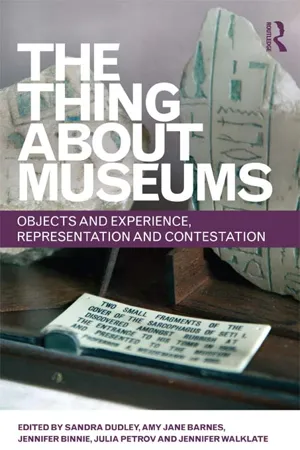
The Things about Museums constitutes a unique, highly diverse collection of essays unprecedented in existing books in either museum and heritage studies or material culture studies. Taking varied perspectives and presenting a range of case studies, the chapters all address objects in the context of museums, galleries and/or the heritage sector more broadly. Specifically, the book deals with how objects are constructed in museums, the ways in which visitors may directly experience those objects, how objects are utilised within particular representational strategies and forms, and the challenges and opportunities presented by using objects to communicate difficult and contested matters. Topics and approaches examined in the book are diverse, but include the objectification of natural history specimens and museum registers; materiality, immateriality, transience and absence; subject/object boundaries; sensory, phenomenological perspectives; the museumisation of objects and collections; and the dangers inherent in assuming that objects, interpretation and heritage are 'good' for us.
eBook - ePub
The Thing about Museums
Objects and Experience, Representation and Contestation
- 396 pages
- English
- ePUB (mobile friendly)
- Available on iOS & Android
eBook - ePub
The Thing about Museums
Objects and Experience, Representation and Contestation
About this book
Information
1 Introduction
Museums and things
Sandra Dudley
Museums are about things. At least, museums hold things; and from most viewpoints objects and collections continue – some post-museums notwithstanding, perhaps – conventionally to define the museum and distinguish it from other cultural, epistemological and pedagogical establishments. This is not to say, of course, that museums are only about things or that objects are all that matters in the museum: much of the museological literature of the past twenty years at least, has been devoted to demonstrating precisely the opposite, showing the extent to which museums are about people, not just collections. Nevertheless, for most institutions and most observers it is objects, and the collection, preservation, storage, documentation, research and display thereof, that most easily characterise museums in contrast to other sorts of publicly oriented organisations which may also have goals of keeping and expanding knowledge, and educating and entertaining people.1 Explorations of museums and heritage settings that begin from and focus on things, can thus illuminate the changing social and political dynamics in how and why objects come to, and then are experienced and utilised within, the museum. Ultimately, these object-focused studies can also give us further theoretical and practical insight into the museum institution itself, as many of the chapters in this book demonstrate.
At the same time, the kinds of museum- and heritage-based, object-focused studies found on the pages that follow, represent an opportunity both to apply approaches from wider material culture studies to museum contexts and to develop and extend thinking about objects through work done in museum settings. Museums are not, it is generally assumed, ‘real life’ in the sense of the life the objects within them lived before they entered its walls: a ritual libation cup on display in an ethnographic museum is no longer used in the religious ceremonies in which it was once so central; instead of moving from hand to hand, mouth to mouth, being filled with ceremonial liquid, drunk dry and refilled once more, the cup sits motionless, empty, permanently parched, viewed passively through the glass of its display case, untouched, unused, unblessed and unmoved. Hence, it is a commonplace to think of museum objects as not only decontextualised – because of their removal from their original contexts – but also ‘dead’.2 But if one can move away from this limited view, as an increasing number of object theorists as well as museum specialists are beginning to do, one sees that while objects may no longer be in their original contexts they are still in a setting that is nonetheless real – they have been re- rather than de-contextualised – and they are still ‘alive’ in the sense of being experienced and engaged with by human subjects. Museum objects continue to participate in socialised relationships and interactions and to be attributed particular – and changing – meanings and values as a result. This, together with the museum space's particularity, because of its use of objects, as on one level at least a material space par excellence (albeit a problematic one), implies some interesting possibilities for researching and theorising people–object engagements and their implications – a good reason for museums and their objects to come back towards the centre of material culture studies.
Indeed, pushing museum studies of objects back towards a central place in material culture studies is part of a wider effort to re-engage the museum at the centre of object theory: a place it has not properly held since the late nineteenth century. It is an agenda that has recently been taken further forward by some edited collections of various kinds (e.g. Edwards, Gosden and Phillips 2006, Knell 2007a, Dudley 2010a). However, fundamental to and central within the late twentieth century efforts that began – or perhaps more properly, reignited – this agenda, is the work of Susan Pearce, in whose honour the essays in this book have been written and collected (e.g. Pearce 1989, 1990, 1992). Pearce's post-structuralist perspectives and her analyses of and insights into the semiotics and multiple interpretations attributable to museum objects and collections by different visitors, curators and others have had a lasting influence that continues today. Indeed, it is an influence that resonates throughout this very volume, directly (e.g. the semiotic model utilised by artist and academic Shirley Chubb as part of her analysis of two of her exhibitions in Chapter 14) and indirectly (e.g. the creative, subjective, poetic interpretations of objects discussed by Nikki Clayton and Mark Goodwin in Chapter 13).
The resurgence of interest in material culture studies and theory which began in anthropology and cognate disciplines in the 1980s and 1990s through the work of Susan Pearce and others (e.g. Miller 1985, Hodder 1987)3 has now spread, to differing degrees and with varying effects, throughout the humanities and social sciences. It is not, therefore, unusual to find a primary focus on objects in fields as apparently distinct as human geography, cultural history, social anthropology or science technology studies. What form that primary focus might take, however, differs widely. In previous decades, for example, material culture studies have concentrated on the sociohistorical trajectories of things, on how objects make and change meanings and values, and on the embeddedness of material culture in social relationships (e.g. Appadurai 1986, Kopytoff 1986, Pearce 1995, Hoskins 1998; on similar themes in relation to colonial exchange see Thomas 1991, 1994). Processes of consumption have been a particularly important focus of much extant work (e.g. Miller 1987) although, as Ingold (2007) has pointed out, there has hardly been an equivalent emphasis on production [although there are some notable exceptions, particularly in the fields of the anthropology of art (e.g. Morphy 1991; various in Coote and Shelton 1992) and textiles (e.g. Barnes 1989; various in Weiner and Schneider 1989, Ahmed 2002)]. Some debates have focused on the notion of agency and whether or not objects can be said to have it in some form (e.g. Gell 1998, Dant 1999, Gosden 2005, Tilley 2007). Recently, there has also been increased interest in sensory perception and the potential contribution of anthropological insights, in particular into the culturally constituted nature of the senses (or at least, of our interpretations of the data we obtain from our physical senses; e.g. Howes 2003, 2005), and in phenomenologically informed approaches that stress, in different ways, the embodied nature of experience (e.g. Ingold 2000, Tilley 2004).
Some of these material culture emphases have been more influential than others on museum and heritage-based studies in recent years. The biographical and social life approaches to objects, and economic anthropology more broadly, have had significant influence on directly or indirectly stimulating studies of object trajectories and exchange in relation to collection and institutional histories (Clifford 1988, Price 1989, Kirshenblatt-Gimblett 1998, Gosden and Knowles 2001; see also Ames 1992), as has actor-network theory (e.g. Gosden, Larson and Petch 2007) and narratology (e.g. Bal 1994). The biographical and social life approach is also that taken by Marlen Mouliou and Despina Kalessopoulou in Chapter 4 of this volume, in which they explore aspects of the lives of emblematic objects in the National Archaeological Museum of Athens, ‘itself a biographical object of a nation’, as they explain. This approach also in some ways underlies, although indirectly, Linda Young's chapter (Chapter 10) on heroes’ house museums – at least in so far as the ‘magic’ and affective power of these places lie in the degree to which their interpretation emphasises the authenticity of their biography as objects. Caroline Bergeron's chapter on museums and collectors (Chapter 17), on the other hand, while it relates to biography in its emphasis on the collection as extension – and, indeed, creation – of the self (cf. Bourdieu 1990), draws heavily too on economic anthropology, particularly classical gift-exchange theory, to explore the relationships between collector-donors and museum-recipients. Claire Warrior (Chapter 19) also examines the contribution of collections to both personal histories and emergent and solidifying identities – in her case, national and individual identities and the narratives and meanings that have developed around Polar artefacts now in the UK National Maritime Museum.
Sense-focused and related material cultural approaches have also begun to be explored in relation to museums (e.g. Classen 2005; various in Edwards et al. 2006, Candlin 2007, Dudley 2010a), and again this is a theme elaborated upon by some of the chapters in this volume. The influence on the museum experience and on our responses to museum objects of the different sensory modalities that are able to operate in a particular gallery environment are considered in Chapter 11 by Helen Saunderson, who brings empirical psychological data to bear on her reflections on visiting an exhibition. In the following chapter, Wing Yan Vivian Ting also examines aspects of sensory and wider bodily experience in museums, this time drawing particularly on both Chinese philosophy of art and Western phenomenological approaches, especially that of Merleau-Ponty. Julia Petrov too (Chapter 16) addresses embodiment, materiality and the senses – especially the relationship between the visual and the (imagined) haptic – in museums, in an exploration that focuses particularly on the display of dress. One may not necessarily agree with her description of curatorial practice as ‘highly haptic’ (except by comparison to the average museum visitor's experience), but her introductory scoping of the museum as a place that emphasises ideas rather than things is an important reminder of a emergent theme in some of the literature in recent years, in which the museum's problematic relationships to objects and the fundamental ways in which people and objects interact, are beginning to be more fully investigated.
Some of the extant and important museum studies – as opposed to material culture studies – literature has examined the museum as an important part of our visual culture or indeed as a ‘way of seeing’ in its own right (e.g. Alpers 1991, Hooper-Greenhill 2000). Many chapters in this book focus not on the senses broadly or on their interrelationships, but on the visual in particular – albeit on differing levels. In Chapter 6, Klaus Wehner, a practising artist, develops an analogy between the ‘posed’ object on display and the photograph, drawing on Barthes’ notion of punctum. Display is the focus too of Michael Katzberg's chapter (Chapter 9) on the power of lighting in developing exhibition narrative – which, like Wehner, Dorsett, Rees Leahy and others, usefully reminds us of the importance of the overall context in which objects are displayed and of the materiality and sensory qualities of that context, as well of exhibited objects individually. Like Wehner, Meighen Katz also focuses on photographs (Chapter 23), in her case American images of the Great Depression in the 1930s. Her discussion brings our attention not only to the power of the visual per se, but also to the materiality of the photograph as object (cf. Edwards and Hart 2004, Edwards 2009, 2010). Roger Sansi (Chapter 15) addresses the visual too, but in the context of the notion of ‘spectacle’ and its possible forms – as the building and blockbuster exhibition, as the museum archive, as relational aesthetics within the gallery space – in contemporary art settings.
Some published work has looked at the very notion of the ‘museum object’, examining the subjective, shifting and often problematic means by which things in interpretive settings are used to represent wider stories or pieces of reality (e.g. Pearce 1992, Knell 2007b). Geoffrey Swinney's chapter (Chapter 3) extends notions of what constitutes a ‘museum object’ to museum registers and exposes them as shifting, situated and contingent constructions of meaning and knowledge no less than any other kind of material culture. Maria Lucia de Niemeyer Matheus Loureiro also seeks to examine fundamental questions about the idea of the museum object (Chapter 5), particularly in the context of art, with her philosophical discussion of the ‘musealisation’ processes (selection, documentation, display) by which something becomes a museum piece. Other work has discussed objects in the context of topics at the core of wider museum studies – rather than material culture studies – focusing on visitors, for instance. Marijke Van Eeckhaut takes such an approach in her exploration of whether paintings can have certain qualities that make them appeal to particular groups (Chapter 8).
Terminology more generally has been the subject of much writing by material culture scholars. The phrase ‘material culture’ is now viewed differently in some contexts than formerly: natural history and geology specimens, for instance, would once have been thought of simply as ‘specimens’ – that is, as natural objects rather than artefacts, they would not have been considered ‘material culture’. Yet now – indeed, since Pearce (1992, 1994a) – we understand that the moment such objects are removed from the ground, the moment they are selected and collected, they become material culture. As such, the study of them can tell us as much, if not more, than we might learn from an aristocrat's art collection or a missionary ethnography collection; ‘they exemplify’, as Hannah-Lee Chalk suggests in Chapter 2, after Prown (1982), ‘unintentional expressions of culture’. Fossils, shells or dead butterflies are ‘as much social constructs as spears or typewriters, and as susceptible to social analysis’ (Pearce ...
Table of contents
- Cover Page
- Half Title page
- Title Page
- Copyright Page
- Dedication
- Contents
- List of illustrations
- List of contributors
- Preface
- 1 Introduction Museums and things
- Part I Objects and their creation in the museum
- Introduction
- Part II Visitors' engagements with museum objects
- Introduction
- Part III The uses of objects in museum representations
- Introduction
- Part IV Objects and difficult subjects
- Introduction
- Index
Trusted by 375,005 students
Access to over 1.5 million titles for a fair monthly price.
Study more efficiently using our study tools.
Frequently asked questions
Yes, you can cancel anytime from the Subscription tab in your account settings on the Perlego website. Your subscription will stay active until the end of your current billing period. Learn how to cancel your subscription
No, books cannot be downloaded as external files, such as PDFs, for use outside of Perlego. However, you can download books within the Perlego app for offline reading on mobile or tablet. Learn how to download books offline
Perlego offers two plans: Essential and Complete
- Essential is ideal for learners and professionals who enjoy exploring a wide range of subjects. Access the Essential Library with 800,000+ trusted titles and best-sellers across business, personal growth, and the humanities. Includes unlimited reading time and Standard Read Aloud voice.
- Complete: Perfect for advanced learners and researchers needing full, unrestricted access. Unlock 1.5M+ books across hundreds of subjects, including academic and specialized titles. The Complete Plan also includes advanced features like Premium Read Aloud and Research Assistant.
We are an online textbook subscription service, where you can get access to an entire online library for less than the price of a single book per month. With over 1.5 million books across 990+ topics, we’ve got you covered! Learn about our mission
Look out for the read-aloud symbol on your next book to see if you can listen to it. The read-aloud tool reads text aloud for you, highlighting the text as it is being read. You can pause it, speed it up and slow it down. Learn more about Read Aloud
Yes! You can use the Perlego app on both iOS and Android devices to read anytime, anywhere — even offline. Perfect for commutes or when you’re on the go.
Please note we cannot support devices running on iOS 13 and Android 7 or earlier. Learn more about using the app
Please note we cannot support devices running on iOS 13 and Android 7 or earlier. Learn more about using the app
Yes, you can access The Thing about Museums by Sandra Dudley, Amy Jane Barnes, Jennifer Binnie, Julia Petrov, Jennifer Walklate, Sandra Dudley,Amy Jane Barnes,Jennifer Binnie,Julia Petrov,Jennifer Walklate in PDF and/or ePUB format, as well as other popular books in Social Sciences & Archaeology. We have over 1.5 million books available in our catalogue for you to explore.