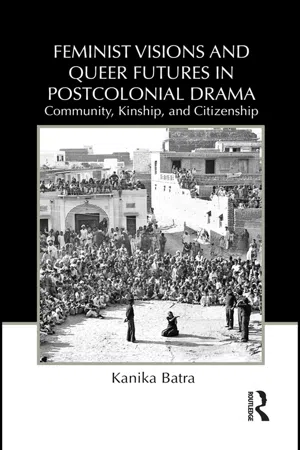
In this timely study, Batra examines contemporary drama from India, Jamaica, and Nigeria in conjunction with feminist and incipient queer movements in these countries. Postcolonial drama, Batra contends, furthers the struggle for gender justice in both these movements by contesting the idea of the heterosexual, middle class, wage-earning male as the model citizen and by suggesting alternative conceptions of citizenship premised on working-class sexual identities. Further, Batra considers the possibility of Indian, Jamaican, and Nigerian drama generating a discourse on a rights-bearing conception of citizenship that derives from representations of non-biological, non-generational forms of kinship. Her study is one of the first to examine the ways in which postcolonial dramatists are creating the possibility of a dialogue between cultural activism, women's movements, and an emerging discourse on queer sexualities.
eBook - ePub
Feminist Visions and Queer Futures in Postcolonial Drama
Community, Kinship, and Citizenship
- 213 pages
- English
- ePUB (mobile friendly)
- Available on iOS & Android
eBook - ePub
Feminist Visions and Queer Futures in Postcolonial Drama
Community, Kinship, and Citizenship
About this book
Information
Part I
Jamaica
1
Making Citizens
Community, Kinship, and the National Imaginary in Dennis Scott’s An Echo in the Bone (1974) and Dog (1978)
His disciplines are towards economy and austerity—a stripping away of whatever will obscure the sinews of the imaginative exercise. This alone is complex, as our lives are, where experience is prismatic and ironic, and where time, space, action and character are not sequential but relative.
The Play asks a question about the experience of violence and attempts not to explain its constituents, but to recreate the complex organism. We may puncture it at any point in time and space, place or race. The same tissues pulse, the same blood spurts, and the same heart must be healed.
(Caroll Dawes)
Written as an introduction to the University of West Indies’ production of Dennis Scott’s play An Echo in the Bone (1974), Dawes’s description attests to the relevance of his drama to contexts and moments other than those of the production. Scott’s reputation as a playwright has been overshadowed by his own fame as a poet and by dramatists such as Derek Walcott who share his focus on colonial history and its postcolonial legacy. Scott’s career as poet, dramatist, and arts administrator in Jamaica in the 1970s is part of a pre-globalization narrative that may seem irrelevant in the face of Jamaica’s current policies of a liberal, privatized economy, making it a willing although severely disadvantaged partner in the global economy. This career, however, inspired a generation of Caribbean theatre and drama workers, and Scott’s legacy continues in the experimental and socially conscious work of the Jamaican playwrights Pat Cumper and Pauline Forrest-Watson, and groups such as Sistren Theatre Collective and Jamaica Youth Theatre. As Director of the Jamaica School of Drama from 1977 to 1982, Scott’s key contribution was initiating theatre for development programs in Jamaican prisons, hospitals for the mentally ill, youth clubs, and sugar cooperatives. He wrote in an unpublished paper titled “Theatre in Development” that the kind of theatre he envisaged gave “people a chance to define, choose, and extend themselves” as both participants and spectators (6). Scott’s belief in local communities as the locus of historical and political consciousness coincided with Jamaica’s experiment with democratic socialist governance introduced by the People’s National Party leader Michael Manley. Defined as sustainable development within broadly socialist ideologies, democratic socialism as the state policy was abandoned in the late 1970s under international pressure to privatize the economy. Analyzing two plays by Dennis Scott, this chapter outlines multiple connotations of community and kinship towards an understanding of citizenship during this crucial period in Jamaica.
In the absence of performance records, the direct influences on Scott’s dramaturgy and on Caribbean performance history during this period can only be estimated.1 From the available records we know that Scott’s drama was influenced by the national cultural policy and intercultural performance theories.2 Rex Nettleford’s account of the role of the arts in Jamaica in the 1970s, Bertolt Brecht’s ideas on theatre as pedagogics, and Jerzy Grotowski’s concepts of performance and spectatorship are the basis of my interlocution of Scott’s plays. These enable a dialogue on the possible impact of the plays on audiences as ‘spectatorial communities’ participating in definitions of postcolonial citizenship. The audiences for Scott’s plays, which were and continue to be performed mainly in university settings, were, of course, different from the audiences of his community drama experiments in rural and urban locations. Through his encouragement of community drama Scott attempted to create a theatre for the masses, but his own plays were for a more specialized audience that were potentially the agents in creating such a theatre.
Focusing on the representation of colonial history in Scott’s play An Echo in the Bone (1974) at the beginning of democratic socialism and the social chaos depicted in Dog (1978) during one of the worst periods of political violence witnessed in postcolonial Jamaica, I outline the contours of normative citizenship propagated by the cultural policies of the Jamaican state. Next, I discuss representations of community offered in the two plays with reference to the normative citizen as an Afro-Caribbean man engaged in productive labor, and speculate on how these representations may have impacted specific audiences as spectatorial communities. I conclude by positing that Scott’s dramaturgy offers a limited but significant demystification of normative citizenship by introducing community and kinship as ideas central to an understanding of Afro-Caribbean history and contemporary Jamaican politics.
SPECTATORIAL COMMUNITIES AND KINSHIP
Scott’s representation of history and politics illustrates how cultural work contends with state ideologies in the creation of a ‘national imaginary’. This can be defined as a horizon of expectations for citizens of Jamaica as a nation including a monoracial (African) heritage, participation in a stable family unit, and a traditional assignment of gender roles. Within this imaginary men are expected to contribute to the national and domestic economies as the primary breadwinners, while women participate in these economies in both productive and reproductive capacities, evident in the government’s encouragement of women as wage earners under the democratic socialist experiment. Surprisingly for a playwright so closely attuned to state policies, Scott’s plays were not primarily meant for the audiences who were the focus of his community drama and theatre in development programs. The performance venues of the plays can help conceptualize the specifics of audience interpellation in the national imaginary envisaged microcosmically as a spectatorial community. An Echo in the Bone was performed as a commemoration play at the University of the West Indies (UWI), Mona, showcased as Jamaica’s entry into the Caribbean Festival of Arts (CARIFESTA), and at the Lagos Festival of Black Arts in the 1970s. The revivals of Echo in the 1980s include a much acclaimed production by Talawa, a black theatre company based in London. Dog was written when Scott was director of the Jamaican School of Drama, and was first performed by the Caribbean Theatre Workshop at the UWI, Mona in 1978; subsequent performances include those in Trinidad and in London as part of the Black Theatre Season. Clearly, these plays showcased Jamaica for international audiences. However, since they have been revived most often at the UWI, an examination of this performance venue is crucial to understanding the creation of spectatorial communities.3
Formed under the aegis of the British government to fulfill the educational needs of its colonies in the West Indies, the UWI can be seen as embodying what David Scott (no relation to Dennis Scott) has perceptively identified in Refashioning Futures as the “crisis” of the postcolonial state. This crisis involves “a decline of the hegemony of the middle class nationalist-modern” whose project was “to integrate progressively the social and cultural formations that composed the plurality of Jamaica around a single conception of the national good and a single portrait of the national citizen-subject.” This is an optimistic view of “hegemonic dissolution” that considers the “increasing moral, social, and economic autonomy of the popular classes.” The sites for the propagation of the nationalist modern are elite dominated and include “university lecturers, psychologists, journalists, radio talk-show hosts, politicians”; those of the popular modern arise from performative locations such as dancehall and reggae and constitute a “subaltern cultural-politics” (David Scott 191–93, 214). An analysis of UWI’s role in the developmental and cultural agenda of the Jamaican state indicates a somewhat different picture of the crisis in postcolonial Jamaica than that presented by David Scott. I am suggesting that a modification of these pertinent ideas can account for the different realms of the ‘national’ and the ‘popular’ in Jamaica: theatre and drama categorized as national culture inhabit institutional and community settings often with explicitly pedagogical aims; dancehall, within the popular domain, often relies on commercial or mass appeal in settings devoted almost exclusively to entertainment with no explicitly pedagogical aim.
The pedagogical dimensions of national culture during the 1970s are outlined by Rex Nettleford in his interview with David Scott. Manley’s “conscious cultural policy,” according to Nettleford, was aimed at “shaping a society” (222, 231). In Caribbean Cultural Identity Nettleford mentions that UWI’s Extra-Mural Department was the nodal point for culture put to developmental purposes; its Creative Arts Centre was the “bridge between the campus and the community through practice of the arts” (50). The UWI can thus be examined as a site for the consolidation of the state’s cultural agenda, dependent, in large measure, upon eliminating distinctions between the national and the popular by using culture for development. To put it differently, under the democratic socialist ideology the university as one of the sites of the “nationalist modern” was urged to make connections with the “popular modern.” It is against this background of the goals and aims of UWI and some of its constituent departments—outlined not by communities but by the dictates of the nationalist modern supposedly for the benefit of those very communities—that Prime Minister Manley’s cultural program can be assessed.
In 1972 Manley appointed an Exploratory Committee on the Arts headed by Nettleford which reported that the responsibility for arts lies on the “community” rather than exclusively on the government. The government’s role is to provide “constructive guidance” to cultural development “linked to economic and social development through the country’s educational policy, adult education and youth community programs as well as direct assistance to national cultural groups” (Caribbean Cultural 90). Trevor Munroe has defined civil society in Jamaica as referring to both the “non-political voluntary associations occupying the space between the state and the market” and “the networks and relationships which may or may not crystallize into groups but which nevertheless connect individuals together in some non-coercive, reciprocally purposive manner.” Munroe mentions the existence of many such groups in third-world contexts that sometimes develop into formal structures; he also emphasizes the role of voluntary efforts, aided by either the government or the private sector, in forming civic associations (78–79). The university is one such locus of networks and relationships that draws strength from “voluntary efforts,” although it does not fit voluntarism neatly as a schema for civil society that is valorized (and sometimes necessitated) in locations with scarce resources such as the third world at large and Jamaica in particular. The university can thus be seen as a site of waged as well as voluntary labor that subsidizes state expenditure through its work with communities in civil society, including the important theatrical experiments in the 1970s mentioned at the beginning of this chapter. Scott’s focus on drama for underprivileged local communities is in keeping with the national cultural pedagogy envisaged by Manley and Nettleford. However, in his own plays, that are the focus of this chapter, he offers a somewhat different view on community.
Caribbean theorizations of community have primarily been in the geographical terms urban, semiurban, or rural offered by Carl Stone; on the basis of affiliation with political parties as suggested by Gray; and more recently, as involving a “conception of difference” in which “conflict, dispute, argument, contestation—in short, agonism—are seen as constitutive rather than dispensable to a common life” according to David Scott (“Permanence” 298). Related to this idea of the community and the reiterated but largely amorphous state-defined program of the well-being of social groups as communities, but also opposed to its claims, are the demands of kinship or personal/familial well-being.4 Kinship and community as represented in Echo and Dog can be read through Joseph Roach’s formulation of the relationship between memory and performance as “surrogation.” For Roach performance “stands in for an elusive entity that it is not, but must viably aspire both to embody and to replace” in the same way as relationships within the community aspire to the obligations of kinship relations (3). The close approximation of community and kinship in these plays is, in my view, a validation of non-biological associations that helps sustain people in times of social conflict and hardship. This is often the case in situations marked by unequal access to resources as well as income disparities exacerbated by the state’s neglect of its poor and disenfranchised populations.
The social purposes of memory, mourning, and performance suggested by Roach serve as my points of departure for an examination of the forms of kinship and community explored in Echo and Dog. Roach has suggested that Echo “dramatizes the cultural politics of memory, particularly as they are realized through communications between the living and the dead” (34). Structured around ritual as a medium of social interaction, Echo is about impoverished Afro-Caribbean peasantry in the 1930s, who suffer under the control of wages, resources, and markets by the Creole landowners. Its central incident is the black farmer Crew’s murder of a white landowner, Mr. Charles, when the latter refuses his request to divert water from his large landholding to Crew’s small farm. Crew’s disappearance (it is assumed he has drowned himself) is the topic of speculation and discussion in the rural community. The Nine-Night ritual arranged by Crew’s widow Rachel in her husband’s memory comprises the action of the play.5 Rachel invites a few close friends to the ceremony, that is marked by ritual drumming, sharing of food, drink, ganja smoking, and recounting stories about the dead person. The incantatory, call-and-response nature of the ceremony builds a natural rhythm, one in which all members of the community participate:
MADAM: Who is Dead?
RACHEL: A man.
P: What is his name?
RACHEL: Crew.
DREAM: Where him come from?
RACHEL: Darkness.
SONSON: Where him gone to?
RACHEL: Darkness.
JACKO: What him life was like?
RACHEL: Sorrow.
STONE: What his life was?
RACHEL: Smoke.
BRIGIT: Who going remember him?
RACHEL: Friends.
STONE: Who going remember him?
RACHEL: Sons.
P: What him leave with us?
RACHEL: Smoke. (85)
The older folk of the village, Rachel, Mas P., Stone, Madam, and Rattler, understand the structural connections between the past and the present better than the young people such as Rachel’s sons Jacko and Sonson, her daughter-in-law Brigit, Madam’s granddaughter Lally, and Lally’s admirer Dreamboat. Despite participating in the ritual, Brigit and Lally constantly question its value. The young people’s skepticism, although it does not affect the bonds within the community, is in contrast to Madam’s compassionate understanding of Rachel’s desire for the mourning ceremony.6
The teleological sequence of the mourning ritual is disrupted by a series of historical and contemporary events: re-enactment of Afrocentric history depicting the middle passage, a slave auction, a slave owner’s encounter with the maroons, and a Creo...
Table of contents
- Routledge Advances in Theatre and Performance Studies
- Contents
- Illustrations
- Permissions
- Acknowledgments
- Introduction
- Part I Jamaica
- Part II India
- Part III Nigeria
- Notes
- Bibliography
- Index
Trusted by 375,005 students
Access to over 1.5 million titles for a fair monthly price.
Study more efficiently using our study tools.
Frequently asked questions
Yes, you can cancel anytime from the Subscription tab in your account settings on the Perlego website. Your subscription will stay active until the end of your current billing period. Learn how to cancel your subscription
No, books cannot be downloaded as external files, such as PDFs, for use outside of Perlego. However, you can download books within the Perlego app for offline reading on mobile or tablet. Learn how to download books offline
Perlego offers two plans: Essential and Complete
- Essential is ideal for learners and professionals who enjoy exploring a wide range of subjects. Access the Essential Library with 800,000+ trusted titles and best-sellers across business, personal growth, and the humanities. Includes unlimited reading time and Standard Read Aloud voice.
- Complete: Perfect for advanced learners and researchers needing full, unrestricted access. Unlock 1.5M+ books across hundreds of subjects, including academic and specialized titles. The Complete Plan also includes advanced features like Premium Read Aloud and Research Assistant.
We are an online textbook subscription service, where you can get access to an entire online library for less than the price of a single book per month. With over 1.5 million books across 990+ topics, we’ve got you covered! Learn about our mission
Look out for the read-aloud symbol on your next book to see if you can listen to it. The read-aloud tool reads text aloud for you, highlighting the text as it is being read. You can pause it, speed it up and slow it down. Learn more about Read Aloud
Yes! You can use the Perlego app on both iOS and Android devices to read anytime, anywhere — even offline. Perfect for commutes or when you’re on the go.
Please note we cannot support devices running on iOS 13 and Android 7 or earlier. Learn more about using the app
Please note we cannot support devices running on iOS 13 and Android 7 or earlier. Learn more about using the app
Yes, you can access Feminist Visions and Queer Futures in Postcolonial Drama by Kanika Batra in PDF and/or ePUB format, as well as other popular books in Media & Performing Arts & Literary Criticism. We have over 1.5 million books available in our catalogue for you to explore.