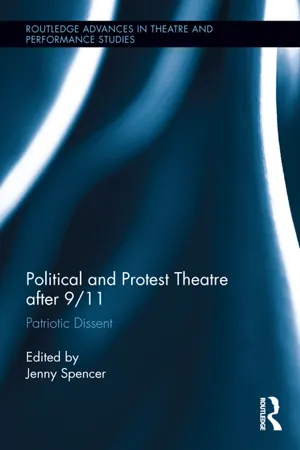
This collection documents and examines political and protest theatre produced between the 9/11 attacks in 2001 and Obama's election in 2008 by British and American artists responding to their own governments' actions and policies during this time. The plays take up topics such as the ongoing wars on terror, Blair's support of U.S. policies, the flawed intelligence that led to the Iraq war, and illegal detentions and torture at Abu Ghraib. The authors argue that engaged artists faced a radically different sociopolitical context for their work after 9/11 compared to earlier social protest movements and new forms of theatre, and different emotional strategies were necessary to meet the challenges. The subtitle Patriotic Dissent suggests the double stance of many artists-- influenced by patriotic expressions of national solidarity, yet critical of the ways that patriotic language was put to use against others. The articles represent a broad range of theatre: Broadway musicals, documentary theatre, adaptations of classical theatre, new plays by British playwrights, street performances and installations, and musical concerts. The contributors' case studies evaluate the effectiveness of important instances of political theatre and protest from this decade, arguing for the significance, relevance, and continuing necessity for evolving forms of political theatre today.
- 246 pages
- English
- ePUB (mobile friendly)
- Available on iOS & Android
eBook - ePub
About this book
Information
Part I
Mainstages
1 The 2003–2004 Season and Broadway Musical Theatre as a Political Conversant
When the revival of Stephen Sondheim’s Assassins opened at the Roundabout Theatre in April 2004, critics’ responses to its aesthetic accomplishments were mixed. Some witnessed an excellent and underrated musical in a superb production; others judged Sondheim’s score as either weak or not well served by John Weidman’s book.1 But all commentators agreed that the historical moment—almost three years after 9/11—added to the complexity of assessing Assassins’s political efficacy. Some reviewers felt the production wrongly sympathized with the thirteen real-life assassins the musical represents; others felt that Sondheim, Weidman, and director Joe Mantello clearly condemned those who would “kill a President,” even if in the U.S., “everybody’s got the right to their dreams,” as the lyrics of the opening song go.2
Assassins, which premiered in a limited Off Broadway run in 1990, is a series of linked vignettes that follow figures from John Wilkes Booth to John Hinckley, attending to some historical detail but disregarding chronology and placing characters together in imagined scenes. Considered one of Sondheim’s “concept” musicals, Assassins connects the idea of America as the land of opportunity with each character’s motivation to kill a president. Each member of the ensemble-based show has a short scene and/or a pastiche number of that character’s historical moment, such as an intentionally cheesy 1970s folk duet, “Unworthy of Your Love,” which Hinckley and Squeaky Fromme sing together, he to a photo of Jodie Foster and she to one of Charles Manson.
The musical opens at a carnival where the Proprietor mans a shooting gallery and offers each of the motley crew a gun and the enticement to kill a president. John Wilkes Booth—as the first—and Lee Harvey Oswald—as the most profound—are heroes for the other assassins, yet their stories, like those of the other characters, have been radically rewritten over time. For example, Booth’s expressed motivations are political, but even as he dictates his intentions while dying in the first book scene, the Balladeer revises the story: Booth killed Lincoln, the Balladeer sings, because he was a bitter actor “who got bad reviews.” Assassins paints a dark picture of the U.S., where frustrated outsiders have no choice but to seek fame through ill-advised, and later misinterpreted, violence. The musical also criticizes how the media distorts events so the real history of the disempowered can never be known.3
Critics were especially attentive to the historical moment of Assassins’s 2004 premiere because the revival had been scheduled to open in November 2001. With rehearsals set to begin on 17 September 2001, Roundabout’s producing director Todd Haimes and Mantello agreed to postpone the musical indefinitely after 9/11.4 New York seemed too fragile to withstand a show that might be seen as espousing extreme violence; one character, Sam Byck, even plans to fly a 747 into the White House to kill then-President Nixon. While post-9/11 might have been the perfect time to feature a musical whose (almost all) white, socially disempowered characters plot and attempt assassinations (some successfully, some not), the artistic team thought staging the show would be inappropriate in the face of national and local trauma and loss. Indeed, that season’s Tony award for best musical went to the saccharine and nostalgic Thoroughly Modern Millie, which beat out the neo-Brechtian and theatrically inventive Urinetown.
By the time Assassins was staged in April 2004, it resonated with public sentiment and coincided with many Americans’ increasing frustration with the Bush administration. In his New York Times commentary on the show, Frank Rich noted:
Two-thirds of Americans expect a terrorist attack before the election, with one-third expecting the political conventions to be a target. At the Assassins curtain call, all I could think of was what it would be like to be watching this show at the end of August, as the Republicans gather 20 blocks away on the eve of 9/11’s third anniversary.5
As Assassins’s production history reveals, a musical’s meaning—like that of all theatre—is thoroughly embedded in its moment of reception. Rich mulled over why the 1990 Off Broadway production of Assassins flopped and this one succeeded, “It’s not the show that has changed so much as the world. The huge difference in response to Assassins from one war in Iraq to the next is about as empirical an indicator of the larger drift of our post-9/11 culture as can be found.”6
In his tenure as the lead theatre critic for the Times (1981–94), Rich consistently noted musical theatre’s political relevance, and he continued to refer to Broadway musicals in his later op-ed pieces like this one. But even critics with less overt enthusiasm for musicals frequently gauge their responses to the production’s opening. For example, in January 2009, as producers scrambled for funds to transfer the previous summer’s Central Park production of Hair to Broadway, Times writer Patrick Healy wondered if “interest in the show’s antiwar-agitator characters may have dimmed with the election of Barack Obama.”7 Musical theatre’s live, present-tenseness—again, like all theatre’s—ensures that we respond to, engage with, and interpret a performance when we see it.
Assuming that political resonance at the moment of reception is more coincidental than intentional, commentators and audiences rarely connect a musical’s meaning to the time of its creation. Moreover, given the commercial exigencies of a form that must be crowd-pleasing, one assumes that musicals cannot afford to be partisan or polemical. Even in not-for-profit venues like university or regional theatres, the season’s musical is supposed to be the surefire hit and moneymaker. Does this mean that Broadway musicals, with their reputation for being happy and escapist, have nothing to say about U.S. politics? And more specifically, have Broadway musicals been entirely silent in responding theatrically to the events of 9/11?
My answer would be “no,” and in what follows, I outline a method for analyzing the Broadway musical as a political project and offer some examples of musicals that spoke back to the events of the day. Because the creation and production of a twenty-first-century Broadway musical is so time-consuming, cumbersome in its multilayered collaboration, and most of all, expensive, musicals cannot respond to current events in a quick and pointed manner like radio, television, the internet, or even nonmusical theatre can. However, I suggest that we look at “timely response” in a more expansive way. If progressive, political nonmusical plays were produced as an immediate response to 9/11 in late 2001 and 2002, then the 2003–2004 season saw a number of musicals that critiqued U.S. politics. In the same season as Assassins, the musicals Avenue Q, Wicked, and Caroline, or Change all opened on Broadway, and all take an ironic or negative view of U.S. politics. Whether they ran for days, months, or years, their presence proves that, in spite of its escapist reputation and undeniable commercial need to attract large audiences over a period of years, the Broadway musical is a political theatre.
The three musicals on which I focus here reveal a range of subjects and styles within the genre, from Wicked’s feminist transformation of one of America’s best-known and beloved stories; to Caroline, or Change’s semiautobiographical meditation on race and power in the 1960s South; to Avenue Q’s edgy takeoff of Sesame Street for twentysomethings. They also run the gamut in form: Wicked is a “classic” formally integrated book musical (in the style of Rodgers and Hammerstein); Caroline, or Change is almost entirely sung-through, with formal similarities to opera; Avenue Q follows a modified revue format.8 Even as the 2003–2004 musicals deal with serious subjects, they are imbued with what John Bush Jones calls “theatrical art’s fundamental component of playfulness.”9 Each incorporates a political critique, using musical theatre’s unique tools—music and lyrics—to engage the audience both viscerally and intellectually.
Avenue Q, Wicked, and Caroline, or Change experienced different, yet fairly typical and lengthy development processes for the early twenty-first century. Contemporary practices make older collaborations—such as South Pacific in 1949, which evolved from a conversation among friends listening to songs in Richard Rodgers’s living room to a fully financed production that opened the following year—look positively quaint. First, a twenty-first-century musical goes through an extended process—usually several years’ worth—of readings, backers’ auditions, and workshops before a fully realized production. These private or semipublic events serve both fiduciary and artistic purposes: they raise money, attract potential producers, and give the creative team a chance to witness how audiences, however selective, respond to the material. Over the course of several years, producers gather funding while the artists sharpen their vision, redrafting to make the piece “work.”
The amount of money needed to produce a musical requires numerous financial backers: “great, gangly committees of producers—and in some cases, giant corporations as producers.”10 For a Broadway-bound musical such as Wicked, many are not theatre people, but all stakeholders still have a voice at the table. Musicals that begin Off Broadway, such as Caroline, or Change and Avenue Q, require less capital upfront, but still involve many people in production.11 Furthermore, the genre’s multidimensionality means that, in addition to a playwright, director, designers, dramaturgs, and producers, a composer, lyricist, librettist, musical director, likely a musical arranger or orchestrator, and choreographer contribute to the project. Decision making becomes immensely complex.
The quest for commercial success—for a Broadway musical to make money (unlikely) or an Off Broadway production to move uptown (more likely)—exerts pressure on the artists and the production.12 Despite the high financial and artistic stakes, however, there is no necessary correlation between profit-seeking theatre and political disengagement, as the musicals of 2003–2004 show.13 All were in some stage of development in September 2001.
The Sesame Street-style, puppet-populated Avenue Q opened on 31 July 2003; with music and lyrics by Robert Lopez and Jeff Marx and book by Jeff Whitty, the artistic and financial development of the musical took four years. Lopez and Marx began collaborating in 1997 at the BMI Lehman Engel Musical Theatre Workshop, a weekly class for aspiring writers. By 1999, they had conceived of “a grown up children’s television show” musical that would speak to peers who had grown up on Sesame Street and were struggling to “make it” in New York City; the concept was “Sesame Street meets Friends.”14 In May 2000, they performed a reading, which drew three interested producers. In the meantime, they made a major conceptual choice to keep the puppeteers in full view of the audience. Over the next two years, librettist Whitty left, director Jason Moore and some of the actors came on board, and the New Group and the Vineyard Theatre agreed to coproduce it. The artistic team workshopped the piece at the Eugene O’Neill Theater Center in August 2002, rehearsals began in January 2003, and the show opened at the Vineyard in June. After receiving rave reviews, the show moved to Broadway. All in all, the process was relatively quick for an inexperienced team, for whom five to ten years of preproduction development is more typical.15 After winning the Tony award for Best Musical, Avenue Q shunned the expected national tour for a “sit-down” run in Las Vegas, which proved unsuccessful.16 In 2009, Avenue Q moved to an Off Broadway house, where it readily fills the smaller, less expensive theatre. The show also has numerous international productions and two national touring companies.17
Wicked, the untold backstory of the Wicked Witch of the West, opened on 31 October 2003. In 1996, composer and lyricist Stephen Schwartz read Gregory Maguire’s novel of the same name, and in 1998, he met with producer Mark Platt of Universal Studios, which owned the rights to Maguire’s book.18 With the backing of a major movie studio, Wicked’s development costs reached $14 million by the time it opened on Broadway. The artistic team possessed considerable experience, a proven track record, and many awards: Schwartz (composer and lyricist of Godspell, Pippin, and composer of numerous Disney animated films), librettist Winnie Holzman (creator of the television series My So-Called Life), director Joe Mantello (Angels in America, Take Me Out), choreographer Wayne Cilento, as well as top designers Eugene Lee (set) and Susan Hilferty (costumes). Still, Wicked had numerous readings and workshops beginning in February 2001,19 and the producers opted to open the show in San Francisco in May 2003, allotting five months for revisions before the Broadway opening. After negative reviews (but audience adoration) in California, they cut and reshaped the piece for Broadway.20 In spite of mixed reviews, Wicked won two Tony awards and has become the biggest hit of this century so far, in 2011 still playing at almost full capacity on Broadway and in open-ended runs internationally.
The production history of Caroline, or Change, which opened on 2 May 2004, relied on something other than the youthful luck of Avenue Q or the glittery punch of Wicked. Developed at the Public Theatre under the guidance of George C. Wolfe, the musical was seeded when the San Francisco Opera commissioned Tony Kushner to write an opera. Ku...
Table of contents
- Cover Page
- Half Title page
- Title Page
- Copyright Page
- Dedication
- Contents
- List of Figures
- Acknowledgments
- Editor's Introduction
- Part I Mainstages
- Part II Alternative Spaces
- List of Contributors
- Index
Trusted by 375,005 students
Access to over 1.5 million titles for a fair monthly price.
Study more efficiently using our study tools.
Frequently asked questions
Yes, you can cancel anytime from the Subscription tab in your account settings on the Perlego website. Your subscription will stay active until the end of your current billing period. Learn how to cancel your subscription
No, books cannot be downloaded as external files, such as PDFs, for use outside of Perlego. However, you can download books within the Perlego app for offline reading on mobile or tablet. Learn how to download books offline
Perlego offers two plans: Essential and Complete
- Essential is ideal for learners and professionals who enjoy exploring a wide range of subjects. Access the Essential Library with 800,000+ trusted titles and best-sellers across business, personal growth, and the humanities. Includes unlimited reading time and Standard Read Aloud voice.
- Complete: Perfect for advanced learners and researchers needing full, unrestricted access. Unlock 1.5M+ books across hundreds of subjects, including academic and specialized titles. The Complete Plan also includes advanced features like Premium Read Aloud and Research Assistant.
We are an online textbook subscription service, where you can get access to an entire online library for less than the price of a single book per month. With over 1.5 million books across 990+ topics, we’ve got you covered! Learn about our mission
Look out for the read-aloud symbol on your next book to see if you can listen to it. The read-aloud tool reads text aloud for you, highlighting the text as it is being read. You can pause it, speed it up and slow it down. Learn more about Read Aloud
Yes! You can use the Perlego app on both iOS and Android devices to read anytime, anywhere — even offline. Perfect for commutes or when you’re on the go.
Please note we cannot support devices running on iOS 13 and Android 7 or earlier. Learn more about using the app
Please note we cannot support devices running on iOS 13 and Android 7 or earlier. Learn more about using the app
Yes, you can access Political and Protest Theatre after 9/11 by Jenny Spencer in PDF and/or ePUB format, as well as other popular books in Media & Performing Arts & Performing Arts. We have over 1.5 million books available in our catalogue for you to explore.