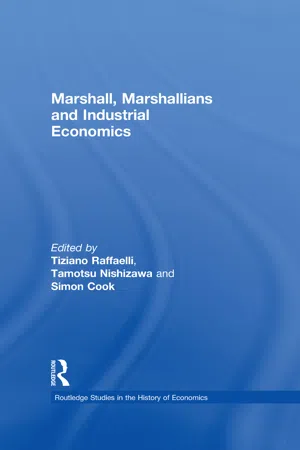
The four sections of the book deal in succession with Marshall's key ideas on the subject, the wider context of his thought in which they are to be read, their later development by some of his pupils, and their revival in contemporary economics. The first and last sections work together to illustrate the evolutionary focus of Marshall's research program and to identify its affinity with modern industrial economics; the second explicates the social assumptions within which the Marshallian paradigm was embedded, in particular those relating to the various relationships that exist between individuals and wider groups; while the third traces the development of Marshall's views by some of his pupils.
eBook - ePub
Marshall, Marshallians and Industrial Economics
- 320 pages
- English
- ePUB (mobile friendly)
- Available on iOS & Android
eBook - ePub
Marshall, Marshallians and Industrial Economics
Section 1
Marshall’s industrial economics
1 Marshall’s Evolutionary Model and its Bearing on Business Organization and Size
Introduction
The first part of the chapter briefly sketches the backbones of Marshall’s evolutionary model in its historical context, a task that is more thoroughly performed elsewhere (Raffaelli 2003). This general model applies to any research field whose subject changes over time, such as biology, psychology, sociology and economics. As the model is never explicitly exhibited, readers may all too easily miss its relevance. However, once spotted in the interstices of Marshall’s writings, it is immediately seen at work in different and apparently unconnected parts of his system, which thus takes on an appearance much closer to the economist’s biological Mecca than is commonly thought. It also allows greater awareness of the overall coherence of Marshall’s work, throwing light on the role of partial equilibrium and time period analysis which, far from being a static straightjacket to ward off evolutionary change, provide evolution with its piecemeal and multifaceted ingredients, as Backhouse convincingly argues in his contribution to this volume. The model guides Marshall’s investigations on business organization and policy that form the main subject of the second part of the chapter, which points out that Marshall’s vindication of the role of small businesses rests on potentialities that are detected thanks to the model itself.
Contrary to the widespread opinion that Marshall’s work ends up in a radical clash between rigorous static equilibrium analysis and ill-conceived attempts to submit economic evolution to scientific investigation, the two sides reveal unexpected interconnections. The very opposition between mechanical models, applicable to systems made up of unalterable units, and biological models, devised to deal with systems that grow organically and whose basic elements change over time, is not to be conceived as a yes-or-no alternative but as a hierarchical ordering that gives rise to two complementary research agendas. This does not mean underestimating the difficulties of their conciliation, which were repeatedly stressed by Marshall himself, conscious as he was of the limited value of his analytical tools to fit in with the evolutionary model he constantly kept in his mind as a regulatory idea.
The Origin of Marshall’s Evolutionary Model
The two pillars of Marshall’s evolutionary thought are the twin concepts of variation and selection that constitute the basis of the Darwinian system. Darwin explained the origin of species through the double movement of accidental variation and hereditary selection, by which successful variations are preserved. The power of the model is too well known to need emphasizing. In its heyday, the theory of evolution tended to become ‘a complete system of philosophy’ (Clifford 1886: 72). The leading figure in the extension of evolutionary thought from biology to psychology and sociology was Herbert Spencer, who, however, gave it an anti-Darwinian twist, substituting design for chance and conceiving of evolution as aiming at ‘higher forms of life’. By 1859, when The Origin of Species was published, Spencer had already developed his own evolution hypothesis. Principles of Psychology, published in 1855, clearly presents his evolutionary scheme based on the relationship between differentiation and integration: the evolution of the mind, like that of life, is driven by a double movement that brings about specialization and automatization of functions (differentiation) and their coordination (integration). Stress is laid here on the progressive tendency of the process that replaces undifferentiated organisms with more complex ones, in which different functions are devolved to specific organs. In the mind, for instance, specific activities are delegated to specific nervous structures and circuits. Here too innovation – like Darwinian variation – is of paramount importance, but it is driven by the organism’s effort of adaptation to the environment rather than by mere accident. This puts the problem of selection on a sidetrack, as its principles are already built into the mechanism that presides over innovation itself.
Darwin’s theory seemed to reinforce the basic tenets of Spencer’s model, adding the power of natural selection, which Spencer appropriated under the spurious label of ‘survival of the fittest’ to adapt it to his view of the progressive nature of evolution.
Spencer then went on to apply the model to his Principles of Sociology (1874–5). The mix of Darwinian and Spencerian ideas that emerged from this period had a profound impact, the dangerous consequences of which are best seen in the highly controversial research programme that goes under the name of social Darwinism.
The disentanglement of the two paradigms engaged the effort of later biologists, so much so that their common elements soon tended to be neglected. Weismann’s chromosomal theory of heredity offered an explanation that confirmed the validity of Mendel’s laws on the inheritance of genetic traits, which ruled out finality and design. The neo-Darwinian synthesis put the doctrine of evolution on firmer ground, and Spencer was relegated into the precinct of the ‘wrong’ evolutionists, whose first champion had been Lamarck.
To understand the cultural climate in which the young Marshall’s reflections were nurtured, it is necessary, at least provisionally, to remove the gravestone that the advancement of biological knowledge placed on Spencer’s system.
‘On some of the conditions of mental development’, a speech Clifford delivered in March 1868, bears witness to this need. The paper is of great interest because Clifford was Marshall’s most intimate friend at a time when both these young men were meditating on similar issues, as testified by Marshall’s philosophical papers. In this speech, Clifford does not hesitate to develop ‘the analogy between the mind and the visible forms of organic life’ and affirms that ‘in its continual changes and in the preservation of the records of those changes every organism resembles the mind’, introducing the supposition ‘that the laws of change are alike, if not identical, in the two cases’ (ibid.: 54–5).
For his theory of mental development, Clifford refers to both Darwin – as the theory relies on an evolution hypothesis that is ‘much the same thing as the Darwinian theory’ (ibid.) – and Spencer, who in a subsequent note is acknowledged to have anticipated the laws of mental development. Though only Principles of Biology is explicitly mentioned (ibid.: 59, 72), a generic reference to Spencer’s other writings calls to mind his psychological work, as does the conclusion that ‘men acquire faculties by practice’ (ibid.: 63).
Marshall paid tribute to Spencer, in 1904, in a letter to The Daily Chronicle, supporting the proposal of a memorial to his name. The letter is worth quoting at length:
He [Spencer] spread his strength over too wide an area … his fame has suffered because his general remarks as to the principles of evolution dealt with conceptions which were themselves in process of rapid evolution; and the younger students of today are often inclined to find little that is both new and true in a saying of him which had sent the blood rushing through the veins of those who a generation ago looked eagerly for each volume of his as it issued from the press. There is probably no one who gave as strong a stimulus to the thoughts of the younger Cambridge graduates thirty years or forty years ago as he … He has, perhaps, been more largely read and exercised a greater influence on the Continent than any other recent English thinker except Darwin.
(Whitaker 1996: III, 97)
This autobiographical mention of the former generation of graduate students suggests that the young Marshall himself shared ‘the wave of enthusiasm’ for the theory of evolution that was experienced by ‘the knot of Cambridge friends of whom Clifford was the leading spirit’ (Pollock, introduction to Clifford 1886:24). Marshall’s remark is noteworthy, especially in consideration of the caution that characterized his early years and his suspicion towards any attempt to transfer the evolution hypothesis to human and social subjects, beyond the realm of organic life to which Darwin’s theory originally applied.
The law of parcimony, a paper Marshall read in March 1867 at the Grote Club, strikes a polemical note against Bain’s application of Darwin’s theory to the human mind:
The phenomena with which Darwin is concerned are very homogeneous. There is in general no cause for presuming reasoning which is applicable to one branch of his subject to be inapplicable to another branch …. But mental phenomena are not homogeneous […] I object to the assumption that the difficulties to be overcome are of the same nature as those which have been overcome, and may be got rid of by a continued application of the same methods. Darwin may possibly be justified in making such an assumption; Bain certainly is not.
(Raffaelli 1994: 99–100)
In another paper, Ferrier’s Proposition One, dating from the same period, he endorses the Scottish idealist philosopher’s vindication of the autonomous origin of self-consciousness and its irreducibility to the historical evolution of mental phenomena caused by external stimuli.
Notwithstanding these philosophical reservations, Marshall depicted an evolutionary model of the functioning of the human mind that was meant to complement Ferrier’s theory concerning its origin. The model, elaborated in the third philosophical paper, Ye machine, is basically the same as Clifford’s and Spencer’s, and is the prototype of Marshall’s model of any evolutionary system. Variation and selection, operated by trial and error, are the basic factors that drive the evolutionary process, allowing the machine to build-up a set of automatisms (predetermined answers) that can be applied whenever it has to deal with repetitive tasks. In this case, it pays to select and store behavioural patterns that prove effective, to spare energy and time for solving new problems. Chance variation brings about different behavioural patterns that are put to test by the environment. Successful variations are saved and preserved, so that their performance becomes automatic when the same problem has to be faced again and again.
So far, this elementary mechanism is purely Darwinian, though its purport is to explain the Spencerian principle that ‘practice makes perfect’ through learning by doing: acquired automatisms become more and more effective as they are repeatedly performed. The functioning of the machine is in full agreement with Clifford’s model of the human mind and also with that of Spencer, and is in keeping with their explanation of the origin and role of instincts. The system works by delegating functions to sub-systems of various levels of complexity, the lower ones requiring less energy and effort. Its evolutionary growth consists in the contrivance of new devices (instincts), which can autonomously deal with standard problems. Its efficient functioning implies that, whenever possible, low-level automatic devices solve the problems it faces, without requiring the intervention of higher mental levels. This explanation of how instincts originate and work is very similar to Spencer’s, and Marshall also contemplates the possibility that acquired automatisms are not only culturally transferred but also hereditarily transferred. This is the issue that biological research would later clarify, introducing a sharp separation between these two modalities of transmission that Spencer blurs when he conceives of cultural transmission as preliminary to heredity, which steps in when the acquired habit or instinct is of use beyond the time limits of individual life.
This category mistake does not weaken the validity of the evolutionary scheme and its applicability to the evolution of any system, each with its own specific modalities of variation, selection and replication. The recent revival of interest in Spencer’s epistemology bears witness to its vitality, notwithstanding the misconstrual regarding the ‘transmission of acquired characters’.
Another feature of Spencer’s philosophy is that reason, conscience and other high-level activities are the result of the growing complexity of the mental system and are called into existence by the stalemate of lower level devices. Reason is the consequence of a process of ‘hesitation’ (Spencer 1855: 566, 595), which signals inability to solve the problem by already acquired automatic devices.
Widespread Applications to Social and Economic Problems
If the way successful variations are transmitted does not have any major impact on the model, neither do the different conceptions of the way variation is produced. Unlike Darwin, both Marshall and Spencer admit of design and conscious intervention, although, unlike Spencer, Marshall insists on the radical difference between the evolution of natural and human systems1 and confines design to the latter.
As for the origin of self-consciousness, Marshall seems slowly to have come to terms with the evolutionary explanation of Spencer’s Principles of Psychology.2 At the beginning, as the above quoted sentences show, he endorsed a different explanation, which did not rule out creation from above or some sort of independent origin of the superior functions of the human mind. However, this has no influence on the system’s functioning: in both cases, the basic Darwinian mechanism of variation and selection by replication is at work. In Ye machine, Darwin and Spencer coexist but live in separate compartments. The upper level of the brain introduces variations that are purposefully designed, as in Spencer, whereas the lower compartment works by chance variation, in a purely Darwinian setting. Independently of their origin, on both levels, variations are submitted to the test of the environment and, if successful, are selected for replication and stored in two separate compartments of the brain (cerebellum and cerebrum).
That this model of the evolution of the mind is the prototype of any model of evolutionary organization is confirmed by the fact that at a key point of Principles, when dealing with ‘industrial organization’, Marshall resorts to the analogy with the nervous system (Marshall 1920: 251 n.). The analogy helps to comprehend the process by which new action patterns are called for and stimulated when usual patterns fail and, once proved effective and of further use in the future, are selected and stored at the appropriate level of the brain. Whether the specific account of the development and location of such patterns is correct or not, the general scheme of their evolution is transferred by Marshall to the study of industrial organization. This is the specific field where its application and the conclusions it leads to have to be tested. And there can be little doubt that, by any standard, the insights he derives from the model greatly outbalance any fault or bias it may have caused.
To better understand how the model works in the field of industrial organization, it is helpful to turn our attention to Chapters 2 to 4 of Book II of Industry and Trade. Far from being descriptive and devoid of theoretical relevance, as is usually thought, these chapters, like many other parts of the book, rely on the well thought-out model that is first expounded in Marshall’s early reflections on the working of the human mind. It is not theory in the same sense in which the word theory ‘applies in the title’ of Book V of Principles, and ‘of that book alone’ (Marshall 1898: 52), as th...
Table of contents
- Cover
- Half Title
- Title Page
- Copyright
- Contents
- List of contributors
- Preface
- Introduction: from the Wanderjahre to the revival of Marshall’s industrial economics
- Section 1: Marshall’s industrial economics
- Section 2: Wider perspectives
- Section 3: The Marshallian school
- Section 4: The revival
- Index
Trusted by 375,005 students
Access to over 1.5 million titles for a fair monthly price.
Study more efficiently using our study tools.
Frequently asked questions
Yes, you can cancel anytime from the Subscription tab in your account settings on the Perlego website. Your subscription will stay active until the end of your current billing period. Learn how to cancel your subscription
No, books cannot be downloaded as external files, such as PDFs, for use outside of Perlego. However, you can download books within the Perlego app for offline reading on mobile or tablet. Learn how to download books offline
Perlego offers two plans: Essential and Complete
- Essential is ideal for learners and professionals who enjoy exploring a wide range of subjects. Access the Essential Library with 800,000+ trusted titles and best-sellers across business, personal growth, and the humanities. Includes unlimited reading time and Standard Read Aloud voice.
- Complete: Perfect for advanced learners and researchers needing full, unrestricted access. Unlock 1.5M+ books across hundreds of subjects, including academic and specialized titles. The Complete Plan also includes advanced features like Premium Read Aloud and Research Assistant.
We are an online textbook subscription service, where you can get access to an entire online library for less than the price of a single book per month. With over 1.5 million books across 990+ topics, we’ve got you covered! Learn about our mission
Look out for the read-aloud symbol on your next book to see if you can listen to it. The read-aloud tool reads text aloud for you, highlighting the text as it is being read. You can pause it, speed it up and slow it down. Learn more about Read Aloud
Yes! You can use the Perlego app on both iOS and Android devices to read anytime, anywhere — even offline. Perfect for commutes or when you’re on the go.
Please note we cannot support devices running on iOS 13 and Android 7 or earlier. Learn more about using the app
Please note we cannot support devices running on iOS 13 and Android 7 or earlier. Learn more about using the app
Yes, you can access Marshall, Marshallians and Industrial Economics by Tiziano Raffaelli,Tamotsu Nishizawa,Simon Cook in PDF and/or ePUB format, as well as other popular books in Business & Business General. We have over 1.5 million books available in our catalogue for you to explore.