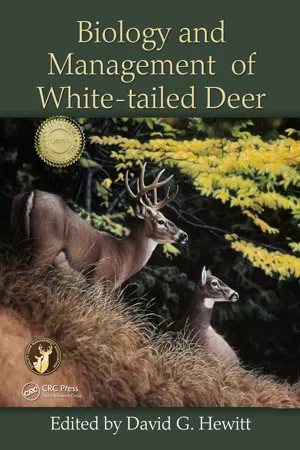
Biology and Management of White-tailed Deer
eBook - PDF

Biology and Management of White-tailed Deer

  1. 686 pages
  2. English
  3. PDF
  4. Available on iOS & Android
eBook - PDF

Biology and Management of White-tailed Deer

About this book

Winner of the Wildlife Society Outstanding Edited Book Award for 2013!

Winner of the Texas Chapter of The Wildlife Society Outstanding Book Award for 2011!

Winner of a CHOICE Outstanding Academic Title Award for 2011!

Biology and Management of White-tailed Deer organizes and presents information on the most studied large mammal species in the world. The book covers the evolutionary history of the species, its anatomy, physiology, and nutrition, population dynamics, and ecology across its vast range (from central Canada through northern South America). The book then discusses the history of management of white-tailed deer, beginning with early Native Americans and progressing through management by Europeans and examining population lows in the early 1900s, restocking efforts through the mid 1900s, and recent, overabundant populations that are becoming difficult to manage in many areas.

Features:

  • Co-published with the Quality Deer Management Association
  • Compiles valuable information for white-tailed deer enthusiasts, managers, and biologists
  • Written by an authoritative author team from diverse backgrounds
  • Integrates white-tailed deer biology and management into a single volume
  • Provides a thorough treatment of white-tailed deer antler biology
  • Includes downloadable resources with color images

The backbone of many state wildlife management agencies' policies and a featured hunting species through much of their range, white-tailed deer are an important species ecologically, socially, and scientifically in most areas of North America. Highly adaptable and now living in close proximity to humans in many areas, white-tailed deer are both the face of nature and the source of conflict with motorists, home-owners, and agricultural producers. Capturing the diverse aspects of white-tailed deer research, Biology and Management of White-tailed Deer is a reflection of the resources invested in the study of the species' effects on ecosystems, predator-prey dynamics, population regulation, foraging behavior, and browser physiology.

Frequently asked questions

Yes, you can cancel anytime from the Subscription tab in your account settings on the Perlego website. Your subscription will stay active until the end of your current billing period. Learn how to cancel your subscription.
No, books cannot be downloaded as external files, such as PDFs, for use outside of Perlego. However, you can download books within the Perlego app for offline reading on mobile or tablet. Learn more here.
Perlego offers two plans: Essential and Complete
  • Essential is ideal for learners and professionals who enjoy exploring a wide range of subjects. Access the Essential Library with 800,000+ trusted titles and best-sellers across business, personal growth, and the humanities. Includes unlimited reading time and Standard Read Aloud voice.
  • Complete: Perfect for advanced learners and researchers needing full, unrestricted access. Unlock 1.4M+ books across hundreds of subjects, including academic and specialized titles. The Complete Plan also includes advanced features like Premium Read Aloud and Research Assistant.
Both plans are available with monthly, semester, or annual billing cycles.
We are an online textbook subscription service, where you can get access to an entire online library for less than the price of a single book per month. With over 1 million books across 1000+ topics, we’ve got you covered! Learn more here.
Look out for the read-aloud symbol on your next book to see if you can listen to it. The read-aloud tool reads text aloud for you, highlighting the text as it is being read. You can pause it, speed it up and slow it down. Learn more here.
Yes! You can use the Perlego app on both iOS or Android devices to read anytime, anywhere — even offline. Perfect for commutes or when you’re on the go.
Please note we cannot support devices running on iOS 13 and Android 7 or earlier. Learn more about using the app.
Yes, you can access Biology and Management of White-tailed Deer by David G. Hewitt in PDF and/or ePUB format, as well as other popular books in Biological Sciences & Ecology. We have over one million books available in our catalogue for you to explore.

Information

Publisher
CRC Press
Year
2011
Print ISBN
9781439806517
eBook ISBN
9781482295986
8
Biology 
and 
Management 
of 
White-tailed 
Deer
FIGURE 
1.3 
Stephanocemas
(left) 
and 
Dicrocerus
(right) 
are 
the 
first 
animals 
to 
shed 
their 
antlers 
on 
regular 
and 
recur-
rent 
basis. 
All 
of 
today’s 
true 
(antlered) 
deer 
arose 
from 
early 
deer 
such 
as 
these. 
(Illustration 
by 
R. 
Babb 
from 
Heffelfinger, 
J. 
R. 
2006. 
Deer 
of 
Southwest. 
College 
Station: 
Texas 
A&M 
University 
Press.)
FIGURE 
1.4 
The 
musk 
deer 
(left), 
muntjac 
(center), 
and 
roe 
deer 
(right) 
provide 
an 
illustrative 
example 
of 
the 
evolution-
ary 
progression 
from 
oral 
to 
cranial 
weaponry 
in 
Cervidae. 
(Photo 
by 
P. 
Myers. 
With 
permission.)

Table of contents

  1. Front Cover
  2. Contents
  3. Preface
  4. Editor
  5. Contributors
  6. Chapter 1: Taxonomy, Evolutionary History, and Distribution
  7. Chapter 2: Anatomy and Physiology
  8. Chapter 3: Nutrition
  9. Chapter 4: Antlers
  10. Chapter 5: Population Dynamics
  11. Chapter 6: Spatial Use of Landscapes
  12. Chapter 7: Diseases and Parasites
  13. Chapter 8: Predator–Prey Relationships
  14. Chapter 9: Interactions with Other Large Herbivores
  15. Chapter 10: White-tailed Deer Behavior
  16. Chapter 11: Management History
  17. Chapter 12: Impacts on Ecosystems
  18. Chapter 13: Impacts of Deer on Society
  19. Chapter 14: Extensive Management
  20. Chapter 15: Management on Private Property
  21. Chapter 16: Managing White-tailed Deer: Eastern North America
  22. Chapter 17: Managing White-tailed Deer: Midwest North America
  23. Chapter 18: Managing White-tailed Deer: Western North America
  24. Chapter 19: Managing White-tailed Deer: Latin America
  25. Chapter 20: Managing White-tailed Deer: Exurban, Suburban, and Urban Environments
  26. Chapter 21: The Future of White-tailed Deer Management
  27. Appendix: Scientific Names of Plants and Animals Referenced in the Text
  28. Back Cover