Based on ethnographic research, this book examines the paranormal investigation subculture in the US. Presenting interviews with investigators as well as extensive field observations, it explores their reasons for getting involved, their use of different investigative methods, the interpretive processes by which they individually and collectively 'sense' spirits, the ways in which these processes are influenced by small group power dynamics, and what paranormal investigation ultimately means to those who participate. While focusing on the practices by which investigators 'sense' spirits in small groups, the author also situates paranormal investigation within a broader cultural context and attends to how investigators attempt to legitimize their practice despite being marginalized by both science and religion. A fascinating study of ghosts as an inherently social phenomenon, Sensing Spirits will appeal to sociologists with interests in ethnography, interactionism, cultural studies and subcultures.
eBook - ePub
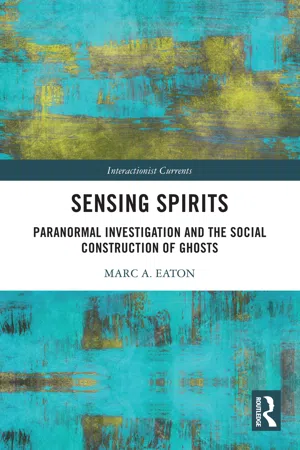
Sensing Spirits
Paranormal Investigation and the Social Construction of Ghosts
- 208 pages
- English
- ePUB (mobile friendly)
- Available on iOS & Android
eBook - ePub
About this book
Information
1 Getting into the spirit
Sensing spirits is a tricky endeavor. As noted in the introduction, institutionalized science and religion exert their “cultural authority” (Hufford 1995) to delegitimize belief in ghosts and hauntings. Nevertheless, significant proportions of people living in ostensibly secularized Western cultures continue to believe in such phenomena. Why do so many people hold such beliefs in the face of delegitimation by powerful institutions?
Hufford (1982) proposes two theories that offer differing explanations for the perpetuation of paranormal beliefs. The first, which he originally proposed as a counterargument to his preferred theory, is known as cultural source theory. According to this explanation, individuals arrive at spiritual explanations for strange experiences because the cultures in which they have been socialized provide models through which these individuals perceive and categorize phenomena. If spiritual explanations are readily available as ways of making sense of personal experiences, individuals will apply these labels to their experiences and perceive the labels as the real explanations for these phenomena. Depending upon one’s cultural context, similar experiences may be defined as a visit by a deceased ancestor, a potential attack by a malevolent spirit, or as a symptom of a medical or psychological disorder.
Hufford’s second, preferred explanation for the persistence of spiritual beliefs is the experiential source theory. This theory proposes that certain types of spiritual beliefs—Hufford (1995) calls them “core beliefs”—are rooted not in cultural models that individuals overlay onto their experiences but rather in the experiences themselves, which he refers to as “core experiences.” Building upon his thorough research on the Old Hag phenomenon (also known as sleep paralysis) he argues that in some cases perceptions of a spiritual presence exist independently of any cultural models that provide a cognitive framework for understanding such experiences. Although he stops short of identifying such experiences as true instances of spirit contact, Hufford (1995; 2005) argues that those who report Old Hag/sleep paralysis experiences reach conclusions about the intrinsic spiritual nature of these through reasoned reflection. For Hufford, the similarity between reports across different cultural traditions of belief suggests that those who report such incidents are genuinely experiencing something that they perceive as a spiritual encounter, even if they may have no cultural tools available to contextualize and normalize the physiological and psychological effects of the encounter.
Using Hufford’s two theories as a starting point, this chapter examines the important roles played by both personal experiences that individuals perceived to be paranormal and cultural representations of such paranormal phenomena. Most people who later became paranormal investigators report one or more early-life experiences that they perceived as spiritual at the time. These experiences drove their interest in learning more about ghosts and eventually led to their participation in paranormal investigation. A minority of investigators report no such experiences and state instead that their childhood interest in ghosts was stimulated by paranormal-themed books, games, TV shows, and movies. Therefore, I suggest that both perceived spiritual experiences and cultural influences are important precursors to individuals’ later involvement in paranormal investigation. Also important is the presence or absence of a supernatural worldview during their formative years. Because religious and paranormal belief systems both presuppose the existence of spiritual entities and claim that spirits can meaningfully interact with the physical world (Baker et al. 2016; Goode 2012; Mencken et al. 2009), it is important to attend to the role religious beliefs played in investigators’ primary socialization. This is particularly true in light of research consistently showing that the family is the most critical agent of religious socialization, especially in childhood and in the context of relatively secular societies such as the United States (Arnett and Jensen 2002; Bengtson et al. 2009; Hunsberger and Brown 1984; Kelley and De Graaf 1997; Myers 1996; Willits and Crider 1989).
Data from my interviews suggest that similar processes are at play in the case of paranormal beliefs. With regard to belief in ghosts, some paranormal investigators report that their family affirmed or at least permitted such beliefs, while others recount parents’ and step-parents’ efforts to suppress such beliefs. These patterns of belief overlapped in complex ways with their families’ levels of religiosity. Ultimately, investigators’ abilities to make sense of their belief in ghosts were affected by their families’ broader supernatural worldviews, which included their positions relative to both conventional religious beliefs and paranormal beliefs. This chapter traces the pathways by which paranormal investigators first became interested in the topic of ghosts and hauntings and explores how these beliefs were nurtured or discouraged within the investigators’ socialization contexts.
Developing an interest in ghosts and hauntings
Of my forty-five interviewees, thirty-eight (84%) trace their interest in ghosts back to some of their earliest memories. Most of these people—twenty-six of the thirty-eight (68%, or 58% of the total interview sample)—became open to the possible existence of spirits following an early-life sensory or extrasensory experience. The remaining twelve had no paranormal experiences prior to getting involved in paranormal investigation, but nonetheless developed an early-life interest as a result of exposure to ghost stories within and beyond their family context.
Early-life sensory experiences
Fifteen of the thirty-eight individuals who became interested in ghosts early in life (39%, or 33% of the total sample) describe instances in their childhood in which they became aware of the presence of a spiritual being or energy through one or more of their senses. Many of these experiences were quite startling at the time. A team leader named Jennifer, for example, believes her interest in ghosts is rooted in a frightening childhood experience:
I’ve always been interested in the paranormal ‘cause I had an experience as a young child. We lived in a haunted house, an old house in North Carolina. I remember being in the bathroom with my stepmother brushing my hair and the door slammed shut! She couldn’t open the door. She kept screaming. And I remember seeing the window sliding up and down. She finally got the door open and picked me up and ran downstairs. And I remember hearing my brother scream as we left.
The sights, sounds, and panicked feelings associated with this event remain vivid in her retelling decades after the events described. Like Jennifer, Suzanne’s account is suffused with sensory information that affirms, in her mind at least, that she encountered an evil entity in her bedroom when she was fifteen years old:
It felt like somebody was beside my bed and had put their hands under the top mattress and just flipped it. And it rolled me right over. It woke me up and I was trying to figure out what happened. I rolled back over and saw the torso of this figure in black. So I rolled back over in the direction that my sister was and saw these red glowing eyes over her bed. Talk about scared to death! I threw the covers over my head and I just remember laying there sweating because I was so afraid.
Not all experiences were as frightening as those described above. Early-life sensory experiences were often fairly innocuous. One investigator named Kaye used to hear “a lot of footsteps and faucets turning on” in her childhood home, while a sensitive named Christy heard “five or six footsteps going up the stairs” in front of her one evening at church when she was a young teen. Phil even remembers being visited by a spiritual presence that he believed at the time to be Santa Claus:
I was probably four or five years old. It was Christmas Eve and it’s nighttime, so everybody’s gone to bed. I’m laying there still kinda awake, and I remember hearing somebody come into my room and feeling them sitting on my bed. They didn’t touch me in any way, shape, or form; didn’t rub my shoulder or pat me on the head or whatever. And then they just got up and walked out.… In the morning, we’re sitting at the breakfast table and I remember saying to my parents, “Santa Claus came into my room last night and sat on my bed!” And I remember both of my parents looking at each other like, “Did you go into his room?” and looking at me like I was crazy. But somebody of adult size came into my room, sat down on my bed, and then just left (emphasis in original).
Whether their encounters were terror-inducing or more mundane, all investigators that report early-life sensory experiences rely upon discrete sensory memories—the sight of a slamming window, a pair of red eyes, or an apparition; the sound of screams and footsteps; the pressure of an adult-sized being sitting on one’s bed—as evidence that they experienced something ghostly during their childhood. Put another way, they sense spirits based on empirical evidence rooted in lived experiences of what they perceive to be a spirit encounter. Like the people who reported Old Hag/sleep paralysis experiences in Hufford’s (1982) study, these individuals reach a spiritual explanation for their experience after rationally assessing the information they gathered through direct sensory observation.
Early-life extrasensory experiences
Eleven of the thirty-eight investigators who became interested early in life (29%, or 24% of the sample) claim that they made contact with spirits (willingly or unwillingly) through extrasensory abilities such as “empathy” or “clairsentience” (sensing the emotions of spirits in their vicinity), “clairvoyance” (seeing spirits in their “mind’s eye”), “clairaudience” (hearing the voices of spirits in their minds), “psychometry” (receiving historical or emotional information about a deceased person by making physical contact with an object they once possessed in life) and “mediumship” or “channeling” (voluntarily allowing one’s body to be temporarily inhabited by a spirit). As a sensitive named Norah explains:
I’ve been sensitive all my life. When I was a child, I could see things out of the corner of my eye [and] I could feel that I wasn’t alone. Or I’d walk by a mirror and see somebody walking next to me.
Likewise, Sabrina recalls that as a child she had a lengthy conversation with a friendly man who turned out to be her deceased great-grandfather:
My earliest memory [of psychic abilities] was when I was almost seven [years old]. I was playing in the country at my great-aunt’s house and I saw a man drive up the driveway. He got out of the truck and started walking toward me, and I just knew [that] I knew him. He started talking to me and we talked about our families and everything. Then he says “Goodbye” and gets in his truck and leaves. And the truck even made the gravel road kick up dirt and stuff. And I went into the house and told my grandmother I was talking to a man outside. Of course, she got very scared but I explained to her what the truck looked like, what he looked like, and that he was talking about his sister that lived in the house, which was my great-aunt. And my grandmother just broke down bawling and she said, “That’s my father that died when you were a baby!” I had described him to a T.
The memories shared by Norah, Sabrina, and others like them are infused with rich sensory details about seeing or otherwise feeling the presence of spiritual entities. The key difference between their stories and those shared by people who reported early-life sensory experiences is that they claim to have acquired this sensory knowledge through extrasensory means. Moreover, each believes that such abilities were present since early childhood, if not birth, and describes their abilities as a “gift,” implying that they had been granted these powers by some higher consciousness or a force external to themselves.
Not all sensitives who had early-life extrasensory experiences report that their abilities were present since birth. Julie, for example, describes herself as receiving “vibes” from objects, and claims that when she touches these objects she experiences, “immense sense of sadness, or anger, or happiness.” She dates the development of these psychometric abilities to her early teenage years, “around the time of puberty.” A second sensitive, Fiona, had a near-death experience after accidentally ingesting a bottle of aspirin when she was a child. Following this medical emergency, Fiona was able to sense the presence of spirits as mental “visions.” She recalls no extrasensory experiences prior to this event and believes that her “brain must have been opened up” to the spirit world as a consequence of her brush with death.
Regardless of whether they believe their abilities are ascribed or achieved, extrasensory experients present their abilities as an innate part of the way they perceive the world. Like those who experienced the Old Hag/sleep paralysis in Hufford’s (1982) study, these sensitives also frame their awareness of a spiritual presence as immediate, undeniable, and rooted in empirical evidence; in the case of sensitives, this evidence also includes knowledge gained through extrasensory means. For this latter group, the fact that they experience this knowledge as being unmediated by physical sensations—as being something they “just know”— increases their confidence in the reality of their abilities and the reliability of the information they gather through extrasensory means. Because they feel as though they can directly communicate with spirits, those who report early-life extrasensory experiences have no doubt about the existence of ghosts.
Early-life enthusiasm
Unlike the investigators described above, twelve of the thirty-eight people (32%, or 27% of the sample) who became interested in ghosts early in life did not trace this interest to a sensory or extrasensory encounter with some spiritual entity or energy. Instead, their interest was piqued through exposure at an early age to a combination of family stories, informal self-education, and paranormal-themed entertainment media. In the absence of any direct personal experience with what they perceived as a spiritual presence, these sources functioned as the primary avenue through which these twelve investigators became intrigued by the idea that ghosts may exist.
Family ghost stories played an important role in three investigators’ early-life enthusiasm. Team leader Roger says his interest in the paranormal is rooted in hearing ghost stories told by two generations of his family:
Most people that I know in the field had a paranormal experience [when growing up]. I didn’t. The reason I got involved was really my parents and grandparents telling me ghost stories when I was a youngster. My grandparents on both sides came from Poland and they often told me ethnic stories. They were fascinating to me as a youngster. And then when I was maybe six or seven years old, my parents told me regional stories. Back when my parents were dating in the 1930s and 1940s, my dad used to take my mom on dates. And they would drive past a large Roman Catholic cemetery with a reputation for a hitchhiking ghost. My dad wanted to see for himself if there was actually something to these stories and maybe even have an encounter himself, so he would drive my mom around in the cemetery in the middle of the night in pitch darkness looking for this ghost. Those were the kinds of stories that I grew up with, and as I grew older I wanted to find out if these stories were in fact true (emphasis in original).
A second team leader, Terri, also identifies as “not one of those that has had this life-altering experience or near-death experience or anything like that.” Rather, like Roger, Terri’s interest is grounded in the intergenerational telling of ghost stories:
There was family interest on both my father’s and my mother’s side. When I was a kid, my great-grandparents on Sundays after church would take us on...
Table of contents
- Cover
- Half-Title
- Series
- Title
- Copyright
- Dedication
- Contents
- Acknowledgements
- Introduction
- 1 Getting into the Spirit
- 2 Learning the “Right” Ways to Sense Spirits
- 3 Discerning Evidence of Spirits
- 4 Empersoning Spirits
- 5 Emplotting Spirits
- 6 Making Sense of Sensing Spirits
- The Dead as Social Objects and Actors
- Methodological Appendix
- Index
Trusted by 375,005 students
Access to over 1.5 million titles for a fair monthly price.
Study more efficiently using our study tools.
Frequently asked questions
Yes, you can cancel anytime from the Subscription tab in your account settings on the Perlego website. Your subscription will stay active until the end of your current billing period. Learn how to cancel your subscription
No, books cannot be downloaded as external files, such as PDFs, for use outside of Perlego. However, you can download books within the Perlego app for offline reading on mobile or tablet. Learn how to download books offline
We are an online textbook subscription service, where you can get access to an entire online library for less than the price of a single book per month. With over 1.5 million books across 990+ topics, we’ve got you covered! Learn about our mission
Look out for the read-aloud symbol on your next book to see if you can listen to it. The read-aloud tool reads text aloud for you, highlighting the text as it is being read. You can pause it, speed it up and slow it down. Learn more about Read Aloud
Yes! You can use the Perlego app on both iOS and Android devices to read anytime, anywhere — even offline. Perfect for commutes or when you’re on the go.
Please note we cannot support devices running on iOS 13 and Android 7 or earlier. Learn more about using the app
Please note we cannot support devices running on iOS 13 and Android 7 or earlier. Learn more about using the app
Yes, you can access Sensing Spirits by Marc A. Eaton in PDF and/or ePUB format, as well as other popular books in Social Sciences & Sociology. We have over 1.5 million books available in our catalogue for you to explore.