"Predictions have made George Friedman a hot property these days." – The Wall Street Journal In The Next 100 Years, George Friedman offers a lucid, highly readable forecast of the changes we can expect around the world during the twenty-first century. He explains where and why future wars will erupt (and how they will be fought), which nations will gain and lose economic and political power, and how new technologies and cultural trends will alter the way we live in the new century.Drawing on history and geopolitical patterns dating back hundreds of years. Friedman shows that we are now, for the first time in half a millennium, at the dawn of a new era – with changes in store, including:• The US–Jihadist war will conclude – replaced by a second full-blown cold war with Russia.
• China will undergo a major extended internal crisis, and Mexico will emerge as an important world power.
• A new global war will unfold toward the middle of the century between the United States and an unexpected coalition from Eastern Europe, Eurasia and the Far East; but armies will be much smaller and wars will be less deadly.
• Technology will focus on space – both for major military uses and for a dramatic new energy resource that will have radical environmental implications.Written with the keen insight and thoughtful analysis that has made George Friedman a renowned expert in geopolitics and forecasting, The Next 100 Years presents a fascinating picture of what lies ahead.
- 272 pages
- English
- ePUB (mobile friendly)
- Available on iOS & Android
eBook - ePub
About this book
Information
CHAPTER 1
THE DAWN OF THE AMERICAN AGE
There is a deep-seated belief in America that the United States is approaching the eve of its destruction. Read letters to the editor, peruse the Web, and listen to public discourse. Disastrous wars, uncontrolled deficits, high gasoline prices, shootings at universities, corruption in business and government, and an endless litany of other shortcomings—all of them quite real—create a sense that the American dream has been shattered and that America is past its prime. If that doesn’t convince you, listen to Europeans. They will assure you that America’s best day is behind it.
The odd thing is that all of this foreboding was present during the presidency of Richard Nixon, together with many of the same issues. There is a continual fear that American power and prosperity are illusory, and that disaster is just around the corner. The sense transcends ideology. Environmentalists and Christian conservatives are both delivering the same message. Unless we repent of our ways, we will pay the price—and it may be too late already.
It’s interesting to note that the nation that believes in its manifest destiny has not only a sense of impending disaster but a nagging feeling that the country simply isn’t what it used to be. We have a deep sense of nostalgia for the 1950s as a “simpler” time. This is quite a strange belief. With the Korean War and McCarthy at one end, Little Rock in the middle, and Sputnik and Berlin at the other end, and the very real threat of nuclear war throughout, the 1950s was actually a time of intense anxiety and foreboding. A widely read book published in the 1950s was entitled The Age of Anxiety. In the 1950s, they looked back nostalgically at an earlier America, just as we look back nostalgically at the 1950s.
American culture is the manic combination of exultant hubris and profound gloom. The net result is a sense of confidence constantly undermined by the fear that we may be drowned by melting ice caps caused by global warming or smitten dead by a wrathful God for gay marriage, both outcomes being our personal responsibility. American mood swings make it hard to develop a real sense of the United States at the beginning of the twenty-first century. But the fact is that the United States is stunningly powerful. It may be that it is heading for a catastrophe, but it is hard to see one when you look at the basic facts.
Let’s consider some illuminating figures. Americans constitute about 4 percent of the world’s population but produce about 26 percent of all goods and services. In 2007 U.S. gross domestic product was about $14 trillion, compared to the world’s GDP of $54 trillion—about 26 percent of the world’s economic activity takes place in the United States. The next largest economy in the world is Japan’s, with a GDP of about $4.4 trillion—about a third the size of ours. The American economy is so huge that it is larger than the economies of the next four countries combined: Japan, Germany, China, and the United Kingdom.
Many people point at the declining auto and steel industries, which a generation ago were the mainstays of the American economy, as examples of a current deindustrialization of the United States. Certainly, a lot of industry has moved overseas. That has left the United States with industrial production of only $2.8 trillion (in 2006): the largest in the world, more than twice the size of the next largest industrial power, Japan, and larger than Japan’s and China’s industries combined.
There is talk of oil shortages, which certainly seem to exist and will undoubtedly increase. However, it is important to realize that the United States produced 8.3 million barrels of oil every day in 2006. Compare that with 9.7 million for Russia and 10.7 million for Saudi Arabia. U.S. oil production is 85 percent that of Saudi Arabia. The United States produces more oil than Iran, Kuwait, or the United Arab Emirates. Imports of oil into the country are vast, but given its industrial production, that’s understandable. Comparing natural gas production in 2006, Russia was in first place with 22.4 trillion cubic feet and the United States was second with 18.7 trillion cubic feet. U.S. natural gas production is greater than that of the next five producers combined. In other words, although there is great concern that the United States is wholly dependent on foreign energy, it is actually one of the world’s largest energy producers.
Given the vast size of the American economy, it is interesting to note that the United States is still underpopulated by global standards. Measured in inhabitants per square kilometer, the world’s average population density is 49. Japan’s is 338, Germany’s is 230, and America’s is only 31. If we exclude Alaska, which is largely uninhabitable, U.S. population density rises to 34. Compared to Japan or Germany, or the rest of Europe, the United States is hugely underpopulated. Even when we simply compare population in proportion to arable land—land that is suitable for agriculture—America has five times as much land per person as Asia, almost twice as much as Europe, and three times as much as the global average. An economy consists of land, labor, and capital. In the case of the United States, these numbers show that the nation can still grow—it has plenty of room to increase all three.
There are many answers to the question of why the U.S. economy is so powerful, but the simplest answer is military power. The United States completely dominates a continent that is invulnerable to invasion and occupation and in which its military overwhelms those of its neighbors. Virtually every other industrial power in the world has experienced devastating warfare in the twentieth century. The United States waged war, but America itself never experienced it. Military power and geographical reality created an economic reality. Other countries have lost time recovering from wars. The United States has not. It has actually grown because of them.
Consider this simple fact that I’ll be returning to many times. The United States Navy controls all of the oceans of the world. Whether it’s a junk in the South China Sea, a dhow off the African coast, a tanker in the Persian Gulf, or a cabin cruiser in the Caribbean, every ship in the world moves under the eyes of American satellites in space and its movement is guaranteed—or denied—at will by the U.S. Navy. The combined naval force of the rest of the world doesn’t come close to equaling that of the U.S. Navy.
This has never happened before in human history, even with Britain. There have been regionally dominant navies, but never one that was globally and overwhelmingly dominant. This has meant that the United States could invade other countries—but never be invaded. It has meant that in the final analysis the United States controls international trade. It has become the foundation of American security and American wealth. Control of the seas emerged after World War II, solidified during the final phase of the European Age, and is now the flip side of American economic power, the basis of its military power.
Whatever passing problems exist for the United States, the most important factor in world affairs is the tremendous imbalance of economic, military, and political power. Any attempt to forecast the twenty-first century that does not begin with the recognition of the extraordinary nature of American power is out of touch with reality. But I am making a broader, more unexpected claim, too: the United States is only at the beginning of its power. The twenty-first century will be the American century.
That assertion rests on a deeper point. For the past five hundred years, the global system has rested on the power of Atlantic Europe, the European countries that bordered on the Atlantic Ocean: Portugal, Spain, France, England, and to a lesser extent the Netherlands. These countries transformed the world, creating the first global political and economic system in human history. As we know, European power collapsed during the twentieth century, along with the European empires. This created a vacuum that was filled by the United States, the dominant power in North America, and the only great power bordering both the Atlantic and Pacific oceans. North America has assumed the place that Europe occupied for five hundred years, between Columbus’s voyage in 1492 and the fall of the Soviet Union in 1991. It has become the center of gravity of the international system.
Why? In order to understand the twenty-first century, it is important to understand the fundamental structural shifts that took place late in the twentieth century, setting the stage for a new century that will be radically different in form and substance, just as the United States is so different from Europe. My argument is not only that something extraordinary has happened but that the United States has had very little choice in it. This isn’t about policy. It is about the way in which impersonal geopolitical forces work.
EUROPE
Until the fifteenth century, humans lived in self-enclosed, sequestered worlds. Humanity did not know itself as consisting of a single fabric. The Chinese didn’t know of the Aztecs, and the Mayas didn’t know of the Zulus. The Europeans may have heard of the Japanese, but they didn’t really know them—and they certainly didn’t interact with them. The Tower of Babel had done more than make it impossible for people to speak to each other. It made civilizations oblivious to each other.
Europeans living on the eastern rim of the Atlantic Ocean shattered the barriers between these sequestered regions and turned the world into a single entity in which all of the parts interacted with each other. What happened to Australian aborigines was intimately connected to the British relationship with Ireland and the need to find penal colonies for British prisoners overseas. What happened to Inca kings was tied to the relationship between Spain and Portugal. The imperialism of Atlantic Europe created a single world.
Atlantic Europe became the center of gravity of the global system (see map, page 20). What happened in Europe defined much of what happened elsewhere in the world. Other nations and regions did everything with one eye on Europe. From the sixteenth to the twentieth century hardly any part of the world escaped European influence and power. Everything, for good or evil, revolved around it. And the pivot of Europe was the North Atlantic. Whoever controlled that stretch of water controlled the highway to the world.
Europe was neither the most civilized nor the most advanced region in the world. So what made it the center? Europe really was a technical and intellectual backwater in the fifteenth century as opposed to China or the Islamic world. Why these small, out-of-the-way countries? And why did they begin their domination then and not five hundred years before or five hundred years later?
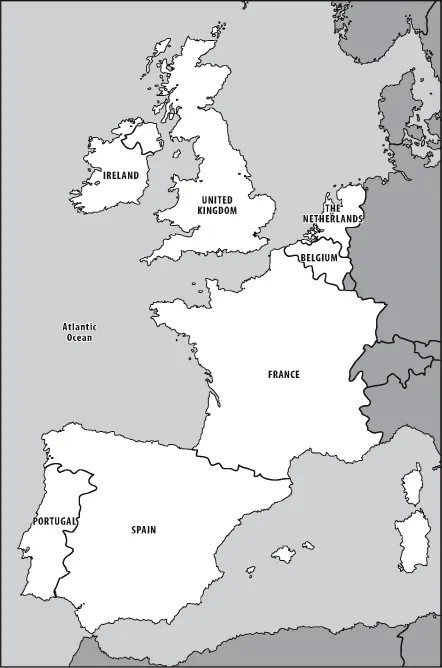
Atlantic Europe
European power was about two things: money and geography. Europe depended on imports from Asia, particularly India. Pepper, for example, was not simply a cooking spice but also a meat preservative; its importation was a critical part of the European economy. Asia was filled with luxury goods that Europe needed, and would pay for, and historically Asian imports would come overland along the famous Silk Road and other routes until reaching the Mediterranean. The rise of Turkey—about which much more will be heard in the twenty-first century—closed these routes and increased the cost of imports.
European traders were desperate to find a way around the Turks. Spaniards and Portuguese—the Iberians—chose the nonmilitary alternative: they sought another route to India. The Iberians knew of only one route to India that avoided Turkey, down the length of the African coast and up into the Indian Ocean. They theorized about another route, assuming that the world was round, a route that would take them to India by going west.
This was a unique moment. At other points in history Atlantic Europe would have only fallen even deeper into backwardness and poverty. But the economic pain was real and the Turks were very dangerous, so there was pressure to do something. It was also a crucial psychological moment. The Spaniards, having just expelled the Muslims from Spain, were at the height of their barbaric hubris. Finally, the means for carrying out such exploration was at hand as well. Technology existed that, if properly used, might provide a solution to the Turkey problem.
The Iberians had a ship, the caravel, that could handle deep-sea voyages. They had an array of navigational devices, from the compass to the astrolabe. Finally they had guns, particularly cannons. All of these might have been borrowed from other cultures, but the Iberians integrated them into an effective economic and military system. They could now sail to distant places. When they arrived they were able to fight—and win. People who heard a cannon fire and saw a building explode tended to be more flexible in negotiations. When the Iberians reached their destinations, they could kick in the door and take over. Over the next several centuries, European ships, guns, and money dominated the world and created the first global system, the European Age.
Here is the irony: Europe dominated the world, but it failed to dominate itself. For five hundred years Europe tore itself apart in civil wars, and as a result there was never a European empire—there was instead a British empire, a Spanish empire, a French empire, a Portuguese empire, and so on. The European nations exhausted themselves in endless wars with each other while they invaded, subjugated, and eventually ruled much of the world.
There were many reasons for the inability of the Europeans to unite, but in the end it came down to a simple feature of geography: the English Channel. First the Spanish, then the French, and finally the Germans managed to dominate the European continent, but none of them could cross the Channel. Because no one could defeat Britain, conqueror after conqueror failed to hold Europe as a whole. Periods of peace were simply temporary truces. Europe was exhausted by the advent of World War I, in which over ten million men died—a good part of a generation. The European economy was shattered, and European confidence broken. Europe emerged as a demographic, economic, and cultural shadow of its former self. And then things got even worse.
THE FINAL BATTLE OF AN OLD AGE
The United States emerged from World War I as a global power. That power was clearly in its infancy, however. Geopolitically, the Europeans had another fight in them, and psychologically the Americans were not yet ready for a permanent place on the global stage. But two things did happen. In World War I the United States announced its presence with resounding authority. And the United States left a ticking time bomb in Europe that would guarantee America’s power after the next war. That time bomb was the Treaty of Versailles, which ended World War I—but left unresolved the core conflicts over which the war had been fought. Versailles guaranteed another round of war.
And the war did resume in 1939, twenty-one years after the last one ended. Germany again attacked first, this time conquering France in six weeks. The United States stayed out of the war for a time, but made sure that the war didn’t end in a German victory. Britain stayed in the war, and the United States kept it there with Lend-Lease. We all remember the Lend part—where the United States provided Britain with destroyers and other matériel to fight the Germans—but the Lease part is usually forgotten. The Lease part was where the British turned over almost all their naval facilities in the Western Hemisphere to the United States. Between control of those facilities and the role the U.S. Navy played in patrolling the Atlantic, the British were forced to hand the Americans the keys to the North Atlantic, which was, after all, Europe’s highway to the world.
A reasonable estimate of World War II’s cost to the world was about fifty million dead (military and civilian deaths combined). Europe had torn itself to shreds in this war, and nations were devastated. In contrast, the United States lost around half a million military dead and had almost no civilian casualties. At the end of the war, the American industrial plant was much stronger than before the war; the United States was the only combatant nation for which that was the case. No American cities were bombed (excepting Pearl Harbor), no U.S. territory was occupied (except two small islands in the Aleutians), and the United States suffered less than 1 percent of the war’s casualties.
For that price, the United States emerged from World War II not only controlling the North Atlantic but ruling all of the world’s oceans. It also occupied Western Europe, shaping the destinies of countries like France, the Netherlands, Belgium, Italy, and indeed Great Britain itself. The United States simultaneously conquered and occupied Japan, almost as an afterthought to the European campaigns.
Thus did the Europeans lose their empire—partly out of exhaustion, partly from being unable to bear the cost of holding it, and partly because the United States simply did not want them to continue to hold it. The empire melted away over the next twenty years, with only desultory resistance by the Europeans. The geopolitical reality (that could first be seen in Spain’s dilemma centuries before) had played itself out to a catastrophic finish.
Here’s a question: Was the United States’ clear emergence in 1945 as the decisive global power a brilliant Machiavellian play? The Americans achieved global preeminence at the cost of 500,000 dead, in a war where fifty million others perished. Was Franklin Roosevelt brilliantly unscrupulous, or did becoming a superpower just happen in the course of his pursuing the “four freedoms” and the UN Charter? In the end, it doesn’t matter. In geopolitics, the unintended consequences are the most important ones.
The U.S.–Soviet confrontation—known as the Cold War—was a truly global conflict. It was basically a competition over who would inherit Europe’s tattered global empire. Although there was vast military...
Table of contents
- COVER PAGE
- TITLE PAGE
- COPYRIGHT PAGE
- DEDICATION
- CONTENTS
- LIST OF ILLUSTRATIONS
- AUTHOR’S NOTE
- OVERTURE: AN INTRODUCTION TO THE AMERICAN AGE
- CHAPTER 1: THE DAWN OF THE AMERICAN AGE
- CHAPTER 2: EARTHQUAKE: THE U.S.–JIHADIST WAR
- CHAPTER 3: POPULATION, COMPUTERS, AND CULTURE WARS
- CHAPTER 4: THE NEW FAULT LINES
- CHAPTER 5: CHINA 2020: PAPER TIGER
- CHAPTER 6: RUSSIA 2020: REMATCH
- CHAPTER 7: AMERICAN POWER AND THE CRISIS OF 2030
- CHAPTER 8: A NEW WORLD EMERGES
- CHAPTER 9: THE 2040S: PRELUDE TO WAR
- CHAPTER 10: PREPARING FOR WAR
- CHAPTER 11: WORLD WAR: A SCENARIO
- CHAPTER 12: THE 2060S: A GOLDEN DECADE
- CHAPTER 13: 2080: THE UNITED STATES, MEXICO, AND THE STRUGGLE FOR THE GLOBAL HEARTLAND
- EPILOGUE
- ACKNOWLEDGMENTS
Trusted by 375,005 students
Access to over 1.5 million titles for a fair monthly price.
Study more efficiently using our study tools.
Frequently asked questions
Yes, you can cancel anytime from the Subscription tab in your account settings on the Perlego website. Your subscription will stay active until the end of your current billing period. Learn how to cancel your subscription
No, books cannot be downloaded as external files, such as PDFs, for use outside of Perlego. However, you can download books within the Perlego app for offline reading on mobile or tablet. Learn how to download books offline
Perlego offers two plans: Essential and Complete
- Essential is ideal for learners and professionals who enjoy exploring a wide range of subjects. Access the Essential Library with 800,000+ trusted titles and best-sellers across business, personal growth, and the humanities. Includes unlimited reading time and Standard Read Aloud voice.
- Complete: Perfect for advanced learners and researchers needing full, unrestricted access. Unlock 1.5M+ books across hundreds of subjects, including academic and specialized titles. The Complete Plan also includes advanced features like Premium Read Aloud and Research Assistant.
We are an online textbook subscription service, where you can get access to an entire online library for less than the price of a single book per month. With over 1.5 million books across 990+ topics, we’ve got you covered! Learn about our mission
Look out for the read-aloud symbol on your next book to see if you can listen to it. The read-aloud tool reads text aloud for you, highlighting the text as it is being read. You can pause it, speed it up and slow it down. Learn more about Read Aloud
Yes! You can use the Perlego app on both iOS and Android devices to read anytime, anywhere — even offline. Perfect for commutes or when you’re on the go.
Please note we cannot support devices running on iOS 13 and Android 7 or earlier. Learn more about using the app
Please note we cannot support devices running on iOS 13 and Android 7 or earlier. Learn more about using the app
Yes, you can access The Next 100 Years by George Friedman in PDF and/or ePUB format, as well as other popular books in Social Sciences & Sociology. We have over 1.5 million books available in our catalogue for you to explore.