- 214 pages
- English
- ePUB (mobile friendly)
- Available on iOS & Android
eBook - ePub
About this book
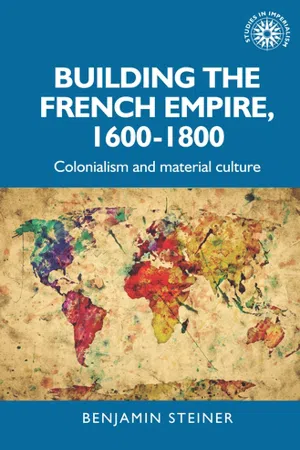
This study explores the shared history of the French empire from the perspective of material culture in order to re-evaluate the participation of colonial, Creole, and indigenous agency in the construction of imperial spaces. The decentred approach to a global history of the French colonial realm allows a new understanding of power relations in different locales. Providing case studies from four parts of the French empire, the book draws on illustrative evidence from the French archives in Aix-en-Provence and Paris as well as local archives in each colonial location. The case studies, in the Caribbean, Canada, Africa, and India, each examine building projects to show the mixed group of planners, experts, and workers, the composite nature of building materials, and elements of different 'glocal' styles that give the empire its concrete manifestation.
Information
Publisher
Manchester University PressYear
2020Print ISBN
9781526167019
9781526143235
eBook ISBN
9781526143259
1
Colonial enclosure: Fortification and castles on the Lesser Antilles
Islands fortified
Is it possible to build an empire on an island? From a new materialist perspective on the formation of imperial spaces this may be so.1 After the arrival of French entrepreneurs and the establishment of settlements on some Caribbean islands, architectural structures transformed landscapes, and spatial representations like maps and plans contributed to the construction of a permanent imperial space. The process of spatial construction will be followed more closely for the cases of Martinique and Guadeloupe, two islands that were colonized by French engineers and cartographers before colonization proper. The strategy proposed by these protagonists of colonial enclosure was based on spatial practices that largely rested on ideas of transposing European concepts of fortification and defensive buildings to the islands.
Based on ideas in postmodern geography this chapter shows that it would be wrong to presume a binary model of spatial construction that perpetuates oppositions of inclusion and exclusion, the ‘we’ and the ‘other’.2 Instead it shows that the French strategy of imposing their material culture did not result in a space that resembled the centre–periphery dichotomy. Rather this space has to be understood in its own right. Although being confined to the outside it was rather open to the interior, mixing European spatial and material elements with indigenous ones in this sense may be described as a hybrid space within a colonial setting.
In 1669, Jean-Charles de Baas-Castelmore, first governor-general of the island of Martinique, wrote a memorandum to Jean-Baptiste Colbert, head of the royal administration for commercial and colonial affairs.3 In this correspondence he reports on the plans of François Blondel, a military officer and a royal engineer, who was sent to the Antilles three years earlier. Blondel had visited Martinique and Grenada, along with the adjacent Leeward Islands of Guadeloupe and Saint-Christophe, colonized by the French over the course of the last three decades, and also Tortuga, the small island off the northern coast of Hispaniola. He conducted geographical surveys of these islands in order to assess their potential for the installation of a comprehensive system of fortifications. The string of fortresses Blondel planned to build for Martinique, Guadeloupe, and Saint-Christophe was, in fact, so extensive that de Baas compared this enterprise to the chain of strongholds at the French frontier with Flanders:
He wants [to build] great fortifications equipped to a high standard with large, deep wells, half-moon fortifications and horn-shaped bastions at precise and regular intervals to the extent allowed by the situation and the rules of engineering, as if he wanted to construct the citadels on the borders of Flanders, and each had to survive a siege against a large army.4
The governor was sceptical about the feasibility of such a large building project, which involved hundreds, perhaps thousands, of workers and great quantities of tools and materials, such as stone, chalk, and wood, as well as provisions, which would all cost the government considerable sums of money to be paid over many years to come. De Baas appreciated Blondel's expertise and the job he did of drawing up maps of the islands. His descriptions were very exact, particularly those depicting natural formations that would make good sites for ports, roads, and fortifications. He suspected, however, that if one were to build all the fortresses the engineer had in mind for these places the costs would not only be excessive, but the plan would also fail to take advantage of the many natural defences of the island. In the case of an enemy attack, the inhabitants were able to retreat to the natural protection of certain places, avoiding a direct confrontation or a formal siege, and to wait until the invasion ended due to the lack of supplies needed for a more sustained attack. What Blondel intended instead, de Baas seems to imply, was to implement the art of fortification on these islands to perfection, which would be, as he writes, a project doomed to fail since it lacks the necessary time and funds.5
The memorandum brings up the question as to what the French were actually going to do to secure their colonial presence in the Caribbean. Blondel's plan goes further than just implementing a military defence for the islands. For him, Blondel writes in his own statement on Guadeloupe, the terrain of the island provides ideal conditions for a rich agriculture, since the mountains are high enough to make it rain sufficiently for the agricultural labour of the inhabitants to be rewarded abundantly.6 At this time the western part of the island of Guadeloupe, called Basseterre by the French, was divided between two proprietors, who bought it after the Compagnie des Iles de l’Amérique went bankrupt in 1646.7 One was Charles Houël, seigneur du Petit Pré, who was also governor of Guadeloupe from 1643; the other buyer was his brother-in-law, Jean de Buisseret, who also held the office of royal councillor.8 Both had erected castles to underline their seigniorial supremacy of the island. The fortresses, however, were not situated to overlook the two halves of the islands, but rather close together on the southwestern coast. Houël's fortress, Fort Saint-Charles, was located by the Galion River, while Boisseret's Fort de la Madeleine stood on the banks of the Baillif River.9 In 1664, the properties were sold to the newly founded West India Company, a few years before Blondel was sent there to examine the state of the two fortresses.
One can gain several insights from Blondel's description of the buildings. He first paints an unfavourable picture of the castle at the Galion, a fortress in the form of an octagonal star, but with imperfections, rather small and with very old walls liable to crumble if hit by enemy cannon fire. Houël's castle was, in fact, ‘quite an appalling tour carée’, Blondel writes, ‘so small, so badly maintained, and, to say the truth, so ridiculous, that this building appears to be nothing more than a heavy mass of stones stacked together with neither intent nor order’.10 In this state Fort Saint-Charles would serve as nothing more than a prison. Blondel estimates that the substance of the existing structure would not justify modernizing the fortress by employing thousands of men, only to stumble from one problem to another.11
This view contrasted directly with that of Père du Tertre, the author of the famous Histoire générale des isles de S. Christophe, de la Guadeloupe, de la Martinique et autres dans l’Amérique, who held the defensive works of Charles Houël in somewhat higher regard.12 The structure he had built after he bought the island was ‘a structure totally new with four façades and four levels; each level had four connected chambers, the walls were built of very nice stones […]; a battery of six cannons commanded the harbour and could thus defend the castle against approaching ships’.13 The fortress was to underline Houël's pretension of being the absolute master (‘le Seigneur absolu’) of Guadeloupe.14 As such the building represented more a symbolic conception of a medieval feudal land order that Houël had to maintain against interest from the investors in the ancient company, other French inhabitants, foreign refugees, especially those Jewish and protestant migrants who fled from Recife in formerly Dutch Brazil after 1654,15 and, perhaps most pressingly, against the threat posed by attacks of the indigenous population and African maroons in the same year.16
Especially mindful of English battleship fleets, Houël began fortifying locations where invaders could make landfall. He ordered the felling of trees along the shoreline in order to block the roads into the interior and to use the trunks for defences. He also mounted cannons at elevated positions and erected – probably only provisionally – batteries that could protect, du Tertre tells us, the whole of the coastline.17 The defensive works, however, were not tested, since the approaching English Republican fleet under Admiral Sir...
Table of contents
- Cover
- Half-title page
- Series page
- Title page
- Copyright page
- Dedication
- Contents
- Illustrations
- Acknowledgements
- Introduction: Building the French empire
- 1 Colonial enclosure: Fortification and castles on the Lesser Antilles
- 2 Ambitions to empire in India: Pondichéry as an imperial city in the Mughal state system
- 3 Decay and repair: Fort Royal as a perennial construction site on Martinique
- 4 Mixed society and African ‘Rococo’: ‘French’ style in Saint-Louis and on Gorée Island
- 5 Variegated engineering: The builders of the Caribbean empire
- 6 Community and segregation in Louisbourg: An ‘ideal’ colonial city in Atlantic Canada
- 7 Motley style: Affective buildings and emotional communities on Martinique, Guadeloupe, and Haiti
- Conclusion: The empire as a material construct
- Bibliography
- Index
Trusted by 375,005 students
Access to over 1.5 million titles for a fair monthly price.
Study more efficiently using our study tools.
Frequently asked questions
Yes, you can cancel anytime from the Subscription tab in your account settings on the Perlego website. Your subscription will stay active until the end of your current billing period. Learn how to cancel your subscription
No, books cannot be downloaded as external files, such as PDFs, for use outside of Perlego. However, you can download books within the Perlego app for offline reading on mobile or tablet. Learn how to download books offline
Perlego offers two plans: Essential and Complete
- Essential is ideal for learners and professionals who enjoy exploring a wide range of subjects. Access the Essential Library with 800,000+ trusted titles and best-sellers across business, personal growth, and the humanities. Includes unlimited reading time and Standard Read Aloud voice.
- Complete: Perfect for advanced learners and researchers needing full, unrestricted access. Unlock 1.5M+ books across hundreds of subjects, including academic and specialized titles. The Complete Plan also includes advanced features like Premium Read Aloud and Research Assistant.
We are an online textbook subscription service, where you can get access to an entire online library for less than the price of a single book per month. With over 1.5 million books across 990+ topics, we’ve got you covered! Learn about our mission
Look out for the read-aloud symbol on your next book to see if you can listen to it. The read-aloud tool reads text aloud for you, highlighting the text as it is being read. You can pause it, speed it up and slow it down. Learn more about Read Aloud
Yes! You can use the Perlego app on both iOS and Android devices to read anytime, anywhere — even offline. Perfect for commutes or when you’re on the go.
Please note we cannot support devices running on iOS 13 and Android 7 or earlier. Learn more about using the app
Please note we cannot support devices running on iOS 13 and Android 7 or earlier. Learn more about using the app
Yes, you can access Building the French empire, 1600–1800 by Benjamin Steiner in PDF and/or ePUB format, as well as other popular books in Technology & Engineering & Art General. We have over 1.5 million books available in our catalogue for you to explore.