eBook - ePub
Available until 31 Dec |Learn more
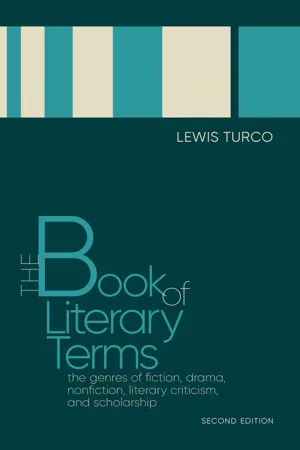
The Book of Literary Terms
The Genres of Fiction, Drama, Nonfiction, Literary Criticism, and Scholarship, Second Edition
This book is available to read until 31st December, 2025
- 272 pages
- English
- ePUB (mobile friendly)
- Available on iOS & Android
eBook - ePub
Available until 31 Dec |Learn more
The Book of Literary Terms
The Genres of Fiction, Drama, Nonfiction, Literary Criticism, and Scholarship, Second Edition
About this book
The much-anticipated second edition of The Book of Literary Terms features new examples and terms to enhance Turco’s classic guide that students and scholars have relied on over the years as a definitive resource for the definitions of the major terms, forms, and styles of literature. Chapters covering fiction, drama, nonfiction, and literary criticism and scholarship offer readers a comprehensive guide to all forms of prose and their many sub-genres.
From “Utopian novel,” “videotape,” and “yellow journalism” to “kabuki play,” “Personalism,” and “Poststructuralism,” this book is a valuable reference offering an extensive world of knowledge. Every teacher, student, critic, and general lover of literature should be sure to add The Book of Literary Terms to their library.
From “Utopian novel,” “videotape,” and “yellow journalism” to “kabuki play,” “Personalism,” and “Poststructuralism,” this book is a valuable reference offering an extensive world of knowledge. Every teacher, student, critic, and general lover of literature should be sure to add The Book of Literary Terms to their library.
Frequently asked questions
Yes, you can cancel anytime from the Subscription tab in your account settings on the Perlego website. Your subscription will stay active until the end of your current billing period. Learn how to cancel your subscription.
No, books cannot be downloaded as external files, such as PDFs, for use outside of Perlego. However, you can download books within the Perlego app for offline reading on mobile or tablet. Learn more here.
Perlego offers two plans: Essential and Complete
- Essential is ideal for learners and professionals who enjoy exploring a wide range of subjects. Access the Essential Library with 800,000+ trusted titles and best-sellers across business, personal growth, and the humanities. Includes unlimited reading time and Standard Read Aloud voice.
- Complete: Perfect for advanced learners and researchers needing full, unrestricted access. Unlock 1.4M+ books across hundreds of subjects, including academic and specialized titles. The Complete Plan also includes advanced features like Premium Read Aloud and Research Assistant.
We are an online textbook subscription service, where you can get access to an entire online library for less than the price of a single book per month. With over 1 million books across 1000+ topics, we’ve got you covered! Learn more here.
Look out for the read-aloud symbol on your next book to see if you can listen to it. The read-aloud tool reads text aloud for you, highlighting the text as it is being read. You can pause it, speed it up and slow it down. Learn more here.
Yes! You can use the Perlego app on both iOS or Android devices to read anytime, anywhere — even offline. Perfect for commutes or when you’re on the go.
Please note we cannot support devices running on iOS 13 and Android 7 or earlier. Learn more about using the app.
Please note we cannot support devices running on iOS 13 and Android 7 or earlier. Learn more about using the app.
Yes, you can access The Book of Literary Terms by Lewis Turco in PDF and/or ePUB format, as well as other popular books in Langues et linguistique & Écriture créative. We have over one million books available in our catalogue for you to explore.
Information
The Genres of Drama
There are several subgenres of the literary genre called drama. The first type of drama in the Western world apparently grew out of ceremonial music as it was performed in sixth-century BC Greece, in the region of Athens; thus, the first “plays” were musical theater. The Greek poet Thespis invented a form of music that required a character, which he himself portrayed, and a chorus; these interacted with one another, telling a tragic story by means of dialogue, song and dance. This form of drama was soon so popular that in 534 BC a theatrical competition was held, in honor of Dionysus, the god of drink, fertility and revelry, to decide the best new tragedy written by the playwrights of the period. Such contests soon became annual events throughout the Greek world, including perhaps Hellenic Egypt, for it has been postulated that The Book of Job of the Old Testament was originally a Greek tragedy, and it has been so reconstructed in the twentieth century.
Over five hundred tragedies were written in ancient Greece, but only thirty-two have survived. Aeschylus added a second character to the cast of the Thespian play in the fifth century BC, and Sophocles added a third. These innovations allowed the playwright to compose works that were infinitely more complex psychologically and more active dramatically. Clearly, the form of tragedy was continually evolving, but in the fourth century BC. Aristotle in his Poetics analyzed the work of Sophocles as typical tragedies, in effect freezing the form, as it were, for the study of scholars and tragedians. Nevertheless, tragedy continued to develop in the works of Hippolytus, Euripides, and others, and other types of plays were added to the programs of the ancient competitions, including burlesques such as the satyr play, which was ribald, satirical, and slapstick, and was performed after every third tragedy just to provide some relief for the tensions that had been building up in the audience throughout the performances.
Eventually there were other types of plays being performed as well, such as comedies, the first of which we call old comedy, examples of which were written by Aristophanes in the fifth century BC. This type of theatrical piece was succeeded by the new comedy of Menander. In the original tragedies and in the satyr plays and old comedies, the characters had been either idealizations, lampoons, or caricatures of people, but Menander injected an element of realism into his productions, and his personae became recognizable as actual people involved in complex situations and actions. The importance of the chorus and many other elements of the early drama diminished. All of the elements still associated not only with drama, but with fiction as well, were present in the New Comedy.
The fiction writer and the playwright have much in common. Both are concerned with narrative, and both use exactly the same elements of narrative: character, plot, atmosphere and theme. However, unlike fiction, drama is a composite genre, consisting of both written material and visual effects. The strengths of drama enable it to be more immediately apprehensible to the senses than are words in a book.
The fiction writer is not limited to one or two writing techniques but may choose from a wide range of narrative devices. The dramatist’s range of writing techniques, however, is limited, for all that may be used onstage is spoken language (see The Book of Dialogue), not ordinarily narration or description, except as spoken by an actor or actress, though on occasion a play—such as “Our Town” by Thornton Wilder—may have a narrator on the stage filling in the exposition: background information that the audience may need in order to understand the significance of the dramatic segments. The writing tools of the playwright, then, are dialogue, monologue, soliloquy and the aside.
In place of narration, however, the playwright is able to utilize stage action, and in place of description, the dramatist provides acts, scenes and sets, so that the audience can actually see and hear the development of character and plot. At this point in our discussion a consideration of Greek tragedy as it was analyzed by Aristotle may be of some value, for it is the paradigm upon which all later drama was founded.
Tragedy
The major and original subgenre of dramatic literature is tragedy, a dramatic form out of classical antiquity, the elements of which are plot, character, spectacle, thought, diction and harmony, i.e., the successful fusion of its parts. Tragedy, according to Aristotle, is the imitation of a “worthy or illustrious and perfect action.” It has “magnitude“ and is written in elevated language that entertains, but it is not meant to be read, for it must be enacted upon the stage. It is a verse drama which has as its protagonist (generally but not always male) the tragic hero or heroine who has stature but does not excel either in virtue or justice; nor is he or she brought low through such character flaws as vice or depravity, but through some error of judgment or circumstance, at which point a sudden reversal, a peripety occurs. The heroic protagonist struggles to avoid inevitable defeat (fate), and during the struggle, sympathy and terror are held in equilibrium as he (or sometimes she) courageously faces the human predicament. Tragedy exhibits the paradox of nobility of character combined with human fallibility, especially hubris—excessive pride or self-confidence, a tragic flaw.
Ostensibly, the antagonist of tragedy is a god, or the gods, but in fact the antagonist is destiny which is in the hands of the three fates, Clotho, who bears the distaff which holds the threads of life, Lachesis, who spins the thread, and Atropos, who cuts the thread when the time comes to do so. This destiny is often bound up with past actions on the part of the protagonist, as in Sophocles’ Oedipus Rex, in which case the struggle of the play becomes an internal struggle, so the overt conflict is interior: Oedipus is locked in mortal combat with himself, with his past, and with the past actions of his ancestors, which he has inherited.
Although the protagonist is heroic, and as such is in a way godlike, he or she is also human, and human beings are fallible. Achilles, who is the hero of Homer’s Iliad (an epic, not a tragedy), was the offspring of Peleus and the minor goddess Thetis who dipped Achilles in the river Styx so that, like the gods, he would be invulnerable. But the heel by which Thetis held him when she dipped him in the magic river that forms the boundary of Hades, the nether world, was not touched by the water, and he therefore remained humanly vulnerable, and mortal, in just this one part of his anatomy. It was in this heel that he was eventually fatally wounded by Paris. Thus, most heroic protagonist...
Table of contents
- Cover
- Half title
- Title
- Copyright
- Dedication
- Contents
- Foreword
- Introduction to the Discipline of Literature
- The Genres of Fiction
- The Genres of Drama
- The Genres of Nonfiction
- The Genres of Literary Criticism and Scholarship
- Acknowledgments and Bibliography
- Author and Title Index
- General Index