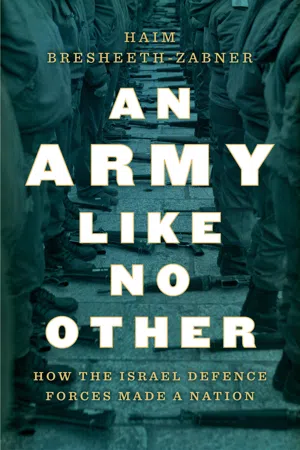
The Israeli army, officially named the Israel Defence Forces (IDF), was established in 1948 by David Ben-Gurion, Israel's first prime minister, who believed that 'the whole nation is the army'. In his mind, the IDF was to be an army like no other. It was the instrument that might transform a diverse population into a new people. Since the foundation of Israel, therefore, the IDF has been the largest, richest and most influential institution in Israel's Jewish society and is the nursery of its social, economic and political ruling class.
In this fascinating history, Bresheeth charts the evolution of the IDF from the Nakba to wars in Egypt, Lebanon, Iraq and the continued assaults upon Gaza, and shows that the state of Israel has been formed out of its wars. He also gives an account of his own experiences as a young conscript during the 1967 war. He argues that the army is embedded in all aspects of daily life and identity. And that we should not merely see it as a fighting force enjoying an international reputation, but as the central ideological, political and financial institution of Israeli society. As a consequence, we have to reconsider our assumptions on what any kind of peace might look like.
- 448 pages
- English
- ePUB (mobile friendly)
- Available on iOS & Android
eBook - ePub
About this book
Trusted by 375,005 students
Access to over 1.5 million titles for a fair monthly price.
Study more efficiently using our study tools.
Information
PART I
ISRAEL’S WARS
1
The Origins of the IDF
Jews wrested the Palestinian homeland from its people by force, and will—have to—ward off confronting that original sin. This, I believe, underlies the Israeli Jewish willingness to use extreme force against Palestinian civilians and the obscenely racist remarks about Palestinian parents willing to send their kids into the street.Suad Dajani, “Yaffawiyya”
There is a well-known jibe about Prussia by Friedrich von Schrötter, who claimed, “Prussia was not a country with an army, but an army with a country.”1 This observation is, if anything, even more apt regarding the relationship between Israel and the IDF. Israeli militarism is not a fad of an extreme junta, but a firmly held belief among most Israeli Jews.
There is a fascinating relationship between military action and social attitudes toward militarism in Israel captured in the following expression: the more the medicine is used, the more it becomes the preferred method for curing the malady. Like some medicines, its efficacy might be doubtful, but that does not deter its usage; rather, it becomes an argument for a dosage increase. The prevalence of military action only makes the inclination for its use more automatic, with failure unlikely to reduce its appeal: when military action does not work, it is seen as an indication that insufficient force was used.
The more a society specializes in using force, the more the world looks like a dangerous place where one needs to use a big stick. As the saying goes: to a hammer, everything looks like a nail. These patterns of social addiction should not surprise us.
The Israeli state and society have been formed by militarism since the early stages of Zionism, without which controlling Palestine would have been unthinkable. The frequent and habitual use of the military at most junctures of Zionist history since the 1930s created deep furrows in the geopolitical landscape of the Middle East, ones consistently frequented, while offering no stable or sustainable existence. If in most states the use of military force is the option of last resort, after all other avenues have been exhausted, in Israel the use of military option comes first, negotiations used only after military options have failed.
The sheer primacy of Israeli militarism was, for decades, a taboo subject, repeatedly denied by Zionist historians and sociologists.2 Baruch Kimmerling notes,
As opposed to the prevalent position in most of the Israeli social science research, which strenuously denies the existence of Israeli militarism, and even the possibility of its creation, Israel has indeed developed a militarism, which, while changing in its form and intensity, has become one of the central organising principles of this society. Israeli militarism has mainly developed as one of the main reactions to the conflict created by the Zionist settlement project in Palestine, vis-à-vis the Arab environment which has perceived it as a definite colonisation project.3
Militarism has created material interests for the continuation of conflict in Palestine; it has become a crucial element of Israeli society.
The transformation of Israeli society from the fabled People of the Book to People of the Gun should not be underestimated. This was a complex and unique process of social engineering. It involved deep changes in the understanding, outlook, and culture of Zionist Jews and, after 1967, of Jewish communities around the world. This entailed creating a people from the divided followers of sacred texts and devotees of cosmopolitan idioms—the ultra-Orthodox Jews of the ghettoes and the liberal, radicalized metropolitan Jewish youth of the fin de siècle. Such a profound transformation was almost unimaginable; understanding its narratives, conditions, and complex development is crucial to understanding Zionism as theory, praxis, and historical phenomenon. This transformation was completed in a relatively short time.
While all modern states have some type of military force, most states could not be described as militaristic. Militarism is a deeply rooted social attitude—the idea that the prime vehicle for resolving national, international, and social conflicts is armed force results from complex sociohistorical processes.4 Although militarism is socially constructed, there is nothing essentialist about it. In the Israeli context, Uri Ben-Eliezer argues that “the use of military force acquires legitimation, is perceived as a positive value and a high principle that is right and desirable, and is routinized and institutionalized within society.”5 We need to probe the specific conditions that created it.
To map Israeli militarism, one must examine Zionist colonization, a somewhat untypical enterprise that was launched when such projects were winding down. The colony had at least one empire protecting it and claimed a territory for itself not by overt conquest and military might, but by stealth and the gradual dispossession of the indigenous population and erosion of its rights. The move toward military force was used to expand its patrimony when other methods failed. Zionist narratives use tropes of “national liberation struggles” that have become the accepted history, occluding the colonial context.
This constructed liberation narrative is not at all obvious; after all, Theodor Herzl describes the project clearly as a settler-colonial enterprise.6 Zionism set up a colonial bank, and its early habitations were called moshavot (colonies)—indeed, they are still called that today. Before the word moshava was coined, the Hebraized colonia was used. The colonizers themselves were fully cognizant of their methods, with Zionist historians later obfuscating it. That Zionism also offered East European Jews respite from antisemitism does not change the colonial contours of the project.
The Zionist project shares characteristics with earlier colonizing projects. In North America and South Africa, colonies were founded by small, religious groups of settlers escaping xenophobia and oppression in Europe. New England Puritans or Cape Town Dutch could hardly depend on the might of empires against indigenous populations. (In fact, many decades passed before the colonial bridgehead became a desirable asset of empires, one worth assisting.) The early Zionists of Khibat Zion (Love of Zion) were victims of religious oppression while they remained in the Russian Pale of Settlement. Like other European colonists, they settled in Palestine as farmers, buying or snatching land from local landowners, and employed the peasants (fellahin) as agricultural labor on the very land they had previously tilled.
Such exploitation led to deep-seated resentment against the dispossessors. In Palestine’s old land-ownership system, villagers owned arable land in common (musha’a), sharing the labor of tilling it and the fruits thereof. Change was introduced by land parcellation and registration under the Ottomans in the eighteenth and nineteenth centuries, yet this hardly changed the fellahin’s relationship to the land. While the land may now nominally “belong” to an absentee landlord, the fellahin treated the land as theirs, despite the obligation to pay a tithe. All this changed with the first Zionist colonies in the 1880s.
The incoming owners bought land not for investment purposes, but rather with the intention of living off it, despite their lack of farming experience. Like English gentlemen farmers, they had no intention of working the fields, a task thought unfitting for European owners; instead, they employed fellahin as day laborers. The fellahin, who until then had little use for cash, living in a rural, autarchic economy, were now exposed to a capitalist system, however primitive. During the first two decades of settlement, before 1905, tensions between the peasantry and the colon greatly increased, occasionally becoming violent, when peasants considered the colon especially unjust.
After the Russian government inspired pogroms in 1903–4, thousands of Jewish refugees arrived in Palestine. The newcomers of the second wave of immigration (referred to in Zionist history as the Second Aliyah) were mainly metropolitan workers from Russia and Poland, radicals purged after the failed revolution of 1905. The Tsar’s reaction toward the society’s most vulnerable—the poorest Jews living in the deeply hostile, antisemitic Pale of Settlement—was vicious. For many of these young workers, leaving Russia was the only way to survive. On arrival in Palestine, such ideologically motivated Zionists with a modernist leftist outlook (but no funds) were unable to purchase land and employ the fellahin like earlier colonists. They purchased land communally and tilled it themselves.
This innovative mode of Zionist colonization—the kernel of the collectivist Kibbutz movement—offered Zionism new opportunities. Until then established Western and Middle European Jewish communities had either ignored Zionism or actively shunned it as dangerous. For some, it threatened Jewish life in Europe (as well as Palestine) through adoption of antisemitic precepts (for example, claiming Jews did not belong in Europe). Denied support by European Jewish communities, Zionist leaders now looked to young and radical committed settlers, who were willing to face adversity en route to their nationalist social utopia. As a result, the movement seemingly morphed from a bourgeois-nationalist organization to one with a socialist agenda.
Though the first kvutzot (collective farming colonies) had to struggle with insurmountable difficulties such as severe shortages of food and tools, lack of agricultural experience, and a marshy floodplain infested with malarial mosquitoes, the newcomers’ potential was soon realized. As the numbers of collectives grew, a pattern for the future Jewish State emerged. The new settlements were located in the periphery of Palestine, rather than the central coastal plain, where most earlier colonies were built. Both the Zionist leaders and the young settlers believed that settlements demarcated the boundaries of a future Jewish State. The new settlements also found the fellahin, who lost their land to the incoming “Muskovy” (Muscovites was used by the Arab population as an iconic shorthand for all newcomers), much more hostile than the earlier settlers. The dispossessed were no longer offered work, and the new settlements were closed to them, as the settlers wished to work the land themselves.7
As tensions increased and conflicts spread, the Zionist leadership understood that this animosity was likely to intensify. The fellahin, who were expected to appreciate the newcomers’ modernity, machines, and medicine, proved to be belligerent. Other sources of conflict were the kibbutzniks’ sartorial codes and lack of modesty, their refusal to learn Arabic, and their use of scarce water resources.8 They did not bother getting to know the land and its inhabitants, whom they perceived as primitive rural brutes, treating the indigenous population in a way similar to colonists in North America centuries earlier. This could only lead to a violent conflict, and Zionists started preparing.
Beginnings of Military Organization
The indigenous Arab population, seeing itself as part of the Arab Mashriq (East), started organizing during the early stages of Zionist colonization. On June 24, 1891, Arab notables grouped together to petition the Sultan against Jewish immigration, without success. In their deposition, they claimed with surprisingly accurate foresight that if more Jews arrived in Palestine “the Muslims themselves will be the sufferers, as the European Jews being skilled in all kinds of trades, the Muslims could not compete against them.”9
In September 1907, as tensions between Zionist colonies and neighboring villages mounted, a number of young Zionists set up a secret association of Shomrim (Watchmen) called Bar Giora (named after a Jewish zealot resisting Roman occupation).10 This clandestine organization—illegal under Ottoman law—used the following revealing motto: “In blood and fire Judea fell, and in blood and fire Judea shall rise.”11 The increasing tension led in 1909 to the setting up of the larger Hashomer (Guardian) armed militia for defending Zionist settlements. Many of the founders of Hashomer later became key figures in Zionism, including Yitzhak Ben Zvi (Israel’s second president), his wife Rachel Yanait, Israel Shochat, and David Ben-Gurion. Hashomer prefigured the Hagana set up in 1920.
The perceived Jewish demand for self-defense was influenced by the worldwide sense of horror after the April 1903 Kishinev pogrom, in which almost fifty Jews died and many more were wounded (and some were raped). This pogrom was instigated by the Russian secret police under the guidance of Interior Minister Vyacheslav von Plehve, a deeply antisemitic politician who supported Zionism because he believed it would rid Russia of its Jews. Following the pogrom, left Zionists and Bundists in Ukraine tried to set up self-defense organizations for protecting Jewish communities. This received much coverage in Oddesan journals and newspapers but was rejected by Jewish communities as dangerous radicalism. This was also Herzl’s opinion expressed in his meetings and letters exchanged with von Plehve, which local Zionists followed.12 This attitude prevailed until the uprising of 1905.
After 1905, the newly arrived young Palestine Zionists were mostly veterans of the anti-Tsarist uprising, having escaped Russia to avoid arrest. They turned their opposition toward the decaying Ottoman Empire, and as the distant Great War was brewing, it became clear that massive changes were under way. A number of young men from Zichron Yaacov, one of the older settlements supported by Baron Edmond James de Rothschild (and named after his father), settled in nearby Shune forming a protomilitary organization called HaGid’onim (the Gideonites). This assembly laid down the foundations for a Jewish military force. The group translated its opposition to the Ottomans into active treason by setting up a covert spy network known later as NILI to assist the British.13 This was the beginning of the special relationship between Zionism and Britain and would help to bring about the Balfour Declaration.
Many Russian socialists in Palestine had military experience, having served in the Russian Imperial Army during the Russo– Japanese War. A leading figure was Joseph Trumpeldor, who joined the army in 1902, returning to serve after losing an arm in 1905, only to be captured by the Japanese at Port Arthur. In captivity Trumpeldor discovered Zionism, forsaking his Russian nationalism. On his release in 1906, he was one of the first Jews to be decorated in Russia, the first Jewish officer of the Tsarist army. Nonetheless, he left for Palestine in 1911, ending up in Degania, a new kibbutz beside Lake Tiberias. At the outbreak of World War I, Trumpeldor ended up in Cairo, together with fellow countryman, Vladimir Jabotinsky, a prominent Odessan intellectual.
Jabotinsky and Trumpeldor not only believed that Palestine was theirs by right, but also that the area now forming the state of Jordan was destined to be included in the future Jewish State. They knew that such a large territory could not be legally purchased and so they planned a Zionist army under British command for conquering Palestine from Turkey. Jabotinsky was certain that this would involve force, as he later wrote: “That the Arabs of the Land of Israel should willingly come t...
Table of contents
- Cover Page
- Halftitle Page
- Title Page
- Copyright Page
- Dedication
- Contents
- Acknowledgements
- Maps
- Introduction
- Part I: Israel’s Wars
- Part II: The Army and Its State
- Part III: Conclusion: Whither Israel?
- Afterword: Can There Be Another Israel?
- Notes
- Index
Frequently asked questions
Yes, you can cancel anytime from the Subscription tab in your account settings on the Perlego website. Your subscription will stay active until the end of your current billing period. Learn how to cancel your subscription
No, books cannot be downloaded as external files, such as PDFs, for use outside of Perlego. However, you can download books within the Perlego app for offline reading on mobile or tablet. Learn how to download books offline
Perlego offers two plans: Essential and Complete
- Essential is ideal for learners and professionals who enjoy exploring a wide range of subjects. Access the Essential Library with 800,000+ trusted titles and best-sellers across business, personal growth, and the humanities. Includes unlimited reading time and Standard Read Aloud voice.
- Complete: Perfect for advanced learners and researchers needing full, unrestricted access. Unlock 1.5M+ books across hundreds of subjects, including academic and specialized titles. The Complete Plan also includes advanced features like Premium Read Aloud and Research Assistant.
We are an online textbook subscription service, where you can get access to an entire online library for less than the price of a single book per month. With over 1.5 million books across 990+ topics, we’ve got you covered! Learn about our mission
Look out for the read-aloud symbol on your next book to see if you can listen to it. The read-aloud tool reads text aloud for you, highlighting the text as it is being read. You can pause it, speed it up and slow it down. Learn more about Read Aloud
Yes! You can use the Perlego app on both iOS and Android devices to read anytime, anywhere — even offline. Perfect for commutes or when you’re on the go.
Please note we cannot support devices running on iOS 13 and Android 7 or earlier. Learn more about using the app
Please note we cannot support devices running on iOS 13 and Android 7 or earlier. Learn more about using the app
Yes, you can access An Army Like No Other by Haim Bresheeth-Zabner in PDF and/or ePUB format, as well as other popular books in Politics & International Relations & Middle Eastern History. We have over 1.5 million books available in our catalogue for you to explore.