eBook - ePub
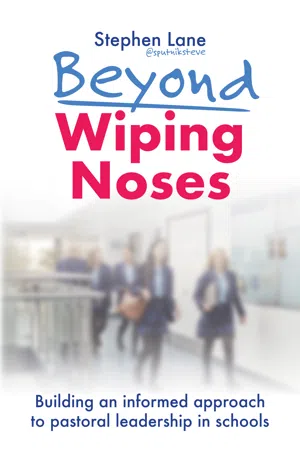
Beyond Wiping Noses
Building an informed approach to pastoral leadership in schools
- 160 pages
- English
- ePUB (mobile friendly)
- Available on iOS & Android
eBook - ePub
About this book
Stephen Lane's Beyond Wiping Noses: Building an informed approach to pastoral leadership in schools sets out the crucial role of pastoral care as part of the function and purpose of schooling - and shares practical insights on how schools can get it right.
Within the current culture of interest in developing research-informed approaches to teaching, the focus has inevitably been focused around pedagogy. However, with the well-documented increase in pupil anxiety and mental ill-health in recent times, there is also a pressing need for schools and teachers to embrace a more rigorous approach to pastoral care.
In this urgently needed book, teacher and Head of Year Stephen Lane (aka Sputnik Steve) presents a case for developing a research-informed approach to the pastoral aspect of teaching. This approach is the result of Stephen's own explorations of pastoral practice - and in Beyond Wiping Noses he offers helpful advice on how to design a knowledge-rich pastoral curriculum that encompasses both knowledge of the self and knowledge of the other.
Stephen expertly surveys the field of pastoral provision and leadership and provides practical takeaways around how schools can build an integrated approach to taking care of their pupils. He considers how pastoral routines can be embedded in the curriculum and developed to take account of cognitive load theory and Rosenshine's principles of instruction.
The book also includes chapters focused on key pastoral considerations - such as safeguarding, behaviour, bullying, and wellbeing and mental health.
Suitable for teachers, school leaders and anyone with a pastoral role in any school setting.
Information
Topic
EducationSubtopic
Education GeneralChapter 1
Pastoral Roles
Introduction
All teachers are pastoral leaders. This may not be welcome news for some of them though. Judging by a Twitter poll I ran in December 2019, over a third of teachers do not like being a form tutor: many of the comments I received in reply articulated negative feelings.1 Some respondents find the pastoral hard, and some demonstrated a clear distinction between the academic and the pastoral, suggesting that the latter should be left for those with a ‘passion’ for it. I think this reflects a worrying tendency in many schools for the pastoral to be treated as a bolt-on to what is seen as their main work – academic attainment, especially in the secondary sector (where I am based). Here, teachers are subject specialists, having most likely completed a subject-based degree before a one-year teacher training course. Some of these courses include strong pastoral elements, but many do not. Many ITT providers are based in schools where pastoral provision might be patchy at best.
Every teacher – indeed, every adult in the school – has a pastoral duty: an obligation to put safeguarding at the forefront of their work and to be mindful of the students’ wellbeing. In a conversation about this on Twitter, one contributor pointed out the vital role played by her daughter’s school librarian in doing more to keep her daughter ‘happy, safe & able to attend school than any other member of staff’.2 However, there are roles within the school designed specifically to focus on pastoral care.
The Form Tutor
Not all teachers are form tutors. Often, those with managerial posts, such as heads of department, are ‘relieved’ of the requirement to be form tutors in order to give them additional management time. In my current role as head of year, I do not have a form. This enables me to visit other teachers’ forms in the morning and affords me time to deal with any pastoral issues that may have arisen. Sometimes, part-time teachers might not have a form. There may be a whole variety of other reasons why teachers might not be form tutors.
The form tutor role usually involves greeting the students at the start of the day for formal registration in ‘form time’, during which administrative tasks are often carried out – checking planners, checking uniform, conveying messages and so on. But its importance goes beyond the administrative. For some, form time represents the buffer zone between out there and in here, where in here is the school day. Form time is the transition time between not school and in school and learning. Some tutors like to cultivate an informal space, or perhaps a semi-formal space, where the transition occurs during the ten or fifteen minutes available. For others, the transition occurs at the threshold of the form room: as students enter, they are expected to immediately transition into ‘school mode’, adopting the appropriate mental stance, ensuring their uniform is correct before coming in and so on. In some schools, form time is expected to be busy, with some personal, social, health, and economic (PSHE) education activities, a topical discussion or similar. In other cases, form time is for social cohesion: a time when students can chat, and the tutor joins in.
Students are often encouraged to cultivate a sense of ownership of the form room, perhaps by creating a wall display. The form tutor adopts the role of a nurturing guide – some more formal than others. Furthermore, the form tutor is often positioned as the first port of call if a student has any issues or questions, and the first port of call for parents too. In some schools the form tutor is more heavily involved in the students’ daily affairs, but the role is fairly universally understood.
It is actually a fairly difficult role to balance. As a form tutor, the relationship you have with your students is not quite the same as it is if you teach those same students in your subject lessons. Judging the degree of formality can be tricky. Fostering a supportive, relaxed and warm atmosphere in form time, one which is also conducive to establishing a sense of preparedness for learning, can be as contradictory as trying to perform Hamlet’s ‘To be or not to be’ soliloquy as a comedic mime. My solution as a form tutor was essentially to treat form time as a lesson, albeit a slightly more relaxed one.
Beyond the constraints of form time, though, the form tutor is, or at least should be, the first point of contact for pastoral issues that arise during the day. This can be very challenging, especially on days when you have a full teaching timetable, break duties and lunchtime meetings. Firstly, when do you find time to listen to your tutee’s concerns? Secondly, when do you find time to pursue any follow-up, let alone complete any necessary paperwork? And what if the concern is a safeguarding one? What if, at the end of breaktime when you’ve just come out of a staff briefing, you find little Gertrude is waiting outside the staffroom to tell you that she wants to die? But you’ve got double Year 11 next, and they’re just three months away from their exams and the head teacher has made it very clear that Year 11 lessons must not be cancelled or missed or delayed and your performance management targets demand that 90% of them get grade 7 or above and they’re the bottom set and if you’re late they’re going to be causing mayhem in the corridors and …
The pressure on teachers just to attend to their classes is immense; additional issues which can arise unexpectedly and have the potential to wipe out a day’s teaching add fuel to an already precarious mix of volatile emotions. Hopefully, in most schools there is a good network of pastoral support structures: perhaps there are non-teaching pastoral support workers who can help a child in trauma; perhaps the head of year has a sensible timetable enabling them to support the child; perhaps there is a member of SLT who can assist. At the very least, you may have a sympathetic departmental colleague who could cover your Year 11 class for a while.
But, ultimately, the form tutor role is inevitably a bolt-on to being a ‘teacher’. In job descriptions, pastoral aspects of the job are always included as core elements, but they are almost always listed after the academic elements. The status of the form tutor has not really been promoted in the literature either. Very little has been written specifically about the role since the 1990s or early 2000s and, like the pastoral in general, it has not been a significant feature in discussion on edu-Twitter or in the wider discourse of research-informed education practice. The more I think about it, the sadder I feel about this apparent neglect of the form tutor role, especially given its clear potential to have a positive impact on children and young people.
Head of Year
I love being a head of year, fraught though it is with the emotional carnage of childhood or – in my Key Stage 3 context – that vicious twilight zone of the emergent teenager. It’s difficult to list all the things that we actually do in pastoral leadership roles – to precisely articulate the nuance of the situations that might arise, to catalogue the multitudinous decisions that we have to make on a daily basis, to fully chart the navigation of tempestuous social relationships, to index the infinite complexities of the endless variations in social, emotional and mental wellbeing that our students experience. And then there is the school context. Whilst there are, no doubt, a hundred commonalities across diverse school communities, there are surely thousands of context-dependent needs and demands that form tutors, heads of year and pastoral leaders must try to understand and negotiate in order to best serve those in our care.
Nevertheless, there is obviously a need to define the role of head of year (or pastoral leader), if only in order that such posts can be advertised and qualified in job descriptions. So, how would you do it? If you were going to write the job description for a head of year role, what would you include? What would be the first bullet point on the list? What would you prioritise? And, perhaps more interestingly, what would you omit?
Perusing the job adverts and accompanying descriptions on the TES website is, again, revealing. Many reflect a desire to find someone who can ‘motivate’ people; who shows ‘enthusiasm, sensitivity, resilience and strong interpersonal skills’; someone who is ‘inspirational’. Of course, they must be ‘an outstanding and talented practitioner’ because everyone must be ‘outstanding’ – it’s a word which has probably done more harm to the teaching profession than any other. And this is the problem with this kind of language – or jargon – as it appears in so many of these advertisements: it’s a sloganised managerialism full of clichés so cold they’ve been rendered ultimately meaningless. Do a search for the term ‘passion’ in teaching job adverts and behold the banality. This kind of wording says nothing about the job. Sure, it presents a kind of idealised set of aims, including the desire to improve ‘young people’s life chances’, but there’s nothing much there in terms of specifics. Meanwhile, job descriptions often include a lot of ‘coordination’, ensuring ‘student progress’ and reviewing attendance data. Whilst these tasks are perfectly reasonable and important, it strikes me that they are somewhat … administrative, managerial, dry. There’s also nothing there about commitment to professional growth or learning, and nothing at all about developing researchor evidence-informed policy or practice.
It could be argued that such job descriptions perpetuate what Lodge (2008, p. 5) sees as the persistence of ‘dysfunctional interpretations’ of the role of head of year: ‘using the system for administration, as a watered-down welfare service, or for behaviour management’. Lodge goes on to present a phrase used by a group of head teachers with whom she was working which she claims ‘poignantly captures two of these distortions: “wiping noses and kicking butts”’ (p. 5). Lodge articulates frustration at the notion of the head of year role being about behaviour management – kicking butts – and we will take a look at this particular aspect of pastoral care in a later chapter. The notion that perhaps we ought to be moving beyond a view of the pastoral as ‘wiping noses and kicking butts’ is one that I can support.
Despite the vastness of the tangled web of all that the pastoral encompasses, it is nonetheless valuable to draw out some of these strands in an attempt to define what a pastoral leadership role might encompass. I’d recommend that you periodically write a list of what your role entails; this is a useful grounding exercise that can help to refocus your priorities in the most hectic of periods, and it could help to identify any areas where you might legitimately ask for support or delegate to others, such as form tutors. Better still, producing such a list in conjunction with colleagues might help to foster a collegial approach to pastoral work that would likely benefit the team and, most importantly, the children in your care. My list looks something like this:

Table of contents
- Praise
- Title Page
- Dedication
- Acknowledgements
- Contents
- Foreword
- Safeguarding
- Introduction
- Chapter 1: Pastoral Roles
- Chapter 2: What Research?
- Chapter 3: A Knowledge-Rich Pastoral Curriculum
- Chapter 4: Bullying
- Chapter 5: Wellbeing, Mental Health and Attachment
- Chapter 6: Behaviour
- Chapter 7: Character
- Chapter 8: Remote Pastoral
- Conclusion
- References and Further Reading
- About the Author
- Copyright
Trusted by 375,005 students
Access to over 1.5 million titles for a fair monthly price.
Study more efficiently using our study tools.
Frequently asked questions
Yes, you can cancel anytime from the Subscription tab in your account settings on the Perlego website. Your subscription will stay active until the end of your current billing period. Learn how to cancel your subscription
No, books cannot be downloaded as external files, such as PDFs, for use outside of Perlego. However, you can download books within the Perlego app for offline reading on mobile or tablet. Learn how to download books offline
Perlego offers two plans: Essential and Complete
- Essential is ideal for learners and professionals who enjoy exploring a wide range of subjects. Access the Essential Library with 800,000+ trusted titles and best-sellers across business, personal growth, and the humanities. Includes unlimited reading time and Standard Read Aloud voice.
- Complete: Perfect for advanced learners and researchers needing full, unrestricted access. Unlock 1.5M+ books across hundreds of subjects, including academic and specialized titles. The Complete Plan also includes advanced features like Premium Read Aloud and Research Assistant.
We are an online textbook subscription service, where you can get access to an entire online library for less than the price of a single book per month. With over 1.5 million books across 990+ topics, we’ve got you covered! Learn about our mission
Look out for the read-aloud symbol on your next book to see if you can listen to it. The read-aloud tool reads text aloud for you, highlighting the text as it is being read. You can pause it, speed it up and slow it down. Learn more about Read Aloud
Yes! You can use the Perlego app on both iOS and Android devices to read anytime, anywhere — even offline. Perfect for commutes or when you’re on the go.
Please note we cannot support devices running on iOS 13 and Android 7 or earlier. Learn more about using the app
Please note we cannot support devices running on iOS 13 and Android 7 or earlier. Learn more about using the app
Yes, you can access Beyond Wiping Noses by Stephen Lane in PDF and/or ePUB format, as well as other popular books in Education & Education General. We have over 1.5 million books available in our catalogue for you to explore.