This edited collection looks at ruins and vacant buildings as part of South Africa's oppressive history of colonialism and apartheid and ways in which the past persists into the present
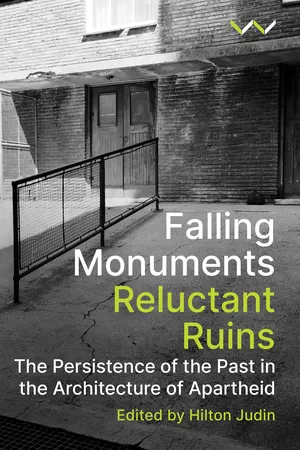
Falling Monuments, Reluctant Ruins: The Persistence of the Past in the Architecture of Apartheid interrogates how, in the era of decolonization, post-apartheid South Africa reckons with its past in order to shape its future. Architects, historians, artists, social anthropologists and urban planners seek answers in this book to complex and unsettling questions around heritage, ruins and remembrance. What do we do with hollow memorials and political architectural remnants? Which should remain, which forgotten, and which dismantled? Are these vacant buildings, cemeteries, statues, and derelict grounds able to serve as inspiration in the fight against enduring racism and social neglect? Should they become exemplary as spaces for restitution and justice? The contributors examine the influence of public memory, planning and activism on such anguished places of oppression, resistance and defiance. Their focus on visible markers in the landscape to interrogate our past will make readers reconsider these spaces, looking at their landscape and history anew.
Through a series of 14 empirically grounded chapters and 48 images, the contributors seek to understand how architecture contests or subverts these persistent conditions in order to promote social justice, land reclamation and urban rehabilitation. The decades following the dismantling of apartheid are surveyed in light of contemporary heritage projects, where building ruins and abandoned spaces are challenged and renegotiated across the country to become sites of protest, inspiration and anger.
This ground-breaking collection is an important resource for professionals, academics and activists working in South Africa today.
eBook - ePub
Falling Monuments, Reluctant Ruins
The persistence of the past in the architecture of apartheid
- 336 pages
- English
- ePUB (mobile friendly)
- Available on iOS & Android
eBook - ePub
Falling Monuments, Reluctant Ruins
The persistence of the past in the architecture of apartheid
About this book
Information
Topic
HistoireSubtopic
Histoire de l'architecturePART ONE
LANDS
1LAND DISPOSSESSION AND THE GHOSTS OF THE MEDUPI POWER STATION
In 2007, South Africa faced the reality of the country’s electricity shortage with the introduction of ‘load-shedding’, a term used to describe scheduled blackouts that affect both households and businesses. In response, Eskom embarked on the construction of two new power stations, Medupi in Limpopo province and Kusile in Mpumalanga, although more than ten years later, these have yet to be completed. The Medupi Power Station is the subject of this chapter. Once complete, it is expected to be the largest power station of its kind in the world. It was built at a time when the growing consensus around climate change had made clear the unsustainability of fossil fuel-based energy. The power station is situated in an arid, bushveld region, near to the South African border with Botswana, on the outskirts of the small town of Lephalale. Medupi is situated about twenty kilometres away from another power station called Matimba, which the electricity public utility Eskom built in the 1980s. To the north of these power stations lies the Grootgeluk coal mine, built by South Africa’s former state-run steel corporation Iscor in the late 1970s. The mine produced coking coal, commonly used to manufacture steel, as well as the bituminous coal that Eskom burnt in its power stations. The Lephalale region has thus for decades been the site of state-driven, sophisticated engineering projects, rooted in the tail end of the apartheid government’s period of high modernism1 and brutal social engineering.
The construction of the Medupi Power Station began in 2008, and its completion date has been regularly postponed. In 2015, community members resident in the township of Marapong, adjacent to Lephalale, complained that the Medupi construction site contained graves that had not been exhumed and were likely destroyed during the construction period. They claimed that the angry spirits were responsible for disruptions at Medupi. The chairperson of one of the organisations representing community members, the Commission for the Promotion and Protection of the Rights of Cultural, Religious and Linguistic Communities (CRL Rights Commission), Thoko Mkhwanazi, said: ‘It’s the bones underneath and in the vicinity. Some of the graves were destroyed there. The belief systems of some people will tell you that this Medupi dream of yours will never happen. It will be another 10 years.’2 The allegations were met with scepticism and disdain from some quarters, with one online news report stating that the CRL commission ‘firmly believes that strikes, political infighting, unionist sabotage and general mismanagement has no role to play in the delays at Medupi. Rather, they spent tax money – the CRL commission is a chapter 9 institution [state institution supporting constitutional democracy] – to compile a report claiming that the ancestors are unhappy as their graves have been disturbed by Medupi’s construction.’3
Eskom had conducted a heritage assessment in 2006 before it began construction and this assessment had not taken account of the graves at the Medupi site. Heritage consultants, Mbofho Consulting and Project Managers, who investigated Eskom’s handling of the community claims in 2018, concluded that there was no ill-will or evidence of a cover-up on the part of Eskom. The graves were for the most part unmarked, with just one bearing a concrete head and slab that melded into the surrounding bushveld seemingly without a trace. While noting the absence of malicious intent, the heritage consultants chastised Eskom for failing to engage community members sooner or paying appropriate attention to local sensitivities.4
‘PLACE OF BONES’
This tale of the restless spirits is shot through with a history of profound and lasting dispossession. This legacy is a part of the founding mythology of the African township, whose name Marapong translates to ‘place of bones’. It is also linked to a historical process of racially delimited technological modernisation, driven by state corporations. In the aftermath of the Sharpeville Massacre of 1960, the apartheid government became increasingly concerned to ensure the country’s economic self-sufficiency in the face of its deepening international isolation. State corporations produced the base inputs, in this case electricity and steel, that could support industrialisation and the mining sector.5 While tied to the national developmental project, these corporations also enjoyed an organisational autonomy from the state bureaucracy, and at times defied the precepts of spatial segregation practised by the apartheid government in the interests of financial efficiency. In this way, while circumscribed by the dictates of racial segregation, technological modernisation in the region could not be strictly identified with the brutality of forced removals that occurred under the Group Areas Act.
Heritage studies in South Africa is intimately linked to the conception of the new nation that emerged after the democratic elections of 1994. In what Leslie Witz, Gary Minkley and Ciraj Rassool term the ‘heritage complex’, it has tied particular pasts to ‘governmentality and the nation-state’.6 These pasts have assumed a regional dimension, with each province being renowned for a particular heritage symbol. As a peripheral, border region, Lephalale has not featured in the national heritage conversation, and the contestation over the graves at Medupi marked the first major engagement between the legitimating authority of heritage consultants and local community histories. The search for missing human remains is also closely bound up with South African nationhood after 1994. Ciraj Rassool has documented the role of material remains in the Truth and Reconciliation Commission, a body set up to usher in the new nation that would emerge in the era of democracy. Rassool writes that ‘again and again, witnesses made claims in respect of body parts and human remains, making their visibility, recovery and repossession a metaphor for the settlement of the pasts of apartheid’.7 But more than a need to settle the past injustice, the restless spirits aroused by the disturbance of graves at the Medupi construction site are seen to actively curtail the economic prosperity of community members. After a century of capital and land dispossession of Africans in the region, those who seek redress for the dead couch their claims for inclusivity in the continued deleterious effects of the restless spirits in their lives, as well as in the construction of Medupi itself.
On the one hand, these complaints are not reducible to claims of land ownership, yet they also indicate a hidden history of autochthony and belonging.8 In their report entitled ‘Medupi Power Station Graves – Towards Healing and Closure’ of October 2018, the heritage consultants Mbofho state: ‘It has not been possible to get an accurate measurement of the social impact of the crisis among the affected people as individuals, as families and as a community.’9 The immeasurable nature of the inflicted hurt creates the impression of an incalculable malaise. In her edited collection entitled Imperial Debris: Reflections on Ruins and Ruination, anthropologist Ann Laura Stoler urges the adoption of a more historical approach to studies of the remnants of colonial rule and consequently to the ‘connective tissue that continues to bind human potentials to degraded environments, and degraded personhoods to the material refuse of imperial projects’.10 Stoler’s focus is avowedly on the ruins of empire, and while Medupi is a contemporary construction project, the principle of dispossession through a history of large technical projects and of social engineering in the region remains.
In an interview with the South African news station eNCA, a traditional healer, Lazarus Seodisa, who has been one of the main drivers of the reburial process, stated the importance of the completion of Medupi’s construction: ‘The company needs to be successful so our children will have jobs.’ While Seodisa expressed no antipathy towards the construction of Medupi, he lamented the lack of educational opportunities for the young people of the community. He stressed that Eskom should have consulted with community leaders before commencing with construction in order to ensure that the remains of the dead were properly laid to rest. Another community member interviewed by eNCA, Johannes Tibanyane, said that his three-day-old infant had been buried at the Medupi site. He was, however, unsure of the fate of the remains once construction began in 2007, and noted: ‘My wife has many problems, she is always complaining about pains on her wrist.’11
Eskom’s defiling of the graves at Medupi constricted the lives and livelihoods of the residents of Marapong, both spiritually and materially. People believed the restless spirits caused mysterious ailments among living family members and contributed to the continual delay of the completion of Medupi, so harming the prospects for employment and economic prosperity among community members. In July 2016, Eskom unveiled a memorial site to commemorate the dead, a site chosen in consultation with community members and traditional leaders.12 But since many of the graves were destroyed during the construction, rendering them unrecoverable, it remains unclear whether this was enough to appease the affected family members.
ISCOR’S ARRIVAL
Iscor began to show an interest in the coal reserves of the Waterberg in the 1970s, bringing its full financial and technical expertise to bear on a region that had escaped state regulation and significant capital investment for much of the twentieth century. While organisationally distinct from the state, the population growth it brought in its wake meant that the Group Areas Board had to ensure an ‘orderly’ urban development, which manifested in racial segregation and the forced removals of Africans living in nominally white areas. In so doing, it cemented decades of the capital dispossession of Africans. In the early 1970s, Iscor began prospecting work at various sites in the vicinity of the town of Ellisras. Lazarus Seodisa had been a part of these prospecting teams. He argued that angry spirits had sabotaged the establishment of coal mines at sites that Iscor deemed unfeasible for the development of a coal mine. At a prospecting site close to the Seleka village, and another close to the dumping grounds in what is now Onverwacht, water flooded out of the first holes that workers dug. Seodisa interpreted this as a sign of the displeasure of the spirits at being disturbed.
At the site of the Grootgeluk coal mine, excavated during the early 1970s, workers insisted that the bones of the deceased known to lie beneath the soil were first exhumed and relocated to nearby gravesites. A former manager of the coal mine and Iscor employee, Joe Meyer, recalled in an interview that Iscor’s managers watched as traditional healers performed cleansing ceremonies during the exhumation and burial. Seodisa argued that the spirits had to be approached with caution and reverence if the mine was to successfully sink a shaft. The restlessness of the spirits has become an important interpretive theme for Seodisa in his narrative of events. As part of his work as a traditional healer in the community, he has lobbied the Department of Traditional Affairs to consider the relocation of graves at the site of the Medupi Power Station. When I interviewed Seodisa in March 2015, he maintained that the spirits of bodies were not laid to rest at Medupi; they have been the cause, he claims, of supernatural incidents and freak accidents at the power station, and he was especially fearful for workers on the night shift.
When Iscor’s workers excavated the site for the establishment of the Grootgeluk coal mine, they uncovered the bones of people who had not received proper burials and were likely to have perished alone. Lazarus Seodisa was one of those workers, and he went on to describe how, while digging up the soil at the site of one of the mine shafts, they uncovered numerous sets of human bones. Community members were able to identify one of these, by the cloth found in its immediate surrounds, as a woman named Sara Moloantoa. She hailed from the ne...
Table of contents
- Cover
- Title
- Copyright
- Contents
- List of Figures
- Foreword
- Acknowledgements
- Introduction
- Part One: Lands
- Part Two: Buildings
- Part Three: Statues, As Monuments
- Contributors
- Index
Trusted by 375,005 students
Access to over 1.5 million titles for a fair monthly price.
Study more efficiently using our study tools.
Frequently asked questions
Yes, you can cancel anytime from the Subscription tab in your account settings on the Perlego website. Your subscription will stay active until the end of your current billing period. Learn how to cancel your subscription
No, books cannot be downloaded as external files, such as PDFs, for use outside of Perlego. However, you can download books within the Perlego app for offline reading on mobile or tablet. Learn how to download books offline
Perlego offers two plans: Essential and Complete
- Essential is ideal for learners and professionals who enjoy exploring a wide range of subjects. Access the Essential Library with 800,000+ trusted titles and best-sellers across business, personal growth, and the humanities. Includes unlimited reading time and Standard Read Aloud voice.
- Complete: Perfect for advanced learners and researchers needing full, unrestricted access. Unlock 1.5M+ books across hundreds of subjects, including academic and specialized titles. The Complete Plan also includes advanced features like Premium Read Aloud and Research Assistant.
We are an online textbook subscription service, where you can get access to an entire online library for less than the price of a single book per month. With over 1.5 million books across 990+ topics, we’ve got you covered! Learn about our mission
Look out for the read-aloud symbol on your next book to see if you can listen to it. The read-aloud tool reads text aloud for you, highlighting the text as it is being read. You can pause it, speed it up and slow it down. Learn more about Read Aloud
Yes! You can use the Perlego app on both iOS and Android devices to read anytime, anywhere — even offline. Perfect for commutes or when you’re on the go.
Please note we cannot support devices running on iOS 13 and Android 7 or earlier. Learn more about using the app
Please note we cannot support devices running on iOS 13 and Android 7 or earlier. Learn more about using the app
Yes, you can access Falling Monuments, Reluctant Ruins by Hilton Judin,Faeeza Ballim,Nnamdi Elleh,Sally Gaule,Kelly Gillespie,Ali Khangela Hlongwane,Tara Weber,Eric Itzkin,Arianna Lissoni,Roshan Dadoo,Yasmin Mayat,Brendan Hart,Temba Middelmann,Barbara Morovich,Pauline Guinard,Muchaparara Musemwa,Goolam Vahed, Hilton Judin in PDF and/or ePUB format, as well as other popular books in Histoire & Histoire de l'architecture. We have over 1.5 million books available in our catalogue for you to explore.