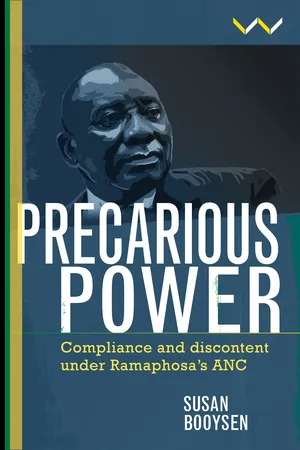
An incisive analysis of South Africa's ANC power-as party, as government, as state
South Africa's African National Congress (ANC) is in decline, its hegemony has been weakened, its legitimacy diluted. President Cyril Ramaphosa's appointment suspended the ANC's electoral decline, it also heightened internal tensions between those who would deepen its acquired status as corrupt and captured, and those who would remodel it as redeemable. These are the incontrovertible knowns of South African politics; what will evolve from this is less certain.
In Precarious Power, renowned political scientist Susan Booysen uses in-depth research and analysis to distill that which is bound to shape South Africa's political future, Booysen focuses on contradictory party politics and internal ANC dissent that is veiled for the sake of retaining an electoral following. Also exposed is the incongruous, populist policymaking, protest politics and the use of soft law to ensure it does not alienate angry citizens, fueling further discontent and protest. The ANC's power has become exceedingly precarious. Precarious Power is the name of the political game, for the foreseeable future.
The comprehensive analysis in Precarious Power will appeal not only to political scientists and postgraduate students, but to all who take a keen interest in current affairs.
- 328 pages
- English
- ePUB (mobile friendly)
- Available on iOS & Android
eBook - ePub
About this book
Information
CHAPTER
1
The ANC and Precarious Power
DISCORD AS THE ANC HOVERS IN POWER
It was no longer the near-mythological liberation party, nor had its days in government bestowed unadulterated glory. Yet, the African National Congress (ANC) remained in power, and generally politically dominant. Its electoral supremacy was dented yet ongoing, evident in the way ANC politics were often substituted for national politics. Its discourses and ideas frequently set the parameters of national debate. The culture and practice of post-liberation struggle party politics, seasoned by 25 years and more in government in South Africa, had bequeathed a lingering form of political dominance to the ANC. No opposition party was in place or rising to challenge it for power.
The times of the coronavirus exposed deep layers of ANC weaknesses and failures, state ruptures and opposition party inability to capitalise on them. The ANC had control of the instruments of state power, yet was unstable and depended on a delicate balance of forces and agencies that operated challenges and protests, and offered support and endorsement in return. The ANC’s historical legitimacy, and its continued assurances that it was organisationally united and had firm intentions to improve policy and governance, had helped citizens to continue suspending their disbelief in the ANC as a viable political force and to continue granting sequential second chances.
The ANC’s slippages in power showed on various fronts. The organisation was riven and at the mercy of shifting balances of factions. As deeper and cross-cutting crises like Covid-19 descended on the ANC, prior organisational battles persisted and shaped the base on which new politics took root and grew. Its command of the state was uncertain, and its electoral support, while not in inexorable decline, was volatile. Its dominance did not extend into the media, economy, civil society, intellectual and policy debates. The Covid-19 times brought reprieves, resets and enclaves of amnesia to prior ANC let-downs. The ANC won some accolades but those did not rebuild former exaltation. As Covid-19 sapped already sparse public resources, the ANC’s state power declined – and yet there was a clamour of contests to own it. Its power was refracted and dispersed among old and new factions, grassroots and state institutions of various ANC-based assemblages. There were few certainties amid many questions as to the exact locus of power.
A loose network of opposition, diverse and largely uncoordinated, operated in the policy and governance space, subsuming the power that the ANC shed, or gathering tools to engage with the ANC. At the elite politics and business levels, there were structured, in-state opportunities for influence and forms of deliberative democracy. The grassroots and the unorganised and often lawless citizenry often devised de facto policy, frequently making use of protest action or self-governance in defiance of state power. Some of their actions were hostile to the ANC government, but in many instances they formed a symbiotic relationship. New, parallel ‘rules’ of state operation were commonplace in state and government and were accentuated in the time of the Covid-19 pandemic. State institutions operated analogously to the formal ANC-controlled state apparatus and pursued own agendas or projects to undermine the prevailing opposing faction and claim institutions for themselves.
Much of policy and governance in the time of the presidency of Cyril Ramaphosa was determined in this way. The ANC was in command and was fairly unchallenged in retaining its party political dominance nationally. The authority of its instruments of state power was still accepted – in the final instance and despite wide-ranging popular protests and resistance – and no general uprising was threatening. Yet, the many permutations under the surfaces of electoral majority and final-instance authority revealed a world of politics that supplemented conventional expectations of multiparty democracy.
The transmutations included shadow institutions, parallel operations, the informalisation and de-institutionalisation of engagement, lawlessness both harmless and destructive, impunity and the appropriation of voids left by soft law and government failures.
In this book I dissect these dynamics across the four pillars of ANC power: the ANC organisationally, in elections, in relation to the people and in state and governance. In some respects, the ANC was dominant despite the extensive contests and its diminished power. It remained the societal focus among political parties; its elections and internal contests absorbed national attention; its internal policy debates regularly became the national discourse. Yet, in most respects the ANC’s control and capacity were dented beyond the hope of restoration to former glory, presumed or real. Problems prevailed organisationally: in elections, in leadership, in government and in the ANC-controlled state. The problems that the ANC experienced, as movement and as government, were cumulative and a downward spiral in which events and developments often mutually reinforced one another. Its relations with its own members and with the people of South Africa were in ebb and flow, informed by hope and often driven by desperation. In crucial national and provincial elections, its outright majorities were often by the barest of margins. As political party, it was no longer deemed to be a saviour. Its ostensibly heroic past was questioned; at best, it was seen as preferable to the party political alternatives. It suffered a growing disbelief as to whether any of its leaders had sufficient integrity to lead South Africa into a better future – the belief had dissipated that it was only a question of time before policy delivery would come to the hitherto forgotten or neglected citizens. The ANC government oversaw the national finances but was unable to counter deficits and stop the drain of public funds in ways that could guarantee sustainability. Problems of economic growth, unemployment and budget shortfalls were endemic, even before the crisis of the coronavirus, and recovery would take far longer than the Ramaphosa presidential term. Trust in multiparty democracy and the institutions of the state was dwindling.
Alternative, community-grown politics, ranging from protest to de facto policy-making by popular action, were common. The ANC tolerated and condoned: as long as it did not act punitively against citizens who broke the law for socio-economic survival, it retained assurance that voters would probably not attach themselves to opposition parties. Across the board, the formal processes of state power persisted at the same time that the informal, alternative and supplementary varieties flourished.
POLITICAL LAND WHERE THE ANC IS DOMINANT
These dynamics amounted to a political Neverland where the ANC prevailed, not for its inherent strengths but because the opposition was weaker. The ANC’s party political dominance relied on holding out the hope that a new and better ANC was rising. This forever-next-new ANC, exemplary and true to the ideals of the movement’s nearly mythological struggle past, still promised to bring economic emancipation and seal political freedoms.1 The ANC, by the time of my analysis, was not only living by legitimation in terms of struggle credentials (with emphasis on the exiled armed component far more than on the internal mass uprising) but was feeding off its own organisational truth: that it possessed an indefatigable ability for self-correction.
Voters and citizens continued to hold out hope that the time of self-destruction was not upon the ANC. In the ANC’s view, it had retained the will and the ability to give effect to its 1912 foundational ideas and democratic South Africa’s 1994 founding ideals – even if, 25 years later, they were questioned increasingly. One of the ingredients of the ANC’s self-renewal formula was its cyclical populist calls when its presidents rotated – new entrants came together with renewed hope. New cohorts of deployee cadres carried forward the mobilisation to ring in changes and to refurbish policy debates, and the tranches of conference resolutions created auras of new ideas, vigour and commitment.
On the ground, there were few signs that the reassurances and rituals were working for the ANC fully and in ways that would still secure deep legitimacy besides helping the ANC to extract itself from quagmires. The practices did work in creating space for the ANC to roll over assurances that it was attending to policy implementation and was in the process of cleaning up government.
The decay at the heart of the ANC was amply revealed in the first two decades of the twenty-first century and in the ANC’s own organisational reports presented to conferences.2 At its 2017 conference, for example, the ANC passed resolutions on anti-corruption, part of the repertoire for organisational renewal. Outright ethical condemnation and resolve to bring in consequences for this form of lawlessness were overshadowed by the ‘protection of the ANC brand’:
The ANC need[s] to decisively attend and act to issues of corruption, ill-discipline, and misconduct across ANC membership … this needs to be considered a vehicle to improve [the ANC’s] electoral support base and strengthen the development of BRAND ANC.3
Investigations proceeded around – not in, because that would have been called ‘purging’ – the ANC to try stopping the impunity with which corruption had been committed, and to extract accountability. Superficially, there was a new era of accountability, but not one that could be practised unapologetically and be pursued with uncompromised organisational backing. This was clear, again, when in the spring of 2020 Ramaphosa took on ANC members in an open letter, challenging them to implement ANC conference resolutions:
As the NEC has determined, we now need to draw a line in the sand. We need to act urgently, we need to be decisive and we need to demonstrate a clear political will. The time has come for the ANC to be unflinching in restoring the values, ethics and standing of our organisation. Our deeds must, always, match our words … Let us together make this a turning point in the fight in corruption. Let us together restore the integrity of our movement and earn the trust that the people of South Africa have placed in us.4
A strong ANC National Executive Committee (NEC) statement tried to link specifics to matters of principle.5 Under scrutiny, however, the pillars of anti-corruption action in the statement crumbled – policies and guidelines to direct anti-corruption action still had to be developed, the ANC’s Integrity Commission still lacked capacity and authority, and investigations remained to be done or completed. Investigations and events like the arrest of the secretary-general changed the political culture nevertheless; it meant that the ANC’s transgressions and excesses in dealing with state power went on public display – and public accountability was demanded. The details of the malaise sat uncomfortably with the traditions of struggle nobility and heroic liberation deeds, and were exacerbated by justice seen to be taking time, and compromised politicians remaining in place – often because there was no one clean enough to be taking action without being exposed themselves.
The ANC showed awareness: arguably, a sense of guilt that on governance and public service it had delivered insufficiently to the citizens, and particularly its own followers, as measured against its own aspirations and political undertakings. The time of Covid-19 brought an inadvertent benefit to the ANC: framed in tragedy, it nevertheless gave the ANC government the chance to claim a blank slate and restart. New policies would be introduced, and the governance failures and disappointments of even the recent past would be blanked out. This gave the grassroots a level of leverage over the ANC in government. Poor and marginalised citizens, around whom much of society and politics revolved, were guaranteed sympathetic treatment by the ANC government when they ignored the law. After all, the ANC itself was setting the standard of governance beyond the formal agreed rules and practices: corrupt and compromised ways of policy-making, implementation and securing benefits for individuals or the party had been commonplace, as had the adoption of policies and making of laws that remained in states of pre-implementation or flawed realisation.
Popular politics in this context, instead of finding traction in some opposition party, established a mildly challenging and generally symbiotic inside track of direct political engagement with the ANC. It aligned with the growing culture of party political de-alignment, as evidenced in Election 2019. Alternative ways of political participation flourished as a form of protest that was a de facto agreement with the ANC to work directly for government deliveries instead of endorsing opposition parties. It was valid as a general rule of engagement; there were many cases (especially evident at the local level) where voters did switch allegiance away from the ANC, albeit not on a scale that matched their dissatisfaction. Protest diversified. On occasion, it also assumed anarchic and anti-systemic, or anomic, forms. Protest was, in essence (and underlying the antagonistic motions of community protests), largely interdependent on the ANC in government, and displayed cooperation between government and the protesting community.
The protests only rarely amounted to outright political rebellion against the ANC as predominant governing party but were aimed at socio-economic living-condition targets. Many of those who had moved away from the ANC party politically, or who had become more politically anomic, remained willing to re-engage with the state and the governing party when it was to their advantage.
A parallel system of supplementary government, albeit never all-encompassing, thus took hold over a wide front. It was a dispersed system of government, of policy delivery through citizen ‘self-help’ to social benefits such as free water and electricity beyond the basic free allowances, unpunished looting of foreigner-owned businesses and big business delivery trucks, or land occupation in new informal settlements. Government tolerated or condoned many of these bottom-up actions. Desperate socio-economic conditions (and, in some cases, opportunism) triggered by government inaction and neglect encouraged citizens to use the formal channels of political engagement (including voting) and then to act along these alternative aven...
Table of contents
- Cover
- Title Page
- Copyright Page
- Contents
- Tables And Figures
- Preface
- Acronyms And Abbreviations
- Chapter 1 The ANC and Precarious Power
- Chapter 2 Shootouts Under the Cloak of ANC Unity
- Chapter 3 Boosted Election Victory, Porous Power
- Chapter 4 Presidency of Hope, Shadows and Strategic Allusion
- Chapter 5 Courts and Commissions as Crutches Amidst Self-Annihilation
- Chapter 6 Reconstituting the Limping State
- Chapter 7 Parallelism, Populism and Proxy as Tools in Policy Wars
- Chapter 8 Protest as Parallel Policy-Making and Governance
- Chapter 9 Parallel Power, Shedding Power and Staying in Power
- Select References
- Index
Trusted by 375,005 students
Access to over 1.5 million titles for a fair monthly price.
Study more efficiently using our study tools.
Frequently asked questions
Yes, you can cancel anytime from the Subscription tab in your account settings on the Perlego website. Your subscription will stay active until the end of your current billing period. Learn how to cancel your subscription
No, books cannot be downloaded as external files, such as PDFs, for use outside of Perlego. However, you can download books within the Perlego app for offline reading on mobile or tablet. Learn how to download books offline
Perlego offers two plans: Essential and Complete
- Essential is ideal for learners and professionals who enjoy exploring a wide range of subjects. Access the Essential Library with 800,000+ trusted titles and best-sellers across business, personal growth, and the humanities. Includes unlimited reading time and Standard Read Aloud voice.
- Complete: Perfect for advanced learners and researchers needing full, unrestricted access. Unlock 1.5M+ books across hundreds of subjects, including academic and specialized titles. The Complete Plan also includes advanced features like Premium Read Aloud and Research Assistant.
We are an online textbook subscription service, where you can get access to an entire online library for less than the price of a single book per month. With over 1.5 million books across 990+ topics, we’ve got you covered! Learn about our mission
Look out for the read-aloud symbol on your next book to see if you can listen to it. The read-aloud tool reads text aloud for you, highlighting the text as it is being read. You can pause it, speed it up and slow it down. Learn more about Read Aloud
Yes! You can use the Perlego app on both iOS and Android devices to read anytime, anywhere — even offline. Perfect for commutes or when you’re on the go.
Please note we cannot support devices running on iOS 13 and Android 7 or earlier. Learn more about using the app
Please note we cannot support devices running on iOS 13 and Android 7 or earlier. Learn more about using the app
Yes, you can access Precarious Power by Susan Booysen in PDF and/or ePUB format, as well as other popular books in History & African History. We have over 1.5 million books available in our catalogue for you to explore.