Building on the work of economic historian Douglass North and Ugandan political scholar Mahmood Mamdani, Friedman argues that the difficulties besetting South African democracy are legacies of the past, not products of the post-1994 era
South Africa's democracy is often seen as a story of bright beginnings gone astray, a pattern said to be common to Africa. The negotiated settlement of 1994, it is claimed, ended racial domination and created the foundation for a prosperous democracy – but greedy politicians betrayed the promise of a new society.
In Prisoners of the Past Steven Friedman astutely argues that this misreads the nature of contemporary South Africa. Building on the work of the economic historian Douglass North and the political thinker Mahmood Mamdani, Friedman shows that South African democracy's difficulties are legacies of the pre-1994 past. The settlement which ushered in majority rule left intact core features of the apartheid economy and society. The economy continues to exclude millions from its benefits, while racial hierarchies have proved stubborn: apartheid is discredited, but the values of the pre-1948 colonial era, the period of British colonization, still dominate. Thus South Africa's democracy supports free elections, civil liberties and the rule of law, but also continues past patterns of exclusion and domination.
Friedman reasons that this 'path dependence' is not, as is often claimed, the result of constitutional compromises in 1994 that left domination untouched. This bargain was flawed because it brought not too much compromise, but too little. Compromises extended political citizenship to all but there were no similar bargains on economic and cultural change. Using the work of the radical sociologist Harold Wolpe, Friedman shows that only negotiations on a new economy and society can free South Africans from the prison of the past.
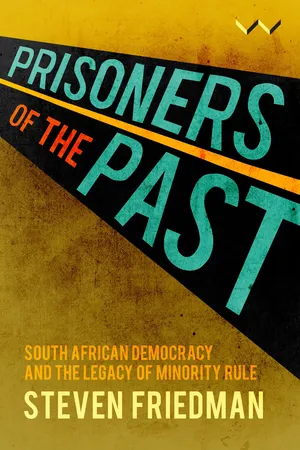
eBook - ePub
Prisoners of the Past
South African democracy and the legacy of minority rule
- 288 pages
- English
- ePUB (mobile friendly)
- Available on iOS & Android
eBook - ePub
About this book
Information
Topic
LittératureSubtopic
Histoire de l'AfriqueCHAPTER
1
The Past Is Too Much With Us: South Africa’s Path-Dependent Democracy
In early 2018, an illusion which had underpinned South Africa’s mainstream debate ended. But, in the main, the debate did not notice.
For several years prior to 2018, the mainstream account – promoted by journalists, commentators, many politicians, and citizens on social media – lamented the country’s fall from grace. The presidency of Jacob Zuma, who was widely associated in the public mind with corruption and patronage, was compared unfavourably to the days before 2007, when he won the ANC presidency. This comparison underpinned an account of South Africa’s reality after 1994. The new democracy, this view claimed, had been the envy of the world, the product of a transition in which the political class had placed the national interest first and produced a constitution of which the country could be proud. For almost a decade and a half, the new democracy flourished. But in 2009, when Zuma became state president, it fell into the hands of the greedy who destroyed the dream and turned South Africa into a society ‘in tatters’.1 Only new leadership could restore it to its former state.
The new leadership duly arrived in the form of current president Cyril Ramaphosa. Although he had served as deputy president in Zuma’s government, Ramaphosa was the unofficial head of the ANC faction which opposed Zuma and so was associated in the minds of many with opposition to corruption. Surveys2 and the 2019 election results showed that he was popular among voters. Business people also appeared to place their trust in him: since he had spent years in business before returning to politics, they assumed that he favoured not only clean government but market-led economic growth. In almost every way, Ramaphosa seemed to be the polar opposite of Zuma. If the standard account was accurate, then, the new presidency would surely trigger growth and renewal.
But while Ramaphosa and his allies did make significant changes to the criminal justice system and state-owned enterprises, both of which had been key targets of the patronage politics of the Zuma era, the problems which were meant to begin vanishing under new leadership have remained. There was no economic revival – on the contrary, even before Covid-19 arrived, the economy faltered, falling into recession in 2018, followed by weak or negative growth in 2019.3 Unemployment reached 29 per cent in mid-2019.4 Despite the removal of board members and senior management at state-owned companies who were accused of corruption and their replacement by people with personal credibility, virtually all these enterprises fell into financial crisis. Some battled to pay salaries,5 while the largest and most important, the power utility Eskom, was forced to introduce rolling power cuts and needed a large infusion of public funds to remain in operation.6 The public debate continued to paint the government as corrupt7 and incompetent.8
For those doggedly committed to the mainstream account, there was an escape hatch. Ramaphosa presided over a deeply divided ANC which seemed to have agreed, at the conference which elected him, to share leadership positions between his faction’s and Zuma’s – its national executive committee, which runs the ANC between conferences, was evenly divided between the two. It could be argued that the people who caused the problem still wielded power. But that argument was less credible than it seemed. The divisions had not stopped the Ramaphosa-led governing party from making changes, and the key positions in the national Cabinet were dominated by ministers loyal to his faction. It was fashionable among commentators to insist that he was in charge of government (although not the ANC)9 – which meant, of course, that the new president’s difficulties within his party did not prevent him from getting government to adopt his programme. Why, then, was there no clear movement towards a stronger economy and more effective government after Zuma’s departure?
Most mainstream explanations remained firmly within the paradigm which insisted that the country’s fate depended on the quality of its head of government. Ramaphosa, they suggested, was not the saviour he had appeared to be (at least to some). He was, in one view, not firm or decisive; he was regularly accused of lacking courage by failing to implement whichever measures the person levelling the accusation felt were required.10 For others, the problem was that he was not a new broom after all: he was happy to serve as Zuma’s deputy president and so was no alternative.11 In this view, the entire governing party was corrupt and it did not matter which individual or faction presided over it. These claims missed crucial realities.
The complaints about Ramaphosa’s indecisiveness ignored the fact that, in a society as divided and fractious as South Africa’s, doing what some people wanted inevitably meant doing what others did not want. Often, those who did not want policy had enough power to defeat it; and so ‘timidity’ may be the only route to change. One example of the ‘leadership’ many wanted was the decision, in 2018, of the Eskom board to inform trade unions that it was not willing to grant any wage increases – precisely the aggressive cost-cutting which is popular in business and among the media. But this decision triggered industrial action which forced Eskom to impose ‘load shedding’, rolling blackouts12 that caused dismay among precisely those voices which had loudly advocated ‘getting tough with the unions’ but seemed unwilling to pay the price. While some in business blamed the government for capitulating to the unions, they did not explain how they would have maintained power supply which, they insisted, should not be disrupted.
Nor is this the only case in which ‘decisiveness’ seemed likely to cost much and reap little. Ramaphosa may have chosen to conciliate his opponents rather than confront them, not because he is a brilliant strategist, but because this was where his temperament inclined him. But the concrete effect may have been to avoid courses of action which would have caused great economic damage. The view that there was no difference between the Ramaphosa group and its opponents ignores the fact, mentioned earlier, that the new ANC leadership introduced significant changes which aimed to restore the status quo before Zuma became president.13 More importantly, as we shall see shortly, it misses the reality that the factional divide within the ANC runs deep because it reflects the contrasting interests of those whom path dependence has included in the market economy and those it has excluded, ensuring that the two groups had very different priorities.
The change in leadership in early 2018 was significant: leaders who wanted what those who shaped the mainstream debate wanted replaced those who did not. The non-appearance of the promised revival surely meant that, contrary to the mainstream account, the actions in office of Zuma and his faction were not the only reasons for the economic and social problems they were said to explain: the causes clearly ran deeper. Closer examination shows that the difficulties persisted after Zuma left office because they existed for a long time before he arrived. The constitutional settlement which ushered in democracy in 1994 was an important break with the political past, but it left much of its economic and social realities intact. These persistent realities explain why the post-Zuma reality is not nearly as different from his term in office as the mainstream accounts hoped it would be.
A PLACE FOR SOME: ECONOMIC INCLUSION AND EXCLUSION
Apartheid was, of course, built on creating a divide between the included and the excluded.
The primary divide was that between black and white, but there were secondary exclusions too. Some black people were allowed to live in the cities permanently, but most could live in urban areas only if they were working on a contract which required them to return annually to ethnically demarcated rural areas. People classified coloured and Indian were allowed to occupy skilled jobs and belong to trade unions with official bargaining rights; black African workers were not.14 In the Western Cape, people classified coloured were given job preference over Africans and harsher restrictions were placed on the right of Africans to live there, making the province the only area in the country where Africans were not in the majority.15 These examples of exclusion among the excluded were symptoms of a wider reality in which political, economic and cultural institutions were designed to serve whites and to exclude the black majority. The primary form of exclusion – the fact that only whites (and latterly people classified coloured and Indian for segregated and subservient parliaments) could vote – ended with the settlement of 1993. But this does not necessarily end the other forms of exclusion. In the economy, while exclusion is no longer entirely racial, it survives and, as before 1994, its effect is to exclude millions of black citizens from the benefits of the formal economy.
That this exclusion cannot be explained by the Zuma presidency is illustrated by data at the tail end of the presidency of Thabo Mbeki – the period in which the economy was, according to the mainstream account, operating as it should. In the fourth quarter of 2008, unemployment fell to its lowest level since credible records were available. While this seems to support the view that the problem began with the Zuma presidency the following year, this ‘record low’ was 21.5 per cent16 – higher than the unemployment rate in the Netherlands at the height of the Great Depression.17 In 2006, more than half the population (51 per cent) received incomes below Statistics South Africa’s lower-bound poverty line, while two-thirds were below the upper-bound line (the two differ in their calculation of what is needed to sustain a household).18 South African poverty rates are higher than those of middle-income countries with a lower gross national income.19 Then, as now, it was trite to point out that South Africa’s level of inequality, measured by the Gini coefficient, was the highest in the world. So too is inequality of opportunity,20 which, according to the 2010 official census, had not changed significantly since 1994.
While it was customary at the time to blame inequality on the post-1994 government’s claimed inability to provide services and programmes which addressed the needs of people who had been excluded by apartheid, the census showed that the government was extending basic services to many more people. The problem was, rather, continued inequality in the formal market.21 To reinforce the point, a study of government programmes since 1994 found that they had transferred assets to people in poverty – but without significantly altering inequality.22 So the key problem was not government failure to provide relief (although the programmes could, it was widely agreed, be run better). It was that the formal economy still bred inequality.
A further indicator of persistent patterns of the past was the survival, in robust health, of racial inequality. In 2010, according to the Johannesburg Stock Exchange, black South African investors owned only 18 per cent of the available share capital in the top 100 listed companies.23 By 2009, the percentage of black professionals in accounting, engineering and law remained at 12 per cent, 24 per cent and 21 per cent respectively.24 Clearly, despite government affirmative action programmes, which were repeatedly denounced by white critics as a sign that white men were being swept aside, whites remained dominant in business and the professions. Most significant of all, research in the same year showed that white incomes had increased faster than those of other races since democracy was achieved.25 The period since 1994 was not one in which the country made slow progress towards racial equality in the economy. It was one in which those who had gained from apartheid benefited disproportionately from democracy.
If economic growth is taken as a measure, evidence seems to support the claim that the economy was growing until Zuma took over and has been in decline since. In 2007, Mbeki’s last full year in office and his last as president of the ANC, South Africa’s growth rate was 5.5 per cent. This followed four consecutive years in which growth exceeded 4.5 per cent. These levels were never reached during Zuma’s term and, in his last four years in office, growth did not reach 2 per cent. In the first year of his term, 2009, the economy contracted by 1.5 per cent.26 It seems easy to conclude that Mbeki’s economic management ensured a growing economy while Zuma’s prompted the reverse. But 2008, during which Mbeki resign...
Table of contents
- Cover
- Title Page
- Copyright Page
- Dedication
- Contents
- INTRODUCTION
- CHAPTER 1 The Past Is Too Much With Us: South Africa’s Path-Dependent Democracy
- CHAPTER 2 Path Dependence: What It Means and How It Explains South Africa
- CHAPTER 3 The Roots of Patronage: Path Dependence, ‘State Capture’ and Corruption
- CHAPTER 4 The Bifurcated Society: Mahmood Mamdani, Rural Power and State Capture
- CHAPTER 5 A Cycle of Crisis and Compromise: Path Dependence, Race and Policy Conflicts
- CHAPTER 6 Missing the Target: The Negotiations of 1993, the Constitution and Change
- CHAPTER 7 The Power of Negotiation: The Prescience of Harold Wolpe
- CHAPTER 8 Towards a Future: A Route Out of Path Dependence
- NOTES
- REFERENCES
- INDEX
Trusted by 375,005 students
Access to over 1.5 million titles for a fair monthly price.
Study more efficiently using our study tools.
Frequently asked questions
Yes, you can cancel anytime from the Subscription tab in your account settings on the Perlego website. Your subscription will stay active until the end of your current billing period. Learn how to cancel your subscription
No, books cannot be downloaded as external files, such as PDFs, for use outside of Perlego. However, you can download books within the Perlego app for offline reading on mobile or tablet. Learn how to download books offline
Perlego offers two plans: Essential and Complete
- Essential is ideal for learners and professionals who enjoy exploring a wide range of subjects. Access the Essential Library with 800,000+ trusted titles and best-sellers across business, personal growth, and the humanities. Includes unlimited reading time and Standard Read Aloud voice.
- Complete: Perfect for advanced learners and researchers needing full, unrestricted access. Unlock 1.5M+ books across hundreds of subjects, including academic and specialized titles. The Complete Plan also includes advanced features like Premium Read Aloud and Research Assistant.
We are an online textbook subscription service, where you can get access to an entire online library for less than the price of a single book per month. With over 1.5 million books across 990+ topics, we’ve got you covered! Learn about our mission
Look out for the read-aloud symbol on your next book to see if you can listen to it. The read-aloud tool reads text aloud for you, highlighting the text as it is being read. You can pause it, speed it up and slow it down. Learn more about Read Aloud
Yes! You can use the Perlego app on both iOS and Android devices to read anytime, anywhere — even offline. Perfect for commutes or when you’re on the go.
Please note we cannot support devices running on iOS 13 and Android 7 or earlier. Learn more about using the app
Please note we cannot support devices running on iOS 13 and Android 7 or earlier. Learn more about using the app
Yes, you can access Prisoners of the Past by Steven Friedman in PDF and/or ePUB format, as well as other popular books in Littérature & Histoire de l'Afrique. We have over 1.5 million books available in our catalogue for you to explore.