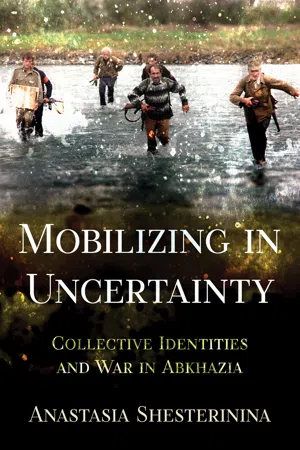
Winner of the Davis Center Book Prize in Political and Social Studies Co-winner of the Charles Taylor Book Award
How do ordinary people navigate the intense uncertainty of the onset of war? Individuals mobilize in different ways—some flee, some pick up arms, and some support armed actors. Drawing on nearly two hundred in-depth interviews with participants and nonparticipants in the Georgian-Abkhaz war of 1992–1993, Mobilizing in Uncertainty explores Abkhaz mobilization decisions during that conflict.
Anastasia Shesterinina uncovers that to make sense of the violence, Abkhaz leaders, local authority figures, and others relied on shared understandings of the conflict and their roles in it—collective conflict identities—that they had developed before the war. People consolidated mobilization decisions within small groups of family and friends and based their actions on whom they understood to be threatened and mobilized to protect. Their decisions shaped how the Georgian-Abkhaz conflict unfolded. Mobilizing in Uncertainty sheds light on broader processes of violence, which have lasting effects on societies marked by intergroup conflict.
The unique context of a conversational interview—an exchange with a focused listener who is eager to devote time to hearing the respondent’s views—allows the respondent to reflect on and even explore her own ideas, to reveal not only strong views but also worries, uncertainties—in a word, to engage human vulnerability.
—Yanow and Schwartz-Shea 2006, 118
Questions of intergroup violence and war are difficult ones to study. We cannot grasp how people arrive at decisions in situations of confusion and shock that these processes bring with them if we rely only on secondary materials, archival or news sources, or elite interviews or infer people’s willingness to mobilize from civil war outcomes, observed behavior, assumption of interests, or retrospective assignment of grievances that could have affected these decisions given the history of intergroup conflict. These sources may be essential to the overall research goals, but they rarely document how participants understood the reality they faced. When they do, as in memoirs, these sources are limited to the personal reflections on conflict of a few individuals and do not provide the sufficient comparative basis to make systematic conclusions about the social processes involved.
I turn to field research with the actors in Georgian-Abkhaz conflict to explore the interpretations of conflict experiences by the participants themselves. This research is based on my careful selection of the case of Abkhazia, locales within the case, and participants in the interviews that I collected in these locales. I substantiate and contextualize these interviews with participant observation in Abkhazia, additional interviews that I collected with Georgians displaced by the Georgian-Abkhaz war of 1992–1993 and with experts in Georgia and Russia, and extensive archival, news, and secondary materials. I take seriously ethnographic surprises, or unexpected narratives and observations that emerge systematically yet are unaccounted for by existing theories. I thus arrive at a novel focus in civil war studies, the centrality of uncertainty to mobilization, and the theoretical approach centered on the collective threat framing mechanism that helps account for how ordinary people navigate this uncertainty.
The following sections walk the reader through the research underlying this book, from the research design to the process of immersive fieldwork.1 I then focus on two ethnographic surprises that drew my attention to the question of uncertainty and the collective threat framing dynamics and give a sense of the materials I use in this book by analyzing a sample interview excerpt.
Research Design
What kind of research design can allow for an in-depth exploration of the process of mobilization? Whereas many studies take a quantitative or cross-case comparative approach to examining civil war mobilization and focus on insurgent leaders,2 my study’s goal is to understand how ordinary people experience mobilization across the prewar, wartime, and postwar stages of intergroup conflict. This book, as a result, is based on a systematic study of a single case that offers wide variation in conflict dynamics across time and space and that existing approaches cannot fully explain. Abkhazia is such a case.
The Case of Abkhazia
A small area along the Black Sea coast, Abkhazia has been a place of imperial conquest, colonial rule, and intergroup conflict for centuries due to its critical geopolitical location at the intersection of the Caucasus, Russia, and the Middle East. It saw striking demographic changes as the Russian Empire established control in the nineteenth century, displacing the majority of Abkhaz. Georgian-Abkhaz conflict evolved in the context of repopulation of Soviet Abkhazia after it was formally integrated into the Georgian state structure within the broader Soviet Union. Daily tensions and episodes of nonviolent and violent contention, such as letter writing to the Soviet center in Moscow, public gatherings, and clashes, characterized the period and culminated in the Georgian-Abkhaz war of 1992–1993. The war displaced most of the Georgian population of Abkhazia and paved the way for the establishment of the contested de facto state supported by Russia. The focus here is on this war.
The term civil war is rarely used in Abkhazia. Locals distinguish the broader Georgian-Abkhaz conflict from the war of 1992–1993 but say that the latter was “not a civil war for us at all. There was an element of great civilian suffering—maybe this is a characteristic of civil war. [But we] see it as a clearly ethnopolitical war because the ethnic factor played such a big role here.” “It was a political war,” they go on to explain, “because it stemmed from the Georgian political elite. The Abkhaz were not the initiator. We simply resisted the ideas and rules imposed by the Georgian center.” Indeed, the war set off with the entry of Georgia’s forces into Abkhazia and Abkhaz resistance to these forces. But it unfolded with the participation of the local population in Abkhazia, a defining element of civil war, and became internationalized with the engagement of foreign fighters and Russian support on both sides in the fighting (Zverev 1996; Baev 2003).
While some scholars characterize the war as conventional (Kalyvas and Balcells 2010, 419), it presents a much more nuanced picture of warfare across the period of the war and in the areas of Abkhazia that were involved in the fighting in different ways. The war started as a case of irregular civil war in August 1992. It was marked by the relative military asymmetry on the Georgian and Abkhaz sides. Since Georgian forces entered Abkhazia when it was Georgia’s autonomous part, the case best resembles other irregular wars “in weak but modernizing states bent on centralization and the subjugation of their periphery” (Kalyvas 2006, 67). Statements by Abkhaz respondents reflect this characterization: “[Georgian leaders, who] thought they were strong, that their hour had come …, emulated the image of the [Soviet] empire that created them. They decided that [Georgia was] the secondary imperial center that could afford such actions, but they did not recognize that they had nothing valuable to offer those territories that they were trying to colonize and occupy.” As a former Georgian resident of Abkhazia who is now an official in the capital of Georgia, Tbilisi, confirms: “If we ask the Abkhaz now, they say that they wanted to gain state independence [from Georgia]. If you ask Georgians, they say that they wanted to preserve state unity, [with Abkhazia as an autonomous part].”
Indeed, Georgia was modernizing and did not have a regular army when the war began. The National Guard and the Mkhedrioni were “regarded at the time as the core of a future Georgian army,” but were best described as a paramilitary rather than a regular force (Coppieters 2000, 21–22).3 “What was called a Georgian army,” Ghia Nodia (1998, 34) says, “was really a bunch of self-ruled … ‘battalions’ comprising both romantic patriots and thugs, whose activities were only loosely coordinated.” “When they entered [Abkhazia in August 1992],” Abkhaz fighters confirm, “they started looting …, did not subordinate [to their superiors].”
The elements of irregular war, that is, Georgia’s preponderance of force and subjugation of the periphery, were evident in the sheer control that these forces established over Abkhazia as they advanced through the territory during the first four days of the war. By August 18, 1992, the east and west of Abkhazia were under Georgian control, with the center left to the Abkhaz side.
A combination of irregular and conventional elements in the fighting defined the war thereafter. Irregular, poorly armed Abkhaz units engaged in the early fighting. At the war’s onset, “people without arms began organizing into groups in their villages,” respondents report. Some joined the fighting alongside the Abkhaz Guard. This Abkhaz force made up of volunteer groups and Abkhaz guards could not be seen as a regular army. As Christoph Zürcher (2007, 216) captures the early character of the Abkhaz force, “the organization of violence did not initially rely on an ‘impersonal’ state bureaucracy but, rather, on densely knit, small-scale networks of interaction that facilitated trust and cohesion.”
As the Abkhaz regained the area adjacent to Russia’s border in October 1992 with the help of foreign fighters, formation of the Abkhaz army formally began and the map of territorial control changed. Conventional battles with clear front lines and heavy weaponry characterized much of the subsequent fighting, including the battle over the capital, Sukhum/i, which ended the war in September 1993. But irregular warfare continued in the east until the end of the war, and the Abkhaz remained a weaker actor until that battle, as observed in the failed attacks on the capital in October 1992 and January and March 1993. This nuanced combination of irregular and conventional fighting and changes in territorial control, which could have affected ordinary people’s decisions, make Abkhazia particularly suited to studying mobilization in civil war.
Research Sites
The dramatic differences with which the war began in the east and west of Abkhazia place these areas at the heart of the micro-comparative research design in this book. I leverage variation in subnational structural conditions and territorial control and individual mobilization trajectories to explore these differences. Proximity to the Russian border in western Abkhazia, where people could flee at the war’s onset and external help could come from, and the former Soviet military base in Gudauta, where some weapons and a hiding place could be accessed in central Abkhazia, starkly contrasted with the situation in the east, where the administrative border with Georgia facilitated immediate establishment of Georgian control over the area. “Tqvarchal was in the blockade from the beginning of the war. They were isolated right away,” respondents say. “We gave in Gagra and Sukhum … and had fighting in two directions, east and west, from the headquarters in Gudauta.” As a result, “Gudauta and Tqvarchal [were] the only ones that did not suffer as much during the war. We did not let Georgians into these towns.” My research ran along the major road connecting these field sites (see figure 1.1 and 1.2).
FIGURE 1.1.Research sites.
FIGURE 1.2.The road connecting research sites.
EAST: TQVARCHAL/TQVARCHELI, GAL/I, AND SUKHUM/I
I studied Abkhaz mobilization in the east in response to the Georgian advance from the administrative border near Gal/i, along Tqvarchal/Tqvarcheli, to Sukhum/i that began on August 14, 1992. The districts that these urban centers give name to differed in their demographic makeup, socioeconomic basis, and prewar intergroup conflict (see figure 1.3). I carried out fieldwork in Sukhum/i and collected interviews with former residents and additional data on the less accessible sites of Tqvarchal/Tqvarcheli and Gal/i in other areas of Abkhazia and Georgia.
FIGURE 1.3.Prewar demographic composition in research districts: east.
Source: Official census data numbers from Trier, Lohm, and Szakonyi 2010.
Before the war, the Gal/i district was nearly all Mingrelian, a subgroup often recorded as Georgian in the Soviet statistics. An agricultural district, it was “one of the richest in the Union” and “produced nuts, tobacco,” former Georgian residents ...
Table of contents
List of Illustrations
Acknowledgments
Note on Translation, Transliteration, and Spelling
Introduction
1. Studying Civil War Mobilization
2. A Sociohistorical Approach to Mobilization
3. Collective Historical Memory
4. Prewar Conflict Identities
5. From Uncertainty to Mobilization in Four Days
6. From Mobilization to Fighting
7. Postwar Abkhazia
Conclusion
Notes
References
Index
Trusted by 375,005 students
Access to over 1.5 million titles for a fair monthly price.
Study more efficiently using our study tools.
Frequently asked questions
Yes, you can cancel anytime from the Subscription tab in your account settings on the Perlego website. Your subscription will stay active until the end of your current billing period. Learn how to cancel your subscription
No, books cannot be downloaded as external files, such as PDFs, for use outside of Perlego. However, you can download books within the Perlego app for offline reading on mobile or tablet. Learn how to download books offline
Perlego offers two plans: Essential and Complete
Essential is ideal for learners and professionals who enjoy exploring a wide range of subjects. Access the Essential Library with 800,000+ trusted titles and best-sellers across business, personal growth, and the humanities. Includes unlimited reading time and Standard Read Aloud voice.
Complete: Perfect for advanced learners and researchers needing full, unrestricted access. Unlock 1.5M+ books across hundreds of subjects, including academic and specialized titles. The Complete Plan also includes advanced features like Premium Read Aloud and Research Assistant.
Both plans are available with monthly, semester, or annual billing cycles.
We are an online textbook subscription service, where you can get access to an entire online library for less than the price of a single book per month. With over 1.5 million books across 990+ topics, we’ve got you covered! Learn about our mission
Look out for the read-aloud symbol on your next book to see if you can listen to it. The read-aloud tool reads text aloud for you, highlighting the text as it is being read. You can pause it, speed it up and slow it down. Learn more about Read Aloud
Yes! You can use the Perlego app on both iOS and Android devices to read anytime, anywhere — even offline. Perfect for commutes or when you’re on the go. Please note we cannot support devices running on iOS 13 and Android 7 or earlier. Learn more about using the app
Yes, you can access Mobilizing in Uncertainty by Anastasia Shesterinina in PDF and/or ePUB format, as well as other popular books in History & Military & Maritime History. We have over 1.5 million books available in our catalogue for you to explore.