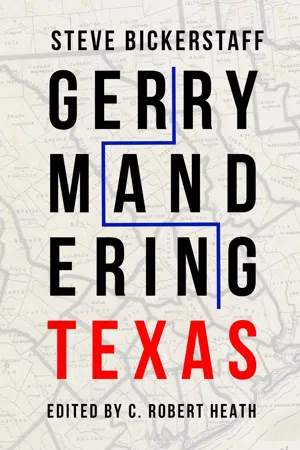
What if gerrymandering were not just a hot button contemporary political issue but actually a deep story of how Texas came to be?
Gerrymandering Texas uses relevant legislation and court cases to tell the political history of the state of Texas. Writing out of decades of experience as an assistant attorney general, senate parliamentarian, expert consultant on redistricting, and law professor, Steve Bickerstaff traces the story of this political practice from 1836 up to the present and prognosticates what lies ahead for the 2020 census and 2021 redistricting.
Since redistricting is the story of boundaries, borders, and representation, Bickerstaff's book also tells the story of Texas's evolution over time. The various Texas constitutions are unpacked, and the changing racial makeup of the state comes into sharp relief. Democrat dominance in state governance gives way to the recent Republican dominance. Bickerstaff's analysis of redistricting, always clear-headed and even-handed, gives new insight into the history of the Lone Star State.
Gerrymandering Texas intersperses history and legal analysis with first-person stories of the author's own many experiences with redistricting, from trying cases, to serving as expert witness, to consulting during the latest Texas constitutional convention. Many of these stories represent the first time Bickerstaff has made public his private opinions about important moments in recent Texas political history—moments in which Bickerstaff was himself a key supporting player.
- English
- ePUB (mobile friendly)
- Available on iOS & Android
eBook - ePub
Gerrymandering Texas
About this book
Information
Publisher
Texas Tech University PressYear
2020Print ISBN
9780896729414
9780896729889
eBook ISBN
9781682830741
Chapter 1:
Redistricting and Gerrymandering
Redistricting and Gerrymandering
The population and demographics of the United States are always changing. In addition to the cycles of birth and death, cities and states grow and shrink alongside the boom and bust of a given local economy. Think of all the people who left their hometowns for education and employment and then never returned. Consider the 86,200 people who moved from California to Texas in 2018. All these population shifts must be accounted for in our representative democracy. These people must be apportioned into districts that will, in part, define the election chances of the people who decide to run for office there. Redistricting is the way we take account of this change and keep the democratic process current.
Although each legislative redrawing of congressional and state legislative districts in Texas over the past 184 years involved some unique elements, there are many significant issues that furnish threads throughout the period. These general tools and tactics have been modified and bastardized by various political actors across Texas history but, broadly speaking, this chapter details how the process gets done.
First, some definitions. The words “apportionment” and “districting” often are used interchangeably by both scholars and the courts. This interchangeable usage sometimes creates confusion. In a technical sense, the words are not synonymous. To apportion seats in a legislative body is to allocate those seats among usually predefined geographical areas or political jurisdictions. On the other hand, districting (or redistricting) is the actual drawing of the geographical boundaries of the electoral areas from which the members of the legislative body are elected. For other democracies and many political scientists, the word “delimitation” (i.e., to set out limits or boundaries) is often used instead of apportionment or districting. So, for example, it is common to refer to the redistricting of the areas from which members of local-government governing boards are elected even though the geographical areas in question, such as precincts or wards, are sometimes not actually called districts.
The best example of apportionment (or reapportionment) is, of course, the allocation of seats in Congress among the fifty states after each decennial census. The US Census is conducted on April 1 of the last year of a decade and is required by the US Constitution to be a count of every inhabitant of every place in the nation, however remote, on that date. The current census not only counts persons but also surveys a wide variety of information about conditions and people. This information is collected, organized, and released in a series of reports, now largely contained in electronic form, over several years.
The first release of census data in the US comes early in the year following that in which the census is conducted and relates population data, including race and voting age, for all geographic areas in the country. The measured data yields information down to small areas generally equivalent to a city block. This detail, combined with computer software designed specifically for redistricting, generally shows that the electoral districts are unequal in population and allows state legislatures, local government officials, redistricting commissions, and the general public to draw and proffer redistricting plans based on the new population data.
Each state is entitled to at least one seat in the US House of Representatives. Congress apportions the remaining 385 seats based on the relative number of persons in each state but does not draw the actual districts. As a result of the 2010 census, for instance, Texas was apportioned four new seats in Congress. The other states gaining seats were Florida (which gained two representatives), Arizona, Georgia, Nevada, South Carolina, Utah, and Washington (which each gained one representative). These twelve reapportioned seats came from New York and Ohio (which each lost two representatives), Illinois, Iowa, Louisiana, Massachusetts, Michigan, Missouri, New Jersey, and Pennsylvania (which each lost one representative). In those seven states entitled to only one representative in 2011 (Alaska, Delaware, Montana, North Dakota, South Dakota, Vermont, and Wyoming), the entire state is the district. In the other states, the state legislature or other entity designated by state law draws the boundaries of the congressional districts.
In Texas, the congressional as well as the state legislative districts are drawn by the state legislature based on this census data. This occurs unless, as I describe later in this book, the state or federal courts or the Legislative Redistricting Board are required to draw the districts because the legislature has failed to act or has adopted unlawful plans. For state legislative seats, however, the formula is less clear. In Texas, the earliest constitutions envisioned a process for the Texas House of Representatives similar in some respects to the one in Congress, with the allocation of legislative seats among the state’s counties. Initially, each county was guaranteed at least one member of this lower chamber of the Texas Legislature. The legislature determined the actual number of representatives per county, who were then elected countywide (i.e., at-large).
By 1875, the year of the writing of the current Texas Constitution, it was impossible to guarantee a seat for each county because the number of counties exceeded the number of representatives allowed by the Constitution. The Constitution, however, still required that the seats be apportioned among the counties but assigned the legislature to draw the districts by combining counties or parts of counties when necessary to form representative districts. Even today, when districts are primarily drawn to equalize population, there remains an element of apportionment in the allocation of Texas House seats among counties in accordance with the constitutional formula.
I use the words “apportionment” and “districting” interchangeably in this book. Except in the circumstance of action by Congress, my choice of wording generally denotes only a personal preference in a specific context and not a substantive difference.
Redistricting Legislation
Electoral districts are established by the Texas Legislature through bills that become law only if they pass both chambers of the legislature and the governor signs them or allows them to become law. There are, however, several aspects of that process that should be noted.
The Texas Legislature has routinely considered separate bills for state senate, state House of Representatives, and congressional districts. A senate bill enacts senate districts. A House bill enacts House districts. The bill establishing congressional districts can originate in either chamber. There is usually only a single bill for each category of districts, which is drawn up in the respective redistricting committee of each chamber after public hearing.
Each chamber must pass the other chamber’s bill for it to be enacted. Like other legislation, bills originating in either chamber are theoretically subject to amendment by the other chamber. The tradition in Texas has been for each chamber generally to pass the other’s redistricting legislation without debate or change, so each chamber in effect does its own redistricting. On the other hand, the bill enacting the congressional districts is often controversial within and between the chambers and may see many changes. This difference in part explains why it has become traditional for congressional redistricting to be done after the regular legislative session in a special session called to consider the specific topic. Sometimes, as in 1981, 1992, and 2003, the governor’s authority to call special sessions has been weaponized in the political fight between the two dominant parties.
Initially, redistricting legislation assigned whole counties within each electoral district. As the number of persons and counties grew, it became necessary to partition some counties to achieve voter equality. Some of these splits were defined in the terms of real estate at the time, as in metes and bounds. Now, it is possible to describe electoral districts using a mixture of whole counties and census geography, such as census block or election precinct Voting Tabulation Districts (VTDs) data.
Redistricting legislation is ordinarily subject to the same rules as are applicable to other legislation. For example, it was possible for the Democrats in the Texas House to kill the congressional redistricting legislation during the 2003 regular session by preventing action on the bill until so late in the session that House rules prohibited consideration of any House bill. On the other hand, special rules may be adopted. For instance, in 1981, the Texas Senate considered senate and congressional redistricting in a “Committee of the Whole Senate” to allow each senator to hear testimony that would typically be heard only by members of the Senate Redistricting Committee.
Redistricting legislation can be vetoed by the governor. In 1981, Republican governor Bill Clements vetoed the bill establishing the new senate districts, sending the issue to the Legislative Redistricting Board. He also vetoed the legislature’s congressional redistricting plan, setting off a contest of wills that lasted through three special sessions. On several occasions, elections were held under plans approved by the LRB or federal courts after the Texas Legislature either failed to act or enacted invalid plans. Many of these stories are taken up in later chapters.
The Texas Legislative Redistricting Board
Under Article III, Section 28, of the Texas Constitution, a Legislative Redistricting Board is tasked with reapportioning the state’s legislative districts, but not congressional or State Board of Education districts, if the legislature fails to do so in its first regular session after publication of the federal decennial census. As previously noted, the LRB consists of five elected officials: the lieutenant governor, the attorney general, the comptroller of public accounts, the commissioner of the General Land Office, and the Speaker of the House of Representatives. The only LRB member not elected statewide is the Speaker, who is elected by the 150 members of the lower chamber of the legislature. Noticeable in absence from this board is the governor. Unlike a legislative enactment, an apportionment plan adopted by the LRB is not subject to gubernatorial veto.
The LRB was created by constitutional amendment adopted by the legislature in 1947 and passed by the voters in 1948. It was considered a means by which legislators could be forced to redistrict in the first legislative session after release of the decennial census or face the prospect that the LRB would do it for them. However, the constitutional provision does not give the LRB authority to redraw congressional districts. Therefore, it has become routine for the legislature to leave congressional redistricting to be done in a special legislative session after adjournment of the regular session.
For three of the past five decades, the LRB has been called on to redistrict the Texas Senate or House of Representatives. Each time, many of the same disputes that affected the legislature resurfaced at the LRB. Even when all or a majority of the LRB were from the same political party, the members of the board often disagreed mightily about which redistricting plan to adopt.
The Tools of Redistricting
The basic tools of redistricting are relatively simple. Most come directly from the US decennial census. They include accurate maps of the area to be redistricted and the existing districts; counts of persons in an area (this data should be available for the smallest geographical areas possible); and means of calculating the data. The object is to describe the electoral districts so that they meet certain public-interest criteria, such as equality in population, contiguity, compactness, preservation of communities of interest, and recognition of natural features (e.g., rivers, lakes, mountains, etc. that could influence travel within a district). Many states explicitly provide these criteria in their constitutions or laws. The Texas Constitution establishes only a few such criteria. Article III, Section 25, provides: “The State shall be divided into Senatorial Districts of contiguous territory, and each district shall be entitled to elect one Senator.” Section 26 of Article III provides: “The members of the House of Representatives shall be apportioned among the several counties, according to the number of population in each,” with a few exceptions. There are no criteria mandated for congressional districts.
In one sense, little about redistricting has changed over the last 180 years. The same problems of personal and political self-interest persist. On the other hand, technology has made redistricting and gerrymandering easier.
In the 1970s, we would spread large census maps (often several at a time) on the floor and use a calculator to add or subtract figures in the Census Bureau’s population booklets to determine a district’s population. Computers were first used for this purpose in the ’80s, but it took at least a day to “run” each plan and errors were sometimes committed. On one occasion, a computer technician discovered after a plan had been adopted that it had inadvertently left out several miscellaneous census blocks in Williamson County. It was my task to explain to the members of the Legislative Redistricting Board how such an error could occur and to ask that an order be adopted nunc pro tunc to correct the mistake. Now, software developed specially for redistricting allows a person to manipulate census and political data on a laptop and know in seconds the effect of moving a single election precinct. The architects of the 2003 redrawing of the congressional ...
Table of contents
- Illustrations and Maps
- Chapter 1: Redistricting and Gerrymandering
- Chapter 2: Is Gerrymandering Legal?
- Chapter 3: The Long Reign of Texas Democrats (1836–1960)
- Chapter 4: Reapportionment Revolution (1961–1970)
- Chapter 5: Urban Changes (1971–1980)
- Chapter 6: Political Sea Change in Texas (1981–2000)
- Chapter 7: Republican Ascension (2001–2010)
- Chapter 8: Republican Dominance (2011–2019)
- Chapter 9: Strategies for Redistricting Texas in 2021
- Chapter 10: Undoing Gerrymandering
Trusted by 375,005 students
Access to over 1.5 million titles for a fair monthly price.
Study more efficiently using our study tools.
Frequently asked questions
Yes, you can cancel anytime from the Subscription tab in your account settings on the Perlego website. Your subscription will stay active until the end of your current billing period. Learn how to cancel your subscription
No, books cannot be downloaded as external files, such as PDFs, for use outside of Perlego. However, you can download books within the Perlego app for offline reading on mobile or tablet. Learn how to download books offline
Perlego offers two plans: Essential and Complete
- Essential is ideal for learners and professionals who enjoy exploring a wide range of subjects. Access the Essential Library with 800,000+ trusted titles and best-sellers across business, personal growth, and the humanities. Includes unlimited reading time and Standard Read Aloud voice.
- Complete: Perfect for advanced learners and researchers needing full, unrestricted access. Unlock 1.5M+ books across hundreds of subjects, including academic and specialized titles. The Complete Plan also includes advanced features like Premium Read Aloud and Research Assistant.
We are an online textbook subscription service, where you can get access to an entire online library for less than the price of a single book per month. With over 1.5 million books across 990+ topics, we’ve got you covered! Learn about our mission
Look out for the read-aloud symbol on your next book to see if you can listen to it. The read-aloud tool reads text aloud for you, highlighting the text as it is being read. You can pause it, speed it up and slow it down. Learn more about Read Aloud
Yes! You can use the Perlego app on both iOS and Android devices to read anytime, anywhere — even offline. Perfect for commutes or when you’re on the go.
Please note we cannot support devices running on iOS 13 and Android 7 or earlier. Learn more about using the app
Please note we cannot support devices running on iOS 13 and Android 7 or earlier. Learn more about using the app
Yes, you can access Gerrymandering Texas by Steve Bickerstaff, C. Robert Heath in PDF and/or ePUB format, as well as other popular books in Politics & International Relations & American Government. We have over 1.5 million books available in our catalogue for you to explore.