As collective violence erupts in many regions throughout the world, we often hear media reports that link the outbreaks to age-old ethnic or religious hostilities, thereby freeing the state, its agents, and its political elites from responsibility. Paul Brass encourages us to look more closely at the issues of violence, ethnicity, and the state by focusing on specific instances of violence in their local contexts and questioning the prevailing interpretations of them. Through five case studies of both rural and urban public violence, including police-public confrontations and Hindu-Muslim riots, Brass shows how, out of many possible interpretations applicable to these incidents, government and the media select those that support existing relations of power in state and society.
Adopting different modes--narrator, detective, and social scientist--Brass treats incidents of collective violence arising initially out of common occurrences such as a drunken brawl, the rape of a girl, and the theft of an idol, and demonstrates how some incidents remain localized while others are fit into broader frameworks of meaning, thereby becoming useful for upholders of dominant ideologies. Incessant talk about violence and its implications in these circumstances contributes to its persistence rather than its reduction. Such treatment serves in fact to mask the causes of violence, displace the victims from the center of attention, and divert society's gaze from those responsible for its endemic character. Brass explains how this process ultimately implicates everyone in the perpetuation of systems of violence.
eBook - ePub
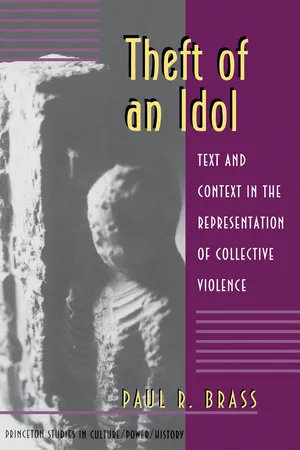
Theft of an Idol
Text and Context in the Representation of Collective Violence
- English
- ePUB (mobile friendly)
- Available on iOS & Android
eBook - ePub
About this book
Information
Publisher
Princeton University PressYear
2020Print ISBN
9780691026503
9780691026510
eBook ISBN
9780691217918
Chapter 1
TEXT AND CONTEXT
IN I, Pierre Rivière, Foucault presents the text—the memoir of a parricide and the dossier associated with it—as “a case, an affair, an event that provided the intersection of discourses that differed in origin, form, organization, and function.” The discourses of judges, prosecutor, country doctor, the great psychiatrist Esquirol, the villagers, including “their mayor and parish priest,” and “the murderer himself” all appear[ed] to be speaking of one and the same thing, of the murders that occurred on June 3, 1835, but the multiplicity of discourses “form[ed] neither a composite work nor an exemplary text, but rather a strange contest, a confrontation, a power relation, a battle among discourses and through discourses,” “used as weapons of attack and defense in the relations of power and knowledge.”1 This contest was one for the definition of the “truth” of the parricide’s act, the truth not of its commission, for which the murderer’s own confession provided sufficient evidence, but the truth of its explanation and meaning, for the context in which it should be placed, and for its broader implications concerning the workings of the human mind in an age of reason from which madness could not be banished.
This struggle for the appropriate explanation of the parricide’s act and for the choice of the appropriate punishment as well involved a contest for domination within domains of legal, medical, criminological, and psychiatric truth and within the institutions in which those domains of truth and knowledge were generated: courts, prisons, hospitals, asylums. It also brought clearly into view the gap in local and national systems of knowledge and explanation. The local doctor, unable to find scientific categories in which to place and define the parricide and his act, saw no reason for the intervention of medico-psychiatric knowledge into this case, which he thought should be left to the judicial system. The Parisian psychiatrists, of course, ultimately succeeded in establishing their claim and the consequent spread of psychiatric “knowledge” not only into the judicial and penal system but throughout modern Western society.
Another consequence of their ultimate victory was the removal from local societies of the power to define and interpret local incidents of violence, to place them in a specific context based on local knowledge. Knowledge of human behavior in nineteenth-century France and in the rest of Western society became nationalized and universalized. Events that occur in isolated villages and hamlets or on the city streets have become subject to placement in categories and contexts previously not known to or incidental to the lives of those who experience them. People with personal knowledge at the sites of occurrences of violence, lacking knowledge of the appropriate scientific categories in which to place them or refusing to accept the contextualizations of them imposed by outsiders, continue to generate their own interpretations. The more perfectly integrated contemporary societies become, however, the more local and national interpretations merge and the more persons in the localities find themselves also readily placing local events into ready-made categories and contexts.
In the twentieth century, local acts of violence are often also commonly placed in other, more direct kinds of political contexts depending upon the ethnic identities of the persons involved in them. Interethnic relations have become such a pervasive concern in contemporary societies that the interpretation of virtually any act of violence between persons identified as belonging to different ethnic groups itself becomes a political act. But the interpretive process is not only political; it also generates competing systems of knowledge concerning interethnic relations, the sources of tension between members of ethnic groups, the causes of discrimination and prejudice, their social and economic bases, and the like. The developers of these systems of knowledge generally claim to stand apart from and above the ethnic interactions they seek to explain and to describe “objectively,” whereas in fact they themselves play a role in their perpetuation by the very process of placing interethnic incidents of violence in broader political contexts.
Interethnic incidents of violence in modern states invariably involve other parties in addition to those who contextualize them in journalistic or social scientific accounts, notably the authorities and especially the police. The police often prefer to define local incidents of violence, whether between members of different ethnic groups or not, simply as crimes and to treat them as such, that is, to localize and confine them. Such localization, however, becomes more difficult when isolated incidents of interethnic violence become transformed into something broader, a “riot” involving large numbers of massed persons from opposing ethnic groups engaged in assaults on persons, lives, and property. In such situations, the police may themselves take sides; even when they do not, they are often accused of doing so, particularly by the side that emerges with the greater losses. Some ethnic “riots” do not even involve two ethnic groups, but often only one community and the police, with the latter perceived or described by spokesmen for the rioting community as responsible for the precipitating incidents leading to the “riot.” When it can be proved that the police and the state authorities more broadly are directly implicated in a “riot” in which one community provides the principal or sole victims, then, of course, one is confronted with a pogrom.
The definition of occurrences of violence involving members of one or more ethnic groups as being merely isolated incidents having no broader significance or as being “riots” or pogroms is frequently itself a part of the political struggle. The boundaries between isolated incidents and proven pogroms are clear enough. However, those between local incidents of violence and “riots,” on the one hand, and between “riots” and pogroms, on the other hand, are not. Some so-called riots are no different in origin from everyday incidents of violence. Others, however, may be pogroms in disguise.
Interethnic or police–people confrontations involving violence in contemporary states almost always lead to the construction of interpretations of them by authorities, media, politicians, and political activists. The struggles to gain acceptance for particular constructions of violent and riotous behavior are inherently political, with important consequences for state policies and resource distribution.2 The constructions that become officially or broadly accepted are usually far removed from the actual precipitating incidents and from local interpretations of them. The scholar who inserts himself into the description of such incidents in a search for objective truth can do no better than to place himself on one side or another in the political struggle. When the search for categories, constructs, and contexts is central to the political struggle, the scholar’s own concepts and the scholar himself cannot stand apart from and outside of them.
Where, then, can a scholar interested in questions of violence place himself in relation to these constructions? One possible posture is to seek to expose the falsifications contained in all of them. However, if one starts with the premise that violence in which innocent persons are harmed and killed is an evil, such a rhetorical strategy provides a poor vantage point. One must, therefore, take a stand rather in relation to the whole process of construction and contextualization. It is my purpose in this volume to find a place to stand in relation to the contextualization of incidents of violence in contemporary Indian society and to ask whether some kinds of constructions contribute more and others less to their perpetuation.
THEORY AND METHOD
The focus of this book is on issues of ethnicity and violence and their relationship to state-building and national unity in India. It is based on field research carried out between 1982–83 and 1994 and on incidents that occurred between 1980 and 1994 at sites of police–public and interethnic violence in north India, which in recent years has given all appearances of undergoing the most extreme paroxysms of caste, communal, and other forms of violence that appear to threaten the unity of the country and the stability of the Indian state. The original research for this project in 1982–83 was carried out with no other intent at the time than to engage in the social scientist’s conventional search for the truth of contemporary public violence through the use of comparative case studies, one of the accepted methods of the social science disciplines. A change in my design came afterward as I looked over my interviews in new ways, treating them as “texts” subject to multiple interpretations rather than as sources of valid or confirmed information or data about events.
I raise three questions concerning the increased incidence and intensity of violence in India in recent years. The first concerns the relationship between issues of ethnicity, communalism, and violence, on the one hand, and national unity, on the other hand. To what extent does this upsurge in violence and the specific forms it has taken indicate a serious threat to the continued unity and integrity of the country and the relations among its major peoples? Since questions of intercaste relations and even more of Hindu–Muslim relations are at the heart of much of this upsurge in violence, the second question is why caste and communal riots persist in India. Third, why especially have Hindu–Muslim riots become endemic? These three questions, I will show, are interrelated.
The argument I develop is that the publicized versions of many so-called caste and communal riots in India, like many aspects of ethnic identity itself, are constructions upon events that are usually open to a multiplicity of interpretations. When examined at the actual originating sites of ethnic and communal violence, it is often the case that the precipitating incidents arise out of situations that are either not inherently ethnic/communal in nature or are ambiguous in character, that their transformation into caste or communal incidents depends upon the attitudes toward them taken by local politicians and local representatives of state authority, and that their ultimate elevation into grand communal confrontations depends upon their further reinterpretation by the press and extralocal politicians and authorities. The “official” interpretation that finally becomes universally accepted is often, if not usually, very far removed, often unrecognizable, from the original precipitating events. This is particularly the case with those riots that are labeled as “communal” or “Hindu-Muslim” riots. Indeed, I intend to demonstrate that the persistence of riots so labeled is in large part a consequence of their functional utility for all dominant political ideologies, both secular and communal, in contemporary India. Their persistence helps local, state, and national leaders of different ideological persuasions in capturing or maintaining institutional and state power by providing convenient scapegoats, the alleged perpetrators of the events, and by providing as well dangers and tensions useful in justifying the exercise of state authority.
The approach adopted here is quite different from the conventional social science accounts of riots and their explanations, which are broadly of two types. The first seeks to develop from descriptions of riots at different times and places an abstract, “objective” model of their sequential character. The classic sequence in the literature on collective violence describes a progression from the juxtaposition of opposed ethnic groups or one ethnic group and the police to the creation of an atmosphere of tension arising out of grievances, conflicts, and frustrations followed by a triggering incident, which then produces a conflagration as does a spark upon some combustible material.3 This sequence is common also in popular and official accounts of the development of riots in India.
The second general approach to the explanation of riots, particularly in societies in which they are endemic or occur in “waves,” discards description and dynamic analysis for ecological comparison, seeking to identify the demographic, economic, and/or political conditions that distinguish cities and towns in which riots have occurred from those in which they have not. Such analyses usually produce tables and charts and ultimately regression equations that account for a percentage of the variance ranging most often from 25 percent to 50 percent, which is considered quite good in social science statistics. Thus, for example, a conclusion may be reached that 40 percent of the riots in America or in India have occurred in cities and towns where blacks and whites or Hindus and Muslims, respectively, live side by side in a 40–60 ratio or some other proportion. Other characteristics are then added to the regression equation that may increase the variance explained to 50 percent or sometimes even more. However far one goes, a substantial amount of the variance always remains unexplained.4 When one keeps in mind that large numbers of people are being killed in those cities and towns where the variance is unexplained, such forms of analysis provide cold comfort even if there were some hope that the explanations of social scientists could be translated into corrective public policies.
I have three objections to these alternative approaches. The first is that the claim of objectivity is unsustainable. No academic accounts of riots I have read are free of subjectivity. Second, these accounts, particularly the statistical, but also the classical sequential model, eliminate agency and responsibility from their explanations. They objectify a sequence or a demographic situation and fail to identify specific persons, groups, organizations, and state agents, who actually inaugurate and sustain riotous events and commit the arson, property destruction, and murder. Third, they fail to identify clearly the linkages between individual and social responsibilities and those of the state and society. Insofar as they do so, they tend to refer vaguely to the existence in the minds and hearts of the people of prejudices and antipathies from which in turn state actors are not free. Such statements have a pious ring to them, but they constitute smokescreens that mask persistent forms of speech, social practice, and organizational activities and the ways in which they form a net of complicity that may spread widely in societies.
In the research on the case studies for this volume, I found it impossible to present an “objective” account that explained each case or all of them fully, that is, which accounted for the event as a whole. Instead, I found more or less persuasive and unpersuasive, more or less scrupulous or self-serving, more or less dispassionate or prejudiced accounts, some of which contained elements of a whole “truth” of the event, but none that could explain the whole. Nor could I free myself completely from my own Western rationalist skepticism, social science training, and personal biases in seeking to construct a holistic account. At the same time, it was also evident that the riotous events I have here documented were not primarily “spontaneous” occurrences or chance happenings and that there were identifiable culprits who had conspired to produce or who had committed acts either designed to produce or whose effects were to produce riotous and murderous results.
Social scientists are trained to be skeptical of conspiracy theories and to leave the attachment of blame to journalists and the judicial system, but this has too often led to the objectification of social processes and the reification of categories such as class, ethnicity, or even “human nature” in a fruitless search for ultimate causes that ignores the dynamics of events, the significance of the interpretations—more or less tendentious—which are presented to “explain” them, and the ...
Table of contents
- Cover Page
- Title Page
- Copyright Page
- Dedication
- Table of Contents
- List of Figures and Tables
- Preface
- List of Abbreviations
- Chapter 1: Text and Context
- Chapter 2: Background
- Chapter 3: Theft of an Idol
- Chapter 4: Rape at Daphnala
- Chapter 5: Horror Stories
- Chapter 6: Horror Stories Untold
- Chapter 7: Kala Bachcha: Portrait of a BJP Hero
- Chapter 8: Conclusion
- Index
- Princeton Studies in Culture/Power/History
- About the Author
Trusted by 375,005 students
Access to over 1.5 million titles for a fair monthly price.
Study more efficiently using our study tools.
Frequently asked questions
Yes, you can cancel anytime from the Subscription tab in your account settings on the Perlego website. Your subscription will stay active until the end of your current billing period. Learn how to cancel your subscription
No, books cannot be downloaded as external files, such as PDFs, for use outside of Perlego. However, you can download books within the Perlego app for offline reading on mobile or tablet. Learn how to download books offline
We are an online textbook subscription service, where you can get access to an entire online library for less than the price of a single book per month. With over 1.5 million books across 990+ topics, we’ve got you covered! Learn about our mission
Look out for the read-aloud symbol on your next book to see if you can listen to it. The read-aloud tool reads text aloud for you, highlighting the text as it is being read. You can pause it, speed it up and slow it down. Learn more about Read Aloud
Yes! You can use the Perlego app on both iOS and Android devices to read anytime, anywhere — even offline. Perfect for commutes or when you’re on the go.
Please note we cannot support devices running on iOS 13 and Android 7 or earlier. Learn more about using the app
Please note we cannot support devices running on iOS 13 and Android 7 or earlier. Learn more about using the app
Yes, you can access Theft of an Idol by Paul R. Brass in PDF and/or ePUB format, as well as other popular books in Social Sciences & Anthropology. We have over 1.5 million books available in our catalogue for you to explore.