Extracted from Volume 16. An authoritative account, based on a series of 16th century alchemical pictures, of Jung's handling of the transference between analyst and patient.
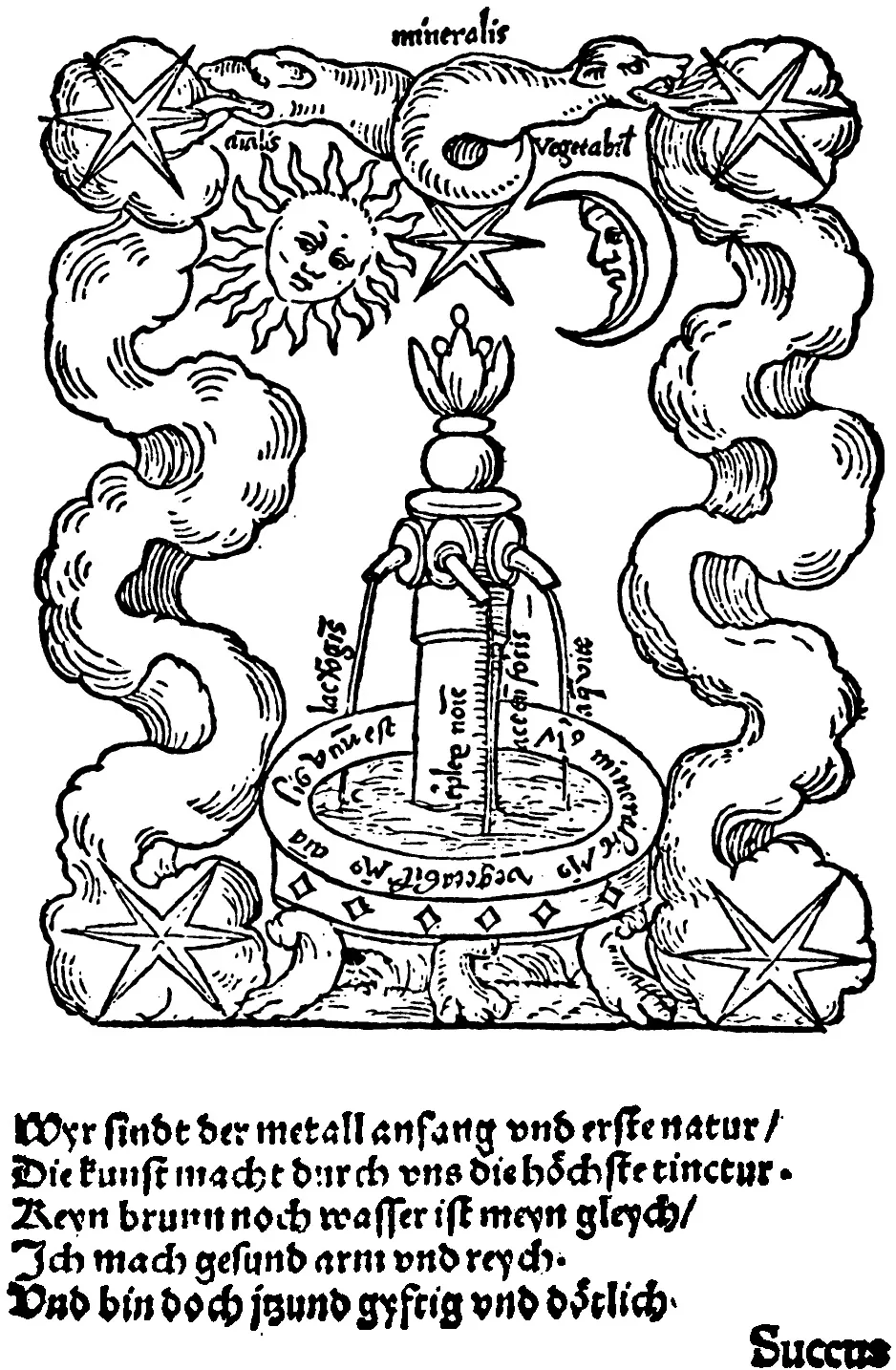
The highest tincture of the Art is made through us.
No fountain and no water has my like/
I make both rich and poor both whole and sick.
For healthful can I be and poisonous.1
[Figure 1]
402This picture goes straight to the heart of alchemical symbolism, for it is an attempt to depict the mysterious basis of the opus. It is a quadratic quaternity characterized by the four stars in the four corners. These are the four elements. Above, in the centre, there is a fifth star which represents the fifth entity, the “One” derived from the four, the quinta essentia. The basin below is the vas Hermeticum, where the transformation takes place. It contains the mare nostrum, the aqua permartens or
the “divine water.” This is the mare tenebrosum, the chaos. The vessel is also called the uterus2 in which the foetus spagyricus (the homunculus) is gestated.3 This basin, in contrast to the surrounding square, is circular, because it is the matrix of the perfect form into which the square, as an imperfect form, must be changed. In the square the elements are still separate and hostile to one another and must therefore be united in the circle. The inscription on the rim of the basin bears out this intention. It runs (filling in the abbreviations): “Unus est Mercurius mineralis, Mercurius vegetabilis, Mercurius animalis.” (Vegetabilis should be translated as “living” and animalis as “animate” in the sense of having a soul, or even as “psychic.”4) On the outside of the basin there are six stars which together with Mercurius represent the seven planets or metals. They are all as it were contained in Mercurius, since he is the pater metallorum. When personified, he is the unity of the seven planets, an Anthropos whose body is the world, like Gayomart, from whose body the seven metals flow into the earth. Owing to his feminine nature, Mercurius is also the mother of the seven, and not only of the six, for he is his own father and mother.5
403Out of the “sea,” then, there rises this Mercurial Fountain, triplex nomine, as is said with reference to the three manifestations of Mercurius.6 He is shown flowing out of three pipes in the form of lac Virginis, acetum fontis, and aqua vitae. These are three of his innumerable synonyms. The aforementioned unity of Mercurius is here represented as a triad. It is repeatedly emphasized that he is a trinity, triunus or trinus, the chthonic, lower, or even infernal counterpart of the Heavenly Trinity, just as Dante’s devil is three-headed.7 For the same reason Mercurius is often shown as a three-headed serpent. Above the three pipes we find the sun and moon, who are the indispensable acolytes and parents of the mystic transformation, and, a little higher, the quintessential star, symbol of the unity of the four hostile elements. At the top of the picture is the serpens bifidus, the divided (or two-headed) serpent, the fatal binarius which Dorn defines as the devil.8 This serpent is the serpens mercurialis,9 representing the duplex natura of Mercurius. The heads are spitting forth fire, from which Maria the Copt or Jewess derived her “duo fumi.”10 These are the two vapours whose condensation11 initiates the process which leads to a multiple sublimation or distillation for the purpose of purifying away the mali odores, the foetor sepulcrorum,12 and the clinging darkness of the beginning.
ROSARIVM
Figure 1
404This structure reveals the tetrameria (fourfold nature) of the transforming process, already known to the Greeks. It begins with the four separate elements, the state of chaos, and ascends by degrees to the three manifestations of Mercurius in the inorganic, organic, and spiritual worlds; and, after attaining the form of Sol and Luna (i.e., the precious metals gold and silver, but also the radiance of the gods who can overcome the strife of the elements by love), it culminates in the one and indivisible (incorruptible, ethereal, eternal) nature of the anima, the quinta essentia, aqua permanens, tincture, or lapis philosophorum. This progression from the number 4 to 3 to 2 to 1 is the “axiom of Maria,” which runs in various forms through the whole of alchemy like a leitmotiv. If we set aside the numerous “chemical” explanations we come to the following symbolical ground-plan: the initial state of wholeness is marked by four mutually antagonistic tendencies—4 being the minimum number by which a circle can be naturally and visibly defined. The reduction of this number aims at final unity. The first to appear in the progression is the number 3, a masculine number, and out of it comes the feminine number 2.13 Male and female inevitably constellate the idea of sexual union as the means of producing the 1, which is then consistently called the filius regius or filius philosophorum.
405The quaternity14 is one of the most widespread archetypes and has also proved to be one of the most useful schemata for representing the arrangement of the functions by which the conscious mind takes its bearings.15 It is like the crossed threads in the telescope of our understanding. The cross formed by the points of the quaternity is no less universal and has in addition the highest possible moral and religious significance for Western man. Similarly the circle, as the symbol of completeness and perfect being, is a widespread expression for heaven, sun, and God; it also expresses the primordial image of man and the soul.16 Four as the minimal number by which order can be created represents the pluralistic state of the man who has not yet attained inner unity, hence the state of bondage and disunion, of disintegration, and of being torn in different directions—an agonizing, unredeemed state which longs for union, reconciliation, redemption, healing, and wholeness.
406The triad appears as “masculine,” i.e., as the active resolve or agens whose alchemical equivalent is the “upwelling.” In relation to it the dyad is “feminine,” the receptive, absorbent patiens, or the material that still has to be formed and impregnated (information impraegnatio). The psychological equivalent of the triad is want, desire, instinct, aggression and determination, whereas the dyad corresponds to the reaction of the psychic system as a whole to the impulse or decision of the conscious mind. This would of course perish of inanition if it did not succeed in overcoming the inertia of the merely natural man and in achieving its object despite his laziness and constant resistance. But by dint of compulsion or persuasion the conscious mind is able to carry through its purpose, and only in the resultant action is a man a living whole and a unity (“In the beginning was the deed,” as Faust says)17—provided that the action is the mature product of a process embracing the whole psyche and not just a spasm or impulse that has the effect of suppressing it.
407At bottom, therefore, our symbolical picture is an illustration of the methods and philosophy of alchemy. These are not warranted by the nature of matter as known to the old masters; they can only derive from the unconscious psyche. No doubt there was also a certain amount of conscious speculation among the alchemists, but this is no hindrance whatever to unconscious projection, for wherever the mind of the investigator departs from exact observation of the facts before it and goes its own way, the unconscious Spiritus rector will take over and lead the mind back to the unchangeable, underlying archetypes, which are then forced into projection by this regression. We are moving here on familiar ground. These things are depicted in the most magnificent images in the last and greatest work of alchemy—Goethe’s Faust. Goethe is really describing the experience of the alchemist who discovers that what he has projected into the retort is his own darkness, his unredeemed state, his passion, his struggles to reach the goal, i.e., to become what he really is, to fulfil the purpose for which his mother bore him, and, after the peregrinations of a long life full of confusion and error, to become the filius regius, son of the supreme mother. Or we can go even further back to the important forerunner of Faust, the Chymical Wedding of Christian Rosencreutz (1616), which was assuredly known to Goethe.18 Fundamentally it is the same theme, the same “Axioma Mariae,” telling how Rosencreutz is transformed out of his former unenlightened condition and comes to realize that he is related to “royalty.” But in keeping with its period (beginning of the seventeenth century), the whole process is far more projected and the withdrawal of the projection into the hero—which in Faust’s case turns him into a superman19—is only fleetingly hinted at. Yet the psychological process is essentially the same: the becoming aware of th...
Table of contents
Cover Page
Title Page
Copyright Page
Dedication
Editorial Note
Table of Contents
List of Illustrations
Foreword
Introduction
An Account of the Transference Phenomena Based on the Illustrations to the “Rosarium philosophorum”
1. The Mercurial Fountain
2. King and Queen
3. The Naked Truth
4. Immersion in the Bath
5. The Conjunction
6. Death
7. The Ascent of the Soul
8. Purification
9. The Return of the Soul
10. The New Birth
Epilogue
Bibliography
Index
Contents of the Collected Works
Trusted by 375,005 students
Access to over 1.5 million titles for a fair monthly price.
Study more efficiently using our study tools.
Frequently asked questions
Yes, you can cancel anytime from the Subscription tab in your account settings on the Perlego website. Your subscription will stay active until the end of your current billing period. Learn how to cancel your subscription
No, books cannot be downloaded as external files, such as PDFs, for use outside of Perlego. However, you can download books within the Perlego app for offline reading on mobile or tablet. Learn how to download books offline
Perlego offers two plans: Essential and Complete
Essential is ideal for learners and professionals who enjoy exploring a wide range of subjects. Access the Essential Library with 800,000+ trusted titles and best-sellers across business, personal growth, and the humanities. Includes unlimited reading time and Standard Read Aloud voice.
Complete: Perfect for advanced learners and researchers needing full, unrestricted access. Unlock 1.5M+ books across hundreds of subjects, including academic and specialized titles. The Complete Plan also includes advanced features like Premium Read Aloud and Research Assistant.
Both plans are available with monthly, semester, or annual billing cycles.
We are an online textbook subscription service, where you can get access to an entire online library for less than the price of a single book per month. With over 1.5 million books across 990+ topics, we’ve got you covered! Learn about our mission
Look out for the read-aloud symbol on your next book to see if you can listen to it. The read-aloud tool reads text aloud for you, highlighting the text as it is being read. You can pause it, speed it up and slow it down. Learn more about Read Aloud
Yes! You can use the Perlego app on both iOS and Android devices to read anytime, anywhere — even offline. Perfect for commutes or when you’re on the go. Please note we cannot support devices running on iOS 13 and Android 7 or earlier. Learn more about using the app
Yes, you can access Psychology of the Transference by C. G. Jung, R. F.C. Hull, R. F.C. Hull,R. F. C. Hull in PDF and/or ePUB format, as well as other popular books in Psicologia & Psicoanalisi. We have over 1.5 million books available in our catalogue for you to explore.