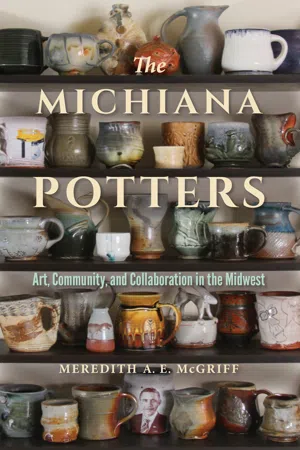
A new pottery tradition has been developing along the border of northern Indiana and southern Michigan. Despite the fact that this region is not yet an established destination for pottery collectors, Michiana potters are committed to pursuing their craft thanks to the presence of a community of like-minded artists. The Michiana Potters, an ethnographic exploration of the lives and art of these potters, examines the communal traditions and aesthetics that have developed in this region. Author Meredith A. E. McGriff identifies several shared methods and styles, such as a preference for wood-fired wares, glossy glaze surfaces, cooler colors, the dripping or layering of glazes on ceramics that are not wood-fired, the handcrafting of useful wares as opposed to sculptural work, and a tendency to borrow forms and decorative effects from other regional artists. In addition to demonstrating a methodology that can be applied to studies of other emergent regional traditions, McGriff concludes that these styles and methods form a communal bond that inextricably links the processes of creating and sharing pottery in Michiana.
eBook - ePub
The Michiana Potters
Art, Community, and Collaboration in the Midwest
- 288 pages
- English
- ePUB (mobile friendly)
- Available on iOS & Android
eBook - ePub
About this book
Information
Publisher
Indiana University PressYear
2020Print ISBN
9780253049643
9780253049643
eBook ISBN
9780253052407
ONE
MICHIANA CONNECTIONS: AN INTRODUCTION
SERENDIPITY
I once heard serendipity described as “the joy of hitting a target you didn’t know you were aiming for”—hopefully one day someone will point me to the source of this apt description. Certainly it is one I can relate to, as my research has had many such moments over the years. I did not set out to study the potters who make wood-fired pottery, nor did I plan to focus my research on the American Midwest. However, I was born and raised in Indiana and enjoyed playing with clay as a child, and I believe my background allowed several chance meetings and unexpectedly helpful connections to lead me to this area of research and, ultimately, the completion of this book. I’ll begin with my journey in order to give readers some background on my own positionality within the worlds of ceramics and folklore, particularly regarding how I found my way to the potters of Michiana.
I first learned of Dick Lehman’s work in clay around twenty years ago, when I was preparing to travel to Japan as a high school exchange student. By that point in my life I had a little experience with ceramics and certainly some enthusiasm for making art, but my knowledge of the big names in American pottery was essentially nonexistent. Dick’s son Scott Lehman was also participating on that trip to Japan, and Scott and I became good friends through the course of our travels; we even stayed in touch for a few years afterward. I can vaguely recall meeting Dick at one of the orientation meetings in preparation for the trip, and I remember learning that he was a potter and had connections to Japanese potters. I had recently spent some time with clay and greatly enjoyed it, so I was intrigued to learn of his profession. The memory of that encounter stayed with me, even as I eventually lost touch with Scott and our journey to Japan became a more distant—yet very fond—memory. I subsequently heard Dick Lehman’s name at various points throughout the years, from my teachers in ceramics, other potters at art fairs, and so on, but it was not until much later that I would realize the serendipitous connection we had made.
In the intervening years between high school and graduate school, I became more and more enthusiastic about pottery. I learned to fire pots in both the Japanese and American styles of raku and completed a BFA in ceramics and a BA in Japanese language and culture. I toyed with the idea of becoming a full-time artist and participated in art fairs and occasional juried shows. About a year after graduating from Ball State University, I spent a month in Japan making pots at the Shigaraki Ceramic Cultural Park, called Togei no Mori in Japanese (fig. 1.1). This was a further bit of serendipity; I would later learn that one of Dick’s good friends is a wood-firing potter in the town of Shigaraki, and Dick has visited him there. In addition, Merrill Krabill, Goshen College’s current ceramics professor, worked as an artist-in-residence at Shigaraki around the same time I was there (although our stays did not overlap); when I interviewed Merrill in the course of my research into the Michiana pottery community, we reminisced about our mutual experiences at Shigaraki.
While I had an enthusiastic beginning to my ceramics career in my twenties, and I still make and sell pottery and sculpture on occasion, these days I find my interest in ceramics is more of an academic one. I entered graduate school intending to analyze the cross-cultural contexts of raku, since it had been for many years my own focus within the world of ceramics. When I finally began the project of interviewing Indiana potters in early 2012, I was working on my MA in folkloristics at Indiana University, and I (like many beginning ethnographers before me) had little idea where such a project could lead. But fate took its course, and I soon reconnected with Scott and Dick Lehman, beginning new friendships after so many years and unknowingly starting down a path that eventually led to the book that lies before you now (fig. 1.2).
The bulk of my research for this book was conducted in collaboration with Traditional Arts Indiana (TAI), an organization committed to “expanding public awareness of Indiana’s traditional practices and nurturing a sense of pride among Indiana’s traditional artists. It calls attention to neglected aesthetic forms that firmly ground and deeply connect individuals to their communities,” a goal they accomplish through documentation, archival work, and public programming (Traditional Arts Indiana, n.d.). My role as a fieldworker for TAI was predominantly on the Indiana Potters Survey, a project I developed in 2012 that entailed surveying professional potters and pottery ateliers around the state of Indiana. The project began as a practicum, developed after conversations with director Jon Kay about my desire to possibly work in public folklore and my existing knowledge of ceramics. He thus suggested I might find some way to work with current potters in the state.

Fig. 1.1. Part of the Shigaraki Ceramic Cultural Park (Togei no Mori) facility in Japan. (Photo by author)
Little did I know what an extensive and rewarding endeavor that would turn out to be. Between early 2012 and 2016, my fieldwork and documentation for the Indiana Potters Survey involved recording audio interviews as well as photographing the artists, studio spaces, processes used, and completed artwork. My focus in the survey was on production potters, by which I mean potters who create functional pottery in large quantities, who usually work full-time making ceramic wares, and who are generally creating items that are thrown on the wheel and glazed and fired in such a way as to be useful in everyday life.

Fig. 1.2. Scott and Dick Lehman, just after unloading Mark Goertzen’s kiln in July 2013. (Photo by author)

Map 1.1. Map showing towns and counties in Indiana and Michigan that may be included in the Michiana designation. (Map created by the author)
To date, I have sat down for formal interviews with about twenty potters around the state of Indiana, many of whom live in Michiana. For outsiders, Michiana is often an unfamiliar word; bringing together the names of two states, it describes an informal regional designation centered around the border of northern Indiana and southern Michigan.1 The extent of the region is ambiguous, but the main towns where the potters featured here have lived and worked include Elkhart, Goshen, Middlebury, and South Bend in Indiana as well as Cassopolis, Three Rivers, and Constantine in Michigan (see map 1.1). However, it is also important to note that while their addresses may indicate these cities or towns, most of the potters choose more rural properties that lie on the outskirts rather than in the town proper. For those familiar with the landscape of the American Midwest, the scenery encountered while driving through Michiana is easily recognizable: flat plains and gently rolling hills, large plots of farmland dotted with old farmhouses and gambrel-roofed barns, and occasional densely wooded areas (crucial for providing the wood for wood firing, which will be discussed in more detail in chap. 3).2 Rivers and small lakes are also in abundance in certain parts of the landscape, and both summer homes and full-time residences often line these little waters. Fishing, canoeing, and other watersports are popular pastimes with many residents, including the potters, many of whom are avid fishermen or sailors in their spare time.
My first introduction to the potters of Michiana came early in my fieldwork, when I interviewed Tom Unzicker—a former resident of Goshen and graduate of both Goshen College and Indiana University—for the Potters Survey. At the time of our interview in April 2012, Tom and his brother Jeff were the proprietors of Unzicker Bros. Pottery in Thornton, Indiana, where they made and sold large wood-fired vessels along with some smaller wood-fired tableware and serving dishes. During our interview, Tom mentioned having worked with Dick Lehman and Dick’s former apprentice Mark Goertzen in Goshen, Indiana. Hearing Dick’s familiar name, I decided I could not pass up the opportunity to reconnect with old friends, so I contacted Dick, Scott, and Mark (who now owns and runs Dick’s former studio in Goshen) to arrange a visit. In August 2012, I travelled to Goshen to interview both Dick and Mark for the TAI project; both welcomed me graciously into their studios and spoke quite enthusiastically about their work in clay. As it turned out, my visit was timed quite serendipitously; the very first Michiana Pottery Tour would be held the following month, and I learned about it just in time to plan a return trip. Both Mark and Dick had a hand in planning the tour, and both strongly recommended that I come back at the end of September to experience it. Upon my return I spent a wonderful day visiting the many potters who were participating in the tour, and I soon began to realize the extent of the pottery community within this region. On the tour’s eight stops, I encountered potter after potter creating beautiful wood-fired pottery (and many who worked with other techniques as well). Afterward, it occurred to me that there were an astonishing number of potters working full-time in this area, and yet, in my experience, so few people outside of the world of contemporary American pottery—and indeed, few within it—seemed to realize that such a cohesive group existed in northern Indiana; as a longtime resident of Indiana and a ceramic artist myself, I was astonished I had never heard mention of the extent of the ceramic work being done in that region. I was intrigued, to say the least, and thus returned time and again to Michiana to interview more of the potters, to learn about their stories and their art. Admittedly, I began to neglect my larger survey of Indiana potters in favor of learning more about those in this specific region.

Fig. 1.3. Pottery studio from the 2014 exhibit “Melted Ash: Michiana Wood-Fired Pottery” at the Mathers Museum of World Cultures. (Photo by author)
My return trips to Michiana over the course of the next year culminated in my curation of an exhibit at the Mathers Museum of World Cultures in Bloomington, Indiana, called “Melted Ash: Michiana Wood-Fired Pottery.” This exhibit opened in August and closed in December 2013 and featured a hands-on mock potter’s studio that illustrated pottery-making processes (fig. 1.3), a full-scale model of the front portion of a wood-fired kiln (fig. 1.4), written and pictorial descriptions of the wood-firing process, and a display of pottery from four of the full-time production potters in Michiana—Dick Lehman, Mark Goertzen, Todd Pletcher, and Justin Rothshank—whom I had identified as being central to the wood-firing tradition and who were, fortunately, able to participate. An additional and rather unique aspect of the exhibit was the inclusion of an area where visitors were given the opportunity to physically pick up and engage with handmade functional pots. The tangible exhibit at the Mathers Museum was accompanied by a corresponding online exhibit through the Traditional Arts Indiana digital archive, titled “Beyond Melted Ash,” which also focused on the Michiana wood-firing tradition.

Fig. 1.4. Model of the front of a wood kiln from the 2014 exhibit “Melted Ash: Michiana Wood-Fired Pottery” at the Mathers Museum of World Cultures. (Photo by author)
In conjunction with these two exhibits, I also organized “Stoking the Fire: A Contemporary Pottery Symposium,” a one-day event in November 2013 that brought together potters, students, and scholars from around the Midwest to engage in conversations about clay as a medium, the wood-firing process, and the significant human connections that are made through creating pots. I was pleased that many Michiana potters were able to participate, and while I originally envisioned the symposium would appeal primarily to Indiana potters and/or those within a relatively short driving distance from Bloomington, I was surprised and pleased to receive a panel proposal that included Keith Ekstam, professor of art and design at Missouri State University; Dale Huffman, professor of art and chair of the Art Department at Carlow University in Pittsburgh, Pennsylvania; and two potters (Dick Lehman and Zach Tate) from the Michiana area. Both Keith and Dale are close friends with potters in Michiana and have collaborated with them on numerous wood firings over the years, and each of them brought a group of students to attend the symposium. Todd Pletcher and Bill Kremer were also able to travel from Michiana to be part of the symposium. A wide range of topics was covered, including personal commentaries about experiences making pottery, international encounters, experiences with different kinds of ceramics-oriented communities, the collaborative nature of wood firing, and overviews of a few regional pottery traditions outside of Michiana. As the primary organizer of the event as well as the exhibit curator, I was happy to have the opportunity to bring together so many pottery enthusiasts from around the Midwest. Overall, the experience fueled my desire to continue my research in the Michiana area and to further explore the sense of community developed among potters.
The following pages concern my research with these Michiana potters, which began in 2012, continued in earnest through 2016, and is still ongoing (though not as intense as it once was) as I finish writing this book in 2018—I imagine my connection with the people of this area will be a lifelong one. Throughout this time, I have been engaged in tracing the development of a thriving regional group of artisans and what Mark Goertzen has designated the Michiana Aesthetic, a set of ideal characteristics sought by many of the Michiana potters. Considering wood-firing results, the Michiana Aesthetic generally refers to a preference for heavy natural-wood-ash deposits and glossy glaze surfaces and a tendency toward cooler rather than warmer colors. However, as I will explain in later chapters, additional aesthetic elements also tend to show up even in ceramic work that is not wood-fired, including dripping or layered glazes, and forms and decorative effects the potters have borrowed from one another through working together.
Going beyond the visual, the term Michiana Aesthetic also functions as a signifier of community; the desire to seek similar visual elements in their pottery is a bonding point around which potters can (and often do) gather. This is particularly clear when they come together to fire a wood kiln that contains pieces made by many potters, sharing in the work of firing while working toward similar wood-fired effects on all their pots. While Mark, Dick, and others in the group have primarily used the Michiana Aesthetic as an indicator of these effects found on their pottery, I have expanded the term to encompass much broader aesthetic values, including ways of living, preferences in modes of display, and shared values and dispositions in their everyday lives.
In this aesthetic movement in Michiana, process and community are inextricably linked, as each supports the other. The presence of strong mentors (in the local schools, ateliers, and clay guild) instills an enthusiasm for pottery and allows for the training of new generations of potters; at the same time, the availability of energetic apprentices allows production potters to make and sell more work, and passionate students make teachers’ jobs more enjoyable. Successful wood firing is dependent upon a dedicated group of potters to care for the kiln, and when coming together around the kiln, friendships are often strengthened, resulting in the mutual desire to fir...
Table of contents
- Cover
- Title Page
- Copyright
- Contents
- Acknowledgments
- 1 Michiana Connections: An Introduction
- 2 Education, Identity, and Vocational Habitus
- 3 The Collaborative Process of Wood Firing and The Michiana Aesthetic
- 4 Collection Practices: Maintaining the Aesthetic
- 5 More Than Pottery in Michiana; More Than Michiana in Pottery
- 6 The Potter’s Work: Conclusions
- Epilogue: Constant Change
- Appendix I: Michiana Pottery Tour Maps
- Appendix II: Apprentices, Assistants, and/or Interns
- Works Cited
- Index
Trusted by 375,005 students
Access to over 1.5 million titles for a fair monthly price.
Study more efficiently using our study tools.
Frequently asked questions
Yes, you can cancel anytime from the Subscription tab in your account settings on the Perlego website. Your subscription will stay active until the end of your current billing period. Learn how to cancel your subscription
No, books cannot be downloaded as external files, such as PDFs, for use outside of Perlego. However, you can download books within the Perlego app for offline reading on mobile or tablet. Learn how to download books offline
Perlego offers two plans: Essential and Complete
- Essential is ideal for learners and professionals who enjoy exploring a wide range of subjects. Access the Essential Library with 800,000+ trusted titles and best-sellers across business, personal growth, and the humanities. Includes unlimited reading time and Standard Read Aloud voice.
- Complete: Perfect for advanced learners and researchers needing full, unrestricted access. Unlock 1.5M+ books across hundreds of subjects, including academic and specialized titles. The Complete Plan also includes advanced features like Premium Read Aloud and Research Assistant.
We are an online textbook subscription service, where you can get access to an entire online library for less than the price of a single book per month. With over 1.5 million books across 990+ topics, we’ve got you covered! Learn about our mission
Look out for the read-aloud symbol on your next book to see if you can listen to it. The read-aloud tool reads text aloud for you, highlighting the text as it is being read. You can pause it, speed it up and slow it down. Learn more about Read Aloud
Yes! You can use the Perlego app on both iOS and Android devices to read anytime, anywhere — even offline. Perfect for commutes or when you’re on the go.
Please note we cannot support devices running on iOS 13 and Android 7 or earlier. Learn more about using the app
Please note we cannot support devices running on iOS 13 and Android 7 or earlier. Learn more about using the app
Yes, you can access The Michiana Potters by Meredith A. E. McGriff in PDF and/or ePUB format, as well as other popular books in Social Sciences & Decorative Arts. We have over 1.5 million books available in our catalogue for you to explore.