- 532 pages
- English
- ePUB (mobile friendly)
- Available on iOS & Android
eBook - ePub
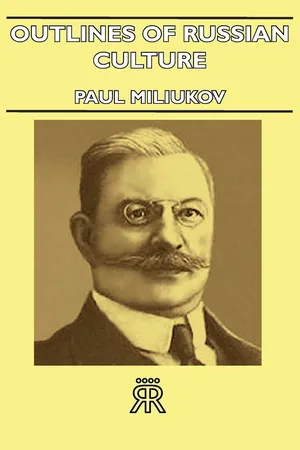
Outlines Of Russian Culture
About this book
Many of the earliest books, particularly those dating back to the 1900s and before, are now extremely scarce and increasingly expensive. We are republishing these classic works in affordable, high quality, modern editions, using the original text and artwork.
Information
RELIGION AND THE CHURCH
CONTENTS
AUTHOR’S PREFACE
EDITOR’S FOREWORD
I THE BEGINNINGS OF CHRISTIANITY IN RUSSIA
II NATIONALIZATION OF FAITH AND CHURCH
III THE ORIGIN OF THE SCHISM
IV DISSENT AMONG THE SCHISMATICS AND THE HISTORY OF THE PRIESTISTS
V THE HISTORY OF THE PRIESTLESS AND THE DISCORD IN THEIR RANKS
VI THE DEVELOPMENT OF RUSSIAN SECTARIANISM
VII THE DESTINY OF THE ESTABLISHED CHURCH
VIII THE CHURCH DURING THE REVOLUTION
EDITOR’S POSTSCRIPT
BIBLIOGRAPHY
INDEX
I
THE BEGINNINGS OF CHRISTIANITY IN RUSSIA
THE cultural influence of the church and religion absolutely predominated in the earlier periods of Russian history, as it usually does with all peoples in an identical stage of development. Nevertheless there was, and still exists, a widespread opinion that the prevailing influence of the church was specifically the national peculiarity of the Russian people. There were two divergent views regarding this peculiarity. The forebears of Slavophilism ascribed to it all the virtues of Russian life. They believed that devotion to the will of God, humility, the love of neighbor, and spiritual contemplation, constituting the very substance of Christian ethics, were eminently natural to the Russian character. In the complete accord of the Christian and national virtues they saw the assurance of a great future to the Russian people. The intellectuals of the eighteen-nineties also attempted to revive this idea, and gained an unexpected influence over the émigré youth of the twentieth century who were reared under the impressions of war and revolution.
The other view ascribed to this peculiarity all the shortcomings of Russian life. It found its most vivid expression in the writings of Chaadaev.1 If Russia lags behind Europe, if its past is sad and its future dark, if it runs the risk of remaining for ages frozen in its Chinese immobility, it is due to corrupted Byzantium. From this poisoned source Russia adopted the great Christian conception, whose vital force was severed at its root by Byzantine formalism. Actually the influence of the Byzantine church on Russian culture was great, but it was a destructive influence.
These two conflicting views agree on one point: the recognition of the great cultural importance of a definite religious form. We shall not analyze this point of view in its essence. Regardless of our opinion, the fact is obvious that, to exert its greatest influence on life, the most lofty, the most perfect religious principle must be assimilated more or less fully and consciously. Yet even the Slavophils admitted, through Khomiakov, their most outstanding representative and theological authority, that it was a great idealization of its past to describe ancient Russia as truly Christian. According to Khomiakov’s sound opinion, ancient Russia had assimilated only the external form—the ritual, not the spirit and substance of Christian faith. Consequently, religion could not exert either as beneficent or as deterring an influence on the development of Russian nationality as the Slavophils and Chaadaev supposed. Since then the views of Khomiakov have been generally adopted and are to be found in the textbooks on the history of the church.
Thus to accept without further examination the Russian nationality as truly Christian would greatly exaggerate the extent of true Christianity the Russians were able to assimilate. An equal exaggeration of the influence of religion would be to charge it with Russia’s backwardness. This backwardness had other purely organic reasons, the effect of which extended to religion itself. The new religion was not only unable to build up the Russian mentality, but on the contrary it suffered from the primitiveness of this mentality. While holding different views on the Byzantine form of religious faith assumed by Russia, it is impossible to deny the fact that in its essence this faith surpassed anything which the Russian people of those days could have assimilated.
The substance of Byzantine Orthodoxy,2 as first adopted, can be judged from a very instructive and valuable document. The religion introduced by St. Vladimir about 990 found many ardent spirits who rushed passionately towards the new “spiritual aliment” eager to partake of the viands of the Byzantine holy feast. In the still pagan Russia there were established pure types of oriental monasticism, hermitical life, reclusion, imitation of Simeon Stylites,3 and many other varieties of corporal self-torture. In the wake of the first pioneers of the new religion came their followers, ever increasing in numbers though not always perhaps as ardent and devoted to asceticism. As usual the fervent inspiration that swayed the ranks of “Christian Warriors” produced an intensive creative power. The last representatives of a generation which had witnessed Russia’s conversion had scarcely died when a reverent legend about their lives began to pass from mouth to mouth and later was written down for the instruction of posterity. These writings have preserved to the present time the pregnant memory of the first spiritual upheaval in Russia, when the most pious members of the community joined the founders of Russian asceticism at the Pechersky Monastery, near Kiev, for a united effort. Somewhat later these records were collected in a volume, and form the famous Paterikon (Lives of the Pechersky Fathers), which for a long time was the most popular and favorite book with the masses. The extent of this upheaval in Russia, where paganism had recently been abandoned, can be judged from the traditions in the Paterikon.
It must not be forgotten that the ascetic of today was but yesterday one of the community, though ranking among its best members. Having shed the old Adam, he could not with one stroke destroy the old pagan and barbarian within himself. Like Abbot Theodosius, with his powerful, physically strong constitution, the monks were accustomed to endure the discomforts of an uncultured existence, and physical labor was habitual to them. Cutting wood and dragging it to the monastery, carrying water, working as carpenters, grinding meal, or helping in the kitchen meant to the brethren only a continuation behind the monastery walls of the same occupations to which they had been applying themselves in the outside world. The real test came with the deprivation of food and sleep, therefore the struggle against natural desires—the fasting and vigils—was considered the greatest spiritual achievement and was attained only by a chosen few who were held in general esteem. For the majority of the brethren the Abbot, though very strict, had to introduce a day-rest instead of a night-rest. At noon the gates of the monastery were closed and the brethren sank into sleep. In spite of this not many could endure the “stalwart standing” in church at night. According to the Paterikon, during one of these “standings” Brother Matthew, famed for clairvoyance, saw the devil dressed as a Pole walking in church and throwing flowers at the brethren. The one to whom a flower clung stood for awhile and then, weakening in spirit, would walk out of the church and into his cell to sleep. Brother Matthew always stood stalwartly to the end of the matins though even for him it was not easy, but once on leaving the church after the matins he was unable to reach his cell and sitting down under the wooden gong used for calling the brethren to church, he fell asleep.
The struggle was great for an ascetic resolved to overcome the temptations, for, only yesterday a pagan, he could not at once free himself of the old beliefs, and in his imagination the natural desires became snares laid for him by the evil force. The demons were to him ancient pagan deities, provoked at the young generation and resolved to avenge themselves for the betrayal of the old religion. In the words of one of the writers of the Paterikon, “the demons, worshiped and venerated by the pagans of old, intolerant of the insult, cried: ‘O wicked enemies, we shall not be placated, we shall fight you unto death!’ ” Then the great struggle began. Night was the most favorable time for diabolic temptations, because the monk at this time was particularly weak, while the foe—in league with the desires of the flesh and the terrors of the night—was particularly strong. The ascetic, worn out with fatigue but resisting the desire to lie down “on the ribs,” would occasionally sit and indulge in a nap. The demons, in the form of fierce dragons familiar to folklore, breathing fire and sparks, would appear before the ascetic, threatening to demolish the walls of his cell and pervading his solitude with shouts, roars of driving chariots, and the strains of diabolical music. Even to the fearless and sober Abbot Theodosius, during the early days of his monastic life, the devil appeared in the shape of a black dog that stood stubbornly before him preventing him from genuflecting until the holy one had courage to strike it, when the apparition vanished. From personal experience the Abbot was convinced that the best means of struggling against the night apparitions was the resistance to the terrors they inspired, and this advice he gave to the brethren. When Brother Hilarion, being pursued at night by the demons, came to Theodosius entreating that he be transferred to another cell, the Abbot administered him a severe reprimand, and the following night Hilarion “lay down in his cell and slept soundly.” However, the struggle did not always end so easily. Thus Brother Isaac lost his mind after seeing one of these apparitions.
It required great effort to overcome the diabolic temptations and desires of the flesh, and on this struggle the most fervent of the ascetics spent their force. This initial step of spiritual effort had but a preparatory significance in the scale of Christian ascetic exercises, yet the most perfect of the Pechersky ascetics could not rise above it. The Kiev ascetics had no clear conception of the higher forms of active and contemplative asceticism, and that which should have been only the method—the liberation of the spirit from earthly aspirations and thoughts—by necessity became to the brethren of the Pechersky Monastery the sole object. Their undisciplined natures did not subject themselves easily to insistent and conscientious efforts. Men with the will power and common sense of the Pechersky Abbot succeeded, indeed, in attaining a sound spiritual balance, but in its establishment too great and important a part was assigned to the external discipline of the mind and will. Because of this discipline Russian ascetics became outstanding administrators, most needed at that time, rather than great torch bearers of Christian sentiment and thought.
Thought was assigned a very humble place at the Pechersky Monastery. We find in the monastic records that when either Brother Hilarion or Brother Nikon was employed in transcribing books, the Abbot sat beside him “spinning fleece” or preparing the thread for bookbinding. Diligent work on books was frowned upon by the brethren, for spiritual pride could easily result from knowledge. In one of the Pechersky legends the love of reading was represented characteristically as a means of diabolical temptation. To one of the brethren, Nikita the Anchorite, the devil appeared in the form of an angel and said: “Thou must not pray but read books; through them thou shalt hold communion with the Lord
abolished fasting on Wednesday and Friday when it coincided with a holiday.
Under the circumstances the immediate influence of the torch bearers of piety in the Pechersky Monastery upon the surrounding world was considerably smaller than that which the pious Kiev legend proved to have on posterity. Only upon the upper classes of their contemporary society could the monastic ascetics exert any influence but even there the monks resolutely observed the commandment, “Render therefore unto Caesar the things which are Caesar’s,” and welcomed a prince “as befits a prince” and a boiarin “as befits a boiarin.” When Abbot Theodosius interfered in the conflict between the princes and tried to persuade Prince Sviatoslav to give back to his elder brother the throne which he had illegally usurped, and in return the Prince threatened to banish him, the brethren entreated their superior to cease his pastoral admonitions. Sometimes the Prince would come to the monastery and listen to the edifying discourses, but if he ever was guided by the monastic advice in his private life his conscience alone could tell. The upper classes, however, did not turn to the monastery even for enlightenment, all they required of an Orthodox priest or monk was what they formerly received from the pagan magi.
The Paterikon recounts that one day the people from a village belonging to the monastery came and begged the Abbot to expel the house demon from the stall where he was wasting away the cattle. Pagan deities did not cease to exist for a Christian of those days; they were merely transformed into demons and the struggle against them became his immediate duty. So the Pechersky Abbot answered the villagers’ call, went to the village, and mindful of the word of the Lord: “Howbeit this kind goeth not out but by prayer and fasting,” spent the night in the stall in prayer until the break of day, and from that time on all the mischiefs of the house demon ceased.
Such was the condition of religious faith in Russia soon after the conversion, and having familiarized ourselves with the humble beginnings of Russian piety we must now turn to its further development.
1 Russian religious thinker of the early nineteenth century.—ED.
2 The term “Orthodoxy” is used throughout this study in its specific sense, to designate Eastern Christianity as distinguished from Roman Catholicism.—ED.
3 The famous Syrian ascetic of the fifth century who was reputed to have spent many years on top of a pillar.—ED.
II
NATIONALIZATION OF FAITH AND CHURCH
IN the early period after the conversion Russian society was divided into two very unequal parts. A small group of people strove eagerly to reproduce in Russia the subtleties of Eastern religion, but the mass of the population, while Christian in name, remained pagan. For a long time two circumstances prevented them both from drawing closer and understanding each other. First, the new faith descended upon Russia with the traits of asceticism, and the Christian ideal it advanced was specifically monastic. This ascetic ideal was foreign and too exalted for the world, whereas the world was too unrighteous and fraught with peril for the ascetic ideal. The only means of safeguarding the purity of that ideal was to escape from the world, therefore monasticism became an indispensable requisite to Christian perfection and every true Christian yearned to retire from the worldly surroundings, which were contrary to his ideal. Second, notwithstanding a most sincere mutual desire to enlighten and be enlightened, it was a difficult task to accomplish. All this led to the dissociation of the laity and clergy. From the early days the Russians could have acquired knowledge of faith from the kindred Slavonic (Bulgarian) source, but until the period of the Mongol domination most of their metropolitans and bishops were Greeks sent from Constantinople and ignorant of the Russian language. Little by little this difficulty was overcome and the learned Greeks were replaced by Russian bishops competent to talk to the parishioners without interpreters, and able to expose their shortcomings in a style comprehensible to all and not based on the principles of Byzantine rhetorics. Yet here a new difficulty presented itself: the Russian priests were little qualified to be teachers. Under these conditions centuries passed, but the spiritual education of the people gained ground very slowly, because the decline in the standard of the priests was more rapid than the rise in that of the masses. The decline in the cultural level and the lessening of piety in the upper clergy is a fact as generally acknowledged by the Russian historians of the church as it is easily explained. Turning away gradually from Byzantium and being deprived of the constant influx of the Greek spiritual force, Russia had not yet the educational means sufficient to replace the ...
Table of contents
- Cover
- Half title
- Title
- Copyright
- Author’s Preface
- Editor’s Foreword
- Part I Religion and the Church
- Part II Literature
- Part III Architecture, Painting, and Music
Trusted by 375,005 students
Access to over 1.5 million titles for a fair monthly price.
Study more efficiently using our study tools.
Frequently asked questions
Yes, you can cancel anytime from the Subscription tab in your account settings on the Perlego website. Your subscription will stay active until the end of your current billing period. Learn how to cancel your subscription
No, books cannot be downloaded as external files, such as PDFs, for use outside of Perlego. However, you can download books within the Perlego app for offline reading on mobile or tablet. Learn how to download books offline
Perlego offers two plans: Essential and Complete
- Essential is ideal for learners and professionals who enjoy exploring a wide range of subjects. Access the Essential Library with 800,000+ trusted titles and best-sellers across business, personal growth, and the humanities. Includes unlimited reading time and Standard Read Aloud voice.
- Complete: Perfect for advanced learners and researchers needing full, unrestricted access. Unlock 1.5M+ books across hundreds of subjects, including academic and specialized titles. The Complete Plan also includes advanced features like Premium Read Aloud and Research Assistant.
We are an online textbook subscription service, where you can get access to an entire online library for less than the price of a single book per month. With over 1.5 million books across 990+ topics, we’ve got you covered! Learn about our mission
Look out for the read-aloud symbol on your next book to see if you can listen to it. The read-aloud tool reads text aloud for you, highlighting the text as it is being read. You can pause it, speed it up and slow it down. Learn more about Read Aloud
Yes! You can use the Perlego app on both iOS and Android devices to read anytime, anywhere — even offline. Perfect for commutes or when you’re on the go.
Please note we cannot support devices running on iOS 13 and Android 7 or earlier. Learn more about using the app
Please note we cannot support devices running on iOS 13 and Android 7 or earlier. Learn more about using the app
Yes, you can access Outlines Of Russian Culture by Paul Miliukov in PDF and/or ePUB format, as well as other popular books in History & World History. We have over 1.5 million books available in our catalogue for you to explore.