A scholar of law and religion uncovers a surprising origin story behind the idea of the separation of powers.
The separation of powers is a bedrock of modern constitutionalism, but striking antecedents were developed centuries earlier, by Jewish scholars and rabbis of antiquity. Attending carefully to their seminal works and the historical milieu, David Flatto shows how a foundation of democratic rule was contemplated and justified long before liberal democracy was born.
During the formative Second Temple and early rabbinic eras (the fourth century BCE to the third century CE), Jewish thinkers had to confront the nature of legal authority from the standpoint of the disempowered. Jews struggled against the idea that a legal authority stemming from God could reside in the hands of an imperious ruler (even a hypothetical Judaic monarch). Instead scholars and rabbis argued that such authority lay with independent courts and the law itself. Over time, they proposed various permutations of this ideal. Many of these envisioned distinct juridical and political powers, with a supreme law demarcating the respective jurisdictions of each sphere. Flatto explores key Second Temple and rabbinic writings—the Qumran scrolls; the philosophy and history of Philo and Josephus; the Mishnah, Tosefta, Midrash, and Talmud—to uncover these transformative notions of governance.
The Crown and the Courts argues that by proclaiming the supremacy of law in the absence of power, postbiblical thinkers emphasized the centrality of law in the people's covenant with God, helping to revitalize Jewish life and establish allegiance to legal order. These scholars proved not only creative but also prescient. Their profound ideas about the autonomy of law reverberate to this day.
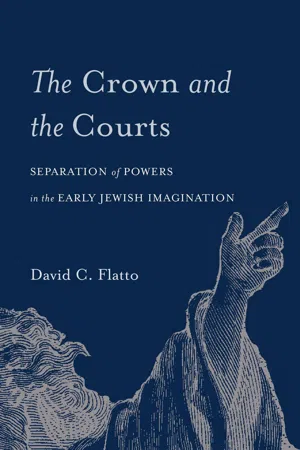
eBook - PDF
The Crown and the Courts
Separation of Powers in the Early Jewish Imagination
- 380 pages
- English
- PDF
- Available on iOS & Android
eBook - PDF
About this book
Information
Table of contents
- Cover
- Title Page
- Copyright
- Dedication
- Contents
- Introduction: Law and Power in Biblical and Western Jurisprudence
- Part One. Second Temple Literature
- Part Two. Rabbinic Literature
- Part Three. Roots, Theory, Afterlife
- Conclusion
- Abbreviations
- Notes
- Acknowledgments
- Index of Names and Terms
- Index Locorum
Trusted by 375,005 students
Access to over 1.5 million titles for a fair monthly price.
Study more efficiently using our study tools.
Frequently asked questions
Yes, you can cancel anytime from the Subscription tab in your account settings on the Perlego website. Your subscription will stay active until the end of your current billing period. Learn how to cancel your subscription
No, books cannot be downloaded as external files, such as PDFs, for use outside of Perlego. However, you can download books within the Perlego app for offline reading on mobile or tablet. Learn how to download books offline
Perlego offers two plans: Essential and Complete
- Essential is ideal for learners and professionals who enjoy exploring a wide range of subjects. Access the Essential Library with 800,000+ trusted titles and best-sellers across business, personal growth, and the humanities. Includes unlimited reading time and Standard Read Aloud voice.
- Complete: Perfect for advanced learners and researchers needing full, unrestricted access. Unlock 1.5M+ books across hundreds of subjects, including academic and specialized titles. The Complete Plan also includes advanced features like Premium Read Aloud and Research Assistant.
We are an online textbook subscription service, where you can get access to an entire online library for less than the price of a single book per month. With over 1.5 million books across 990+ topics, we’ve got you covered! Learn about our mission
Look out for the read-aloud symbol on your next book to see if you can listen to it. The read-aloud tool reads text aloud for you, highlighting the text as it is being read. You can pause it, speed it up and slow it down. Learn more about Read Aloud
Yes! You can use the Perlego app on both iOS and Android devices to read anytime, anywhere — even offline. Perfect for commutes or when you’re on the go.
Please note we cannot support devices running on iOS 13 and Android 7 or earlier. Learn more about using the app
Please note we cannot support devices running on iOS 13 and Android 7 or earlier. Learn more about using the app
Yes, you can access The Crown and the Courts by David C. Flatto in PDF and/or ePUB format, as well as other popular books in Law & Legal History. We have over 1.5 million books available in our catalogue for you to explore.