Families in market economies have long been confronted by the demands of participating in paid work and providing care. Across Europe the social, economic and political environment within which families do so has been subject to substantial change in the post-World War II era and governments have come under increasing pressure to engage with this important area of public policy. In the UK, as elsewhere, the tensions which lie at the heart of the paid work/unpaid care conflict remain unresolved posing substantial difficulties for all of law's subjects both as carers and as the recipients of care. What seems like a relatively simple goal – to enable families to better balance care-giving and paid employment – has been subject to and shaped by shifting priorities over time leading to a variety of often conflicting policy approaches.
This book critiques how working families in the UK have been subject to regulation. It has two aims:
· To chart the development of the UK's law and policy framework by focusing on the post-war era and the growth and decline of the welfare state, considering a longer historical trajectory where appropriate.
· To suggest an alternative policy approach based on Martha Fineman's vulnerability theory in which the vulnerable subject replaces the liberal subject as the focus of legal intervention. This reorientation enables a more inclusive and cohesive policy approach and has great potential to contribute to the reconciliation of the unresolved conflict between paid work and care-giving.
eBook - ePub
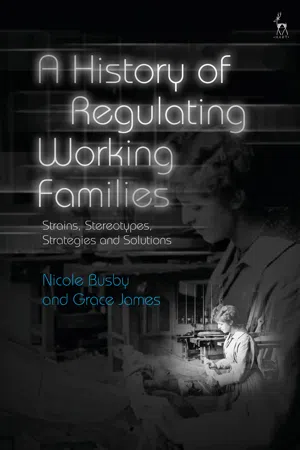
A History of Regulating Working Families
Strains, Stereotypes, Strategies and Solutions
- 184 pages
- English
- ePUB (mobile friendly)
- Available on iOS & Android
eBook - ePub
A History of Regulating Working Families
Strains, Stereotypes, Strategies and Solutions
About this book
Information
1
Introduction
I.Scope and Aims
The notion of explicitly regulating working families is a very modern concern, yet families worldwide have long been confronted by the practical, financial and emotional demands of participating in paid work and providing care for their dependent members. This book traces and critiques how laws, and labour laws1 in particular, have helped or hindered working families in the UK. An historical perspective provides a useful vantage point from which to assess the variety of, and similarities within, legal approaches favoured over time and allows us to reflect upon the differing strains and stereotypes that have challenged the lives of working families. We shed light on conflicts and tensions, constructed and real, between the needs of working families and other institutions or within families themselves during any given period. The critical identification of prominent stereotypes, such as the ‘single mother’ or ‘the elderly relative’, is useful in this assessment as they have, in different ways at different junctures and depending upon the objectives of the policy discussed, been used to both justify and restrict particular legal approaches. Relatedly, an historical perspective provides an opportunity, with the advantage of hindsight, to (re)consider potential strategies and solutions adopted in relation to working families. This can include consideration of policies that are adopted at specific points in history or that are shelved. Indeed a deliberate lack of political engagement can be significant in this context as non-engagement or neutrality as a strategy has consequences for all concerned: as Herring suggests, ‘it is impossible for the state to take a neutral stance towards forms of caring’.2 We comment upon strategies and solutions in order to demonstrate how they shape, promote or challenge the very strains and stereotypes that we identify.
We aim to map and critique a particular journey in the UK’s legal history and, in doing so, seek explanations regarding, for example, why regulators engaged, or failed to engage, with the difficulties faced by working families and why the work–family balance (WFB) framework came to be constructed in the way that it did. Importantly, we consider whose interests have been, and continue to be, promoted by the adoption of particular strategies and solutions. Of equal, if not greater, significance is our examination of whose interests have been, and continue to be, sidelined or ignored. We also consider what alternative constructions might have offered and could, in the future, offer working families. Overall, we demonstrate that the transformations in the UK vis-à-vis the regulation of working families, especially over the past five decades, have either promoted or sidelined a myriad of interests which are diverse and often competing: transformations that have huge consequences for, and have resulted in the (re)positioning of, care work and labour market activities. The need to fundamentally re-examine our approach to the legal regulation of working families is situated in the realities of this transformation and the interests and values it embodies: interests and values that, as we argue, need to be revealed and challenged in order to better support working carers and the recipients of their care going forward.
Before discussing the broader context for our particular focus and outlining the methodology and structure of the book, it is necessary to define our specific interpretation of key terms, namely ‘the family’, ‘care work’ and ‘dependency’, and to outline the core theoretical perspective – vulnerability theory – and the main themes from that perspective that facilitate and influence our critique.
II.Key Definitions
A.The Family
Definitions of ‘the family’ are undoubtedly subjective and, as Herring notes, ‘family forms have varied enormously over the ages and … the notion of what a family is or what family life involves changes between generations and societies’.3 For many years marriage, sexual relationships and parenting have provided the main focus for definitions of the family and this institution is often thought to be permanent and principally responsible for care work: ‘Family is wrongly assumed to be unchanging, an essentialized institution, natural in form and function, that is the repository for dependency’.4 Such views have fortunately been challenged by those who want a more inclusive and flexible definition that better reflects the functions of family life today rather than the form of the family,5 and seek to avoid emphasis on the sexual relationship, as well as biological and heteronormative bias.6
In this book we reject the traditional heteronormative conception of the family and our definition includes all types of family arrangements. In addition, we welcome calls for a better understanding of the implications of constructing the family as ‘separate’ and ‘private’: ‘The family’, as Fineman asserts, ‘is contained within the larger society, and its contours are defined as an institution by law’.7 We recognise the symbiotic relationship between the family and other social institutions noting that ‘it is very important to understand the roles assigned to the family in society – roles that otherwise might have to be played by other institutions, such as the market or the state’.8 We, as do Fineman and others, call for more emphasis on relationships of care9 when designing social policies relating to the family. Moreover, as will become evident in the substantive chapters that follow, we berate any inability to grasp the profound, and often undervalued, effect of families ‘on the success and failure of policies created for the market and the state’.10
Whilst most of the discussion around definitions of ‘the family’ have centred on, and been developed within the context of, family law, there are clear implications for our project. This book is concerned with laws and policies that aim to support working families. Hence, if ‘the family’ is defined too narrowly for this purpose then care work that is undertaken by workers who fall outside the definition will be excluded. For this reason it is crucial that we remain sensitive to any assumptions that are made within adopted definitions of families over time: we also agree with Murray and Barnes’s view of ‘the practices of family’ as ‘predicated on shared and situated relationships of care’11 and with Silva and Smart’s view that ‘families remain a crucial relational entity playing a fundamental part in the intimate life of and connections between individuals’12 and, we would add, other institutions – such as the market and the state. How far and in what ways these connections are supported is considered in the book, where we use the broad terms of ‘familisation’ and ‘defamilisation’ to help us unpack and critique where responsibility for care work is situated at any given time: the former denotes a strategy that, consciously or not, places care as a private familial concern. The latter refers to a process of moving care from the private into a public place – with greater responsibility for the state.13
B.Care Work
Unpaid work involving the care of children is being undertaken within tens of millions of families across the UK. In addition, over 8 million people provide care for adults who are ill, frail or disabled and that figure is predicted to rise.14 An estimated 1.3 million care for both children and parents.15 The extent of unpaid care work being undertaken on a daily, and often nightly, basis is staggering and provides a blunt reminder that most of us will be cared for and provide care for someone close to us at some point in our lives. The importance of such care work is fundamental but difficult to measure, especially as it has historically gone unrecognised in any material sense. Most will agree that such relationships are crucial to the daily existence and wellbeing of millions of recipients of care:16 it is also an essential component of our humanity that enhances the quality of our lives.17 Although the nature of care work will have altered in many ways, this basic fact is not specific to any time or place in history.
For the purpose of this book, we define care work as domestic/private18 and unpaid work that involves taking care of others – usually family members – including children, older people in need of care and those who are disabled or sick. Care work can involve physical, mental and emotional labour.19 It can be mundane and repetitive, can be incredibly stressful and exhausting but can also be life-enhancing, pleasurable and mutually rewarding.20 Although the nature and scope of care work is clearly context-specific and changes over time21 and within individual relationships, the skills involved should not be underestimated.22 Moreover, it is important to recognise the impact of this unpaid labour upon a carer’s wellbeing. This impact can also shift over time23 and is dependent upon, for example, her/his own health, the age and wellbeing of the recipient of her/his care, the support network available to the individual and family, as well as particular workplace cultures and expectations. In relation to the latter, Carers UK have found that many carers of older dependants feel that they have little choice but to reduce working hours or leave paid employment altogether because of the lack of support available to them: an estimated 600 people give up paid work every day for this reason.24
Although our focus is on private and unpaid care work, often termed ‘informal’ care, participating in paid work is in many ways an act of care, in that it provides financial support for all family members: by defining care work as unpaid private/domestic labour and excluding paid work it is not our intention to negate this contribution to the family or to underestimate the symbiotic relationship that exists within families where responsibilities for work (paid and unpaid) might be negotiated and re-negotiated across time between the parties.25 Nor does our focus on the paid work/unpaid care equation mean that we wish to exclude carers who do not or cannot undertake paid work alongside their care commitments. Such individuals are worthy subjects of labour law, but our overriding aim is to explore the effects of state attempts to rebalance the relationship between paid work and caregiving and the place of law and policy in achieving this.26 Importantly, making a distinction between unpaid private (care) work and paid work enables us to unpack the gender inequalities that exist in how labour is divided: unpaid (and paid) care work has always been predominantly undertaken by women and as a consequence of this, women have either been excluded from or marginalised within labour markets,27 a fact that is explored further in chapter two and which resonates throughout the book.
C.Dependency...
Table of contents
- Cover
- Title Page
- Preface
- Contents
- 1. Introduction
- 2. Women and Work
- 3. Mothers and Fathers
- 4. Children’s Welfare
- 5. Eldercare
- 6. Conclusions: Strains, Stereotypes, Strategies and Solutions
- Index
- Copyright Page
Trusted by 375,005 students
Access to over 1.5 million titles for a fair monthly price.
Study more efficiently using our study tools.
Frequently asked questions
Yes, you can cancel anytime from the Subscription tab in your account settings on the Perlego website. Your subscription will stay active until the end of your current billing period. Learn how to cancel your subscription
No, books cannot be downloaded as external files, such as PDFs, for use outside of Perlego. However, you can download books within the Perlego app for offline reading on mobile or tablet. Learn how to download books offline
Perlego offers two plans: Essential and Complete
- Essential is ideal for learners and professionals who enjoy exploring a wide range of subjects. Access the Essential Library with 800,000+ trusted titles and best-sellers across business, personal growth, and the humanities. Includes unlimited reading time and Standard Read Aloud voice.
- Complete: Perfect for advanced learners and researchers needing full, unrestricted access. Unlock 1.5M+ books across hundreds of subjects, including academic and specialized titles. The Complete Plan also includes advanced features like Premium Read Aloud and Research Assistant.
We are an online textbook subscription service, where you can get access to an entire online library for less than the price of a single book per month. With over 1.5 million books across 990+ topics, we’ve got you covered! Learn about our mission
Look out for the read-aloud symbol on your next book to see if you can listen to it. The read-aloud tool reads text aloud for you, highlighting the text as it is being read. You can pause it, speed it up and slow it down. Learn more about Read Aloud
Yes! You can use the Perlego app on both iOS and Android devices to read anytime, anywhere — even offline. Perfect for commutes or when you’re on the go.
Please note we cannot support devices running on iOS 13 and Android 7 or earlier. Learn more about using the app
Please note we cannot support devices running on iOS 13 and Android 7 or earlier. Learn more about using the app
Yes, you can access A History of Regulating Working Families by Nicole Busby,Grace James in PDF and/or ePUB format, as well as other popular books in Law & Labour & Employment Law. We have over 1.5 million books available in our catalogue for you to explore.