Jesuit engagement with natural philosophy during the late 16th and early 17th centuries transformed the status of the mathematical disciplines and propelled members of the Order into key areas of controversy in relation to Aristotelianism. Through close investigation of the activities of the Jesuit 'school' of mathematics founded by Christoph Clavius, The Scientific Counter-Revolution examines the Jesuit connections to the rise of experimental natural philosophy and the emergence of the early scientific societies.
Arguing for a re-evaluation of the role of Jesuits in shaping early modern science, this book traces the evolution of the Collegio Romano as a hub of knowledge. Starting with an examination of Clavius's Counter-Reformation agenda for mathematics, Michael John Gorman traces the development of a collective Jesuit approach to experimentation and observation under Christopher Grienberger and analyses the Jesuit role in the Galileo Affair and the vacuum debate. Ending with a discussion of the transformation of the Collegio Romano under Athanasius Kircher into a place of curiosity and wonder and the centre of a global information gathering network, this book reveals how the Counter-Reformation goals of the Jesuits contributed to the shaping of modern experimental science.
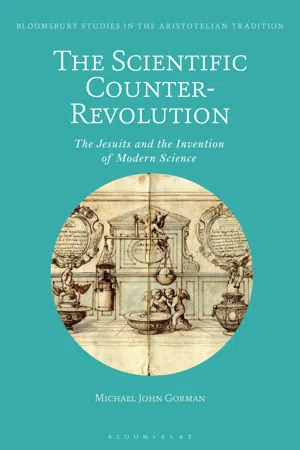
eBook - ePub
The Scientific Counter-Revolution
The Jesuits and the Invention of Modern Science
- 296 pages
- English
- ePUB (mobile friendly)
- Available on iOS & Android
eBook - ePub
The Scientific Counter-Revolution
The Jesuits and the Invention of Modern Science
About this book
Information
Prior to any detailed discussion of the work carried out by the globally distributed community of Jesuit mathematical practitioners in seventeenth-century Europe, it seems worth asking just how such a community ever came to exist in the first place. How, we might ask, did its members become equipped with the mathematical instruments, books and training that allowed them to enter into astronomical disputes, to perform geometrical demonstrations and to correspond with each other on topics of mathematical and philosophical import? How did mathematical practices come to be granted a sufficient amount of social and cognitive status within the political structure of each Jesuit college to nurture their continued existence within the Jesuit collegiate network?
To attempt to answer these questions, the present chapter will look at Christoph Clavius’s project for establishing the Jesuit intellectual flagship in Rome, the Collegio Romano as a centre of mathematical skill and authority, with a view to granting special training to gifted Jesuit mathematical practitioners before redistributing them to the different provinces of the order. In attempting to create an authoritative, distributed community of Jesuit mathematicians, Clavius faced a number of obstacles both inside and outside the order, which he was only able to overcome by enlisting powerful political support. Clavius’s defence of the newly promulgated Gregorian calendar against the attacks of Michael Maestlin, Joseph Scaliger, François Viète and others played an important part in securing Jesuit mathematical authority in a wider European context.
As well as being indispensable for mastery of the other arts and sciences and for the administration of civic affairs, mathematical knowledge was presented by Clavius to his Jesuit superiors as an antidote to conversational embarrassment. Noblemen were interested in mathematical problems, and it would bring disgrace to the Jesuit order if its members were unable to discourse intelligently on mathematical subjects in the company of princes. The dinner-table was a politically charged space during the Counter-reformation. The training of Jesuits as rhetoricians and humanists formed part of an attempt to reconquer this space, which had been encroached upon by Luther’s Tischreden and by the myriad works of the Protestant humanists. Clavius inscribed mathematical training firmly within this project.
Unlike his Jesuit predecessor Balthasar Torres and many other sixteenth-century mathematicians of a practical bent, Clavius embraced print culture. Apart from his own printed works, he was closely involved in the production of the mathematical part of enormous Bibliotheca Selecta produced by the Jesuit diplomat and scholar Antonio Possevino. Possevino’s work was intended to be a sanitised reworking of the Protestant Conrad Gesner’s Bibliotheca Universalis, as part of a larger vision of global evangelization through print, centralised correspondence and coordinated pastoral work. While Possevino intended to establish a centre for the training of missionaries in Rome, a project that eventually led to the foundation of the Roman Collegium de Propaganda Fide, Clavius established a centre for mathematical training, his mathematical academy. His purposes were closer to Possevino’s than one might initially expect. The distribution throughout the Jesuit provinces of mathematical experts trained in the Roman centre, like the distribution of Jesuits skilled in eloquentia, Greek and Hebrew, would bring great glory to the Jesuit order and recover some of the souls to the Catholic church that had been lost through the alluring erudition of the great Protestant humanists of the sixteenth century.
Jesuit humanism and the Counter-reformation
At intermittent moments between 1562 and 1565, the Majorcan Jesuit Jerónimo Nadal took time off from the Council of Trent to compose a dialogue. Originating as a response to an attack on the Jesuits penned by Melanchthon’s pupil and friend Martin Chemnitz, the dialogue was staged as an ecumenical meeting of three travellers, whose largely pacific encounter was made plausible by the peace of Augsburg of 1555, finally granting official tolerance to religious diversity in in German lands. The participants in Nadal’s apologetic mis-en-scène were a Lutheran (Philippicus), a Catholic ill-disposed towards the Jesuits (Libanius), and Philalethes, a ‘friend and past pupil of the Society, who learned about the nature our Society’s organization from the Jesuits in Cologne’. Two of the projected four parts of the Dialogue were completed by Nadal. In the first, Philalethes explains the early origins of the Society to Libanius and Philippicus. In the second part, he elaborates on the organizational structure of the order. These were to be followed by two ‘negative’ parts, attacking, respectively, Chemnitz and his heretical associates, and the Dominican theologian Melchor Cano, a vigorous opponent of the early Society and the root of many of its initial troubles with the Inquisition.
The defence of the Jesuits mounted by Philalethes in Nadal’s dialogue is threatened intermittently by the undisciplined wrath of Philippicus. Irritated by the learned Greek and Hebrew citations with which Philalethes sprinkles his discourse, Philippicus, transparently a mask for Melanchthon and his followers, threatens to destabilise the very conventions governing dialogue form:
What shall we do, Libanius? What are we waiting for? We will not hear any more from this man. Let us prepare our blades for combat.
Despite these moments of dramatic tension, the dialogue between the three travellers continues for long enough to allow Nadal’s mouthpiece Philalethes to expound upon the various aspects of the Jesuit ministry in some detail. The discussion of the Jesuit educational ministry, composed by an insider deeply involved in its development, draws heavily on the relevant sections of the recently published Constitutions of the order, and prefigures the Ratio studiorum, which Nadal was to be intimately involved with at the early stages. Nadal defends the involvement of the Jesuits in pedagogy in purely apostolic terms:
[T]hey [i.e. the Jesuits] judge that teaching the youth pertains to the ministry of the word of God; their only reason for opening the schools was so that with this hook they might draw students of literature to piety
Shortly afterwards, after an official visit of inspection to the Jesuit college of Cologne, Nadal elaborated that:
The Society would never have undertaken the task of giving lessons in colleges, if it did not also understand that by so doing it was also giving a moral training […] So for us lessons and scholarly exercises are a sort of hook with which we fish for souls.
As Gabriel Codina Mir, has observed, ‘on reading some of the statements made by Nadal, it is easy to believe that the Colleges of the Jesuits were only conceived in order to combat Protestantism, at least in Germany and in the countries affected by the Reformation, and that the study of letters was only envisaged with the aim of fighting the Protestants with their own weapons. As Belles-lettres were in vogue, the Jesuits occupied themselves industriously with them, but always kept the apostolic goal which they had set for themselves clearly in view’.
The apostolic ends of Jesuit education were reflected clearly in the pyramidal disciplinary structure which characteri...
Table of contents
- Cover
- Half-Title Page
- Series Page
- Title Page
- Dedication
- Epigraph
- Contents
- Acknowledgements
- Resources for the Book
- List of Figures
- List of Abbreviations
- Introduction: What Scientific Counter-Revolution?
- 1 Establishing Mathematical Authority: The Politics of Christoph Clavius
- 2 Mathematics and Modesty: The Problemata of Christoph Grienberger
- 3 Discipline, Authority and Jesuit Censorship: From the Galileo Trial to the Ordinatio Pro Studiis Superioribus
- 4 The Jesuits and the Vacuum Debate
- 5 The Angel and the Compass: Athansius Kircher’s Geographical Project
- 6 Between the Demonic and the Miraculous: Athanasius Kircher and the Baroque Culture of Machines
- 7 From ‘The Eyes Of All’ to ‘Usefull Quarries in Philosophy and Good Literature’: The Changing Reputation of the Jesuit Mathematicus
- Index
- Copyright
Trusted by 375,005 students
Access to over 1.5 million titles for a fair monthly price.
Study more efficiently using our study tools.
Frequently asked questions
Yes, you can cancel anytime from the Subscription tab in your account settings on the Perlego website. Your subscription will stay active until the end of your current billing period. Learn how to cancel your subscription
No, books cannot be downloaded as external files, such as PDFs, for use outside of Perlego. However, you can download books within the Perlego app for offline reading on mobile or tablet. Learn how to download books offline
Perlego offers two plans: Essential and Complete
- Essential is ideal for learners and professionals who enjoy exploring a wide range of subjects. Access the Essential Library with 800,000+ trusted titles and best-sellers across business, personal growth, and the humanities. Includes unlimited reading time and Standard Read Aloud voice.
- Complete: Perfect for advanced learners and researchers needing full, unrestricted access. Unlock 1.5M+ books across hundreds of subjects, including academic and specialized titles. The Complete Plan also includes advanced features like Premium Read Aloud and Research Assistant.
We are an online textbook subscription service, where you can get access to an entire online library for less than the price of a single book per month. With over 1.5 million books across 990+ topics, we’ve got you covered! Learn about our mission
Look out for the read-aloud symbol on your next book to see if you can listen to it. The read-aloud tool reads text aloud for you, highlighting the text as it is being read. You can pause it, speed it up and slow it down. Learn more about Read Aloud
Yes! You can use the Perlego app on both iOS and Android devices to read anytime, anywhere — even offline. Perfect for commutes or when you’re on the go.
Please note we cannot support devices running on iOS 13 and Android 7 or earlier. Learn more about using the app
Please note we cannot support devices running on iOS 13 and Android 7 or earlier. Learn more about using the app
Yes, you can access The Scientific Counter-Revolution by Michael John Gorman in PDF and/or ePUB format, as well as other popular books in Philosophy & Philosophy History & Theory. We have over 1.5 million books available in our catalogue for you to explore.