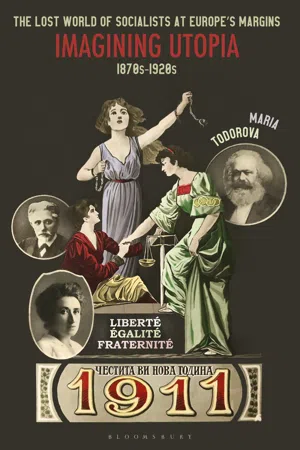
Maria Todorova's book is devoted to the 'golden age' of the socialist idea, broadly surveying the period in and around the time of the Second International. It critically examines the promise for an alternative socialist utopia from 1870 to the 1920s. Todorova brings in the experience of the periphery in a comparative context in the belief that the margins can often elucidate better the character of a phenomenon, and de-provincialize it from essentialist notions. In doing so, The Lost World of Socialists at Europe's Margins moves beyond the traditional historiographical emphasis on ideology by looking at different intersections or entanglements of spaces, generations, genders, ideas and feelings, and different flows of historical time.
The study provides a social and cultural history of early socialism in Eastern Europe with an emphasis on Bulgaria, arguably the country with the earliest and strongest socialist movement in Southeast Europe, and one that had a unique relationship to both German and Russian social democracy. Based on a rich prosopographical database of around 3500 biographies of people born in the 19th century, the book addresses the interplay of several generations of leftists, looking at the specifics of how ideas were generated, received, transferred and transformed. Finally, the work investigates the intersection between subjectivity and memory as reflected in a unique cache of archival materials containing over 4000 documentary sources including diaries, oral interviews, and unpublished memoirs. A microhistorical approach to this material allows the reconstruction of 'structures of feeling' that inspired an exceptional group of individuals.
eBook - ePub
The Lost World of Socialists at Europe’s Margins
Imagining Utopia, 1870s - 1920s
- 384 pages
- English
- ePUB (mobile friendly)
- Available on iOS & Android
eBook - ePub
About this book
Information
Part I
Centers and Peripheries
All things were together, infinite both in number and in smallness; for the small too was infinite.
Anaxagoras
Scale has become an important category in the present debate about the meaning of the historical profession. When explored analytically by Jacques Revel some twenty years ago in Jeux d’échelles, it dealt mostly with microhistory and the gains we acquire from the intensive study of limited objects. Recognizing the crisis in the classical paradigms with which we analyze the social, it explored the relative significance of the big versus the small, of detail versus the whole, of the local versus the global, of the value of exception versus generalization.1 By 2013, when the American Historical Review housed a debate on the question of scale in history, it dealt almost exclusively with macrohistory, although with some nostalgic nods in the direction of the assaulted area studies.2
One is tempted to ascribe this to a European versus an American debate, reflecting the scale of the geopolitical ambitions and practices of the spaces that these respective academics inhabit. Yet, a more careful scrutiny belies this dichotomy. It is true that area studies are especially challenged in the United States where the trend in historical thinking is geographically on the scale of the world and temporally in large periods, from the human (200,000 to 4 million years) to the planetary (Gaian), and the cosmological, as illustrated in the work of its chief practitioner David Christian, who borrowed Revel’s title to use as a foil: “Macrohistory: The Play of Scales.”3 However, only some area studies are affected (East European in particular) whereas others are booming (Islam and the Middle East, or Asian studies).
European historians, on the other hand, are equally engaged in the global turn, both with individual contributions and in transatlantic publications.4 In both the American and European cases, the focus on macrohistory can easily slip into the marketing of world history teaching and a happily celebrated monolingualism (often bordering on monoglossia) but, at the same time and constructively, also in the new and deserved interest in environmental studies, and several stimulating big turns: the Atlantic, the oceanic, borderland history, and so on, even as much of this was prefigured by the Annales school, specifically the work of Fernand Braudel and by the pioneering scholarship and journalism of C. L. R. James.5 Despite the appearance that global is taking over, smaller scale initiatives and interesting work continue to be generated on the micro and intermediate levels. Inconveniently, specificity does not want to disappear.
European historiography has gone methodologically through several turns in the past decades—from comparative history and transfer studies to an emphasis on histoire croisée, entangled history, or connected histories.6 But both the American and European endeavors have been equally inspired by the striving to supersede the nation-state, to shed the swaddling bands in which modern historiography was born in the nineteenth century, and which nowadays are perceived as its original sin. To what extent they succeed in this endeavor is still open: it is a work-in-process with contradictory results and with serious side effects.
So, what happens if we use the change of the optical range on an object of research that, although belonging to the nineteenth and twentieth centuries, by definition superseded national boundaries and reached global dimensions (although in the parlance of the day, and if we are to stick to emic categories, it referred to itself as “international” which, being a secondary category, still binds it to the “national,” just as it does the “transnational”). We are speaking, of course, of socialism. To Eric Hobsbawm, the birth of socialism and its spread, together with the rise of the workers’ movement, was the pivotal moment of the nineteenth century, especially after 1848.7
The new technologies that revolutionized Europe in the second half of the nineteenth century, and especially after 1870—the train, the steamship, electricity, the telegraph, industrial chemistry, and also photography, cinema, and radio—resulted in massive industrial growth and an enormous surge in international trade, which reached 9 percent of the global GDP. This level was reached only in the 1970s (today it is around 18 percent), and scholars are speaking of the first wave of globalization (ours being the second).8 This was accompanied by the growth of disruptive political developments, the enfranchisement of the majority of male citizens, and the rise of mass movements, mostly inspired by nationalism and socialism as well as international solidarity. While socialist internationalism came into being in the framework of early industrialization and the formation of nation-states, enforced by demands for democratic participation and labor protection, “it was only just before and after the revolutionary wave of 1848 that leagues and committees with international aspirations began to be formed.”9 In the words of Patrizia Dogliani, this internationalism of oppressed peoples “was based, however, on the ‘sacredness of nationality’ and a notion of brotherhood inherited from masonry, mutualism and proto-syndicalism.”10
Logistically, the International Workingmen’s Association, known later as the First International, failed as an organizational structure. Formed in 1864, it was torn between different factions, most prominently between Marx’s followers who favored parliamentary agitation and the anarchists around Bakunin who focused on economic struggle. It finally split in 1872, and the First International was officially dissolved in 1876. It left, however, a powerful legacy, both in the concept of internationalism as “the ideal of universal emancipation and of activities linked to the struggles of the popular and working classes” and, more concretely, in “The Internationale,” the song written by Eugène Pottier to the melody of the Marseillaise.11
The new and current melody of “The Internationale,” composed by Pierre De Geyter in 1888 coincided with the foundation of the “Nouvelle Internationale” (to distinguish it from the “Vieille Internationale”) in 1889, although there had been attempts already from the early 1880s. Known as the Second International after its dissolution, it operated with periodic international congresses of which there were nine before the outbreak of the First World War. All of them were held in cities of Western Europe (France, Germany, England, Belgium, the Netherlands, Denmark, and Switzerland), reflected also in the numbers of delegates, overwhelmingly from these countries. According to Moira Donald, 58 percent of the delegates at the nine congresses came from three countries: France (26 percent), Germany (16 percent), and the United Kingdom (16 percent). Belgium had 9 percent, Switzerland 5 percent, Austria 4.5 percent, and Russia 3.5 percent. Italy, Sweden Bohemia, Poland, Denmark, and the Netherlands hardly made 3 percent, and the rest even less.12 After 1900, the International operated in a more regular and centralized way, under the coordinating oversight of the International Socialist Bureau (ISB), with a permanent executive council in Brussels.
By general consent, the era of the Second International, from the last quarter of the nineteenth century to the First World War, was the acme of social democracy as a movement. What made it the Golden Age in the words of Leszek Kołakowski was the spread of parliamentary institutions over most of Europe and the radical extension of male suffrage, which allowed for the creation of socialist political parties. Kołakowski himself attributed the Golden Age to the fact that the Marxist doctrine was not so rigidly codified and allowed for discussions of theoretical and practical problems.13 For James Joll, “socialism, from being a doctrine of economic and political theorists, became the creed of mass parties.”14 The institutionalization of socialism was thus in the form of autonomous parties based on the national principle. As Stephen Bronner notes: “Neither the First International led by Marx nor the Second International of the socialist labor movement was ever conceived to supplant the positive functions of the nation-state.”15
Some thirty parties were founded in Europe between 1871 and 1905, variously describing themselves as “social democratic,” “socialist” or “labor”: the German Socialist Workers’ Party in 1875 (preceded by the workers’ association in 1863 and the Socialist Democratic Workers’ Party in 1869), the Portuguese in 1871, the Danish in 1876, the Czech in 1878, the French and Spanish in 1879, the Dutch in 1881, the Belgian in 1885, the Norwegian and the Armenian Hanchaks in 1887, the Swiss in 1888, the Austrian and Swedish in 1889, the Hungarian in 1890 (with a predecessor in the General Workers Association), the Bulgarian in 1891, the Italian and Serbian in 1892, the Polish and Romanian in 1893, the Croatian in 1894, the Slovenian in 1896, the Russian in 1898 (preceded by the Russian Group for the Emancipation of Labor in 1883), the Finnish Labor Party in 1899, the Ukrainian social-democratic party in Galicia in 1899, the United Kingdom Labor Party in 1900 (which was a Social Democratic Federation in 1883), and the Latvian in 1904.16 As of 1889, they were united in the Socialist International, which held regular congresses, coordinated, from 1900 on, by the ISB in Brussels. With few exceptions, in which they are unevenly represented, one can read about the constituent parties almost solely in national accounts. This period also saw the gradual expansion of socialist ideas over the globe but until after the First World War international socialism was mostly a European enterprise.
Of the non-European socialist movements, by far the most significant in this period was the American movement, and it had a direct influence with the adoption of May 1 as International Workers’ Day by the Second International in 1891, in recognition of the Haymarket affair of 1886. While organized socialism had its roots in the 1876 Workingmen’s Party with strong Lassallean and anarchist influences, the Socialist Party of America was formed in 1901. In other aspects, American socialism was characterized by its strong populist and Christian roots, as a whole not preoccupied by doctrinal issues and with practically no parliamentary representation, unlike its European counterparts. Like the British Labor Party, it “remained somewhat incomprehensible to most European Socialists, and . . . lay outside the main stream of the movement.”17 The other movement that was held in disproportionally high esteem in the Second International even as it was unable to have deep roots in its own country was Japanese socialism, characterized by factionalism and a few ephemeral formations in the early 1900s.18 The Chinese socialist party was formed in 1911 and had exclusively educational activities.19 India saw practically no socialist influence until the end of the First World War and the effects of the Russian Revolution.20 The influence of socialist ideas in the Arab world and Modern Turkey remained limited among select intellectuals and embryonic until the 1920s.21 Iran’s social-democratic movement dated from the Persian Constitutional Revolution, 1905–1907, under the direct Russian organizational influence from Transcaucasia.22
Zooming out to world history, in one of its latest impressive iterations of the period from 1870 to 1945, the emerging social-democratic parties are confined to the West, juxtaposing them to the “primitive and dark” forces of the peasant masses in southern and Eastern Europe.23 As for the Second International, it is deemed worthy of mention on two half-pages of an 1,160-page tome and, in what is surely an idiosyncratic choice and interpretation, exemplified by a brief biographical sketch of Jean Jaurès and the assertion that “his [sic!] ‘Second International’” “sought evolution, country by country, toward a transnational democratic socialist state.”24 But socialism rendered irrelevant seems to be a trend in the new world/global history. In the equally impressive achievement of Jürgen Osterhammel, who offered a sweeping survey and rethinking of the nineteenth century, socialism merits less than five pages in its 1,167, even if in the concluding chapter it is called “the most important nineteenth-century current of dissident ideas.”25 As Enzo Traverso in his critical review essay rightly observes, “Anxious to avoid the pitfall of historical teleology—socialism having been one of its main figures—he [Osterhammel] sketches a picture in which socialism simply vanishes.”26 Big surveys are often barometers of the latest fashionable trend, of contemporary moral geopolitics, and of the unsurprisingly eclectic and unavoidably incomplete knowledge of their authors.
This is the place to tackle the notions of core and periphery. Introduced in the 1950s in the vocabulary of the United Nations, specifically the Economic Commission on Latin America, they were theorized later by Immanuel Wallerstein in several works.27 Wallerstein and other proponents of world-system theory stressed the processual character of these concepts: “In world-system analysis, core-periphery is a relational concept, not a pair of terms that are reified, that is, have separate essential meanings.”28 Standing on but critically complicating dependency theory, world-system theory was mostly used to describe the international division of labor and its repercussions on the social system. Within this framework, Christopher Chase-Dunn has developed a comparative theory of the semi-periphery, to which Eastern Europe is often (but not always) added.29 For Chase-Dunn, the semi-periphery favors the development of interesting social and political phenomena and therefore can be said to occupy “a structural position which often has developmental (or evolutionary) significance.”30
While criticized for its excessive economism and neglect of s...
Table of contents
- Cover
- Half-Title
- Dedication
- Title
- Contents
- List of Illustrations
- Acknowledgments
- List of Abbreviations
- Map of Bulgaria
- Introduction
- Part I Centers and Peripheries
- Part II Generations
- Part III Structures of Feeling
- Notes
- Bibliography
- Index
- Copyright
Trusted by 375,005 students
Access to over 1.5 million titles for a fair monthly price.
Study more efficiently using our study tools.
Frequently asked questions
Yes, you can cancel anytime from the Subscription tab in your account settings on the Perlego website. Your subscription will stay active until the end of your current billing period. Learn how to cancel your subscription
No, books cannot be downloaded as external files, such as PDFs, for use outside of Perlego. However, you can download books within the Perlego app for offline reading on mobile or tablet. Learn how to download books offline
Perlego offers two plans: Essential and Complete
- Essential is ideal for learners and professionals who enjoy exploring a wide range of subjects. Access the Essential Library with 800,000+ trusted titles and best-sellers across business, personal growth, and the humanities. Includes unlimited reading time and Standard Read Aloud voice.
- Complete: Perfect for advanced learners and researchers needing full, unrestricted access. Unlock 1.5M+ books across hundreds of subjects, including academic and specialized titles. The Complete Plan also includes advanced features like Premium Read Aloud and Research Assistant.
We are an online textbook subscription service, where you can get access to an entire online library for less than the price of a single book per month. With over 1.5 million books across 990+ topics, we’ve got you covered! Learn about our mission
Look out for the read-aloud symbol on your next book to see if you can listen to it. The read-aloud tool reads text aloud for you, highlighting the text as it is being read. You can pause it, speed it up and slow it down. Learn more about Read Aloud
Yes! You can use the Perlego app on both iOS and Android devices to read anytime, anywhere — even offline. Perfect for commutes or when you’re on the go.
Please note we cannot support devices running on iOS 13 and Android 7 or earlier. Learn more about using the app
Please note we cannot support devices running on iOS 13 and Android 7 or earlier. Learn more about using the app
Yes, you can access The Lost World of Socialists at Europe’s Margins by Maria Todorova in PDF and/or ePUB format, as well as other popular books in History & 20th Century History. We have over 1.5 million books available in our catalogue for you to explore.