eBook - ePub
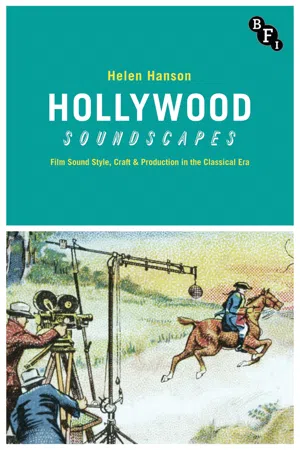
Hollywood Soundscapes
Film Sound Style, Craft and Production in the Classical Era
- 200 pages
- English
- ePUB (mobile friendly)
- Available on iOS & Android
eBook - ePub
About this book
The technical crafts of sound in classical Hollywood cinema have, until recently, remained largely 'unsung' by histories of the studio era. Yet film sound – voice, music and sound effects – is a crucial aspect of film style and has been key to engaging and holding audiences since the transition to sound by Hollywood's major studios in 1929. This innovative new text restores sound technicians to Hollywood's creative history. Exploring a range of films from the early sound period (1931) through to the late studio period (1948), and drawing on a wide range of archival sources, the book reveals how Hollywood's sound designers worked and why they worked in the ways that they did. The book demonstrates how sound technicians developed conventions designed to tell stories through sound, placing them within the production cultures of studio era filmmaking, and uncovering a history of collective and collaborative creativity. In doing so, it traces the emergence of a body of highly skilled sound personnel, able to apply expert technical knowledge in the science of sound to the creation of cinematic soundscapes that are alive with mood and sensation.
Information
1
Introduction: Sound and Silences: Writing the History of Sound Craft in Hollywood’s Studio Era
They can make or break a picture, yet they seldom rate more than a passing nod. They’re the forgotten men of an industry that forgets easily. That’s the technical mob, those worthies who struggle with gadgets and can turn up with anything that is humanly possible of contrivance. Remuneration for their work is manifested at the pay window and an occasional credit mention on the subtitle frame for a quick and unimportant flash of recognition which the public seldom reads, cares less and gets impatient to get over with.
‘Hollywood’s Unsung Heroes’, Variety Anniversary Edition, Wednesday 6 January 1937, p. 46
The technical crafts of sound in the classical Hollywood cinema have, until recently, been largely ‘unsung’ in the histories of the studio era. Since the transition to sound by Hollywood’s major studios, broadly completed by 1929, film sound, in its entire array (voice, music, sound effects), has been a crucial aspect of film style, and key to engaging and holding audiences. In the classical Hollywood sound film, sounds emphasise visual action, underline character, enhance settings and develop mood and ambience in a myriad of inventive and affective ways. The recording, editing, mixing, balancing and precise placement of sounds was the responsibility of the ‘forgotten men’ referred to above, who mastered the technical roles of sound production: the Sound Recordists, Boom Operators, Sound Production Mixers, Sound Editors, Sound Mixers, Sound Effects Editors and Sound Directors who formed the sound departments of the Hollywood majors in the studio era.
‘Sound design’ is now widely accepted as an important area of creative labour in contemporary film production; the role of ‘sound designer’ emerged with technical innovators such as Walter Murch and Randy Thom, working in the production cultures of post-1970s cinema, cultures that contrasted with the classical Hollywood mode of production in terms of work regimes and organisation.1 However, the long and complex history of this crucial, yet largely invisible work and the technicians who executed it still remain largely unknown in film history.
This book restores sound technicians to Hollywood’s creative history. Exploring a range of films from the early sound period (1931) through to the late studio period (1948), and drawing on a wide range of archival sources, I reveal how Hollywood’s sound craft worked, and why its practitioners worked in the ways they did. The book demonstrates how sound technicians developed conventions designed to tell stories through sound; it places them within the production cultures of studio era filmmaking, uncovering a history of collective and collaborative creativity. I trace the emergence of a body of highly skilled sound personnel, able to apply expert technical knowledge in the science of sound to the creation of cinematic soundscapes alive with mood and sensation.
The concept of a ‘soundscape’ has informed my study. Established in the work of acoustic ecologist R. Murray Schafer, a ‘soundscape’ connotes a ‘sonic environment’ and, as Schafer details, the term ‘may refer to actual environments or to abstract constructions, such as musical compositions and tape montages’, and, by extension, to the creation of the ambient narrative territories of cinema.2 Schafer’s definition of ‘soundscape’ draws on the field of cultural ecology; for him, the soundscape of a specific location is shaped by its environment – it has a morphology – and can be imbued with cultural, and place-specific, resonances. The term ‘soundscape’ has gained a presence and relevance in discussions and debates about film sound, and it has gradually acquired a critical currency in film sound studies, evident in work by sound practitioners, such as David Sonnenschein, and sound theorists and historians, such as Emily Thompson, Randolph Jordan and Jonathan Sterne.3 As these writers acknowledge, ‘soundscape’ has come to connote both the acoustic environment created for a listener by the sounds that surround them, and the forms of knowledge (cultural, aesthetic, technological) that structure listening. As set out below, I draw on Schafer’s idea of the structuring of a soundscape by different sounds, and I understand the soundscapes of the classical Hollywood cinema as shaped and conditioned by the forms of knowledge and practices of the body of sound technicians who produced them.
Schafer conceptualises the soundscape as a ‘sonic environment’ composed of distinct strata, or layers, of sound: ‘keynote sounds’, ‘signal sounds’ and ‘soundmarks’.4 The keynote of a soundscape is formed by the sounds so frequently heard that they comprise the ‘background’, the ‘fundamental tone around which the composition may modulate’.5 Keynote sounds form a ‘ground’ against which ‘signal sounds’ stand out. ‘Signals sounds are foreground sounds’, some of which constitute ‘acoustic warning devices: bells, whistles, horns and sirens’.6 The third stratum of Schafer’s soundscape is formed by soundmarks, ‘a community sound which is unique or possesses qualities which make it specially regarded or noticed by people in that community’.7
Research for this project began with my attention being captured by cinematic soundscapes: the layering and patterning of sound effects and silence in dark thrillers such as Cat People (Jacques Tourneur, 1942), Phantom Lady (Robert Siodmak, 1944) and Dark City (William Dieterle, 1950). The soundscapes of these films include sequences exhibiting expert and effective sound design – the beat and pacing of footsteps create suspense, whilst the sonic contrasts between silence and sound, and the layering of ambient keynote sounds, form the narrative territories of the cities in which they are set. I have analysed the sound conventions and style in those films elsewhere, but the initial question that surfaced, for me, on hearing those films was: ‘Who did the sound?’8 The question initially seemed simple – a matter of attributing credit by finding the names of technicians who worked on the sound for these films, but as I began to pursue the trail of technicians, it became clear that the question needed refining. It was not only a matter of researching ‘who’ undertook the tasks of sound recording, mixing, editing and re-recording in the sound departments of the Hollywood studios, but of understanding the material practices of the ‘doing’ of those tasks, and of grasping the forms of knowledge (technical, aesthetic, pragmatic or contextual, and economic) that underpinned that ‘doing’. As I pursued my research further, it became evident that as a body of workers Hollywood’s sound technicians were operating in a much wider field of activity than simply at the end of a microphone boom, or sitting at a mixing console; they were involved in cross-institutional technical research, the development of standards, the dissemination of practices and of conventions in sound aesthetics. In accounting for this wider field of activity, my research question moved from ‘who did the sound’ to a wider investigation of the framing contexts that shape sound technologies, style and practice. Hence, the concept of a soundscape can serve a dual purpose in thinking about the histories of Hollywood film sound; it can refer to the ways that sounds build the acoustic territory of the diegesis – a narrative soundscape – and it can refer to how a film’s soundscape is shaped by the morphology comprising its technological and production contexts. The book analyses four distinct spheres of activity in which sound technicians exercised their influence on classical Hollywood soundscapes: through their shaping of technical research, in their formation of aesthetic discourse, through their work ‘below-the-line’ in classical Hollywood’s production cultures, and in their participation in institutional networks and labour organisations.
The period the book covers extends from the early stages of sound production (1931) to the end of the major studio era (1948). Periodisations in film sound history have, understandably, focused upon major moments of change. The transition between silent and sound cinema seemingly offers one of the clearest marks of periodisation in film history. As Donald Crafton argues, ‘few demarcations are so sharply drawn, so elegantly opposed, so pristinely binary’.9 The transformations in technology, industry organisation and film style that the coming of sound brought to Hollywood have offered rich material for insightful film histories, and the changes in the transitional period have been very thoroughly mapped.10 The temporal definitions assigned by historians to the transitional period have been part of a conceptualisation of change; period boundaries necessarily mark not only a distinctive break at their boundary points, but simultaneously construct an internal consistency within and between these boundaries. In the existing critical literature of film sound histories, the transitional period is constructed precisely as a period of change, and consequently, the period ‘beyond’, in which changes are less pronounced, has been constructed as one of comparative stability. David Bordwell, Janet Staiger and Kristin Thompson, and Donald Crafton, adopt 1931 as the date marking the end of major technological and stylistic changes.11
Recent historical work on film sound has begun to periodise change in new ways. Rick Altman’s work on the multiple and intermedial practices of combining sound, song, voice and music with silent film exhibition demonstrates that audiovisual combinations in cinema have long established traditions, and that many practices in post-transitional sound cinema retain traces of earlier contexts.12 In his work on the coming of sound, James Lastra pinpoints 1934 as marking a stabilisation in practices and models of representation in sound; and Lea Jacobs establishes that the early sound period was marked by widespread innovation in methods of creating pace in narrative movement, dialogue timing and underscoring. Her study traces changing practices up to the mid-1930s.13 Michael Slowik analyses scoring practices from the beginning of the transition up to 1934, tracing varying practices with distinct musical styles, different film genres and levels of budget.14 Katherine Spring presents the transition to sound anew by tracing the convergence between Hollywood and the popular music industry, and the role of the pop song in early sound cinema.15
The primary focus of this book is the agency – that is, the activity and influence – of Hollywood’s sound technicians between 1931 and 1948; this period is ‘beyond’ the transition to sound, although of course the transition forms a crucial background context to my study. The major period of the Hollywood studio system of the 1930s and 1940s has often been conceived as characterised by relative stability and homogeneity in film style and production, but if the historical focus is recalibrated from a macro level to a closer tracking of the activity of the sound craft across the period, then it becomes evident that this period is alive with myriad changes and modifications to sound technologies, style and production practices. The book conceives of these changes as ‘dynamic’, rather than linear; conceptualising change as dynamic permits an understanding of change processes as uneven, and as varying according to the agents and contexts within which they occur. The term ‘dynamics’ has applicability in a range of fields – in physics it describes the motion of bodies dependent on the intensity of their mobilising forces; the term also incorporates the idea of the patterns of change, and of the role of interaction in change; and we can speak of ‘personality dynamics’ or ‘group dynamics’. Dynamics shift with variations in force or intensity, and, depending on the intensity of movement, a dynamic can be arrested, and re-stabilised.
During the period examined in this book, the activities and influence of sound technicians evolved. From their position as Hollywood’s newest workforce in the early 1930s, they deployed highly specialised technical knowledge to shape film sound technologies and standards, they developed and disseminated shared values in sound film style, they applied their craft in sound film production processes and they participated in and influenced industrial institutions and organisations. Through detailed archival and empirical research, I trace how the work and agency of sound technicians was engaged in influencing the processes, or dynamics, of change.
The book is organised to examine the dynamics of film sound in the broad areas of activity in which sound technicians participated: it analyses dynamics in technological innovation; the dynamics of sound film style; dynamics in the contexts of film production and the dynamics of labour relations and organisations. Changes occurred in these different, but concurrent and related, contexts at different rates, and on different scales. The book considers the issue of scale by choosing case studies illustrating the dynamics of film sound at different scalar levels through the period. I examine dynamics at a ‘macro’ level, analysing, for example, cross-industry projects on defining sound standards in the mid-1930s, projects which involved Hollywood’s senior sound technicians. I also turn my attention to ‘micro-level’ contexts on specific film productions by analysing the fine-grained production decisions made by sound technicians that underpin the crafting of sound for a sequence. Between the macro and micro levels is a middle level, the level of studio and of craft, and the level at which organisational and shared craft conventions in sound practice were shaped by groups of technicians. The book examines these shared conventions, as well as some instances of how these conventions were oriented towards the ‘practice preferences’ of particular studios.
Concepts of scale and level have been important in studies of media industries, and in film history, and these concepts define the ‘level of analysis’ at which research takes place, the methodologies used, and how claims about causality, agency and power within work cultures are calibrated.16 Amanda Lotz defines the most common levels used in the field as those of national/international, the focus on specific industrial contexts, analyses of particular organisations, and research into individual productions and studies of individual agents. Lotz notes that the level of organisations, productions and individual agents typically have a ‘more micro level focus’, within which researchers ‘place much emphasis on understanding the complexities of practices and the varied agency of those who may work within vast media conglomerations’.17 She observes that, traditionally, micro-level studies have diverged from macro-level studies, in that these studies ‘often have not supported deterministic hypotheses proposed by theories produced at the macro level, or at least have suggested that the daily processes of production of media industries are far more complicated than the macro-level views might have the field understand’.18 It is possible to connect micro- and macro-level studies by ‘negotiating’ between the methods of analysis, and by combining the concerns of political economy, grounded in empirical data, with an understanding of the often ‘complex, ambivalent and contested’ nature of the cultural industries.19
Scaling my study to draw on case studies at the distinct levels of micro-, mid- and macro-industry analysis has allowed me to capture an overall field of activity for Hollywood’s sound technicians. Alongside their demarcated roles in the vertical hierarchies of studio sound departments...
Table of contents
- Cover
- Title Page
- Dedication
- Contents
- Acknowledgements
- List of Illustrations
- 1. Introduction: Sound and Silences: Writing the History of Sound Craft in Hollywood’s Studio Era
- 2. Art, Science and Showmanship: The Technical Cultures of Hollywood’s Sound Engineers and the Shaping of Film Sound Technologies
- 3. ‘Ear Appeal’: The ‘Story Values’ of the Classical Hollywood Sound Film
- 4. Crafting the Sequence: Sound Work and the Dynamics of Production
- 5. From Gadgeteers to Sound Experts: Defining and Recognising Sound Labour and Expertise
- 6. Conclusion
- Notes
- Bibliography
- Index
- eCopyright
Trusted by 375,005 students
Access to over 1.5 million titles for a fair monthly price.
Study more efficiently using our study tools.
Frequently asked questions
Yes, you can cancel anytime from the Subscription tab in your account settings on the Perlego website. Your subscription will stay active until the end of your current billing period. Learn how to cancel your subscription
No, books cannot be downloaded as external files, such as PDFs, for use outside of Perlego. However, you can download books within the Perlego app for offline reading on mobile or tablet. Learn how to download books offline
Perlego offers two plans: Essential and Complete
- Essential is ideal for learners and professionals who enjoy exploring a wide range of subjects. Access the Essential Library with 800,000+ trusted titles and best-sellers across business, personal growth, and the humanities. Includes unlimited reading time and Standard Read Aloud voice.
- Complete: Perfect for advanced learners and researchers needing full, unrestricted access. Unlock 1.5M+ books across hundreds of subjects, including academic and specialized titles. The Complete Plan also includes advanced features like Premium Read Aloud and Research Assistant.
We are an online textbook subscription service, where you can get access to an entire online library for less than the price of a single book per month. With over 1.5 million books across 990+ topics, we’ve got you covered! Learn about our mission
Look out for the read-aloud symbol on your next book to see if you can listen to it. The read-aloud tool reads text aloud for you, highlighting the text as it is being read. You can pause it, speed it up and slow it down. Learn more about Read Aloud
Yes! You can use the Perlego app on both iOS and Android devices to read anytime, anywhere — even offline. Perfect for commutes or when you’re on the go.
Please note we cannot support devices running on iOS 13 and Android 7 or earlier. Learn more about using the app
Please note we cannot support devices running on iOS 13 and Android 7 or earlier. Learn more about using the app
Yes, you can access Hollywood Soundscapes by Helen Hanson in PDF and/or ePUB format, as well as other popular books in Media & Performing Arts & Film History & Criticism. We have over 1.5 million books available in our catalogue for you to explore.