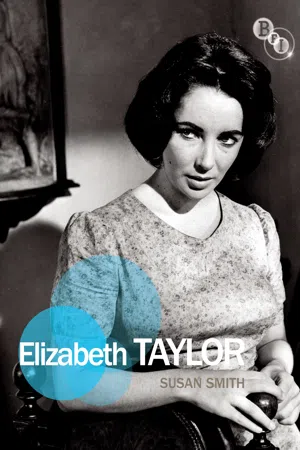
Elizabeth Taylor was one of the major film stars of the twentieth century, embodying all the glamour and allure of Hollywood stardom. Yet her achievements as an actress have often been overshadowed by her beauty and tumultuous life off-screen.
To redress this imbalance, Susan Smith offers an illuminating study of Elizabeth Taylor's work in film, exploring her fascinating trajectory from child to adult star. Smith reveals the influence that Taylor's early work exerted over her later career and the ways in which her on-screen identity is profoundly rooted in her association with animals and nature. Smith carefully unpicks what made Taylor such a distinctive and dynamic on-screen performer – from the expressive use she made of her eyes to the dramatic significance of her voice – and considers the importance of certain professional collaborations that Taylor forged during her career, most notably her acting partnership with Montgomery Clift.
- 184 pages
- English
- ePUB (mobile friendly)
- Available on iOS & Android
eBook - ePub
Elizabeth Taylor
About this book
Information
1 RIDING TO STARDOM
Some of my best leading men have been dogs and horses.
Elizabeth Taylor (quoted in Ursini, 2008, p. 32)
Meeting The Pie
Velvet Brown (Elizabeth Taylor) and her sisters have just broken up from school for the summer holidays and are walking through the village. Having left Malvolia (Juanita Quigley) at the sweet shop, Velvet continues on her way with Edwina (Angela Lansbury). On seeing this oldest sister march imperiously past her boyfriend Ted (Terry Kilburn), deliberately ignoring him, Velvet expresses surprise at her impoliteness only to be gently mocked in return. ‘Velvet, you’re too young to understand some things. Have you ever really felt keen about anything?’ asks Edwina. ‘Oh, yes!’, replies Taylor’s character emphatically, stretching out her left hand towards a horse standing harnessed to a cart nearby. ‘Horses!’ responds Edwina in disgust, ‘What does it feel like to be in love with a horse?’ ‘I lose my lunch’, sighs Velvet. ‘You’re a child’, continues Edwina scathingly and, lifting her right hand up to her heart, she asserts grandly, ‘Here’s where you feel it. It … it skips a beat.’ On watching Edwina depart left of frame for her romantic tryst with Ted at the Spinney, Velvet skips along to a nearby bridge and, bending down, picks a cane of grass from the hedge for use as a makeshift riding crop. Then, turning around gleefully to check that no one is watching, she passes through the open gate that marks the boundaries of the village. With the vivid blue expanse of the sea in the distance, she sets off along a country track, holding her body upright as her legs jump up and down frenetically in pretend horse-like movements, urging her imaginary steed on in excited, high-pitched tones and slapping her stick against her side. The vibrant colours and open reaches of the sea and sky heighten the utopian feeling arising from Velvet’s act of breaking free from the ties of family and school life and, as she moves off into the distance, the film dissolves to a shot showing her now at the top of a hill overlooking Sewels, to the left of which sits Mi (Mickey Rooney), resting by the crossroads.
Oblivious to his presence, she continues along the lane, her equine exhortations still audible amid the music, before being brought to a halt by his calling out to her: ‘Whoa! … I wouldn’t be cantering that horse uphill’ he advises. ‘I don’t usually. I was hurrying’, replies Velvet. ‘Hurrying? Where to?’ enquires Mi. ‘No place. Just hurrying’, she says matter-of-factly. A brief exchange between them ensues, during which Velvet’s attempts at friendliness and sympathy are met with sarcasm and defensive pride from the impoverished Mi (now alone in the world following the death of his father). Then, just as he begins to soften in his approach on seeing her hurt reaction (‘Didn’t mean to be rough with you, but a fella gets tired of people being sorry for him. He gets not to like it’), she becomes distracted by the sound of a horse neighing in the background. Turning around, still clutching her makeshift riding crop in both hands, she hurries across towards a stone wall bordering a field, her excitement signalled by the introduction of a dramatic strain of music on the soundtrack. There she is greeted by the thrilling sight of a majestic chestnut-coloured horse galloping freely (without harness or rider) across the pasture, the deep blue sea again iridescent in the background. After him chases Farmer Ede (Reginald Owen), his shouts of ‘Whoa!’ audible amid the grand pulsating score, which, mirroring the rhythms of the horse’s hooves, perfectly captures the exhilaration of this moment.
And so begins the most important sequence in Elizabeth Taylor’s film career: the one that, in paving the way for her first encounter with the horse, would set her on the road to movie stardom. Prior to the film’s release, Taylor was not by any means a child star, having played only minor/secondary roles in a small number of films. Looking back at her performance in MGM’s Lassie Come Home (1943), it’s easy to detect in retrospect the presence in fledgling form of her on-screen persona as the beautiful little English girl endowed with a touching compassion for animals. The secondary nature of her role there belies the pivotal place she occupies: like a good little fairy, her acts of kindness towards the beleaguered collie (‘Poor Lassie. Poor Lassie. Poor girl’) are what drive the narrative towards its satisfying conclusion. But Lassie Come Home didn’t make Taylor a star. It is only with National Velvet that she was able to assume the equivalent of Roddy McDowall’s character in that earlier film, moving from her role as kindly onlooker figure to playing the part of the main child whose close bond with her beloved animal forms the centrepiece of the story.
At the time that National Velvet was released, it was Mickey Rooney, not Taylor, who was the established star of the picture and this is reflected in the decision by director Clarence Brown and screenwriters Theodore Reeves and Helen Deutsch to depart from Enid Bagnold’s source novel (2000 [1935]))1 by structuring the film’s narrative around his character’s journey to and from the village of Sewels. As well as granting Mi’s emotional journey a greater weighting than in the book, this foregrounding of Rooney’s star presence posed a potential challenge to the primacy of Velvet’s relationship with her horse. Such a threat is evident in the staging of her first encounter with this animal since, in timing it so that it follows on directly from her initial meeting with Mi, it invites Velvet’s passionate response to the horse to be read, in psychoanalytic terms, as a displacement of her emerging feelings of attraction towards Rooney’s character. That this scene should even be amenable to such a reading is in one sense quite daring, countering, as it does, the conservative strategies that Studlar argues the film employs so as to contain and defuse the more radical implications arising from ‘Taylor’s erotically charged feminine presence’ as a child actress (2010, p. 32).2 This potential romantic subtext is suggested by other elements in the script, most notably Velvet’s naming of the horse The Pie (which rhymes, of course, with Mi)3 and her appropriation of Edwina’s words (both here and elsewhere) to describe the horse’s emotional impact on her. ‘It’s like Edwina said. It skipped a beat instead of losing lunch’, she enthuses softly while holding her right hand up to her heart as Lansbury had done earlier. But as a means of understanding the full complexities of Velvet’s relationship with the horse and the latter’s importance in forging Taylor’s stardom this kind of reading is quite limited, bearing some resemblance to those biographical accounts of the actress that construe her love of animals purely as a substitute for/precursor to her romantic relationships with the opposite sex4 (more on which in Chapter 4).
To interpret Velvet’s passionate response to The Pie purely as a displacement of her attraction to Rooney’s character would in fact be to impose on her relationship with the horse an anthropocentric viewpoint (particularly a psychoanalytic reading of the horse as ‘phallus’) that is out of kilter with Taylor’s performance. On talking to the horse, as she befriends it in the lane, the actress perfectly encapsulates what Freud construes as the child’s non-arrogant way of relating to animals.5 Lowering her voice so that it assumes a deeper, throatier sound (like a horse’s welcoming nicker), she soothes the animal in a manner quite at odds with the farmer’s malign interpretation of him: ‘There. What a lovely boy he is. Oh, you’re a sweet one’, she says on approaching the horse and reaching up towards him. Then, on being told by Ede that the gelding is ‘a murderous pirate not deserving of a name!’, she protests by bestowing on this creature an identity that the farmer steadfastly refuses: ‘Oh, no, not “Pirate”. He’s a gentle one. I’ll just call him Pie.’
During the scene as a whole, moreover, the actress invests Velvet’s reactions to The Pie with such emotional intensity that it becomes difficult not to be convinced that she is indeed very genuinely distracted by the horse whose exhilarating gallop across the field not only prompts her to interrupt her conversation with Mi but even brings her to the point of losing awareness of him altogether. Her invocation of Edwina’s words is thus addressed to herself rather than towards him and when Mi asks her if she is feeling all right (as he does later on in the stable), she expresses surprise on being brought out of this state of self-absorbed wonder, her body trembling in excitement as she tries to explain her reaction to the horse in more understandable terms. ‘Oh! Isn’t he beautiful? He’s new. I’ve never seen him before’, she says with a look of exhilaration on her face.
In her discussion of Velvet’s attraction to the horse, Studlar argues that ‘The film (like the book) … justifies an excessiveness that could be read as sexual by making Velvet part of a family of obsessive collectors and strivers: her brother collects insects; one sister, canaries; and the other, boyfriends’ (2010: 30). The screenwriters’ decision to reconfigure the Brown family so that only one daughter is mad about horses allows for a much greater concentration of emotional energy in Velvet, however, than those of the other characters. Their alternative interests (as Lansbury’s mock-theatrical display of being in love suggests) are treated as comic infatuations or endearing eccentricities far removed from the grand passion with which Taylor realises her protagonist’s equine obsession (all of which ironically undercut Edwina’s sense of superiority about her romantic feelings for Ted).
The emotional excess that characterises Taylor’s performance of such equine passion is strikingly at odds, in fact, with the very notions of disavowal and containment that underpin an interpretation of her character’s love of The Pie as a safe outlet for her desire for Mi. The actress’s intense rendering of Velvet’s attraction to The Pie instead imbues the girl’s rapport with the horse with a sense of value in its own right. This in turn raises the question of whether her relationship with this animal can be understood purely in terms of sublimated or displaced sexuality since there are parallels gestured at between them that lie outside such an explanatory framework. It is these aspects to Velvet’s bond with her horse that are not catered for by Studlar’s reading. In focusing only on how the film seeks to defuse any sexual undercurrent to the girl’s passion for ‘all things “horsey”’ (ibid.), it invokes as its reference point the very same psychoanalytic construction of this animal that was inherent in that earlier interpretation of Velvet’s initial encounter with The Pie:
Unlike Alfred Hitchcock’s Marnie (1962) [sic], which takes the ‘horse equals phallus’ element of the girl’s horse fantasy to its psychosexual limits, National Velvet constructs the girl’s love of horses as both a phase (‘all things in their time,’ as her mother says) and the positive psychological impetus for striving for greatness. (ibid.)
Liz Burke also cites Hitchcock’s Marnie (1964) in her discussion of National Velvet but, while this is again for the purpose of contrast rather than comparison, in her case she does so in a way that is much less chained to a psychosexual reading. Observing that: ‘It is a text full of fantasy and identification that isn’t afraid to represent the overwhelming passion some adolescent girls feel for horses’ and that ‘Liz Taylor’s performance equally embodies that passion to an almost hysterical degree’, she argues that, while this ‘could be seen as a precursor to the hypnotic stare she uses to bewitch Montgomery Clift in A Place in the Sun (1951), a mere six years later’, ‘the passion here is more innocent, more aligned with fantasies of freedom and autonomy than in her subsequent roles’:
A key scene in the film occurs through a transition. We see Velvet in the bedroom she shares with her two sisters, pretending to ride The Pie using string looped through her toes, for reins. The scene dissolves to her riding The Pie in reality, lost in the speed and the feeling of total communication with an animal of another species. (How do I know this? Because I know that feeling.) In the background is a rear-projected scene of sky and sea. There is an element of fantasy here. It is the first time we’ve seen her on a horse and until this point it hasn’t been clear if she even knows how to ride. Visually, it recalls a scene in Hitchcock’s Marnie (1964), where Tippi Hedren rides her favourite horse. But there is none of Hitchcock’s psychosexual weirdness here, just sheer, unadulterated joy. (2002)
This gels more strongly with my own sense that Velvet’s affinity with the horse is ultimately founded on kinship rather than notions of sublimated or displaced sexuality. The sequence leading up to her first encounter with The Pie is an important case in point since, in showing her breaking free from the boundaries of the village and riding her imaginary horse along the track, it prefigures the animal’s own act of racing across the field then leaping over the wall before galloping down the lane whence she has just come. Her own act of cantering her imaginary horse along the lane is crucial in forging this parallel between herself and The Pie since it presents her (like those later sequences of her riding in bed) as both rider and horse, human and animal, with the top half of her body fulfilling the former role and her legs the latter. Mi’s act of shouting out ‘Whoa!’ to her as she passes him along the lane develops this ambiguous blurring of human and animal identities, invoking as it does a form of exhortation usually addressed to horse rather than rider. It is indeed this very same word that Farmer Ede shouts out to The Pie as he races away from him in the field and this continuity between girl and horse is reflected in the echoing rhythms of the music as it seeks to evoke first her ‘canter’ then his faster gallop. Her description of herself as going ‘No place. Just hurrying’ also links her more closely to the wild abandoned movements of the horse than Mi, whose own earlier purposeful walk along the lane towards Sewels, suggested (in ways consistent with his character’s psychological containment) a much more controlled, regulated form of behaviour. This is developed through the pair’s contrasting reactions to the sight of the horse leaping over the wall, with Mi’s horrified ‘He’s loose!’ finding its antithesis in Velvet’s excited ‘He made it! Did you see him take that fence?’ This pattern of association continues with Velvet’s daring act of running out in front of The Pie, prompting Mi to call out fearfully: ‘Come back! You’ll get trampled on!’ As Taylor and the horse come together for the first time in the same frame (with the aid of back projection), the film presents them like mirror images of each other. Stretching out her arms while shouting ‘Whoa! Whoa! Whoa!’ ecstatically, she prompts him to rear up and spread his forelegs in a rhyming gesture. This rapport between them is also registered at the level of colour through the echoes in her red dress with its white collar and cuffs of his chestnut coat and white markings.

Given such parallels6 and taking into account the fact that Velvet’s second encounter with The Pie again culminates in the thrill of seeing him jump over the wall of the field where he is kept, it’s possible to understand her attraction to this horse as rooted in an identification with his wild, rebellious spirit and yearning to break free from the confines of his position. Unlike the earlier reading, therefore, which centred on Rooney’s character as the key to understanding that relationship, this one arises out of sensitivity to the creative implications of Taylor’s own performance and the affinity it suggests with this animal. As such, it provides a much stronger basis for understanding why the actress’s rapport with the horse in National Velvet was to prove so crucial to the forging of her on-screen star identity.
Taylor’s identification with the animal’s desire for freedom first found expression in Lassie Come Home during the sequence where her character, Priscilla, is shown deliberately opening the gates of her grandfather’s estate in Scotland, thereby allowing Lassie to escape from her cruel mistreatment at the hands of the dog trainer and begin her long journey back home: ‘She’s going towards south, Grandfather! She’s going towards Yorkshire!’ cried Priscilla then in exhilaration. In addition to his habit of leaping over the wall of the field (like Lassie’s repeated jumping over the cage of her pen), The Pie’s impulse to escape from his human bondage manifests itself in his refusal to comply with Velvet’s father’s (Donald Crisp) attempt to make him earn his keep by working as a farmhorse (following her winning of the animal at the raffle). On being harnessed to the farm cart by Mi on Mr Brown’s instruction (despite resistance from Velvet), he proceeds to run amok and cut loose from his bonds, destroying the cart in the process.
The braces motif
This revolt against the farmer’s authority invites comparison with Velvet’s own later act of gender rebellion in disguising herself as a male jockey...
Table of contents
- Cover
- Title page
- Contents
- Acknowledgments
- Introduction
- 1 Riding To Stardom
- 2 The Animal Returns
- 3 Acting On Instinct?
- 4 Compassion
- Coda: Moving On
- Notes
- Bibliography
- Filmography
- Index
- eCopyright
Trusted by 375,005 students
Access to over 1.5 million titles for a fair monthly price.
Study more efficiently using our study tools.
Frequently asked questions
Yes, you can cancel anytime from the Subscription tab in your account settings on the Perlego website. Your subscription will stay active until the end of your current billing period. Learn how to cancel your subscription
No, books cannot be downloaded as external files, such as PDFs, for use outside of Perlego. However, you can download books within the Perlego app for offline reading on mobile or tablet. Learn how to download books offline
Perlego offers two plans: Essential and Complete
- Essential is ideal for learners and professionals who enjoy exploring a wide range of subjects. Access the Essential Library with 800,000+ trusted titles and best-sellers across business, personal growth, and the humanities. Includes unlimited reading time and Standard Read Aloud voice.
- Complete: Perfect for advanced learners and researchers needing full, unrestricted access. Unlock 1.5M+ books across hundreds of subjects, including academic and specialized titles. The Complete Plan also includes advanced features like Premium Read Aloud and Research Assistant.
We are an online textbook subscription service, where you can get access to an entire online library for less than the price of a single book per month. With over 1.5 million books across 990+ topics, we’ve got you covered! Learn about our mission
Look out for the read-aloud symbol on your next book to see if you can listen to it. The read-aloud tool reads text aloud for you, highlighting the text as it is being read. You can pause it, speed it up and slow it down. Learn more about Read Aloud
Yes! You can use the Perlego app on both iOS and Android devices to read anytime, anywhere — even offline. Perfect for commutes or when you’re on the go.
Please note we cannot support devices running on iOS 13 and Android 7 or earlier. Learn more about using the app
Please note we cannot support devices running on iOS 13 and Android 7 or earlier. Learn more about using the app
Yes, you can access Elizabeth Taylor by Susan Smith in PDF and/or ePUB format, as well as other popular books in Media & Performing Arts & Film History & Criticism. We have over 1.5 million books available in our catalogue for you to explore.