. . . a keen and brilliant critical account of Pasolini's films and writings . . . --Italica
Rohdie's personal, idiosyncratic critical style is backed up by serious scholarly research, as the rich bibliography attests. This is one of the most original recent additions to the ever-growing literature on Pasolini. --Choice
. . . refreshingly personal and full of unpredictable tangents. --Film Quarterly
Sam Rohdie has written a personal, wonderfully lucid account of Pier Paolo Pasolini's cinema and literature.
- 224 pages
- English
- ePUB (mobile friendly)
- Available on iOS & Android
eBook - ePub
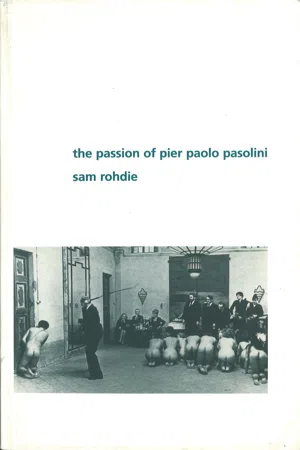
The Passion of Pier Paolo Pasolini
About this book
Information
Edition
1Chapter 1
Pasolini Fragments
Borders
In Rossellini's Stromboli (1949), the tuna fishing sequence is shot as it occurs. It is not a staged event for the camera, but an event in reality which the camera catches, then frames. The sequence signifies itself: the fishermen of Stromboli are catching the tuna. But it also signifies within the fiction Karin's distress at nature and the power of it which works upon her. That power is reiterated when she tries to escape from Stromboli only to be overcome once again by its sublimity. The real, at the fringes of the fictional film, is absorbed by the fiction. From a real event, it becomes a fictional sign, motivated within the actions of the film.
Nevertheless, the sequence also tears the texture of the fiction. Its reality is too much for the fiction to absorb completely. Rather than serving the context in which it is inserted, it also disrupts that context by moving away from the fiction towards the reality whence it came. The film complicates the edge between the text and what lies beyond its fringes, what is classed as real.
Italian neo-realism, particularly in the films of De Sica and Rossellini, deployed strategies for rendering reality 'in' film. In Rossellini's use of the sequence shot – as in Stromboli – time and space were rendered whole. Reality was not disrupted, and the distance between pro-filmic event and filmic representation was reduced as much as possible, almost to the point where the difference between them disappeared. It was precisely the wholeness of reality and the strength it attained in the film that overwhelmed Karin with its strangeness and power. It also overwhelms the audience. Both audience and character experience the miracle of the real. This miracle 'in' and 'of' reality disrupts the fiction.
Rossellini's films hover on a line between reality and text. 'Reality' is united to the structures of the film, but the union is temporary and unstable. The alterity of reality is not suppressed by the fiction (as it is in classic film narratives). On the one hand, reality is fictionalised by the film; on the other hand, it is cited by it. Reality is in the film and outside the film, a fragment of an exterior continuity brought into the fiction, but whose force, nevertheless, exceeds the film's constructed continuity of a fictional illusory real.
Pasolini's Rome novels are structured, like Rossellini's films, along a boundary, on one side of which is Roman dialect-slang, and on the other literary language. The one language, as structured by Pasolini, is real and popular, the other artificial and bourgeois (albeit spoken by millions of Italians!). The real is textualised by Pasolini and made literary (characters speak, not persons), while the artificial, because marked as such, assumes the full presence of its artificiality.
With Ragazzi di vita and Una vita violenta – which a lot of fools think is the result of a superficial documentarism – I placed myself in a line with Verga, Joyce and Gadda: and this was at the price of a tremendous literary effort: anything but documentary immediacy! To refashion, to mimic the 'interior language' of a character is terribly difficult, added to the fact that in my case – as was often the case with Gadda – my character spoke and thought in dialect. It was necessary to descend to the linguistic level of the character, using dialect in direct speech, and using a difficult linguistic contamination in indirect speech: that is, in the entire narrational part, since the world is the world 'as seen by the character'. The sounding of a false note is always a risk in the writing: it is enough to go a bit too far towards 'language' or towards dialect and the difficult amalgam is destroyed, and goodbye style.1
One language in the novels is cited by another. In part this is because speech becomes writing. This is not a representational gesture, but an act of quotation, like an actor speaking lines. It is language performed. Whether trying to speak like Proust or trying to speak like a Roman pimp, Pasolini's language nevertheless can be felt within the other language. The narrator may write like Proust, but it is only a likeness. The characters may speak like Rome slum kids, but it is a speech corrupted by literature. Such imitation presupposed, as Pasolini said, 'a frightening literary effort'.2
For Pasolini neo-realist writing was different from this. Neo-realist writers, for him, sought to represent the speech of ordinary Italians by naturalising it, as if, in their novels, ordinary Italians were speaking. Pasolini's slum kids only spoke like slum kids; that is, rather than attempting to naturalise their speech, he sought to artificialise. The analogy is marked, not masked. Pasolini framed reality in mimetic analogies of it, pointing to the analogy, rather than creating a make-believe illusion of reality. His reality included the object imitated (the object-language) and the linguistic act of imitation (the metalanguage which cited the object-language).
André Bazin categorised film history as a history of two cinemas: a 'cinema of reality' and a 'cinema of the image'.3 He preferred the former. Pasolini belonged with the latter, more with Soviet silent cinema, with Vertov and Eisenstein, than with Italian neo-realist cinema. 'Reality is there, why manipulate it?' Rossellini had said.4
Even in the densely edited sequences of classical cinema – shot-reverse-shot dialogue scenes – the spectator is caught in a fictional web, from which it is difficult to be free. Each shot and every change of shot have motives within the fiction. It is within that logic that the spectator is caught. At every point in Pasolini's fictions, written or filmed, Pasolini used various means, principally mimetic – citation, quotation, pastiche, parody, analogy, repetition, rhyme – to pull the spectator out of a fictional logic, beyond the edge of fiction, to its other side, to the 'writing' which produced it. Writing is always present in the Pasolinian fiction, not to destroy the fictionality of the fiction, but on the contrary to emphasise it by starring it.
To watch Pasolini's films is to watch a parable, a type of non-fictional fiction, evidently made up and false, yet whose falsity is there to express a truth. It is also like a fairy tale. There is a similar sense to Kafka, or in Pasolini's posthumous novel, Petrolio; certainly it is present in Pasolini's plays. It has great force in his films like Teorema (1968) and Porcile (1969). It might be argued that this is true of all literature, certainly of most interpretations of literature, but Pasolini's writing is overmarked; hence the artificiality of the fiction as only an effect of writing marked. The fact that his language cites itself as well as the other languages it contains makes his writing something different.
Pasolini's novels are a meeting place of languages. The writing does not represent. It cites. It repeats. It forms analogies. Literary language and dialect scrape at the edges of one another. At the same time, because the languages are mimed, the mimed languages touch the borders of the originals. It is this touch which reveals reality.5
I am reminded of Dziga Vertov and The Man with a Movie Camera (1929) where the film being watched is an imitation of the film being made in the film being watched. The interconnection of mirrors and citations is vertiginous, especially at the level of time. The film the spectators are watching in the film is the film which is being made which includes them and which is the film that we watch as second-order spectators; the imitation by Vertov, but an imitation at one remove, is a metalanguage, which knows. Primarily, it knows the cinema. It knows it not by explanation, but by exemplification. The Vertov film, like Pasolini's films, is part parable of cinema, part illustration of it.
In Pasolini's work (and also Vertov's), reality is twofold and a paradox. It is the reality of the language cited and the reality of its citation, that is, the reality of its artistic deformation. The drama of Pasolini's writing is at the neuralgic points of the paradox. At these points his writing becomes beautiful.
In Accattone (1961), squalid scenes are accompanied by the sacred music of Bach's St Matthew's Passion: the brutal beating of Maddalena by the Neapolitans; Accattone's theft of the necklace from his son; his fight with his brother-in-law. Accattone, a pimp and a thief, is framed and lit like a Mannerist saint. The scenes are stylistic imitations of contrary styles. Reality is mimed by a realist-naturalist language, contaminated by a high-art framing of the realism by imitations of the style of epic religious paintings: 'a technique of sacrality', Pasolini called it; 'In Accattone, I walk above an abyss, one side formed by the religious epic, the other by realist "naturalism"'.
With Accattone, inexpert as I was in cinema, I simplified to the maximum the objective simplicity of the cinema. And the result ought to have been – and in part was – a sacredness: a technique of sacredness that profoundly affected settings and characters. There is nothing more technically sacred than a slow pan. Especially when this is discovered by a dilettante, and used for the first time. ... Sacredness, frontality. Hence, religion. Many have spoken of the religiosity of Accattone; of the fatality of his psychology, etc. Even the lenses were kept at 50mm and 75mm; lenses which weigh on things, emphasise their fullness, their chiaroscuro, give them density, often unpleasantly, like wood eaten by termites or soft stone. ... Especially if it is used with 'dirty' lighting – backlighting ... which hollows out the eye sockets, produces shadows under the nose and around the mouth, dilates the image and gives it a grainy effect, almost like a photographic negative, etc. ... And by the fact of this – this technical, or if you like stylistic, procedure – you can speak, I would say, of 'religiosity' with regard to Accattone ... because only by means of these technical procedures and these stilemes is it possible to recognise the real value of this religiosity ... religiosity is not so much the need of the character for personal salvation (who goes from pimp to thief?) or, externally ... the sign of the cross at the scene of the fatal accident, which determines and concludes everything, but rather it is 'in the way of seeing the world'; in the technique of sacredness by which he is seen. ... My vision of the world is in essence epico-religious; thus also and above all they are in squalid characters, characters outside of historical consciousness and thus outside bourgeois consciousness; these elements, at play in the psychology of a poor, poverty-stricken wretch, a lumpenproletarian, are always in a certain measure 'pure' because they are without consciousness and thus 'essential'.6
What do a contemporary Roman pimp and a sixteenth-century Mannerist Christ have in common? The pimp was made sacred by Pasolini because the pimp was regarded by him as a prelapsarian primitive. Though existing in modern society, he was outside it, or at the edge of it, an archaism, an ancient shard, left-over in the present. Pasolini said he entered the borgate like an anthropologist-archaeologist, notebook in hand, to dig out language.
The pimp simply acted, simply was. For Pasolini, he acted unconsciously, instinctively, beyond the social, hence beyond the law, above all beyond the law of the symbolic and of language and meaning.
The purity of the pimp was the purity of someone in an unsullied state of being; appropriately, he was made to speak a language that was beautiful rather than meaningful. He performed language. His language was a language of grunts, roars, shouts, bursts of laughter, giggles, farts, imprecations, curses. His language sounded more than it signified. It was language before Language. It was language before history.
The pimp did not use language. His language was no more useful than he was. His language was the expression of language, its joy, not its use to represent. He did not speak in functional signs. He spoke expressively, phatically. And he spoke innocently (unlike the poet). His speech communicated nothing, and because of that it was beautiful and living: ' ... the people of the borgate: they were alive, their speech was alive. Words, phrases were a continuous, joyous inventiveness, everything that came out of their mouths was a pearl.'7
The pimp was like the poet, but he was a poet without consciousness. The poet began with the meaningfulness of symbolic language, which he then compromised with sound, with rhyme, with beat and metre. The poet had to seek, by great effort, the absolute beauty which the pimp naturally already possessed. Poetry was a metalinguistic imitation of an original innocence, a lost innocence, which poetry restored in action, in the poem, but also retained as a conscious memory of what had been lost.
Poetry was the knowledge of innocence and the frame of it.
The uselessness of the pimp guaranteed, for Pasolini, the pimp's sacredness. Because the pimp was outside the social – who could be less productive than the pimp? – Pasolini could think of him as outside the symbolic. With a language which was direct and meaningless, beautiful and nonfunctional, he invented the pimp who lived a life that was equally so: pure expression, pure poetry, utter uselessness. It was this pure poetry which the poet toiled to refind. The pimp was not only the analogue of the poet, he was at the heart of poetry. On the other hand, the pimp was a poetic creation. He was Pasolini's sign of the poetic.
The pimp was innocence in action, yet falsely so. He was a product of artifice, raised by art to a position whereby he could speak the truth of a reality which did not exist, which was ideal and absent, a potential reality, one that could be supposed to be still innocent of the world, and thought to have, impossibly, predated History. This 'reality' was in a critical, essentially linguistic relation to reality.
At the moment in the film that Accattone understands and appreciates the innocence he has lived unconsciously, he dies, thus losing reality at the precise instant that he gains the consciousness of it. This is a parable of the Fall. And it is also a parable about writing and poetry. This loss of innocence and gain of consciousness – a tale about the entry into the symbolic – does not occur once and for all, but it occurs, necessarily, again and again. It needs to be repeated as the precondition for creating anything at all. Poetry is that repetition. Pasolini mourned, in his funereal parables, a loss he not only engendered, but celebrated. After all, wasn't it he who told the tale? 'This way of finding oneself in the other, this objectification, is always more or less a form of alienation, at once a loss of oneself and a recovery of oneself.'8
The sacred language in which Accattone is framed – by the camera, by the painterly mise en scène, by the lighting, by the music – is the equivalent of a literary language, of a Gaddian language. It is also simultaneously the formalisation and imitation of the pure expressive primitive language of the pimp. The artifice cites that language, and also duplicates it, though of course at another level. The citation brings out, performs sacredness.
Reality is and is not the subject of Pasolini's work. He points to it, but by using it. Reality is not what he represents in his work, but rather the element that 'acts' within it. Reality is essentially linguistic and formal. It is a predicate and the work is the predication of reality, the enactment of it in language, not the representation of reality by language. Pasolini theorised the cinema as the 'written language of reality'; the cinema, he said, 'writes reality with reality'. This theory is a theory of mimesis, hence it is a theory of language and the activity of language.
By the sign one usually means a match of signifier and signified, writing and object, in a recto-verso relation, as if signifier and signified were the two sides of a coin. It is this relation that is posited in representational aesthetics. Strictly speaking, there is no signified to Pasolini's writing, or at least not 'exactly'. The signified of his writing is only another writing which he sometimes called 'reality'. The cinema of Pasolini is the metalanguage of reality, its anamorphosis. There is not reality, then the image as its sign, but only languages whose edges touch, and ignite.
Abjure
Pasolini went from one unsatisfactory situation to another only to find, when he arrived at the new, that he ...
Table of contents
- Cover Page
- Title Page
- Contents
- Acknowledgments
- Preface
- Chapter 1 Pasolini Fragments
- Chapter 2 India
- Chapter 3 And Africa?
- Chapter 4 Revolution
- Chapter 5 Gennariello
- Chapter 6 Writing
- Chapter 7 Marilyn
- Notes
- Filmography
- Bibliography
- Index
- eCopyright
Trusted by 375,005 students
Access to over 1.5 million titles for a fair monthly price.
Study more efficiently using our study tools.
Frequently asked questions
Yes, you can cancel anytime from the Subscription tab in your account settings on the Perlego website. Your subscription will stay active until the end of your current billing period. Learn how to cancel your subscription
No, books cannot be downloaded as external files, such as PDFs, for use outside of Perlego. However, you can download books within the Perlego app for offline reading on mobile or tablet. Learn how to download books offline
Perlego offers two plans: Essential and Complete
- Essential is ideal for learners and professionals who enjoy exploring a wide range of subjects. Access the Essential Library with 800,000+ trusted titles and best-sellers across business, personal growth, and the humanities. Includes unlimited reading time and Standard Read Aloud voice.
- Complete: Perfect for advanced learners and researchers needing full, unrestricted access. Unlock 1.5M+ books across hundreds of subjects, including academic and specialized titles. The Complete Plan also includes advanced features like Premium Read Aloud and Research Assistant.
We are an online textbook subscription service, where you can get access to an entire online library for less than the price of a single book per month. With over 1.5 million books across 990+ topics, we’ve got you covered! Learn about our mission
Look out for the read-aloud symbol on your next book to see if you can listen to it. The read-aloud tool reads text aloud for you, highlighting the text as it is being read. You can pause it, speed it up and slow it down. Learn more about Read Aloud
Yes! You can use the Perlego app on both iOS and Android devices to read anytime, anywhere — even offline. Perfect for commutes or when you’re on the go.
Please note we cannot support devices running on iOS 13 and Android 7 or earlier. Learn more about using the app
Please note we cannot support devices running on iOS 13 and Android 7 or earlier. Learn more about using the app
Yes, you can access The Passion of Pier Paolo Pasolini by Sam Rohdie in PDF and/or ePUB format. We have over 1.5 million books available in our catalogue for you to explore.