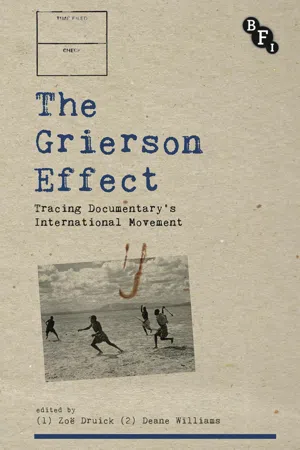
This landmark collection of essays considers the global legacy of John Grierson, the father of British documentary. Featuring the work of leading scholars from around the world, The Grierson Effect explores the impact of Grierson's ideas about documentary and educational film in a wide range of cultural and national contexts – from Russia and Scandinavia, to Latin America, South Africa and New Zealand.
In reconsidering Grierson's international infl uence, this major new study emphasises the material conditions of the production and circulation of documentary cinema, foregrounds core issues in documentary studies, and opens up expanded perspectives on transnational cinema cultures and histories.
eBook - ePub
The Grierson Effect
Tracing Documentary's International Movement
- 272 pages
- English
- ePUB (mobile friendly)
- Available on iOS & Android
eBook - ePub
The Grierson Effect
Tracing Documentary's International Movement
About this book
Information
1
John Grierson and the United States
Stephen Charbonneau
John Grierson’s status as a uniquely transnational historical figure is evidenced by his synergetic relationship with the United States. Certainly, as often noted, Grierson’s particular filmic discourse was forged by his postgraduate years in Chicago, Hollywood and New York. As Jack C. Ellis has recognised, Grierson returned home from the US having solidified three fundamental premises: ‘citizenship education was the broad necessity, film the chosen medium, documentary its special form’.1 Of course, these so-called premises were not strictly speaking the byproduct of American culture. Grierson’s time in America afforded him the opportunity to experience contemporary trends in global cinema that included Hollywood, but also encompassed Soviet montage (Sergei Eisenstein’s Battleship Potemkin [1926]) and romantic ethnography (Robert Flaherty’s Nanook of the North [1924] and Moana [1926]).
At least where the US is concerned, it is best to not speak of impact – in which we make a clean, a priori detachment of the Griersonian tradition from American institutions and social policies. It would be a mistake to consider this tradition as an entity unto itself, as if it had exerted an influence on American culture from the outside. Instead, it is much more productive to speak of relation, of an interiorisation in which a Griersonian educational media formation is implicated, shaped and reflected by social developments and institutions in the United States. While much has been written about Grierson’s life – and this essay stands on the shoulders of the work of historians and film scholars such as Ellis, Ian Aitken and many others – the hope is that by both adopting a cultural materialist posture and setting our aperture specifically upon the Griersonian tradition and its relationship to the US, that familiar facets of Grierson’s legacy will appear anew, more fluid, and more relevant to our contemporary media moment. Certainly, when looked at from this vantage point, one of the critical institutions that moves to the fore is the Rockefeller Foundation and its support for Grierson’s studies and work at different stages of his life. Whether the particular type of support under discussion is the fellowship that brought Grierson to the US in the first place, or seed money to initiate a new postwar educational film endeavour, the Rockefeller Foundation is an important benefactor for Grierson.
In each of the three following sections – on the 1920s, 30s and 40s – the Rockefeller Foundation is referred to as either a primary or secondary factor in the development of particular modes of educational cinema. By doing so, our analysis of Grierson’s US activities will hopefully support our concern with the dialectical interconnectedness between the Griersonian tradition and broader social forces. In the course of this chapter, I will review Grierson’s critical years at the University of Chicago and the well-known influence of the American intellectual, Walter Lippmann; Paul Rotha’s visit to the US in the late 1930s against the backdrop of calls for a new educational cinema; and, in a post-World War II era, Grierson’s articulation of a particular kind of internationalism in an array of speeches, interviews and proposed projects. As Forsyth Hardy has noted, during the immediate postwar period, ‘it was the international idea which dominated [Grierson’s] thinking and he felt that the big momentum for the wider international development lay in the United States’.2 Cutting across all three of these sections is an emphasis on the ways in which the Griersonian tradition develops in tandem with broader modern liberal discourses hailing new instruments of governance to cope with the realities of modernity.
SOCIAL SCIENCE, CITIZENSHIP AND ‘DRAMATIC PATTERNS’
In 1924, John Grierson – a twenty-six-year-old lecturer from Scotland – received a fellowship from the Laura Spelman Rockefeller Memorial to study in the US.3 This particular event is worth noting not simply for biographical purposes, but also for the way in which it places Grierson’s individual history within a broader social context. The memorial was established in 1918 to honour the memory of Laura Spelman Rockefeller, the wife of John D., Sr.4 The memorial was part of a social formation in the 1920s whose aim was to engender new forms of governance and knowledge. In particular, the Rockefeller Foundation’s philanthropic support for education, science technology and the social sciences was grounded in a desire to find ‘practical applications of the results of [subsidized] research’.5 The focus of the fellowship for Grierson, specifically, would turn to the ‘role of communication in shaping public opinion’.6 This instance of private philanthropy registers the influence of American social theory on the management of modern, industrial societies. While itself the byproduct of the concentration of wealth in capitalist society, this private endeavour registers a large-scale, institutional interest in managing modernity.
As has been reviewed extensively, Grierson developed ties to a handful of accomplished social scientists at the University of Chicago, such as Charles Merriam, Robert Park and Harold Lasswell. While Grierson never received a formal degree from the university, he performed graduate research for Merriam on the immigrant population in Chicago. Starting with a specific focus on deviance, Grierson cast a wide net that encompassed ‘records of the criminal courts … members of the I.W.W. [Industrial Workers of the World], alcoholics, and drug addicts’.7 In reviewing such a broad cross-section of what Ellis calls ‘social restiveness’ in Chicago, Grierson sought out patterns of behaviour among personal records and biographical details.8 Ellis notes that a ‘common characteristic was discovered – these were people who had been driven from their homes or, at any rate, had lost contact with their families’.9We can recognise in this work a desire to tease out explanatory variables which would lend themselves to greater management in this new world. And it was precisely this theme of novelty – the sense that modernity was a ‘new’, perhaps unruly experience in need of scientific theories and instruments for greater governance – that traversed both the priorities of the memorial and the interests of Grierson. In Grierson’s case, novelty arose as a theme through his reduction of social restiveness down to the level of generational differences. Specifically, he focused on the process of Americanisation and a developing ‘strain between generations – the parents trying to hang onto the old world; the young attempting to become part of the new …’.10 In doing so, the media – specifically the press – came into sharper focus. The reason for this was because Grierson noted a schism in the publics addressed by particular newspapers.11 As Ellis summarises:
For the foreign-born there were six thousand foreign-language newspapers in the country at the time. For the first generation there was the Hearst press, like Chicago’s Herald Examiner, and its imitators … Grierson noted that, with their headlines and photos, their simplifications and dramatizations, these papers served as informal but nonetheless compelling means of leading young Lithuanians and Poles, Germans and Italians, Irish and Czechs away from their parents and the old country and into an Americanization of one sort or another.12
The splintering of immigrant families across generational lines was – it seemed ...
Table of contents
- Cover
- Title Page
- Dedication
- Contents
- Acknowledgments
- Notes on Contributors
- Introduction
- 1. John Grierson and the United States
- 2. John Grierson and Russian Cinema: An Uneasy Dialogue
- 3. To Play The Part That Was in Fact His/Her Own
- 4. Translating Grierson: Japan
- 5. A Social Poetics of Documentary: Grierson and the Scandinavian Documentary Tradition
- 6. The Griersonian Influence and Its Challenges: Malaya, Singapore, Hong Kong (1939–73)
- 7. Grierson in Canada
- 8. Imperial Relations with Polynesian Romantics: The John Grierson Effect in New Zealand
- 9. The Grierson Cinema: Australia
- 10. John Grierson in India: The Films Division under the Influence?
- 11. Grierson in Ireland
- 12. White Fathers Hear Dark Voices? John Grierson and British Colonial Africa at the End of Empire
- 13. Grierson, Afrikaner Nationalism and South Africa
- 14. Grierson and Latin America: Encounters, Dialogues and Legacies
- Select Bibliography
- Appendix: John Grierson Biographical Timeline
- Index
- List of Illustrations
- eCopyright
Trusted by 375,005 students
Access to over 1.5 million titles for a fair monthly price.
Study more efficiently using our study tools.
Frequently asked questions
Yes, you can cancel anytime from the Subscription tab in your account settings on the Perlego website. Your subscription will stay active until the end of your current billing period. Learn how to cancel your subscription
No, books cannot be downloaded as external files, such as PDFs, for use outside of Perlego. However, you can download books within the Perlego app for offline reading on mobile or tablet. Learn how to download books offline
Perlego offers two plans: Essential and Complete
- Essential is ideal for learners and professionals who enjoy exploring a wide range of subjects. Access the Essential Library with 800,000+ trusted titles and best-sellers across business, personal growth, and the humanities. Includes unlimited reading time and Standard Read Aloud voice.
- Complete: Perfect for advanced learners and researchers needing full, unrestricted access. Unlock 1.5M+ books across hundreds of subjects, including academic and specialized titles. The Complete Plan also includes advanced features like Premium Read Aloud and Research Assistant.
We are an online textbook subscription service, where you can get access to an entire online library for less than the price of a single book per month. With over 1.5 million books across 990+ topics, we’ve got you covered! Learn about our mission
Look out for the read-aloud symbol on your next book to see if you can listen to it. The read-aloud tool reads text aloud for you, highlighting the text as it is being read. You can pause it, speed it up and slow it down. Learn more about Read Aloud
Yes! You can use the Perlego app on both iOS and Android devices to read anytime, anywhere — even offline. Perfect for commutes or when you’re on the go.
Please note we cannot support devices running on iOS 13 and Android 7 or earlier. Learn more about using the app
Please note we cannot support devices running on iOS 13 and Android 7 or earlier. Learn more about using the app
Yes, you can access The Grierson Effect by Zoë Druick, Deane Williams, Zoë Druick,Deane Williams in PDF and/or ePUB format, as well as other popular books in Médias et arts de la scène & Film et vidéo. We have over 1.5 million books available in our catalogue for you to explore.