- 72 pages
- English
- ePUB (mobile friendly)
- Available on iOS & Android
eBook - ePub
Double Indemnity
About this book
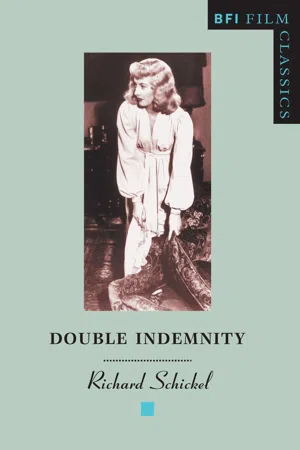
A new kind of film emerged from Hollywood in the early 1940s, thrillers that derived their plots from the hard-boiled school of crime fiction but with a style all their own. Appearing in 1944, 'Double Indemnity 'was a key film in the definition of the genre that came to be known as film noir. Its script creates two unforgettable criminal characters: the cynically manipulative Phyllis Dietrichson (Barbara Stanwyck) and the likeable but amoral Walter Neff (Fred MacMurray). Billy Wilder's brilliant direction enmeshes them in chiaroscuro patterns, the bright California sun throwing shadows of venetian blinds across dusty rooms, shafts of harsh lamplight cutting through the night. Richard Schickel traces in fascinating detail the genesis of the film: its literary origins in the crime fiction of the 1930s, the difficult relations between Wilder and his scriptwriter Raymond Chandler, the casting of a reluctant Fred MacMurray, the late decision to cut from the film the expensively shot final sequence of Neff's execution. This elegantly written account, copiously illustrated, confirms a new the status of 'Double Indemnity' as an undisputed classic.
Information
1
It has all the characteristics of the classic forties film as I respond to it. It’s in black and white, it has fast badinage, it’s very witty, a story from the classic age. It has Edward G. Robinson, and Barbara Stanwyck and Fred MacMurray and the tough voice-over. It has brilliantly written dialogue, and the perfect score by Miklos Rosza. It’s Billy Wilder’s best movie ... practically anybody’s best movie.
Woody Allen1
Agreed. With amendments. Extensive ones. For Double Indemnity acts as a kind of purgative, at once bringing out the worst in us while making us feel so much the better for it. As such it contains more devious felicities than memory, however fond, can summon up in the course of a casual conversation. It has, as well, more dark virtues than we may be able to pick up as – warmed, relaxed, our critical faculties disarmed by the nostalgic impulse – we revisit it via home video or late-night television. It is, in fact, a movie that not only withstands rigorous scrutiny, but actually improves the more closely we study it, the more we know about the circumstances of its creation.
All the good qualities Woody Allen quickly enumerated for his biographer, Eric Lax, obviously deserve additional consideration. But there are others he did not mention which must be taken up as well. These, indeed, account for much of the film’s powerful initial impact and for its continuing – and still growing – claim on our attention.
Perhaps the most basic of them, made clear only if one happens to read James M. Cain’s original tale while studying the film version, is the craftsmanship with which the screenplay is fashioned. The wit which Allen rightly admires is not present in Cain’s text. While its prose is admirably straightforward, and aware of the ironies in which it is dealing, you will not find much ‘badinage’ in it. That’s the creation of Wilder and his screenwriting collaborator, Raymond Chandler. Their dialogue is just a little jazzier than any we are likely to hear in life. More important, though, their adaptation shrewdly and smoothly solves problems of structure and characterization that the novelist did not work out very carefully. The gain in plausibility is incalculable. And it is accomplished without blurring the bleakness of Cain’s instinctive existentialism.
Imagery is the movie’s other great strength – more immediately apparent to most viewers than the subtle remodelings Wilder and Chandler undertook when they moved into this property and made it their own. Allen’s glancing reference to the film stock on which the film was shot does not quite cover this matter, as he would surely agree. Wilder is not a director who frames his shots eccentrically or cuts for shock effect. He is fond of saying (with a degree of false modesty) that since he doesn’t much like shooting, he does whatever he can to keep the job simple. But he is a man who likes to work in close, not to say claustrophobic, quarters. And he is, even in his comedies, powerfully drawn to what I think of as night-for-day shooting; that is to say, rooms that are quite dimly lit even though we know the sun is shining outside. Chiaroscuro, shadow projections, shafts of bright light entering the frame at arresting angles – these are among Wilder’s favorite devices, and Double Indemnity, which was his third film as director, represents his first full-scale orchestration of them. It may not be too much to say, indeed, that like the subsequent Sunset Boulevard it is a drama about light, about a man lured out of the sunshine and into the shadows.
Be that as it may, it must be said that the movie’s visual style analogizes very well with its literary style. It is no more ‘realistic’ than its dialogue, but it is certainly not expressionistic, either. Perhaps the best way to put it is this: stylistically the film presses firmly against the imagistic conventions of American movies of its time without shattering them by a resort to inflated stylization. Working this borderline it manages simultaneously to reinforce the most potent quality of Cain’s work – its air of doomy portent – while adding felt realistic substance to a story that was originally written in some haste for magazine serialization by an author who lacked time, space and perhaps inclination for extended descriptive detail. Put simply, the movie has a very firm sense of place – no movie, documentary or fictional, offers a better sense of how the Los Angeles of its moment looked – but at the same time it energizes that reality with a subtle air of menace. And few movies of any era have more deliciously proved the writerly adage that landscape is character. You could charge L.A. as a co-conspirator in the crimes this movie relates.


The noir style
Dialogue and imagery (and, yes, performance – the actors Allen mentions were never better than they are in this film) transform an essentially banal and in some respects unpersuasive narrative. They impart to Cain’s story something it also did not have in its rather tatty original form, namely weight and conviction. They, more than the tale they tell, are the source of Double Indemnity’s original impact, and they remain the basis of its continuing hold on us. To put the point simply, their singular qualities are the source of the film’s singular – no other word will do – authority.
That authority was recognized immediately, even though it was not at all well defined by its first reviewers. A number of them, in fact, were hesitant in their praise, some because they had trouble categorizing the film, others because they were morally offended by it. But whatever judgments they expressed, they still treated Double Indemnity with a certain respect, grasping that this was a movie to conjure with, even if they didn’t quite know why or how to go about it. The same was true within the industry. The picture did not win any Academy Awards, but it did get seven nominations, recognition few crime films before or since have received. Hollywood didn’t quite understand what it had on its hands, either, but it certainly was something – that much it could see. And try somehow to imitate.
Double Indemnity placed its first viewers at a double disadvantage. The most obvious of them was that the genre to which it quite clearly belongs, film noir, had not yet been named, let alone anatomized: the first public use of the term appears to have been in a French film journal in 1946, and it did not become common American critical coinage for at least another twenty-five years. There was thus no convenient tradition with which to link Double Indemnity, no simple way of defining it through apt comparison. James Agee, for example, evoked Madame Bovary and the whole fictional tradition of bourgeois adultery when he reviewed it.2 Bosley Crowther in the New York Times mentioned French realism, without defining what he meant by the term.3
The other problem confronting Double Indemnity’s contemporary commentators was its source. The film’s literary antecedents seemed at the time utterly disreputable, and in those days literary antecedents were everything (or very nearly so) in determining the ‘seriousness’ of an American movie. It was almost impossible to admit that a major film could be drawn from a source the ‘trashiness’ of which everyone felt obliged to insist upon when they considered it. Therefore the positive response to the film that instinct generated was often tempered, in 1944, by second thoughts emanating from those centers of the brain which house the Mandarin impulse.
Today, almost a half century later, film and literary scholarship having proceeded apace, these defects in the original response to Double Indemnity enhance its historical importance, therefore its air of authority. They show us that in the intervening years we have at least a little expanded the range of our response to certain kinds of movies and writing. Indeed, I would argue that the success of the movie itself, in particular the respectability conferred on it by the several Academy Award nominations it received, played a key role in that expansion, from which (pleasant bit of circularity here) its own reputation has profited.
We know, of course, that despite its lack of a proper French name, the manner we now so easily identify as film noir was beginning to take form, critically unremarked, in the early 40s. We also know that genre experts have traced the roots of this style back to the gangster cycle of the 30s and beyond that to the German Expressionism of the 20s (to which Billy Wilder can also trace his roots). But having acknowledged all that, I still think it is plausible to argue that Double Indemnity, offering as it did such a bold and artful example of film noir’s characteristic images and themes, focused serious attention on that manner as no previous film had done. It can also be argued that the film’s success turned a style until then only occasionally resorted to into a full-scale commercial cycle, which then, by the sheer weight of its numbers, turned film noir into one of the significant signatures of its historical moment. A simple set of statistics, gathered by Alain Silver and Elizabeth Ward in their indispensable Film Noir encyclopedia,4 supports this point: they list four American films noirs for 1941, four for 1942, two for 1943, seven that shared 1944 release with Double Indemnity. Thereafter, though, the numbers begin a startling rise: 16 for 1945, 24 for 1946, 29 for 1947, and so on until a tapering off begins in 1952.
Double Indemnity had, I believe, an analogous effect on people’s understanding of the literary (or must one still say sub-literary?) tradition it drew on. This is less immediately obvious, and it is more difficult to explain. But it is necessary to consider it.

Above and overleaf:
Film noir’s characteristic images
Film noir’s characteristic images

Begin with the fact that the very phrase film noir derives from a literary source. It is a variation on the French term for a certain sort of lowlife novel, the roman noir. This, in turn, was related to the trademark phrases, série noir and fleuve noir, by which Parisian publishers identified the translations and imitations of the American ‘tough guy’ or ‘hard-boiled’ mysteries and crime novels they began publishing in series in the late 1930s and early 40s. James M. Cain was among the authors represented in these books. So were such contemporaries as Dashiell Hammett, W. R. Burnett, Horace McCoy, Cornell Woolrich and, latterly, Raymond Chandler. Now observe that the connection between cinematic and literary noir was not hard to trace. Many of the films noirs that immediately preceded Double Indemnity in the early 40s were based on works by these writers (The Maltese Falcon, High Sierra, The Glass Key, Phantom Lady, Murder, My Sweet), as were many that immediately followed.
This close connection between a ‘school’ of writers who had first been identified as such in the late 30s (much to their own distaste, since they mostly disdained one another’s work) and the movie style that emerged in the next decade was not, so far as I know, much noticed at the time in the United States. But the ‘cinematic’ quality of their work had been recognized. And held against them, of course.
The first American critic to write at all seriously about any of these writers was Edmund Wilson, who in 1940 published ‘The Boys in the Back Room’, a series of essays (later expanded into a short book) about writers who had lived at least for a time in California and used the state as a setting.5 It was a rather awkward grouping, gathering under the same tent such disparate figures as John O’Hara, John Steinbeck, William Saroyan and, in the book version, Nathanael West. But the first of these pieces was devoted to Cain, McCoy and Eric Knight, author of Lassie Come Home, who in a different (not to say schizophrenic) mood, and under a pen name, had written You Play the Black and the Red Comes Up, which he may have meant as a parod...
Table of contents
- Cover
- Title Page
- Contents
- Dedication
- Acknowledgments
- ‘Double Indemnity’
- Notes
- Credits
- Bibliography
- eCopyright
Trusted by 375,005 students
Access to over 1.5 million titles for a fair monthly price.
Study more efficiently using our study tools.
Frequently asked questions
Yes, you can cancel anytime from the Subscription tab in your account settings on the Perlego website. Your subscription will stay active until the end of your current billing period. Learn how to cancel your subscription
No, books cannot be downloaded as external files, such as PDFs, for use outside of Perlego. However, you can download books within the Perlego app for offline reading on mobile or tablet. Learn how to download books offline
Perlego offers two plans: Essential and Complete
- Essential is ideal for learners and professionals who enjoy exploring a wide range of subjects. Access the Essential Library with 800,000+ trusted titles and best-sellers across business, personal growth, and the humanities. Includes unlimited reading time and Standard Read Aloud voice.
- Complete: Perfect for advanced learners and researchers needing full, unrestricted access. Unlock 1.5M+ books across hundreds of subjects, including academic and specialized titles. The Complete Plan also includes advanced features like Premium Read Aloud and Research Assistant.
We are an online textbook subscription service, where you can get access to an entire online library for less than the price of a single book per month. With over 1.5 million books across 990+ topics, we’ve got you covered! Learn about our mission
Look out for the read-aloud symbol on your next book to see if you can listen to it. The read-aloud tool reads text aloud for you, highlighting the text as it is being read. You can pause it, speed it up and slow it down. Learn more about Read Aloud
Yes! You can use the Perlego app on both iOS and Android devices to read anytime, anywhere — even offline. Perfect for commutes or when you’re on the go.
Please note we cannot support devices running on iOS 13 and Android 7 or earlier. Learn more about using the app
Please note we cannot support devices running on iOS 13 and Android 7 or earlier. Learn more about using the app
Yes, you can access Double Indemnity by Richard Schickel in PDF and/or ePUB format, as well as other popular books in Media & Performing Arts & Film & Video. We have over 1.5 million books available in our catalogue for you to explore.