eBook - ePub
Gilda
About this book
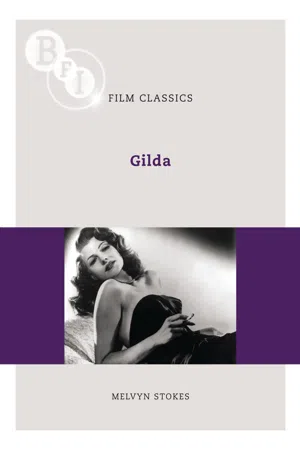
Melvyn Stokes's study of the 1946 classic Gilda describes the film's production and reception history, as well as addressing Rita Hayworth's complex star persona and ethnicity identity; Gilda's status as a 'noir' film; and what the film had to say about relations between men and women in a world transformed by war.
Information
1 Background
The story, in many places, is familiar. An American, who at times wears a white tuxedo, running a bar and casino with a crooked roulette wheel in an exotic foreign location; a love triangle; a memorable song; Nazis; murders – with the consequences of the most crucial of these brushed aside by a sympathetic policeman. But Gilda (1946) was much more than a formulaic attempt by Columbia Pictures to repeat the success of Warner Brothers with Casablanca (1942). It had a much darker tone – Johnny Farrell, a professional gambler, is rescued from a robbery by Ballin Mundson, an elegant figure who carries a cane-knife. Subsequently, Johnny ingratiates himself with Ballin, and becomes the manager of the casino he owns in Buenos Aires, Argentina. Enough hints are dropped (the way Ballin and Johnny glance and smile at each other, the fact that Ballin slips his arm into Johnny’s outside Gilda’s dressing-room, and the constant word-play around the cane-knife) to suggest that the relationship between the two men is homoerotic. On one of Mundson’s business trips, however, he returns with a wife, Gilda. It quickly becomes clear that Johnny and Gilda have once been lovers. In the beginning, Johnny represses his continuing feelings for Gilda by trying (unsuccessfully it appears) to keep her faithful to Ballin.

There is also a criminal dimension to what soon becomes a seething emotional triangle: Ballin is tied in with a shadowy group of Nazis in a bid to secure a world monopoly in the supply of tungsten. The two storylines run together when he kills a Nazi agent in the middle of Carnival and is forced to fake his own death to escape the law. Johnny now supplants Ballin as head of the tungsten combine and as Gilda’s husband. But Johnny’s purpose in marrying Gilda is not simply to cement his control of the cartel (which Ballin has bequeathed to Gilda with Johnny as executor). It is to make her suffer: he effectively imprisons her, trying to ensure that she remains faithful to Ballin’s memory. Gilda takes her revenge by performing a song (‘Put the Blame on Mame’) and semi-striptease in Johnny’s bar, ‘proving’ she is the tramp Johnny believes her to be. Under pressure from Detective Maurizio Miguel Obregon (Joseph Calleia), Johnny gives up all the information on the tungsten cartel. In return, Obregon assures Johnny that Gilda – who is about to leave for America – had only ever pretended to be promiscuous. Johnny goes back to Gilda at the casino and the two reconcile. Ballin now reappears, intent on killing them both, but is instead killed by Uncle Pio (Steven Geray), a casino employee. Obregon arrives and points out that a man can only die once and there is in any case something called ‘justifiable homicide’. Johnny and Gilda are free to return to the United States together. Unlike Rick Blaine, they can go home again.
The parallel with Casablanca is revealing in other ways. In Casablanca, the three main protagonists are all noble individuals. Victor Laszlo (Paul Henreid) is the leader of the anti-Nazi underground movement in Europe. Rick Blaine (Humphrey Bogart) has fought the fascists in Spain. His cynicism and materialism seem to stem mainly from the consequences of his doomed love affair with Ilsa Lund (Ingrid Bergman) in Paris. He is still idealistic enough to sacrifice casino profits by letting a young man win enough at roulette to allow his wife to escape the seductions of Captain Renault (Claude Rains). Ultimately, he sacrifices his love for Ilsa by arranging for her to leave Casablanca with her husband Victor. Ilsa herself has only allowed herself to fall in love with Rick in Paris because she believes Victor is dead. Once she learns he is alive and ill, she immediately breaks off her relationship with Rick to look after him. Of the secondary characters, even the corrupt and exploitive Captain Renault ultimately decides to join the Free French army in fighting the Vichy regime and the Nazis. While Renault heads off with Rick at the end of the movie, few have suggested that this ‘beginning of a beautiful friendship’ is anything but heterosexual.
The case of Gilda is very different. None of the principal characters is in any way noble. Gilda is a showgirl. After the collapse of her relationship with Johnny, she marries Ballin because he is rich. She appears, for much of the film, to be completely amoral. To make Johnny jealous, she flirts – and seemingly more than flirts – with several men. Johnny, though able-bodied, appears to have played no part in the war. He is a very marginal figure, a down-at-heel professional gambler, when the film begins. By offering to put his crooked expertise at Ballin’s disposal, he rises to become manager of the Mundson casino. He also eventually becomes Ballin’s deputy in his plan to acquire an international monopoly of tungsten. The casino, indeed, is really only a front, a laundering operation to cover Ballin’s real ambition, the drive for world domination. With his scarred face and ruthlessness (he is indifferent to the fact that the cartel he runs has bankrupted some suppliers, including the little man, and has no qualms about murdering a German agent in cold blood), Ballin is a villain straight from central casting. To many of those writing about the film it has also seemed likely that Johnny and Ballin, at least before Gilda appears on the scene, have been lovers.2
Both Casablanca and Gilda profited heavily in terms of publicity from contemporary events. Casablanca had its New York première just over two weeks after Allied forces landed in North Africa. It had a highly topical title and its première was greeted by a parade of supporters of the Free French movement.3 Gilda similarly gained much publicity from the testing of an atomic bomb on Bikini atoll in the Marshall Islands on 1 July 1946, a few weeks after the film’s première. At the suggestion of the Columbia publicity department the bomb itself was named ‘Gilda’ and had a picture of Rita Hayworth on the side. While this enhanced Hayworth’s reputation as a 1940s sex goddess (the French satirical magazine Le Canard enchaîné began referring to her as an ‘anatomical bomb’), the actress herself disliked the stunt.4
Otherwise, the story of the immediate reception of the two films diverged sharply. With few dissenting voices, critics responded favourably to Casablanca. The most enthusiastic review was probably that of Bosley Crowther in the New York Times. ‘The Warners … have a picture’, Crowther wrote, ‘which makes the spine tingle and the heart take a leap.’5 Many American critics, in contrast, were unsure what to make of Gilda. Crowther, in contrast to his view of Casablanca, disliked almost everything about it from its ‘vaporous thread of plot’ through Hayworth’s ‘five-and-dime’ acting and ‘crude’ dances to the production team responsible for such a ‘slow, opaque, unexciting film’.6 Other critics had mixed views. There was a general consensus that the storyline was confused and made little sense. ‘If you aren’t a stickler for commonsense and significance’, remarked the Newsweek critic, ‘Gilda is a lot of fun in a cluttered way.’ John McCarten of the New Yorker wrote that the film revolved around ‘a susceptible lady’ who was ‘as innocent as a lamb and just about as bright … who marries two lunatics in rapid succession’. Other reviewers believed that the plot ‘doesn’t bear close inspection’: it was ‘boring and slightly confused’, ‘not easy to believe’ and ‘bewildering and somewhat pointless’. A number felt that the film itself was too long, and had lost impetus along the way.7 In contrast, a minority, led by Kate Cameron [Dorothy King] of the New York Daily News, praised the film’s producers for maintaining suspense throughout.8
The contrasting reception of the two films was echoed in terms of Academy Awards. Casablanca had eight Oscar nominations and won three (Best Picture, Best Director, Best Screenplay).9 Gilda gained no Oscar nominations (the film is listed on a website devoted to the Oscars as one of that year’s ‘sins of omission’).10 On the other hand, despite the lack of ecstatic reviews and Oscars, not to mention the superficially unappealing nature of the characters in Gilda, the film outperformed Casablanca at the box office, earning back $7.5 million at the time of its first release compared with $3.5 million for Casablanca.11
Commercial success, of course, is far from being a reliable guide to whether a film will achieve classic status. Gilda is a film of high quality, with compelling characters, memorable (often quotable) dialogue, imaginative cinematography and superb set design and costuming. But so were many films that have not come to be regarded as classics. The case for viewing Gilda as a classic rests on three principal grounds. The first is the astonishing bravura performance by Rita Hayworth in the title role. Hayworth’s road to Gilda (her thirty-ninth feature film) and her performance in the movie will be discussed in Chapter 3. The second reason for seeing Gilda as a classic is its emergence as a major site of critical and analytical commentary. As Chapter 5 shows, many film scholars have written about the film in the last forty years. Third, Gilda has been cited by – or has influenced – a whole range of international cultural productions. It has been referenced in fashion: in 2001, Saks Fifth Avenue in New York offered a shortened version of the famous dress Hayworth wore during her semi-striptease and the ‘Gilda look’ using cosmetics became fashionable in London.12 In music, Argentinian rock band Serú Girán paid tribute to the film in the song ‘Salír de la Melancolia’ (Coming out of Melancholy) on their 1981 album Peperina. Gilda has been cited many times in television programmes (the celebrated poster of Hayworth wearing her black ‘Mame’ dress appears on the wall of the apartment of Ros Doyle [Peri Gilpin] in at least one episode of Frasier, 1993–2004).
Finally, of course, among other cultural productions, Gilda has been a constant reference point for film-makers. In Vittorio De Sica’s Bicycle Thieves (1948), Antonio Ricci (Lamberto Maggiorani) takes a new job putting up cinema posters. Another employee shows him what he has to do by pasting up a picture of Rita Hayworth wearing her black ‘Mame’ dress. The first time Ricci puts up this poster, however, a thief destroys his livelihood by stealing his bicycle. In The Shaw...
Table of contents
- Cover Page
- Title Page
- Contents
- Introduction
- 1 Background
- 2 Making Gilda
- 3 Rita Hayworth as Gilda
- 4 Gilda the Film
- 5 Interpreting Gilda
- 6 Gilda and Its Contexts
- Notes
- Credits
- Bibliography
- eCopyright Page
Trusted by 375,005 students
Access to over 1.5 million titles for a fair monthly price.
Study more efficiently using our study tools.
Frequently asked questions
Yes, you can cancel anytime from the Subscription tab in your account settings on the Perlego website. Your subscription will stay active until the end of your current billing period. Learn how to cancel your subscription
No, books cannot be downloaded as external files, such as PDFs, for use outside of Perlego. However, you can download books within the Perlego app for offline reading on mobile or tablet. Learn how to download books offline
Perlego offers two plans: Essential and Complete
- Essential is ideal for learners and professionals who enjoy exploring a wide range of subjects. Access the Essential Library with 800,000+ trusted titles and best-sellers across business, personal growth, and the humanities. Includes unlimited reading time and Standard Read Aloud voice.
- Complete: Perfect for advanced learners and researchers needing full, unrestricted access. Unlock 1.5M+ books across hundreds of subjects, including academic and specialized titles. The Complete Plan also includes advanced features like Premium Read Aloud and Research Assistant.
We are an online textbook subscription service, where you can get access to an entire online library for less than the price of a single book per month. With over 1.5 million books across 990+ topics, we’ve got you covered! Learn about our mission
Look out for the read-aloud symbol on your next book to see if you can listen to it. The read-aloud tool reads text aloud for you, highlighting the text as it is being read. You can pause it, speed it up and slow it down. Learn more about Read Aloud
Yes! You can use the Perlego app on both iOS and Android devices to read anytime, anywhere — even offline. Perfect for commutes or when you’re on the go.
Please note we cannot support devices running on iOS 13 and Android 7 or earlier. Learn more about using the app
Please note we cannot support devices running on iOS 13 and Android 7 or earlier. Learn more about using the app
Yes, you can access Gilda by Melvyn Stokes in PDF and/or ePUB format, as well as other popular books in Media & Performing Arts & Film History & Criticism. We have over 1.5 million books available in our catalogue for you to explore.