eBook - ePub
Gun Crazy
About this book
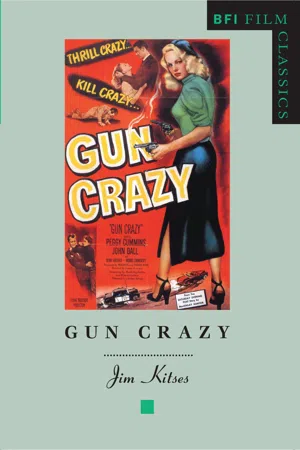
Joseph H. Lewis's 'Gun Crazy' is the story of two young lovers who embark on a crime spree. For this book, Kitses researched widely into the film production's history and explored its connection to the crime film tradition and to the dark underside of American society.
Information
1

If ever a film opened with a defining moment in a young character's life, that film is Gun Crazy. A peak achievement of film noir, the dark crime and failure stories that dominate the post-war American cinema, Gun Crazy plunges its audience into the shadows from its very first shot. In a bad dream that rapidly becomes nightmare, a dark and private desire is indulged and retribution is instantaneous. This is your life, Bart Tare.
Gun Crazy opens in medias res and in medias noir, in the middle, that is, of Bart Tare's attempted theft of a gun, and in the midst of a veritable cloudburst of classical noir image coding. In a brilliant little expressionist poem, a tableau comprising some nine shots and seventy seconds, Gun Crazy presents us with the fundamentals of the noir formula: a deviant act in a dark and oppressive world, an isolated, alienated and obsessed hero, temptation, failure and defeat. There is a theatrical flavour to it all, a bravura distillation of the essentials, an exemplary vignette captured on stage and in frame in a series of snapshots: a dark, rainy street; a boy, standing, staring at us; the boy framed by and looking in the window; the boy's face, possessed, fascinated, looking; a display of handguns, the centrepiece an ivory-handled Western-style six-shooter; the face receding, a neon sign pulsing behind on–off, on–off; the boy winding up and pitching his rock; the boy posed crucified against the broken window; the sheriff's face, huge and hard; the sprawled boy's look up, a world of wet.
More than a dream, it is a feverish masturbatory fantasy, the furtive hand reaching through the broken glass, the boy trying to get off with his gun, the wetness and the fall, the castrating gaze of the Father and the Law. Introducing the film's basic strategy, the violent is here coloured with the erotic, a conceit enhanced by the long-take shot which builds from the opening credit on, the slow, focused intensity coming to a violent climax, almost comical in its explosive release of tension. We are left with Bart as the butt of the noir universe's joke, the teenager as fall guy, the pathetic loser.
In a stylistic flip-flop somewhat reminiscent of Citizen Kane's famous opening, which fades from the dark inner recesses of Kane's extinguishing consciousness to the bright 'objective ' world of the 'News on the March' account of his life and career, Gun Crazy dissolves from Bart lying in the gutter of his defeated dream to the sun-drenched courtroom of evidence and testimony, law and justice, that seeks to make sense of the boy and his actions. It may seem outrageous to mention Kane in the same breath as our little epic; however, parallels do come to mind. The courtroom scene, for instance, will proceed through the testimony of Ruby, Bart's sister, his friends, and his teacher, each resulting in a flashback (the opening scene logically the sheriff's) as in the main narrative of Kane, as the judge tries to get to the bottom of Bart's obsession with his Rosebud – guns.
During this testimony, the mise-en-scène stresses Bart's impotence, supplying us visually with a set of variations on a still life – a hangdog Bart immobile in a chair – in place of the opening's images of Bart in mesmerised action. The climax of that scene is of course the boy's pitching of the rock at the window through which we view him, an attempt to break into the store, but also a futile attempt to break out, and to reach out, of his constraining world. For Bart freedom evidently resides with the gun, and for his dangerous act of breaking the glass, the law, and very nearly the illusionist distance between audience and spectacle, the boy is banished in the ensuing scene to the far corners of the frame, a series of deep focus compositions holding him to one side and against a courtroom window, a safe distance from the site of testimony in the foreground. Again, the visual design may recall Kane and the image of the young Charlie playing in the snowy distance ('The Union forever'), trapped within the dark window frame before which his fate is being sealed.
In drawing these parallels to the American cinema's most famous and influential work, I am not trying to borrow prestige, or to blur the radical differences that exist. Gun Crazy's stunning achievement is intimately bound up with, and a direct result of, its relatively low-budget, low-class origins. Its genealogy is distinctly minor league; Gun Crazy is at the opposite end of the spectrum from Citizen Kane in terms of production values, authorial stature and power, historical significance. Humble Bart Tare is destined to become neither capitalist titan nor cultural icon. Instead of an American colossus, citizen Tare will be very much the typical noir protagonist – an unknown soldier, a small-time guy. But for all its modesty of subject and means, the film does resemble its heavyweight predecessor in some crucial respects; stylistically, it is an extraordinarily inventive work, and it too lays claim to our attention as one of those films that is quintessentially American.
2
Gun Crazy's inspired, lurid title hurtles on to the screen with the tabloid pizzazz of a headline. Just to complicate matters, however, Gun Crazy was originally released by United Artists in January 1950 as Deadly is the Female, then re-released six months later under the title of the source material, MacKinlay Kantor's Saturday Evening Post short story. Such a spin was clearly possible on a narrative summarised by the office of Motion Picture Production Code chief Joseph Breen, the guardian of the era's morality whose authorial interventions in the script's development had been extensive, as: 'a man's mania for guns is capitalised upon by an adventuress . . . and both lose their lives after a career of crime.'1
If the different titles problematised the question of whether Bart or his sharp-shooting inamorata, Laurie, owned the narrative and was responsible for its violence, the ill-advised attempt to avoid exploitational overtones with poetic inversion failed to fool a discerning Variety: 'Hiding behind the awkward title . . . is a story of desperate young love and crime.'2 In any case, the film was well received by a savvy local and trade press, the sharp critic in the Los Angeles Times impressed that 'a crime picture can come along at this late date and top nearly all that have preceded it . . . hell on wheels . . . use of the medium in its sharpest, simplest sense.'3
Where a sophisticated eye saw iconographic purity, the more jaded view of national reviewers was dismissive – 'humdrum pulp fiction'.4 Although inevitably hurt by its uncertain release, it is doubtful whether the film could have done well in any case. What did it have going for it? No powerful imperialist studio logo roared a promise of prestige or glamour at the audience. MGM reportedly wanted to buy the film and lend their marketing clout, but a condition was the removal of the King Brothers' producers credit, in studio eyes synonymous with cheapjack product. The feisty Kings – the 'B-picture Kings', Frank, Maurie and Hymie – predictably refused. Gun Crazy was doomed to become one of the great cult movies of American film history, the favourite B-movie of everybody-in-the-know. But what everybody would not know is that the film was conceived and released as a modest A-level production. The romantic myth surrounding the film has it the achievement of an auteur inspired by shoestring limitations to create the very epitome of B-film noir. Ironically, the truth is that the enterprising Kings – Monogram Studio masters of the cheapie and quickie, of formula efforts with no stars and lean budgets – were attempting to upgrade with Gun Crazy, and its proposed $500,000 budget and thirty-day schedule, to come in at the floor of the A-level production, the so-called 'nervous A'. Yet the film must have screamed 'B-movie!' at its original audiences, as it has at their successors.5
One can see why. Despite aiming high (for them), the Kings were inevitably to live down to their reputation somewhat in mounting the production. The economising would be obvious in the small scale, the few crowd scenes, the stock footage. To helm the project they had originally considered art director Gordon Wiles, whom they had direct The Gangster the previous year, but in the end they brought in Joseph H. Lewis, a veteran of successful B-movie and, more recently, 'nervous A' studio assignments. But the crucial factor was the casting. The Kings had originally gone after both Gregory Peck and Dana Andrews for Bart, and later there was talk of pairing the likes of Farley Granger and Susan Hayward to play the outlaw couple. However, in the eyes of Hollywood's elite, lowbrow Monogram and the proletarian Kings were a standing joke, sources of the worst pictures on the market. Moreover, Gun Crazy was going into production while the jury was still out on more ambitious independent projects. Established stars were understandably wary of leaving big studio lots to share in the poorboy Kings' gamble – capitalising on the success of small pictures such as their earlier When Strangers Marry and Dillinger to try to move up. Ultimately, the Kings were forced to go with minor stars John Dall and Peggy Cummins, both a B-minus in name voltage, casting which would result in full-blooded and sensitive performances, but which lacked iconographic oomph.
In short, Gun Crazy both benefited and suffered from changes in the industrial landscape, as did its director. As Paul Kerr has argued, economic developments in Hollywood such as the break-up of block booking attendant on the Supreme Court anti-trust rulings in 1946–8, and the consequent divestiture of the studios' exhibition arm, boosted the efforts of enterprising independents like the Kings, and were critical factors in shaping the contours of film noir and the careers of B-movie directors such as Lewis.6 A system in flux was opening up new directions for creative work, as evidenced by the limited but real advance in resources for a minuscule B-movie such as Columbia's My Name is Julia Ross (1945). A 65-minute thriller with Nina Foch as the put-upon heroine, this modest picture was recognised as a sleeper by studio head Harry Cohn while it was in production, and given more shooting time, a preview and an independent release. It was a breakthrough for director Lewis, whose career so far had consisted of some two dozen quickies at various studios – mostly Western and action movies on which Lewis would often leave his idiosyncratic touch, long, long takes and deep-focus shots framed by wagon-wheels or such in the foreground.
But it was Gun Crazy that was to provide Lewis's only real breakthrough: a tight, evocative script, the support of independent-minded street-fighter producers, performances by two gifted, offbeat players, censors' interventions on behalf of a pushy Zeitgeist – all coming together with his stylish, inventive direction in a remarkable synergy. The result was a bona fide American masterpiece, pint-sized though it may be, one of Hollywood's transcendent works, an indispensable portrait of a transitional moment and ethos, a world of small-time characters and big-time aspirations, brought to life in a genuine desert island movie (if the ship is sinking . . .). Starting in the late 1960s, auteur critics made valiant efforts to attribute the authorship of Gun Crazy to Lewis. In vain. A hodgepodge of a filmography absolutely resists reduction to any consistency, and provides vivid evidence of how dependent Lewis always was on collaborators. Although there are a number of interesting films, especially the distinguished, Philip Yordan-scripted, upper-echelon noir, The Big Combo (1955), as an auteur Lewis is essentially a stylist without a theme, and it is Gun Crazy that provides his body of work with its centre of gravity.

(I. to r.) Producer Frank King and cinematographer Russell Harlan, standing; Peggy Cummins and director Joseph H. Lewis, seated above
But it was not so much auteurism that drew the film into the spotlight in the 60s as the spectacular success of what some thought to be a direct descendant, the Arthur Penn-directed Bonnie and Clyde. Perhaps it was the visual link of the beret that both heroines sport, after the most famous photograph of the original Bonnie, but many critics invoked Gun Crazy, and in some cases preferred it. Over the years Gun Crazy has received a goodly share of attention for its pivotal place in the distinguished company of the fugitive-couple narrative cycle. Where Fritz Lang's depression-era You Only Live Once and Nicholas Ray's They Live By Night (1948) see their subjects as innocent victims, the King Brothers were clearly more interested in the greater commercial potential gained by centring the romantic narrative on rebellious characters who actively choose to be criminals, as is suggested ...
Table of contents
- Cover Page
- Title Page
- Contents
- Acknowledgments
- 'Gun Crazy'
- Postscript: 24 August 1995
- Notes
- Credits
- Bibliography
- eCopyright
Trusted by 375,005 students
Access to over 1.5 million titles for a fair monthly price.
Study more efficiently using our study tools.
Frequently asked questions
Yes, you can cancel anytime from the Subscription tab in your account settings on the Perlego website. Your subscription will stay active until the end of your current billing period. Learn how to cancel your subscription
No, books cannot be downloaded as external files, such as PDFs, for use outside of Perlego. However, you can download books within the Perlego app for offline reading on mobile or tablet. Learn how to download books offline
Perlego offers two plans: Essential and Complete
- Essential is ideal for learners and professionals who enjoy exploring a wide range of subjects. Access the Essential Library with 800,000+ trusted titles and best-sellers across business, personal growth, and the humanities. Includes unlimited reading time and Standard Read Aloud voice.
- Complete: Perfect for advanced learners and researchers needing full, unrestricted access. Unlock 1.5M+ books across hundreds of subjects, including academic and specialized titles. The Complete Plan also includes advanced features like Premium Read Aloud and Research Assistant.
We are an online textbook subscription service, where you can get access to an entire online library for less than the price of a single book per month. With over 1.5 million books across 990+ topics, we’ve got you covered! Learn about our mission
Look out for the read-aloud symbol on your next book to see if you can listen to it. The read-aloud tool reads text aloud for you, highlighting the text as it is being read. You can pause it, speed it up and slow it down. Learn more about Read Aloud
Yes! You can use the Perlego app on both iOS and Android devices to read anytime, anywhere — even offline. Perfect for commutes or when you’re on the go.
Please note we cannot support devices running on iOS 13 and Android 7 or earlier. Learn more about using the app
Please note we cannot support devices running on iOS 13 and Android 7 or earlier. Learn more about using the app
Yes, you can access Gun Crazy by Jim Kitses in PDF and/or ePUB format, as well as other popular books in Media & Performing Arts & Film & Video. We have over 1.5 million books available in our catalogue for you to explore.