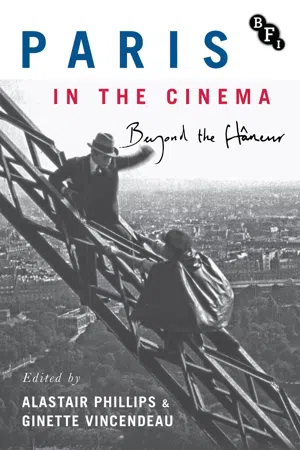
eBook - ePub
Paris in the Cinema
Beyond the Flâneur
- 286 pages
- English
- ePUB (mobile friendly)
- Available on iOS & Android
eBook - ePub
Paris in the Cinema
Beyond the Flâneur
About this book
'Paris in the Cinema' offers a new approach to the representation of Paris on screen. Bringing together a wide range of renowned French and Anglophone specialists in film, television, history, architecture and literature, the volume introduces, challenges and extends ideas about the city as the locus of screen modernity. Through a range of concrete and historically-specific case studies, ranging from particular districts such as Saint-Germain-des-Pres and les banlieues (the suburbs) in French cinema, to iconic figures such as the detective Maigret and the lovers, and from locations such as the hotel, the building site and the Eiffel Tower to filmmakers such as Agnes Varda and Jean-Pierre Jeunet, this unique text demonstrates how the cinematic city of Paris now constitutes a major archive of French cultural history and memory.
Information
Part I
LOCATIONS

The Eiffel Tower: A Parisian Film Star
Nicoleta Bazgan
For a world-renowned icon that has been filmed from all angles, the Eiffel Tower remains intriguingly opaque. It still exudes an enigmatic fascination, like a film star coming from the silent era. At first glance, the immobile Tower seems to be merely a clichéd image that offers a readily readable location. Yet, in a dynamic interaction with the on-screen cityscape and the cinematic audience, the Tower has constantly challenged the representation and experience of Parisian space. The monument’s image has been actively marketed since the Eiffel Tower’s debut at the 1889 Exposition Universelle when postcards were sold underneath its great spanning arches.1 In its very first roles in newsreels, the towering landmark tested the limits of the camera. Its massive height led to the first vertical tracking shot in the history of cinema in the Lumière Brothers’ Panorama pendant l’ascension de la Tour Eiffel/Panorama during the Ascent of the Eiffel Tower (1897–98) and redefined the tilt in Thomas Edison’s Panorama of the Eiffel Tower (1900). As its image is now intimately connected to the history of cinema, the very presence of the landmark on screen might be considered a cinephilic gesture in itself.
Since the Tower’s breakthrough role in René Clair’s Paris qui dort/The Crazy Ray (1924), the monument’s fame has grown through unforgettable performances and countless cameos. In a stunning range of films, the Parisian icon has, for example, been examined in the documentary Paris 1900 (Nicole Védrès, 1948), revered in Les Quatre cents coups/The 400 Blows (François Truffaut, 1959), featured in the blockbuster Taxi 2 (Gérard Krawczyk, 2000) and celebrated by Hollywood in Funny Face (Stanley Donen, 1957). Over the course of its long career, the Tower has therefore acquired all the characteristics of a French film star. It enjoys dual success in mainstream and auteur cinema, with regular appearances in Hollywood films. In the national industries of tourism, fashion and cosmetics, the glamorous monument embodies a sophisticated form of Frenchness.2 On screen, numerous cameos define the Tower’s star persona as a Parisian icon capable of invoking well-established facets of the city. In more complex roles, however, the landmark fully reveals its paradoxical nature. It acts as a protagonist but also takes the place of the camera itself. Notoriously ambivalent, its body is connected to both joyful celebration and deadly seduction. Through these constitutive paradoxes, rather like all major film stars, the Tower embodies a wide range of contradictions.
As an urban icon,3 the Tower has been typecast in a ‘perfect fit’4 with its off-screen image. Roland Barthes explains its magnetism in the real cityscape as a ‘pure – virtually empty – sign’.5 In contrast, its appearances on screen, however brief, are already invested with meaning. Even in establishing shots, the Tower cannot be solely read as a metonymical monument. Instead, it becomes a site where different facets of Paris – the city of romantic love, the city of modernity, the touristic city – are shaped through shifting meanings. The prologue of Paris, je t’aime (2006) shows a twinkling Tower at night, with fireworks that burst into a spectacular celebration, setting the audience ablaze with emotion. The gleaming beam and magical shimmer of the landmark recall that cinema, too, is light in movement. When the film title appears over this background, cinematic gaze and desire are aligned with the consumption of Paris, the city of romantic love. Although the iconic cameos of the Eiffel Tower have become a key part of its global mainstream appeal, this typecast role represents only one side of its intricate stardom.

The Eiffel Tower’s cameo as an urban icon in Paris, je t’aime (Olivier Assayas, et. al., 2006).
Through its position as both protagonist and camera, the Eiffel Tower reveals a simultaneous sense of concrete presence and subjective perception in urban space. Taking the Tower’s place, the camera as a material ghost can record the Parisian cityscape through a myriad point-of-view shots in all directions. In over-the-shoulder shots, the on-screen landmark ‘cuts’ the landscape using its open latticework as a frame and viewfinder. Through its architecture, the Tower merges inner and outer space, situating the visitor at once in its structure and elsewhere in the surrounding Parisian landscape, immersed in a multisensory experience. In the 15-minute short La Tour/The Tower (1928), René Clair conveys the transformative experience of a visit to the landmark. The monument’s symmetrical latticework cuts kaleidoscopic slices in the Parisian landscape, displaying fragmentary ways of seeing. Pans, tilts and tracking shots frame a mobile cityscape. Close-ups of the Tower reveal the tactility of the iron filigrees through startling details. The concrete materiality of the edifice and the emotional immersion in the Parisian scenery fuse objective and subjective perception, changing the experience of the city.
As a star body, the Tower appears in different scales that emphasise its tactile qualities, from a lofty silhouette to a fetishised element such as a girder, pillar, arch, elevator, platform, staircase or filigree in a technique originating from photography.6 At night, shimmering lights outline the landmark to display its electric glamour. The monument’s tri-dimensional structure opens up a vertical labyrinth, while its platforms function as stages, mirroring the horizontal maze of the urban sprawl and public squares. Its architecture offers countless possibilities for actions to assert or contest the urban power grid.
The honourable Tower has been regularly filmed hosting official and festive events. The short newsreel Lunch on the Eiffel Tower (Topical Film Company, 1914), for example, records a sumptuous formal meal in the landmark’s restaurant and an elevator descent showcasing the stunningly beautiful cityscape. In stark contrast, a British Pathé newsreel from 1912 shows Franz Reichelt testing a flying costume and jumping off the Tower to his death in front of the cameras, becoming, as François Truffaut puts it, ‘without a doubt, the first victim of cinema’.7 The Icarian hubris captured on screen highlights the morbid side of the monument where spectacle and danger coalesce. Since the first documentaries, the Tower’s body has thus been deeply ambivalent, torn between sensational leisure and fatal magnetism.
Connected to the broader landscape, the Tower, through its constitutive paradoxes, taps into, and frequently unsettles, the main binaries that structure cities to produce multiple layers of social, cultural, economic and affective space. The interplay between the distance and proximity to the landmark, for instance, translates into social belonging and exclusion. Numerous films use windows with a view on the Eiffel Tower to indicate an affluent position in the city, from La Règle du jeu/The Rules of the Game (Jean Renoir, 1939) to Le Dîner de cons/The Dinner Game (Francis Veber, 1998). In La Haine/Hate (Mathieu Kassovitz, 1995), a character’s failed attempt to ‘switch off’ the lights of the monument poignantly shows his marginalisation in social space.8 In this role, the Parisian landmark actively exposes, and often problematises, the main binaries that produce urban space: centre/periphery, inclusion/exclusion, order/chaos and self/other. During its long career, the star landmark has therefore become a celluloid palimpsest where different social and cultural tensions are constantly reworked.
In more complex appearances, the Tower undermines the artificial divisions that filter the lived experience in urban space, thriving through the embodiment of perplexing contradictions. Three key performances of the Tower illustrate how its function as protagonist/camera and ambivalent body interact to disrupt conventional binaries, while establishing the main coordinates of its star appeal. In Paris qui dort, René Clair links the Tower’s image to romantic love and deadly seduction, showing its tremendous visual power. In Le Mystère de la Tour Eiffel/The Mystery of the Eiffel Tower (Julien Duvivier, 1928), the landmark is screened as a site of playful adventures and uncanny danger, revealing a mysterious sonic space. Within the next decades, as film production moved into the studios, the Tower was mostly present on sets as a replica. Returning to location shooting, the French New Wave filmmakers established the icon as a coveted presence in art-house films and revitalised its image through roles displaying its timeless modernity, self-referential persona and everyday presence in the city. In particular, Zazie dans le métro (Louis Malle, 1960) shows how a visit to the monument becomes an inner journey and how films mediate the experience of the landmark, contributing to its affective impact.
A Dark-Bright Star Is Born
René Clair cast the Eiffel Tower in his first feature film, Paris qui dort, at a time, in 1923, when the Tower was a prominent subject in the Paris art world. Influenced by both avant-garde groups and the mainstream film industry in which he worked, the filmmaker, who saw cinema’s main purpose as ‘recording movement’, directed a film with motion as a ‘visual theme’.9 In it, an old scientist paralyses the city with a crazy ray, a transparent reference to cinema itself.10 Only Albert (Henri Rollan), the watchman of the Eiffel Tower, and five persons travelling in an airplane remain out of the ray’s reach. All Paris belongs to them, but soon their absolute freedom becomes oppressive. When they receive a call for help from the scientist’s niece, they hurry to reset the world in motion.
The film opens with the Tower’s subjective viewpoint in an aerial vista screening the Seine, flickering in the sun, on which barges slowly advance underneath the arched bridges. An extreme-long shot of a majestic panorama follows, with a recognisable Arc de Triomphe in the frame. When the watchman wakes up the next day, he discovers a frozen city, shown through a dizzying tilt on the Champ de Mars. Disguised as Albert’s point of view, the shot unexpectedly uncovers him at the bottom of the frame. The playful shift in perspective certainly serves to undermine fixed points of observation, in a contemporary change that reflects the modernist era. It also reminds us that the Eiffel Tower is, at all times, both camera and protagonist.
When Albert leaves the edifice, the camera vertically tracks his circular descent of a spiral staircase, thus reinforcing the symmetrical geometry of the frame. His active movements are intercut with tilts of the Tower’s silhouette viewed from a distance. After several cuts, the camera forgets about the hero and begins to wander on the Tower’s iron curves, fetishising its tactile latticework. A shot lingers on a platform to absorb the massive iron beams radiating in all directions. When Albert steps into the mise-en-scène, his presence comes as a surprise, since the Tower now occupies the spotlight. As the watchman gets off the west pillar, the spectator feels more connected to the bodily presence of the monument than to the protagonist.
In the second part of the film, the Tower becomes both a site of playful spatial practices and a fault line where the urban id erupts through aggressive and libidinal impulses. After using Paris as a playground, the six protagonists spend their days on the Tower. A fast tilt on a girder un...
Table of contents
- Cover
- Title Page
- Contents
- Acknowledgements
- Beyond the Flâneur: An Introduction
- Part I: Locations
- The Eiffel Tower: A Parisian Film Star
- Working-class Paris and Post-war Noir: Les Portes de la nuit
- The Caves of Saint-Germain-des-Prés in 1950s French Cinema
- Paris in the Summer of 1959: Le Signe du lion
- Truffaut’s Apartments
- The New Wave Hotel
- The Vanishing of Les Halles
- The Parisian Banlieue on Screen: So Close, Yet So Far
- Part II: Characters
- Maigret from across the Channel
- Parisian Cinephiles and the Mac-Mahon
- Beyond the Flâneuse: The Uniqueness of Cléo de 5 à 7
- Amateur Filmmakers’ Paris: Home Movies at the Forum des Images
- The Concierge in Contemporary French Cinema
- Parisian Lovers in the Contemporary Romcom
- The Enduring Glamour of the Parisienne
- Part III: History
- Charles Dickens’s Two Cities
- From Meryon to Ulmer’s Bluebeard: A Baudelairian Iconography
- Site of Infamy: The Vel’ d’Hiv in French Cinema
- ‘Unremarkable Paris’: Jacques Becker’s Urban Everyday
- Television and the Renewal of Paris: From Official Discourse to Social Criticism
- Parisian Building Sites (1945–75): From Modernity to Abstraction
- The Mirror of a City: The ‘Parisian Collection’ of the Forum des Images
- Part IV: Interview
- Filming Paris: An Interview with Jean-Pierre Jeunet
- Contributors
- Select Bibliography
- Index
- eCopyright
Trusted by 375,005 students
Access to over 1.5 million titles for a fair monthly price.
Study more efficiently using our study tools.
Frequently asked questions
Yes, you can cancel anytime from the Subscription tab in your account settings on the Perlego website. Your subscription will stay active until the end of your current billing period. Learn how to cancel your subscription
No, books cannot be downloaded as external files, such as PDFs, for use outside of Perlego. However, you can download books within the Perlego app for offline reading on mobile or tablet. Learn how to download books offline
Perlego offers two plans: Essential and Complete
- Essential is ideal for learners and professionals who enjoy exploring a wide range of subjects. Access the Essential Library with 800,000+ trusted titles and best-sellers across business, personal growth, and the humanities. Includes unlimited reading time and Standard Read Aloud voice.
- Complete: Perfect for advanced learners and researchers needing full, unrestricted access. Unlock 1.5M+ books across hundreds of subjects, including academic and specialized titles. The Complete Plan also includes advanced features like Premium Read Aloud and Research Assistant.
We are an online textbook subscription service, where you can get access to an entire online library for less than the price of a single book per month. With over 1.5 million books across 990+ topics, we’ve got you covered! Learn about our mission
Look out for the read-aloud symbol on your next book to see if you can listen to it. The read-aloud tool reads text aloud for you, highlighting the text as it is being read. You can pause it, speed it up and slow it down. Learn more about Read Aloud
Yes! You can use the Perlego app on both iOS and Android devices to read anytime, anywhere — even offline. Perfect for commutes or when you’re on the go.
Please note we cannot support devices running on iOS 13 and Android 7 or earlier. Learn more about using the app
Please note we cannot support devices running on iOS 13 and Android 7 or earlier. Learn more about using the app
Yes, you can access Paris in the Cinema by Alastair Phillips, Ginette Vincendeau, Alastair Phillips,Ginette Vincendeau in PDF and/or ePUB format, as well as other popular books in Media & Performing Arts & Film & Video. We have over 1.5 million books available in our catalogue for you to explore.