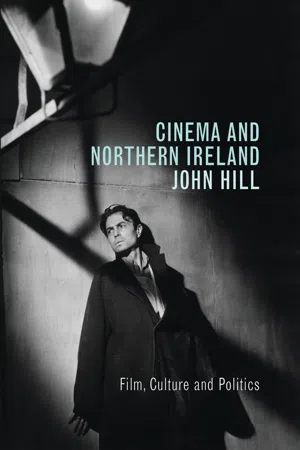
- 269 pages
- English
- ePUB (mobile friendly)
- Available on iOS & Android
eBook - ePub
About this book
Traces the history of film production in Northern Ireland from the beginnings of a local film industry in the 1920s and 1930s, when the first Northern Irish 'quota quickies' were made, through the propaganda films of the 1940s and 1950s and on to the cinema of the 'Troubles'.
Information
1
‘Ulster must be made soft and romantic’
Northern Ireland Film-making in the 1920s and 1930s
The beginnings of local film production in Northern Ireland occurred in the 1930s, when a number of features involving the local actor and singer Richard Hayward were made. The first of these was The Luck of the Irish, made in 1935, followed by The Early Bird (1936), Irish and Proud of It (1936) and Devil’s Rock (1938). Partly because they have been difficult to see, and partly because they were cheaply and quickly made, these films have commonly been seen as historical oddities unworthy of sustained critical attention.1 However, while it would be hard to mount a case for these films as ‘lost treasures’, they do possess considerable historical interest, not only because they were the first feature films to be shot in Northern Ireland but also because of what they reveal about the political and cultural concerns of the period. When they are viewed in context, it is apparent that the films did not emerge out of the blue but grew out of, and contributed to, more general ideological and cultural currents. For, while these films were not ‘propaganda’, they did enjoy the semi-official support of the state. Moreover, in the way that they sought to represent Northern Ireland on screen, it is also evident that they were influenced by, and overlapped with, other attempts to ‘imagine’ a distinct Northern Irish – or ‘Ulster’ – identity during this period.
‘A fertile ground for propaganda’: film and the promotion of Northern Ireland
Given the turbulence of the early years of the Northern Ireland state, it was unlikely that it would devote much attention to a policy for film production. However, precisely because of the threatened status of the new regime (and the success of unionism during the Home Rule period in exploiting possibilities for propaganda), the Unionist government (elected in May 1921) did appreciate the value of favourable media publicity. Apart from a short period during 1926 and 1927, however, it avoided engaging directly in publicity (at least until 1938 when it opened the Ulster Office in London) and opted to lend support to bodies that were nominally independent. The most important of these, during the early years, was the Ulster Association (For Peace With Honour), which was established in April 1922 to encourage ‘a better understanding of Ulster at home and abroad’ and to support ‘the Prime Minister and Government in the resolute stand they were making against the attacks on the constitution assured by the Government of Ireland Act’.2 Although the Association was funded by local businesses, the Unionist Prime Minister, James Craig, was its President and the organisation acted as a semi-official mouthpiece of government. The Association appointed a Director of Publicity, established offices in Belfast and London, and distributed news and information favourable to the new regime across Britain. Thus, by the close of its first year of activities, the organisation claimed to have secured 60,000 columns of information on Northern Ireland in the world’s press, and distributed 10,000 ‘Ulster Publications’.3 Following the abandonment of the Boundary Commission and subsequent agreement on the border issue in 1925, the Association felt that its propaganda goal had been accomplished and transferred its publicity activities (and London office) to the Ministry of Commerce in 1926. However, given the drain on public expenditure involved in maintaining social services on a par with the rest of the UK, the government came to the conclusion that the cost of sustaining the operation was too high and opted, the following year, to cease its activities in this area and confine its funding to the Ulster Tourist Development Association (UTDA).
This was not as peculiar a decision as it might initially appear. The UTDA was, in fact, the brainchild of the Ulster Association, which had launched the organisation at a conference in January 1924. Robert Baillie, the Chair of the Association’s publicity committee, also became the UTDA’s first chairman. Although the organisation’s purpose was to foster and develop ‘tourist traffic in Northern Ireland by advertising the advantages and amenities of the various districts’, its close connections with government and the Ulster Association also meant that its promotion of tourism could assume a more directly political character.4 Thus, an early UTDA pamphlet distributed in America was attacked in the Northern Ireland House of Commons by the Nationalist MP, Patrick O’Neill, as ‘nothing more than propaganda for the Presbyterian Church’.5
Although the UTDA’s ventures into film were primarily concerned with promoting awareness of Northern Ireland as a tourist location, this too could take on a political dimension. As early as 1912, James Craig had recognised the propaganda value of film newsreels by arranging for the recording – ‘under the fierce glare of electric light and to the click of a dozen cinematograph machines’ – of the signing of the Ulster Covenant by Edward Carson and others on ‘Ulster Day’.6 The Ulster Association had also helped to organise the filming of the opening of the Northern Ireland Parliament in 1921.7 Given these precedents, the UTDA was also keen to encourage the newsreel companies to visit Northern Ireland and scored a particular publicity success in 1930 when several companies (including Gaumont, Pathé and British Movietone) despatched units to cover the newly established Tourist Trophy Motor Car Race on the Ards circuit.8 The following year, the UTDA also used the occasion of the motor race to arrange the filming of Craig (now Viscount Craigavon) and members of the Cabinet at Parliament Buildings by newsreel cameramen, including representatives from British Movietone News and British Paramount.9 Craigavon himself was recorded delivering a four-minute speech that emphasised Northern Ireland’s ‘prosperity’ as well as its links with America and safety as a place to visit.10 However, this seems to have been a relatively unusual occurrence and, while the newsreels did continue to cover Northern Ireland stories, these generally dealt with sporting events rather than overtly political matters.
In addition to the newsreels, the UTDA was also active in encouraging film-makers to include Northern Ireland in various travelogues. In 1927, they helped Sydney Cook of Queensland to complete a film on Northern Ireland that, it was claimed, was destined to be shown in 800 Australian cinemas.11 In 1928, they also assisted Pathé to film material for the Pathé Pictorial series and Gaumont for its cinemagazine, Gaumont Mirror (which included footage of the Carrick-a-Rede rope bridge, the glens of Antrim and the mountains of Mourne).12 In 1932, the Executive Committee of the UTDA also agreed to contribute £100 towards the Northern Ireland section of what later became known as The Voice of Ireland, written and directed by Lieutenant-Colonel Victor Haddick.13 This is commonly taken to be the first indigenous sound feature to be made in Ireland although the shooting of the film was in fact silent, with sound added later in a London studio.14
Haddick was himself from the North, born in Donaghdee and educated at Royal Belfast Academical Institution. After a military career in the Leinster Regiment, he was involved in the Everest expedition of 1924, in which Irvine and Mallory both lost their lives. Along with Captain J.B. L. Noel, he made a film record of the expedition, and further filming ventures followed, including India, Past and Present, Romance of Turkey and Ireland’s Rough-Hewn Destiny. Somewhat ironically, the contents of this last film had already given rise to controversy due to the small number of scenes relating to the North. For while Haddick himself claimed that the film dealt with ‘the agricultural districts of the whole country and not only the Free State’, this did not prevent questions being raised in the British House of Commons concerning the involvement of the Empire Marketing Board (which had been established by the British government in 1926 to encourage Empire trade).15 The Northern Ireland government also felt it was a mistake for the EMB to have been associated with a film that was mainly devoted to the south.16 There was, therefore, suspicion of political interference when a screening of the film, and accompanying lecture by Haddick, at the Imperial Institute in London in 1929 was cancelled. According to the papers at the time, the organisers of the event, the Irish Literary Society, had been forced to cancel due to the conditions laid down by the Institute, which included the playing of the British national anthem and a prohibition on Irish pipers and vocalists.17
Like Ireland’s Rough-Hewn Destiny, The Voice of Ireland mainly deals with the South. However, as a result of the UTDA’s involvement, it does include a substantial section set in the North. According to the Belfast News-Letter, about one-third of the picture is devoted to Northern Ireland and each of the six counties is featured.18 The story of the film is loosely concerned with the return to his native land of an exile, whose travels take him to the four provinces of Ireland, including Ulster. In the scenes set in Northern Ireland, Richard Hayward assumes what he subsequently described as the ‘The Voice of Ulster’, visiting various locations, performing a number of Ulster songs and providing a spoken commentary.19 In the few minutes of footage that have survived, this includes stops at various tourist sites (including the Giant’s Causeway), a song in ‘the sweet town of Coleraine’ and short sequences of shots of Belfast (‘the Ath...
Table of contents
- Cover
- Title Page
- Dedication
- Contents
- Acknowledgments
- Introduction
- 1. ‘Ulster must be made soft and romantic’: Northern Ireland Film-making in the 1920s and 1930s
- 2. ‘Ulster will fight again’: Cinema and Censorship in the 1930s
- 3. ‘Ulster at Arms’: Film and the Second World War
- 4. ‘What ideas and beliefs concerning Ulster’?: The Struggle Over Film Images in the Postwar Period
- 5. ‘Go-ahead Ulster’: Film, Modernisation and the Return of the Repressed
- 6. From ‘propaganda for the arts’ to ‘the most powerful industry in the world’: Film Policy, Economics and Culture
- 7. ‘It’s chaos out there’: Changing Representations of the ‘Troubles’
- Select Bibliography
- Index
- List of Illustrations
- eCopyright
Trusted by 375,005 students
Access to over 1.5 million titles for a fair monthly price.
Study more efficiently using our study tools.
Frequently asked questions
Yes, you can cancel anytime from the Subscription tab in your account settings on the Perlego website. Your subscription will stay active until the end of your current billing period. Learn how to cancel your subscription
No, books cannot be downloaded as external files, such as PDFs, for use outside of Perlego. However, you can download books within the Perlego app for offline reading on mobile or tablet. Learn how to download books offline
Perlego offers two plans: Essential and Complete
- Essential is ideal for learners and professionals who enjoy exploring a wide range of subjects. Access the Essential Library with 800,000+ trusted titles and best-sellers across business, personal growth, and the humanities. Includes unlimited reading time and Standard Read Aloud voice.
- Complete: Perfect for advanced learners and researchers needing full, unrestricted access. Unlock 1.5M+ books across hundreds of subjects, including academic and specialized titles. The Complete Plan also includes advanced features like Premium Read Aloud and Research Assistant.
We are an online textbook subscription service, where you can get access to an entire online library for less than the price of a single book per month. With over 1.5 million books across 990+ topics, we’ve got you covered! Learn about our mission
Look out for the read-aloud symbol on your next book to see if you can listen to it. The read-aloud tool reads text aloud for you, highlighting the text as it is being read. You can pause it, speed it up and slow it down. Learn more about Read Aloud
Yes! You can use the Perlego app on both iOS and Android devices to read anytime, anywhere — even offline. Perfect for commutes or when you’re on the go.
Please note we cannot support devices running on iOS 13 and Android 7 or earlier. Learn more about using the app
Please note we cannot support devices running on iOS 13 and Android 7 or earlier. Learn more about using the app
Yes, you can access Cinema and Northern Ireland by John Hill in PDF and/or ePUB format, as well as other popular books in Médias et arts de la scène & Histoire et critique du cinéma. We have over 1.5 million books available in our catalogue for you to explore.