- 234 pages
- English
- ePUB (mobile friendly)
- Available on iOS & Android
eBook - ePub
About this book
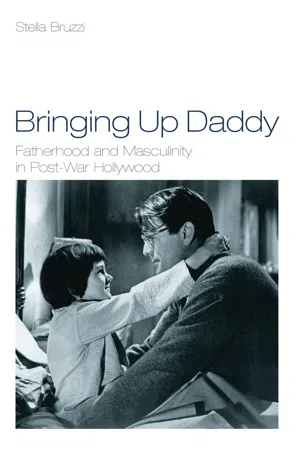
Offering a broad perspective on the Hollywood dad, looking at important Hollywood fathers and discussing films from many genres, this book adopts a multi-faceted theoretical approach, making use of psychoanalysis, sociology and masculinity studies and contextualising the father figure within both Hollywood and American history.
Information
1
Since You Went Away: Masculinity and Change after World War II
Hollywood’s handling of World War II constructed a particular relationship between combat, masculinity and the role of the father. Norman Mailer remarked, ‘nobody was born a man; you earned manhood provided you were good enough, bold enough’ (Gilmore 1990: 19). So the myth goes, that while it was boys who went to war, it was men who came back. Hollywood’s tendency in the late 1940s, however, was to focus on boys coming back from the war, fathers and older men proving more marginal and less significant narrative figures. The impact of World War II on mature masculinity was complex. Although it all too soon narrowed its scope, an excellent place to find, in the late 1940s, discussions of war’s role in the definition of American masculinity was the women’s monthly, McCall’s, in which writers such as influential psychologist Marynia Farnham explored topical ideas about gender and society. An article from February 1946 adopted the sentiment (without its irony) of Mailer’s comment above, as it told its readers ‘Now you have a man: a man who has lived in a man’s world has come to live with you. Can you live up to him?’ World War II changed many aspects of masculinity, including fatherhood; notions of manhood on the battlefield were markedly different from the ideals of masculinity that emerged in peacetime. Following a pronounced but temporary surge in divorces in 1946–7, marriages and births increased and the role of the father, having been less important during the war, became once more, a significant component of masculinity. But, ‘fatherhood’ is not, as observed in the Introduction to this book, comfortably assimilated into ‘masculinity’, and what the contemporary images of fatherhood in immediate post-war America demonstrate, both within and outside of Hollywood, is that becoming a father often compromised traditional concepts of what constituted being a man.
Despite the emergence of more enlightened attitudes to fathering in the first half of the twentieth century, the most significant event of the 1940s – the war – heightened the desire for a return to a more traditional patriarchal image. One compelling reason for this was the Depression of the 1930s, when many fathers found themselves unemployed and so confined to a more domestic role. As fatherhood became less defined by work and more identified with childcare so, some psychologists and sociologists have argued, men felt increasingly emasculated. According to Elizabeth and Joseph Pleck, it became clear that ‘the central lesson of the Depression was that paternal involvement was never the main goal of fathers or their children: money was’ (Pleck and Pleck 1997: 43). At times (such as wartime) when women’s earning potential greatly increased, men felt their masculinity to be threatened.
This gender imbalance lies at the heart of Mildred Pierce (1945), which, while made at the end of the war, does not make any direct reference to it. By principally feminist film theorists and historians, Mildred’s hunger for financial success is not only noted as an underlying reason for the failure of her marriage to Bert but also viewed as representative of the experience of multitudes of American women who found fulfilment in employment during the war. In Women’s Film and Female Experience, 1940–1950, Andrea S. Walsh comments, ‘Like most real-life women in her situation, Mildred was left with little money and few skills to support her family’ (1984: 125; my italics). Walsh then argues that the film’s ideological function was to legitimate the pressures on women to leave the workplace and return to the home, while also maintaining that the film manages to be a celebration of female bonding, an equivocal reading that exasperated Linda Williams in ‘Feminist Film Theory: Mildred Pierce and the Second World War’ (1988: 15). Pam Cook, but less overtly than Walsh, located Mildred Pierce within its broad socio-political context as she interpreted the end (Mildred’s reunion with Bert) as ‘a reminder of what women must give up for the sake of the patriarchal order’ (1998: 80).
Susan Faludi in Stiffed: The Betrayal of the Modern Man (1999) expands upon these ideas when arguing that the war proved to be ‘the last gasp’ as opposed to the crowning moment of a generous, meek and altruistic masculinity. The moment of transition from one kind of masculinity to another is echoed in Mildred Pierce, although the common interpretation of Bert as the film’s embodiment of traditional patriarchy is hugely problematic, as he is a dull, spineless man. The gentler masculinity that, Faludi suggests, was eventually ousted after the war is, for her, exemplified by war journalist Ernie Pyle’s lyrical depictions of ‘GI Joe’, the ‘common man’ of war. This humane, anonymous figure is further eulogised in William Wellman’s 1945 film about Pyle’s time following US troops in the war, The Story of GI Joe (Faludi 1999: 17–20). Faludi believes however, that, while the veterans of World War II ‘were actually inclined toward a continuation of the common-man ethic’, the general public was less keen on sensitive masculinity. The men might have been ‘eager to embrace a masculine ideal that revolved around providing rather than dominating’ (23), but American society as a whole came out of the war ‘with a sense of itself as a masculine nation, our “boys” ready to assume the mantle of national authority and international leadership’ (16).
This chapter will concern itself with a few films made during the World War II (notably Since You Went Away and Meet Me in St. Louis) but principally with films made in its immediate aftermath. In the father films of the period, the ambivalence detected by Faludi is also in evidence. Hollywood’s attitude to war and fatherhood is unexpected. I am indebted to Michael Walker for the crucial observation that men very rarely return from war as fathers in Hollywood films; soldiers are either without dependents or they die in combat before they can return to their families. There were fewer fathers on active duty during the war than might have been expected, due to the US army’s resistance to sending family men; however, this is one of those instances when Hollywood constructs its own independent myth about fatherhood.1 In the movies, sons come back and fathers die in battle. Those fathers who return are both exceptional and problematic. In Since You Went Away or its darker counterpart, Ophuls’ The Reckless Moment (1949), the fathers are alive at the end of the war, but we never see them. Al in The Best Years of Our Lives (1946) is a returning father, but his adjustment to civilian life is fraught, while in Tomorrow Is Forever (1946) everyone thinks the father is dead although he has not in fact been killed (this time in World War I) and returns in disguise. In accordance with Mailer’s sentiments, Hollywood in the 1940s portrayed combat as a young hero’s business, fathers frequently being the men who stayed at home. In It’s a Wonderful Life (1947), George Bailey, who is unable to enlist due to his partial deafness, is contrasted with his dashing bachelor war hero brother Harry, while in Gentleman’s Agreement the inference is that widowed father Phil Green did not serve in the war, he, like Bailey, being sharply differentiated from another character who obviously did fight – his best friend, who spends the entire film in full uniform.
Thomas Schatz identifies an immediate post-war trend in Hollywood ‘toward serious drama with a strong male focus’ (1997: 369), citing The Best Years of Our Lives and It’s a Wonderful Life as important examples; he also detected a rapid phasing out of combat and war movies at the war’s end, only to be started up again in the late 1940s with films such as I Was a Male War Bride (1949) (368). Schatz writes that ‘male melodramas’ of 1946–7 centred ‘on the efforts of a vaguely despondent male beset by post-war angst to “find himself”’ (369), although there were surprisingly few of these films focused on GIs’ ‘trauma of readjustment’, the one example Schatz offers being Till the End of Time (1946). Arguably, Hollywood is here reflecting the desire identified by Faludi to repress caring, sensitive masculinity in favour of hyper-masculine toughness. As Schatz suggests, the late 1940s saw an increase in the number of Westerns, particularly military Westerns such as John Ford’s cavalry trilogy (Schatz 1997: 372). Alongside these, comedy dramas such as The Egg and I (1947), Life with Father (1947) and Ma and Pa Kettle (1949) in which domestic tribulations become the source of comedy and sentimentality proved extremely popular; these Schatz then links with the ‘seemingly endless procession of films celebrating the American hearth and home’, which he links to the contemporary social and political desire to persuade women back into the home (373).
Various films released in the late 1940s feature father figures, although conspicuously few of them enter into a discussion of fatherhood as such. Among the different kinds of fathers these films depict, there are very few young fathers, despite a pervasive cultural emphasis on youthful masculinity at the end of the war. In Movies: A Psychological Study (1950), which examines films released in the latter half of the 1940s in America, France and Britain, Wolfenstein and Leites differentiate between the ‘Older Generation’ father – the father who is not the hero but the hero’s parent – and the ‘The Hero as Father’. They persistently demonstrate that the majority of fathers in late 1940s’ films are older and the father of the hero/heroine rather than the protagonists themselves. Of these fathers they comment:
The hero’s father is usually a sympathetic character, and almost always ineffectual. His relation with the hero is friendly, but he can give him little more than good will. In most cases, it would make no difference to the course of events if the father were eliminated from the story. His is a non-essential background figure (1950: 110).
This generalisation holds for many post-war films: the kindly, ineffectual fathers in Till the End of Time or Teresa (1951), and the good, upright father in Orson Welles’ The Stranger (1946). It might be ungenerous to call these fathers ‘colourless’ (103), but they are all characterised by their marginality to the plot. Wolfenstein and Leites, however, omit to mention films of the late 1940s that significantly fail to conform to their model such as Fort Apache, The Heiress (1949) and House of Strangers (1949), all of which revolve around strong, even abhorrently authoritarian patriarchs or The Furies, released in 1950, in which T. C. Jeffords is a cantankerous, volatile cattle baron with barely disguised incestuous yearnings for his daughter.
The rare younger father/hero conventionally becomes a father after the war has ended. Two important examples are Fred Zinnemann’s films The Search and Teresa. In The Search, a GI stationed in 1945 Germany takes care of a Czech boy who has lost his mother; in Teresa, the youthful returning son/soldier becomes a father after he has returned to America with his Italian bride. Fatherhood in these two films is defined as being post-war, suggesting a new beginning and a curing or forgetting of the traumas of war.
As Michael Walker has again identified, a narrative motif persists in Hollywood whereby news of a pregnancy or imminent fatherhood immediately precipitates a soldier’s death, so the father-to-be dies in action before he can see his child.2 Before World War II, this melodramatic conjunction of birth and death is found in films such as Pilgrimage (1933) in which the father is killed on the battlefield at the time his (illegitimate) child is born or The Old Maid (1939) in which George Brent gets Bette Davis pregnant and is promptly killed in the Civil War. 1940s’ examples include My Foolish Heart (1949) and Tomorrow Is Forever (although in the latter the father turns out not to have died). This central motif is also used to overtly propagandistic effect; in films such as Tomorrow Is Forever, The White Cliffs of Dover (1944) and To Each His Own (1946), the father’s sacrifice in World War I is linked specifically to the son’s desire to fight in World War II. The incompatibility of soldiering and fatherhood is used to more humorous effect in The Story of GI Joe, in which a new father (a secondary character) provides the film’s comic relief as, between battles in war-torn Italy, he repeatedly tries to find a gramophone on which to play a recording of his daughter saying ‘Hello, Daddy’. Whether or not the father, Private Warnicki, survives the war is left ambiguous. During the sustained bombardment of a hilltop monastery (presumably Monte Cassino), he stumbles back to camp suffering from shell shock and is taken off babbling to the medics. We do not see Warnicki again and his collapse (a sort of death) conforms to Walker’s pattern in that it comes at just the point when he manages, finally, to hear his child’s voice. This motif of the soldier dying as he is about to become or has just become a father continues to Pearl Harbor (2001), a film that echoes another 1940s’ concern: who, when the father is dead, is going to father the child about to be born? Establishing another convention about Hollywood fathers, in Pearl Harbor, as in Tomorrow Is Forever and My Foolish Heart, the widow (or presumed widow in Tomorrow Is Forever) marries a man who will be a suitable father, but who, crucially, she does not love.
Films that deal with the role of the father in the troubled aftermath of the war reflect the image of America as a nation in transition. Central to the question of the father’s role in the late 1940s is the issue of change: how much had war changed the men who fought in it? How much had that same war changed the women and families on the home front? How resolvable would be the differences between the needs and desires of men and women once the men returned home? An article in McCall’s ‘Now You Have a Man’ was written relatively soon after the end of the war in February 1946 by Marynia Farnham who, a year later, co-wrote (with Ferdinand Lundberg) the hugely influential Modern Woman: The Lost Sex. The article (like the book) painted a narrow, anti-feminist picture of life. Opening with a soldier saying ‘I found that I was a man and could act and feel like a man. I am not going to give that up’, Farnham continues by suggesting that the wives left at home (whether or not they wanted to give up work) should ‘accept’ their husbands had changed and ‘must be prepared to do the adjusting themselves and learn to live up to the challenge of their men’ (McCall’s 1946a: 18). ‘Now You Have a Man’ established various fundamental incompatibilities between the man’s war experience and the contemporaneous experience on the home front, again intimating that somehow fatherhood – the domestic masculine ideal – was likewise incompatible with being a ‘man’. In Farnham’s estimation, war was a uniquely, intensely male experience during which men discovered ‘that they have this great capacity for identification and common cause, for putting aside the small and the stupid, the cruel and the painful in human emotions’ (126).
Women were viewed as largely detrimental to the returning man’s well-being; either they kept their sons ‘weakened’ and ‘immature’ (126) by practising what Philip Wylie in Generation of Vipers (1942) dubbed ‘Momism’, or they are comically caricatured as a predatory regiment who ‘smoke on the street, stand at bars and mingle in male society entirely unrestricted’ (McCall’s 1946a: 126), having usurped the male breadwinning role. Farnham advocates the return to patriarchal order: women should be ‘prepared to abdicate in favor of their husbands’ (130) and fathers should be demurred to in the home and beyond it must establish themselves as ‘the core of the citizenry’ (130). In fact, reintegration and yet more shifts in gender roles after the war caused many more problems than Farnham envisaged. Articles written for McCall’s only slightly later indicated that the world and women had changed too much for things simply to return to ‘as they were’ before the war. In ‘Is Your Child Your Own?’ (McCall’s 1946b), the subjects were unemployment, the father working far from home and the dramatic post-war rise in the divorce rate. In ‘Marriage Is ...
Table of contents
- Cover
- Title Page
- Dedication
- Contents
- Acknowledgments
- Introduction
- 1. Since You Went Away: Masculinity and Change after World War II
- 2. The Return of the Patriarch: Generation and Traditionalism in the 1950s
- 3. Revolution and Feminist Unrest: Fatherhood under Attack in the 1960s and 1970s
- 4. Back to the Future: Nostalgia, Tradition and Masculinity in the 1980s
- 5. The Next Best Thing: Men in Crisis and the Pluralisation of Fatherhood in the 1990s and 2000s
- Bibliography
- Index
- List of Illustrations
- eCopyright
Trusted by 375,005 students
Access to over 1.5 million titles for a fair monthly price.
Study more efficiently using our study tools.
Frequently asked questions
Yes, you can cancel anytime from the Subscription tab in your account settings on the Perlego website. Your subscription will stay active until the end of your current billing period. Learn how to cancel your subscription
No, books cannot be downloaded as external files, such as PDFs, for use outside of Perlego. However, you can download books within the Perlego app for offline reading on mobile or tablet. Learn how to download books offline
Perlego offers two plans: Essential and Complete
- Essential is ideal for learners and professionals who enjoy exploring a wide range of subjects. Access the Essential Library with 800,000+ trusted titles and best-sellers across business, personal growth, and the humanities. Includes unlimited reading time and Standard Read Aloud voice.
- Complete: Perfect for advanced learners and researchers needing full, unrestricted access. Unlock 1.5M+ books across hundreds of subjects, including academic and specialized titles. The Complete Plan also includes advanced features like Premium Read Aloud and Research Assistant.
We are an online textbook subscription service, where you can get access to an entire online library for less than the price of a single book per month. With over 1.5 million books across 990+ topics, we’ve got you covered! Learn about our mission
Look out for the read-aloud symbol on your next book to see if you can listen to it. The read-aloud tool reads text aloud for you, highlighting the text as it is being read. You can pause it, speed it up and slow it down. Learn more about Read Aloud
Yes! You can use the Perlego app on both iOS and Android devices to read anytime, anywhere — even offline. Perfect for commutes or when you’re on the go.
Please note we cannot support devices running on iOS 13 and Android 7 or earlier. Learn more about using the app
Please note we cannot support devices running on iOS 13 and Android 7 or earlier. Learn more about using the app
Yes, you can access Bringing Up Daddy by Stella Bruzzi in PDF and/or ePUB format, as well as other popular books in Media & Performing Arts & Film History & Criticism. We have over 1.5 million books available in our catalogue for you to explore.