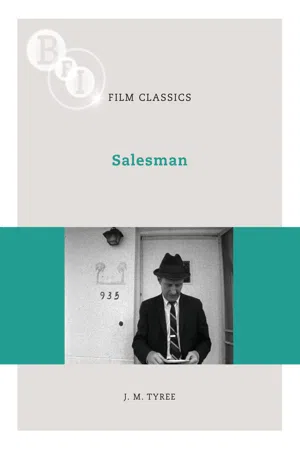
Selected by the Library of Congress as one of the most significant American films ever made, Salesman (1966–9) is a landmark in non-fiction cinema, equivalent in its impact and influence to Truman Capote's 'non-fiction novel'
In Cold Blood.
The film follows a team of travelling Bible salesmen on the road in Massachusetts, Chicago, and Florida, where the American dream of self-reliant entrepreneurship goes badly wrong for protagonist Paul Brennan. Long acknowledged as a high-water mark of the 'direct cinema' movement, this ruefully comic and quietly devastating film was the first masterpiece of Albert Maysles, David Maysles and Charlotte Zwerin, the trio who would go on to produce The Rolling Stones documentary, Gimme Shelter (1970).
Based on the premise that films drawn from ordinary life could compete with Hollywood extravaganzas, Salesman was critical in shaping 'the documentary feature'. A novel cinema-going experience for its time, the film was independently produced, designed for theatrical release and presented without voiceover narration, interviews, or talking heads. Working with innovative handheld equipment, and experimenting with eclectic methods and a collaborative ethos, the Maysles brothers and Zwerin produced a carefully-orchestrated narrative drama fashioned from unexpected episodes.
J. M. Tyree suggests that Salesman can be understood as a case study of non-fiction cinema, raising perennial questions about reality and performance. His analysis provides an historical and cultural context for the film, considering its place in world cinema and its critical representations of dearly-held national myths. The style of Salesman still makes other documentaries look static and immobile, while the film's allegiances to everyday subjects and working people indelibly marked the cinema. Tyree's insightful study also includes an exclusive exchange with Albert Maysles about the film.
eBook - ePub
Salesman
About this book
Information
1 The Path to Salesman
Be there when it happens
We might think of our obsession with ‘reality’ as something novel, but on 24 November 1963, millions of Americans had seen Lee Harvey Oswald murdered live on television, and several days later, they pored over the images from the Zapruder film in the pages of Life magazine. Key events had been filmed before, but not like this. During the 1960s, technology allowed new kinds of images to be broadcast with unprecedented speed: the 1960 Kennedy–Nixon presidential TV debates; the 1962 Telstar satellite broadcasts of simultaneous television images from America and Europe; the ‘living-room war’ in Vietnam; the moon landing. Very early on, between 1958 and 1961, film-makers understood that with the new lightweight equipment, like the 16mm Auricon Cine-Voice, the Éclair Noiseless Portable Reflex, the Arriflex 16 M cameras and the Nagra pulse tape recorder, which dropped the weight of sound equipment from 90kg to around 9kg, they could record on the fly and also pick up synchronised sound and images with hand-held gear (Ellis and McLane, 2005, p. 210; McElhaney, 2009, pp. 4–5). This meant the abandonment of unwieldy tripods and large crews, developments that, in turn, allowed non-fiction film-makers to screen unstaged aspects of life on an unprecedented scale.
Such were the dreams, at any rate, that lay behind Robert Drew’s 1960 film Primary, about the political campaign in Wisconsin between John F. Kennedy and Hubert Humphrey for the Democratic Party presidential nomination. Drew, who had been a photojournalist, was primarily interested in new forms of reportage, and Time–Life Broadcast productions had hired him to try them out. He felt that ‘real life never got on to the film, never came through the television set’, and he hoped to ‘find a dramatic logic in which things really happened’. His plan entailed founding something no less grand than ‘a whole new basis for a whole new journalism’. It would be:
a theatre without actors, it would be plays without playwrights, it would be reporting without summary and opinion, it would be the ability to look in on people’s lives at crucial times from which you could deduce certain things, and see a kind of truth that can only be gotten by personal experience.4
Drew needed brilliantly innovative cameramen who understood how to capture this vision, which is better viewed as an impossible ideal, a characteristic national mood or a utopian speech act rather than an achievable goal. Practical problems also existed: synched sound was not yet perfected, for example. Drew went looking for ‘people who can sense an interesting situation … find characters in it, sense what is about to happen, be there when it happens, render it on film or tape with art and craft and insight as it happens’. He attracted cameramen who hadn’t been classically trained as cinematographers in the creation of static images and who didn’t use multiple takes, during which little was left to chance.
On Primary, Drew recruited three film-makers who would make groundbreaking contributions to English-language non-fiction cinema: Richard Leacock, D. A. Pennebaker and Albert Maysles. Leacock went on to publish a provocative essay, entitled ‘For an Uncontrolled Cinema’, in the summer 1961 issue of Film Culture, in which he expressed what sounds like a shared wish to ‘record aspects of what did actually happen in a real situation … what did happen in its most absolute sense’ (Leacock, 1970, p. 78). Maysles, for his part, was responsible for photographing two of Primary’s best-known shots: a long, hand-held, balletic, single take following JFK through the hallways and stairs of a Polish Legion hall, and a lingering view of Jackie Kennedy’s nervous fingers in a pair of white gloves behind her back as she gave a speech. The latter shot proved controversial because of its intrusiveness and sense of editorialising, but the footage can be related to Albert Maysles’s enduring interest in discovering hidden, unexpected and unplanned images of humanity behind the public facades of various kinds of performers, a crucial theme in Salesman, Gimme Shelter and Grey Gardens.
Intimate film report
In Moscow for the American National Exhibition in 1959, Albert Maysles had filmed ‘impressionistic’ elements of Russian life with Pennebaker and Shirley Clarke for Opening in Moscow, also assisting on Leacock’s film about Leonard Bernstein in the USSR.5 Maysles had been to the Soviet Union before, in 1955, visiting Russian mental health hospitals, again in 1956, travelling from Eastern Europe via motor scooter, and in 1957, with his brother David on a BMW motorcycle. Albert returned with lectures on life in the USSR, illustrated with photos, and with short films such as his first, Psychiatry in Russia (1955). While formally conventional – the film solves the 1950s problem of sight and sound with a standard voiceover – Psychiatry in Russia calls itself ‘a personal report’, lingering on images of working people, mental health professionals and patients. Maysles relates how Russians attribute their ‘comparative low incidence of mental disorders’ to ‘social equality’. A more lavish and propagandistic American production released in the same year as Psychiatry in Russia was Anthony Mann’s Strategic Air Command, sponsored by the US Air Force, directed in VistaVision, and called a ‘pictorial show of the beauty and organized power of the United States’ (Amberg, 1971, pp. 294–6). By contrast, a pamphlet for Maysles’s second film, Russian Close-Up (1957), described a ‘Completely Uncensored Movie Film and Lecture’ and presented him as a ‘Lecturer, author and photographer’ who had captured ‘swaddled infants, children with sand pails, school children in uniform, athletes, teachers, workers, housewives, psychiatrists, lawyers, ice cream vendors …’ Posters promoting his ‘intimate film report’ in 1959 called him a ‘psychologist-cinephotographer’.
The Maysles brothers were born in Dorchester, Massachusetts – Albert in 1926, David in 1932 – and raised in Brookline by Russian Jewish parents, living adjacent to the rough Boston Irish neighbourhood of Jamaica Plain, territory that produced Salesman’s protagonist, Paul Brennan. David had a parallel but more traditional life in the movies, working as an assistant producer on the Marilyn Monroe pictures Bus Stop (1956) and The Prince and the Showgirl (1957) before joining Albert on the motorcycle tour behind the Iron Curtain that led to Russian Close-Up and the brothers’ first film together, Youth in Poland (1957, unfinished).6 An image reveals the brothers in identical-looking jackets on their BMW in front of the Kremlin, David on the front wearing goggles and bracing strapped-down boxes of equipment, Albert on the back looking directly into the camera. In a 1998 profile by Brooke Comer, Albert described the motorcycle journey in terms of a closeness so in synch that one brother could sleep while the other drove, a tender and poignant image that also makes for a tempting yet incomplete analogy for their film-making (Beattie, 2010, p. 112).
In 1962, the brothers formed their own production company, Maysles Films, and shot Showman, about producer Joseph E. Levine’s promotional campaign for De Sica’s 1960 film Two Women. Showman was created under trying conditions – access was fettered, a voiceover proved necessary and, like many early Maysles films, it remains in legal limbo. De Sica’s female lead, Sophia Loren, won the Academy Award for Best Actress. It was the sort of break that ‘just happened’ in the Maysles’s films time and again: the chance to follow the Beatles on their 1964 tour of America for What’s Happening! The Beatles in the USA, the emotional collapse of Paul Brennan during Salesman, the live killing captured in Gimme Shelter and the bonding with their subjects in Grey Gardens. Luck was involved, but also an instinct for pursuing inherently compelling and unpredictable situations.
In an April 1963 interview with Mark Shivas, the brothers explained Showman, in the process delineating key elements of the philosophy that would guide future films. Plus X film ‘pushed’ to 1,000 ASA didn’t feel overly grainy; whenever possible, no attempt would be made to elicit acting; the modus operandi would involve a rigorous insistence on not directing or controlling the subjects:
Q: Did you put the camera down if you found anybody acting, or what? A: I don’t understand the nervousness on the part of the film-makers about what’s going to happen when people see the camera. Nothing’s going to happen if you don’t think too much about it. If you’re concerned about the presence of the camera, others are going to be concerned about it. The camera stays on my shoulder all the time so sometimes I am shooting and sometimes I am not. It’s in the same position all day long and they can’t tell. If they were to think about it, they’d get awful tired of thinking about it. It’s like it’s part of the room, part of the furniture. (Beattie, 2010, p. 4)
In the interview, the brothers also introduced an idea for an ambitious film project:
We have plans for a major film to be made specifically for the motion picture theatre. This film is going to cost about 175,000 dollars, which isn’t very much for an American feature production. We’ll shoot less than 100,000 feet of film, but it’ll take four or five months to shoot and double that time to edit. It’s like the Family of Man exhibition in motion pictures. (Beattie, 2010, p. 6)
An initial idea for a feature involved working life on a whaling ship, recalling Moby-Dick (Junker, 1969, p. 108).7 Another early plan involved following a single pregnant woman. The ambitions of Maysles Films are clarified by their reference to the photo exhibition The Family of Man, curated by Edward Steichen at the Museum of Modern Art in 1955. The Family of Man encompassed the globe, selecting over 500 photographs from a pool of nearly two million submissions, with photographers from over sixty countries. Yet this all-embracing vision was precisely what the Maysles abandoned in Salesman for a look through a keyhole into one very specific set of rooms – the gritty rooms of life on the road. The finished film could have been one submission to The Family of Man, but it also seemed to topple the conception that a total perspective was a practical or desirable goal.
By 1963, British documentarian Derrick Knight had used elements of spontaneity and synched sound, in an admittedly fictionalised format, for A Time to Heal, his account of convalescent Welsh coal miners. Knight’s film borrowed both the lightweight equipment and some of the early 1960s notions of North American documentarians (Russell, 2010, p. 45); it also maintained a traditional focus on ‘social documentary’ in British national cinema. While Maysles Films continued to follow celebrities for shorts and work-for-hire films throughout the mid-1960s, the brothers began to look elsewhere for subject matter. David Maysles elaborated in a 1966 interview with Jonas Mekas: ‘This story will have something the other films we did till now didn’t have – it will be because it is a good story, but not because it’s about a “famous person.” It will be a person and a story that nobody knows anything about’ (Beattie, 2010, p. 36).
Reality, vérité, actuality, truth and all that
The Maysles brothers screened Showman at a now-legendary 1963 Lyon conference organised by the French national broadcasting system Radiodiffusion-Télévision Française. Roberto Rosellini complained that it was shapeless anti-art, while Louis Marcorelles declared it among the ‘great films’ he’d seen since the war, noting that the film-makers ‘create without theories, according to a glorious American tradition’ (McElhaney, 2009, p. 8; Beattie, 2010, p. 10). Also on hand in Lyon were many other pioneers, including Drew, Leacock, the Québécois Michel Brault, and the French film-makers Jean Rouch and Edgar Morin. Leacock and Rouch clashed in person at the conference, as Jack Ellis and Betsy McLane summarise in A New History of Documentary:
Both of them were hoping to find ‘the reality of life’, ‘the truth in people’ hidden under the superficial conventions of daily living. Rouch sought to pierce the observable surface to reach this underlying truth by means of discussion, interview, and a fictional sort of improvisation. Leacock thought he could capture the same obscured reality by photographing people without intruding; that subjects would reveal what they really felt and were like when unself-consciously relaxed or deeply involved in some activity. (Ellis and McLane, 2005, p. 217)
Rouch’s notion of cinéma vérité foregrounded the presence and process of the film-makers and even mixed fact with fiction. Chronicle of a Summer, the landmark collaboration of Morin and Rouch with Raoul Coutard, Roger Morillère and Brault, for example, features one scene in which their sound recordist and cameraman debate the politics of Algeria with the film’s subjects. The film shows its subjects commenting on a screening of the film itself, exemplifying the provisional truth-status of cinéma vérité as a form of ongoing research. ‘What interests me’, said Morin, ‘is not a documentary that shows appearances but an active intervention to cut across appearances and extract from them their hidden or dormant truths’ (Rouch, 2003, pp. 252–3). Rouch’s restlessness remains satisfying – the ending of Chronicle of a Summer contains a meditation on the film’s failures: ‘We wanted to make a film of love, but it’s turned out an impersonal kind of film, of reaction from reaction, which isn’t necessarily sympathetic.’ The film’s avant-garde project of chipping away at artifice (‘this film, unlike normal cinema, reintroduces us to life’) exists in tension with certain acknowledged impossibilities.
The term coined for the Maysles’s more observational mode of film-making, ‘direct cinema’, is often taken for a doomed belief in an objective vision beyond artifice and intervention. In a 1964 profile by Maxine Haleff, Albert Maysles rejected
any labels or styles of filming … If you have to use a label, I suppose direct cinema is the one that’s the most meaningful. What we’re doing is direct in every way. We’re not using scripts which frequently make for indirection. It’s a kind of barrier. For us it’s another impediment between the moment something is really happening in life and the moment that it gets recorded into film. (Beattie, 2010, p. 13)
Here, immediacy sounds like an obtainable goal; everything would have looked the same had the camera not been present. Such impossible statements must be historicised as an allergic reaction to what felt like phoney and overly artificial styles of film-making, especially those in mid-1960s Hollywood. Dave Saunders (2007, p. 75) also has linked the idealism of direct cinema to the Transcendental tradition of American philosophy, especially Ralph Waldo Emerson’s passage about becoming ‘a transparent eyeball’ in a moment of insight: ‘I am nothing; I see all’. Other statements Albert Maysles made to Haleff, however, sound more practical and complicated. In trying to describe ‘how active a role we take’, he likened the camera to a ‘non-directive therapist’ and a ‘real person listening’, explaining that ‘because the observation is one where the observer is really interested in what’s going on, it makes him a kind of participant. So, in that sense, not all of it is just going in one direction – from the person who’s being filmed out to everybody. There is a bounce-back …’ (Beattie, 2010, p. 15).
Sometimes acknowledged, sometimes repressed, reflexivity always crops up, even if direct cinema’s practical methods were eclectic and its outlook remained Emersonian and overtly anti-theoretical. In a 1965 interview, James Blue asked Albert Maysles, ‘Do you feel that in your films you get complete objectivity? Do you pretend to present “reality” per se?’ The answer was critical: ‘Absolutely not. It would be deadness of some sort if we did that. We are filming human be...
Table of contents
- Cover Page
- Title Page
- Contents
- Acknowledgments
- Introduction
- 1. The Path to Salesman
- 2. Performers, Authors, Directors
- 3. Americana
- Conclusion: Reality and its Discontents
- Appendix: Albert Maysles on Salesman – An Exchange with J. M. Tyree
- Notes
- Credits
- References
- eCopyright
Trusted by 375,005 students
Access to over 1.5 million titles for a fair monthly price.
Study more efficiently using our study tools.
Frequently asked questions
Yes, you can cancel anytime from the Subscription tab in your account settings on the Perlego website. Your subscription will stay active until the end of your current billing period. Learn how to cancel your subscription
No, books cannot be downloaded as external files, such as PDFs, for use outside of Perlego. However, you can download books within the Perlego app for offline reading on mobile or tablet. Learn how to download books offline
Perlego offers two plans: Essential and Complete
- Essential is ideal for learners and professionals who enjoy exploring a wide range of subjects. Access the Essential Library with 800,000+ trusted titles and best-sellers across business, personal growth, and the humanities. Includes unlimited reading time and Standard Read Aloud voice.
- Complete: Perfect for advanced learners and researchers needing full, unrestricted access. Unlock 1.5M+ books across hundreds of subjects, including academic and specialized titles. The Complete Plan also includes advanced features like Premium Read Aloud and Research Assistant.
We are an online textbook subscription service, where you can get access to an entire online library for less than the price of a single book per month. With over 1.5 million books across 990+ topics, we’ve got you covered! Learn about our mission
Look out for the read-aloud symbol on your next book to see if you can listen to it. The read-aloud tool reads text aloud for you, highlighting the text as it is being read. You can pause it, speed it up and slow it down. Learn more about Read Aloud
Yes! You can use the Perlego app on both iOS and Android devices to read anytime, anywhere — even offline. Perfect for commutes or when you’re on the go.
Please note we cannot support devices running on iOS 13 and Android 7 or earlier. Learn more about using the app
Please note we cannot support devices running on iOS 13 and Android 7 or earlier. Learn more about using the app
Yes, you can access Salesman by J.M. Tyree in PDF and/or ePUB format, as well as other popular books in Media & Performing Arts & Film & Video. We have over 1.5 million books available in our catalogue for you to explore.