- 146 pages
- English
- ePUB (mobile friendly)
- Available on iOS & Android
eBook - ePub
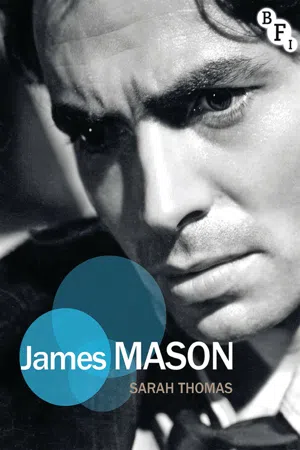
James Mason
About this book
Sarah Thomas's study moves beyond the image of the brooding, destructive man at odds with employers and his own star status to explore the complexity of Mason's career and star persona. Her analysis is structured around three strands central to understanding stardom: the star persona, industry and power, and screen performance. Thomas addresses the incredible range of Mason's star career – 1930s 'quota quickies'; 1940s Gainsborough melodramas; the desperate IRA man in Carol Reed's 'Odd Man Out' (1947); from the 1950s onwards, Hollywood classics including starring in Hitchcock's 'North by Northwest' (1959) and playing Humbert Humbert in Kubrick's 'Lolita' (1962). She also considers in depth his undervalued post-1962 career, off-screen celebrity status, non-film work, comic and vocal performances, and the star's own self-commentary. In doing so, she offers a new perspective on such subjects as power and powerlessness; public image and national identity, contextualizing Mason's career in wider histories of British, American and European transnational filmmaking.
Information
1 INTRODUCTION
Halfway through Vivian Kubrick’s behind-the-scenes documentary about her father’s film The Shining (1980), James Mason appears. Dressed in a light grey Victorian suit and accompanied by a small group of friends and family, he introduces everyone to Jack Nicholson and Stanley Kubrick during a break in filming. His unexpected appearance can be explained – Kubrick was making the film at Elstree Studios where Mason was filming Murder by Decree (1979), and having worked together on Lolita (1962), Kubrick allowed the actor a rare guest pass to the set. Nevertheless, it is a deeply incongruous moment. We’ve just seen examples of Kubrick’s meticulous staging, fractious relationship with Shelley Duvall, and Nicholson’s energetic preparation for the scene where he breaks down the bathroom door with an axe (intercut with the completed scene), but suddenly this restrained, polite excitement descends onto the set. Mason’s family are so very ordinary: aside from his wife, Clarissa, there are also two girls in their ‘Sunday best’ keen yet intimidated to meet Nicholson, and an elderly woman with an eminently recognisable ‘grandmotherly’ perm and thick glasses; yet everything about The Shining is so absolutely extraordinary, even behind the scenes. Mason stands in the middle, bisecting these spaces and people; not simply a combination of the ordinary and extraordinary, but also apart from both in his effortless smart appearance, calm aloofness, yet amiable, relaxed attitude.
But James Mason was an incongruous and contradictory figure; a star often positioned as one between worlds – between leading man and character actor, Hollywood and Britain, control and powerlessness, menace and allure, the ultimate Odd Man Out – and described by Life magazine as one whose ‘sombre, sensual handsomeness arouses hopes and anxieties in women’ (Osborne 1947: 33). Despite the randomness of using Vivian Kubrick’s documentary as an opening to this book, what the short film reflects on around the production of The Shining parallels many of the subjects that I will explore around Mason’s stardom, including this dissonance. The connection helps contextualise my study as an analytical history of Mason’s career with its reference to Lolita and Murder by Decree, and where the figure of the American Kubrick (and his British-raised daughter) working amidst the British film industry hints at the attention paid to transnational statuses (and families) that will follow. Mason’s cameo in the documentary comes immediately after Nicholson has defined himself as a ‘celebrity’ (and the endless, exhausting round of meeting so many people this role entails). At first it seems like Mason’s own celebrity is being dismissed here – is he simply another person Nicholson-the-celebrity must meet? – but Vivian’s commentary acknowledges the star and his visit as ‘special’. The persistence of star persona (and the performance of self-as-image) runs throughout Nicholson’s knowing presence – he is constantly playing up to Vivian’s camera as ‘Jack’. But equally, space is given over to discussions of the labour of acting and his own (and Duvall’s) technical processes. Nicholson talks of his willingness to hand control over to someone else, and inherent in any discussion around Kubrick is the subject of power. There is even an (admittedly light-hearted) conversation about salaries when Danny Lloyd naively states that he ‘must have $500 or $600!’ by now. My analysis of James Mason mirrors these concerns, looking similarly at the screen and behind it over the course of its three chapters. It explores Mason’s star labour and the issues of money and power that ran throughout his career and perceptions of its success. I will examine how he approached roles and developed performative technique, and I will consider different elements of Mason’s star persona – from the image he played up to of ‘the-man-you-love-to-hate’ to his complex celebrity status, and even his ‘ordinariness’.
The son of a textile merchant, James Mason was born in Huddersfield, Yorkshire, in 1909 and lived a comfortable life in the leafy part of the town’s Croft House Lane. Before embarking on his acting career, he went to Marlborough College, read architecture at Cambridge University, and then on to London, Dublin and regional theatres before turning to the cinema. Between 1935 and 1943, he had minor roles in major British films, and major roles in minor films, building up a steady presence in the industry. His breakthrough was The Man in Grey (1943), and his star status was consolidated with the other Gainsborough Pictures melodramas that followed, where he was often cast as a menacing but romanticised anti-hero. The British public loved Mason and his brutal screen persona, voting him the most popular British star of 1946, by which time he had caught Hollywood’s eye. He was just as rebellious off screen, constantly criticising the film industry and attempting to produce his own films. In disgust with the British film industry, he ran off to the United States in 1947, and then ran back in 1962 disgusted with Hollywood films. He married twice: first to Pamela Kellino in 1941 who went with him to Hollywood, where they had two children, Portland and Morgan. In 1964, they divorced acrimoniously with a financial settlement heavily in Pamela’s favour. Compared to the turbulence of his first two decades of international stardom, the final twenty years of Mason’s career seem low-key – in line with his reserved visit to The Shining’s set. After the divorce, he settled in Corsier-sur-Vevey, Switzerland, and from this base travelled extensively throughout Britain, Europe and the rest of the world to make films. In 1969, he met the Australian actress Clarissa Kaye whilst filming Age of Consent in Australia and they married two years later. He died in 1984. Throughout all this, he made over a hundred films with a handful usually cited as really significant, including The Seventh Veil, Odd Man Out, The Reckless Moment, The Desert Fox, Julius Caesar, A Star Is Born, Bigger Than Life, North by Northwest, Lolita, Georgy Girl, Heaven Can Wait and The Shooting Party.
Mason characterised his life and career as one of three ages: Britain and popular stardom (up to Odd Man Out [1947]), the Hollywood studio system (up to North by Northwest [1959]), and the British homecoming and movement into character roles (from Lolita to his death). This book too follows a ‘three act structure’, but takes a different path to Mason’s view over its three chapters. Instead of exploring one period of Mason’s life concurrently over each chapter, I wanted to analyse his stardom through modes of reading. I came to this project with a distinct interest in those conventional divisions – the movement between Hollywood and British cinemas, and the shift from leading man to character actor, bound together by a coherent star image of brooding exoticism/eroticism – but in the end, to simply concentrate on these boundaries did not sufficiently reflect the multiplicity (and at times shambolic nature) of Mason’s career and persona. For example, many of his star-making roles of the mid-1940s could be categorised as supporting ones, he often occupied a secondary position in films focused on major female Hollywood stars, and he did not completely disappear from leading roles post-1962. My three chapters focus on methodological approaches to stardom: the star persona, economics and industry, and screen performance. Often in star studies these are explored concurrently, but what interested me was how separating them out articulated such a wide range of histories and versions of ‘James Mason’ beyond those already most established. I do not completely abandon chronology – the first two chapters use periodisation as a structuring technique to consider possible developments in image and labour – but I am wary of constructing more teleological readings where the problems of one era in turn create the features of another. One outcome of this is a repeated emphasis on Mason’s post-1962 films – despite making up half of his filmic output, these are too often reduced to footnotes.
Chapter 2: ‘Persona’ begins by positioning Mason’s star persona as illustrative of Richard Dyer’s concept of structured polysemy, whereby multiple meanings converge and interact with each other to reinforce a coherent image or to contain oppositional elements where differences complicate but equally inform the wider persona (1998: 63–64). Dyer’s description of images that may often ‘be to some degree in opposition or contradiction’ (ibid.: 64) rests on those contradictions being available so that they can be overtly held in tension, negotiated, or masked in the public sphere (through roles and promotional material) or the private/public sphere (circulated gossip). Across his whole career, Mason’s public image was – at various times – made up of different aspects and identities, but most sustained attention has been paid to one particular element of his persona and how this predominantly contributes to scholarly readings or histories of British cinema. As well as providing an overview of his persona and responses to it, this chapter uses Mason to map developments in critical approaches to stardom: how an understanding of his persona illustrates the changing ways stars have been (and may be) analysed, and how modes of analyses feed back into definitions and interpretations of Mason’s persona and the overall perception of his stardom. Aside from the inherent duality of the Mason image that dominates public discourse, what is also interesting within critical readings/retrospectives of the star is the degree to which some identities are absent or have only recently re-entered the discussion, especially those developed during his American career and beyond, which are centred around his ageing and his place within a quirky family setting and specific regional locale. Dyer comments that ‘the possibilities of meaning are limited in part by what the text makes available’ (ibid.: 64), and to some extent, I recognise that one of the ‘texts’ that produce star meaning must also include critical writing, be it scholarly or retrospective. Analyses and reflections on Mason’s persona are part of the process whereby discourse ‘masks’ and/or ‘reconciles’ contradictory elements in their pursuit of a central subject of investigation that conventional biography, publicity and further primary sources may otherwise reveal.1
Chapter 3: ‘Power’ shifts focus away from reading Mason through the cultural meaning of his star image towards one that explores his professional labour status and career management through the question of ‘power’. Starting with Mason’s own commentary in his role as writer-documenter, I then place the star in the industries he worked in, using archival sources and industrial histories to draw together more information about his salaries, contracts, employment conditions and studio negotiations, talent agencies and his semi-freelance status. This contextualises and historicises Mason’s account of his own power struggles within wider histories of professional labour and industrial structures. Mason – quite understandably – is concerned with his own failures in a singular sense; he made bad decisions, employers undervalued him, independent productions were centred around his star status and determination, and so on. But there is a need to step beyond a history and analysis of Mason himself to consider other histories of producers, stars and studios and how struggles around labour, power and independence form a bigger picture of film production in the twentieth century. This approach builds upon Paul McDonald’s work, which called for a shift from the dominant mode of analysis of stars as ‘fundamentally symbolic entities’, recognising that whilst ‘stars are texts, meaning, images and culture, they are also more than this [and it is] necessary to place stardom in a particular economic and industrial context’ (2013: 3). New histories of labour organisation, professional agents and film production provide a bedrock to understanding some of Mason’s own difficulties (and achievements) during his time in Hollywood and beyond, often revealing his experiences as much more conventional and shared than otherwise supposed. An analysis of the star through this methodological approach not only establishes further depth to his own star status, but contributes to industrial and economic analyses through a case study of an actor whose labour struggle is not an extreme of success or failure and one who moves between the UK, Hollywood and European production occupying contracted, semi-freelance and independent status.
Finally, Chapter 4: ‘Performance’ shifts attention back to Mason’s screen work. His death in 1984 intensified evaluation of the star, especially his value as an actor, and, in addition to characterising him as the ‘nearly man’ of Hollywood stardom, many obituaries also emphasised his performative skills. Philip French in the Observer called him ‘one of the four or five best film actors this country has produced’ (1984: 19), and The Evening Standard described him as ‘the actor who set a standard in excellence and maintained it’ (Sheldon and Meilton 1984). The increased recognition of Mason’s acting skills was apparent elsewhere. In a 1973 profile of the actor, the New York Times film critic Vincent Canby wrote that although
no longer the leading man he once was … for some time I’ve been thinking that Mason was becoming a better and more interesting actor with the passage of time, but having recently reseen Lolita and North by Northwest and Georgy Girl, it now occurs to me that he has always been superb.
Sidney Lumet, who directed Mason in four films (The Deadly Affair [1966], The Sea Gull [1968], Child’s Play [1972] and The Verdict [1982]), commented that ‘I always thought he was one of the best actors who ever lived. He always reminded me more of an actor in a theatre repertory ensemble than a movie star, and it was what made him so good’ (qtd. in Morley 1989: 142–43). There is an obvious undercurrent of cultural judgment running through these reflections: Mason failed as a star, but – in the end – was victorious as an actor. The apparent conflict between the high and low cultural value of actor and star is, of course, limiting in scope, and scholarly analyses of stardom complicate this through their consideration of the performance of stardom on and off screen – of self/image and of character/role – and it is not what I am interested in here. Instead, I identify four thematic areas with which to analyse his performances: stage and screen, monologues and silences, tragedy and comedy, and intellectual distance and emotional empathy. This is partly to draw continuities across his career in terms of acting style and characteristics, and partly to expand analyses of Mason’s screen work beyond those that neatly cohere with the dominant persona of the sardonic or romanticised perversity of his mid-1940s roles.
What remains is a star immensely difficult to pin down and in constant tension. Contradiction lies inherently within a star persona that has long been characterised through the transgressions of national context, romanticised violence, voice and look, and authority and rebelliousness. As I will examine, to this we can add excessive but reluctant narratives of celebrity and interplay between youth and ageing, national and regional. He pursued a career always in flux – running from one industry to another, between contracts and freelance status, and working extensively in transnational environments. And an acting style that negotiated registers, media form, genre and style to create sophisticated characterisation, and the performance of role and of self, is present throughout the whole of Mason’s working life. Dissonant incongruity runs through James Mason’s stardom, crossing boundaries of cultural image, labour status and acting technique, but in each sphere in markedly different ways.
2 PERSONA
‘To be a successful film star as opposed to a successful film actor, you should settle for an image and polish it forever. I somehow could never quite bring myself to do that’ (Mason qtd. in Hirschhorn 1977: 22). Thus James Mason sums up stardom and the management of his own public persona, identifying in it inconsistencies and idiosyncrasies. Typical of how critical studies conceptualise stars, Mason’s star persona can be identified as multiple identities that lie between on-screen roles, promotional material and interviews, gossip, and the active role played by audiences, critics and the star himself in further articulating cultural meanings around that figure. These disparate meaning-making elements then cohere into a more singular public persona. In spite of Mason’s above observation, wider discourse constructs a very polished and distinct meaning around the persona of ‘James Mason’, closely positioned through his star-making roles of the 1940s, irascible off-screen personality and career trajectory – from Britain to Hollywood and back again. This persona embodies a continual site of dualism and tension, usually fashioned as a form of romanticised aggression. Peter William Evans writes that ‘the Mason persona exemplifies the conflict in men between competing instincts, a struggle reaching its most dramatic climaxes in his various encounters with women’ (2001: 113). Andrew Spicer labels Mason ‘the Byronic male’ whose appeal lay in a combination of the ‘sadistic but vulnerable’ (2003: 24–25), and Gill Plain calls him ‘predatory, menacing, emotionally detached, and yet also, paradoxically, [he] embodies an almost feminine beauty’ (2006: 105). Adrian Garvey (2015, 2016) characterises him as a perverse patriarch defined more by attitude and voice than any visual sign, whilst for others his appeal lies in a resemblance to the Brontë’s Heathcliff or Rochester.1 Throughout, Mason’s persona is that of a transgressive figure who mixes good and evil, romance and violence, rebelliousness and authority; handsomeness countered with a sneer, coupled with a voice part-velvet, part-strained and steely. Even in the thirty-plus years since his death, the image of the brooding, sinister, charming anti-hero prevails, and it is through this distinct persona that Mason’s popular stardom has been most understood and examined.
This chapter will reflect on a series of different public identities and contexts around Mason and examine the relationship between the changing images and spaces of his star persona and his significance to scholarly studies of stardom. Ora Gelley (in relation to Ingrid Bergman) has highlighted how some critical analyses tend to take publicity discourse at face value, a strategy that then blocks critical readings of other elements (such as Bergman’s films). She suggests that one impact of this is that critical readings too readily accept publicity material’s assessment of a star’s career (2008: 26). To some degree this is also true of Mason. But, as I will explore, much promotional material produced during Mason’s long career constructed and circulated furthe...
Table of contents
- Cover
- Title Page
- Contents
- Acknowledgments
- 1 Introduction
- 2 Persona
- 3 Power
- 4 Performance
- Notes
- Bibliography
- Filmography
- Index
- eCopyright
Trusted by 375,005 students
Access to over 1.5 million titles for a fair monthly price.
Study more efficiently using our study tools.
Frequently asked questions
Yes, you can cancel anytime from the Subscription tab in your account settings on the Perlego website. Your subscription will stay active until the end of your current billing period. Learn how to cancel your subscription
No, books cannot be downloaded as external files, such as PDFs, for use outside of Perlego. However, you can download books within the Perlego app for offline reading on mobile or tablet. Learn how to download books offline
Perlego offers two plans: Essential and Complete
- Essential is ideal for learners and professionals who enjoy exploring a wide range of subjects. Access the Essential Library with 800,000+ trusted titles and best-sellers across business, personal growth, and the humanities. Includes unlimited reading time and Standard Read Aloud voice.
- Complete: Perfect for advanced learners and researchers needing full, unrestricted access. Unlock 1.5M+ books across hundreds of subjects, including academic and specialized titles. The Complete Plan also includes advanced features like Premium Read Aloud and Research Assistant.
We are an online textbook subscription service, where you can get access to an entire online library for less than the price of a single book per month. With over 1.5 million books across 990+ topics, we’ve got you covered! Learn about our mission
Look out for the read-aloud symbol on your next book to see if you can listen to it. The read-aloud tool reads text aloud for you, highlighting the text as it is being read. You can pause it, speed it up and slow it down. Learn more about Read Aloud
Yes! You can use the Perlego app on both iOS and Android devices to read anytime, anywhere — even offline. Perfect for commutes or when you’re on the go.
Please note we cannot support devices running on iOS 13 and Android 7 or earlier. Learn more about using the app
Please note we cannot support devices running on iOS 13 and Android 7 or earlier. Learn more about using the app
Yes, you can access James Mason by Sarah Thomas in PDF and/or ePUB format, as well as other popular books in Media & Performing Arts & Film & Video. We have over 1.5 million books available in our catalogue for you to explore.