Werner Herzog's Nosferatu – Phantom der Nacht (1979) is one of the masterpieces of the New German Cinema of the 1960s and 70s. Adapted from Bram Stoker's Dracula, and mindful too of F. W. Murnau's earlier German film version of that same novel, Herzog's film is perhaps the most compelling screen treatment of the vampire myth.
In this comprehensive account of Nosferatu, S. S. Prawer begins with discussion of Stoker's book, the cultural fascination with vampires, and the formation and evolution of Herzog's career. Taking the production history into account, Prawer ultimately foregrounds the cultural and aesthetic components of the film that combine to such powerful effect.
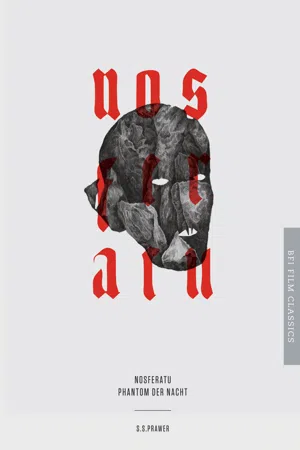
This second edition features a new foreword by Brad Prager and original cover artwork by Matt Brand.
- 104 pages
- English
- ePUB (mobile friendly)
- Available on iOS & Android
eBook - ePub
About this book
Information
1 From Dracula to Nosferatu
Like Mary Shelley’s Frankenstein and Stevenson’s The Strange Case of Dr Jekyll and Mr Hyde, Stoker’s late Victorian novel belongs to a cherished class of nineteenth-century fictions in which ‘an unusual individual in touch with private fears at a time when these fears were shared by the outside world consciously or unconsciously exploited the link between the two’.17 Dracula, never out of print since its first publication, is also a filter through which folk beliefs, rural and urban myths, and historically conditioned as well as perennial psychological experiences have passed into the ken of successive generations. Much of this is sexual: vampirism, as Stoker presents it, involves sadistic and masochistic practices, symbolic rapes of men, women and children, sudden changes from virgin to whore, and violations of jealously protected inner and outer spaces by vampire-hunters; neither the bodies of men and women, nor bedrooms, tombs, asylums, chapels, are sacrosanct.18
Social implications involve aristocratic violations of bourgeois proprieties, disastrous incursions of eastern strangers into western cities, capitalists ‘sucking blood’ – a metaphoric usage that Stoker’s contemporary Karl Marx made peculiarly his own.19 Freudians could detect instances of ‘the return of the repressed’, ancient fears returning to life – the dead coming back to plague the living, revenants and ghouls, succubi and succubae, lamias, empusas and striges – while Jungians could have a field-day searching for denizens of the collective unconscious where Shadow battled Anima. Medical fears also found an echo in such works: vampiric incursions could recall outbreaks of bubonic plague, smallpox, venereal disease (Stoker himself, like many of his contemporaries, may have suffered from syphilis), cholera, influenza and, more recently, SARS and AIDS. Dracula enshrines a version of the Doppelgänger, the spectral double beloved of German writers and film-makers: the vampiric Count may be seen as Jonathan Harker’s double, acting out repressed desires that come to the surface when Jonathan is confronted by three vampire women (one of whom seems strangely familiar!) before Dracula chases them back with his homoerotic ‘This man is mine!’ And vampirism, as we meet it in Stoker’s novel, is spilt religion: it parodies the Eucharist and needs a panoply of crucifixes and communion wafers (along with garlic and pointed stakes) for its defeat.
Dracula derives his name from a historic figure: Vlad Dracula, a fifteenth-century ruler of Wallachia, named after the Order of the Dragon into which his father had been received – though ‘Dracul’ (dragon) also meant ‘Devil’ in Romanian, an appropriate sobriquet in view of his legendary cruelty that involved impaling hundreds of victims at a time. Many of his brutal deeds took place in neighbouring Transylvania, famous for the exploits of Countess Elisabet Báthory, who sought to rejuvenate herself by bathing in the blood of freshly killed young girls – just as Stoker’s Dracula grows younger as he sates himself on the blood of his male and female victims.20
Stoker spent six years studying vampire lore, in the British Museum and in other libraries, through conversations with Arminius Vambery, a Hungarian professor of Oriental Languages whom he met and befriended in London in 1890, and through extensive acquaintance with many vampire-plays performed in London (often translated from French Grand Guignol), penny-dreadfuls like Varney the Vampyre, or, The Feast of Blood, travel writings and a rich Romantic tradition that was very much alive in Victorian England. There were poems by Goethe, Coleridge, Byron, Southey and Keats, featuring vampiric beings of both sexes, ‘Gothic’ novels by Ann Radcliffe, Matthew ‘Monk’ Lewis and Charles Maturin, and one story in particular, penned by Stoker’s fellow Irishman Sheridan Le Fanu, ‘Carmilla’, which had taken its place in a remarkable collection of Le Fanu’s short stories entitled In a Glass Darkly (1872). The influence of Le Fanu’s tale is most clearly visible in the chapter from Dracula which Stoker later excised and which was published separately as ‘Dracula’s Guest’. The most powerful influence of all, however, was the work of Wilkie Collins, especially The Woman in White of 1860, whose multi-narrator and multi-document structure Dracula mirrors, and whose plot includes a wicked foreign nobleman and scenes in a Victorian lunatic asylum. The appearance, in Dracula, of a ghostly ‘Lady in Black’ is a nod to Collins as surely as a child’s invocation of a ‘Bloofer lady’ echoes the ‘boofer lady’ of Dickens’s Our Mutual Friend.
Stoker’s novel has perennial appeal; but it is firmly rooted in Victorian soil. It shows a bourgeois businessman travelling into foreign regions in quest of improved sales and in a spirit of enterprise. An English aristocrat, a wealthy American and a spirited woman who is more than a swooning invalid or her complement, the ‘Angel in the House’, all join him in the task of foiling a foreign danger that is threatening the stability of Victorian marriage and Victorian society. In this task of thwarting an invader from eastern lands they are helped by a scientist and occultist from a friendly western power, the Netherlands. The setting is London, which had, by the 1890s, become the biggest city in the world; battening on its teeming life, Dracula becomes an ancestor of more recent power-hungry figures like Blofeld or Goldfinger or the controllers of SMERSH.
Stoker firmly sketches in a background of scientific discovery and technological innovation; information is imparted, collected and stored not only in handwritten diaries but also in documents produced on typewriters and speech recorded on phonographs. Van Helsing, the Dutch vampire-hunter, is a disciple of Jean-Martin Charcot and adopts his guru’s theories of hysteria along with his experimental practice of hypnotism. In fact, Van Helsing and other male characters are themselves subject to hysterical attacks, proving that one need not have a womb (hustera) to be so afflicted. There is much talk of medical theories, their limitations and the gradual crossing of frontiers that formerly guarded unknown territories of body and mind, as well as the application of recent medical practices like blood transfusion.21
Above all, Dracula enshrines in its two principal female figures, Mina and Lucy, two conceptions of women that complemented one another towards the end of the nineteenth century. On the one hand there is fear of the disruptive effects female sexuality might have within a patriarchal society: Lucy, who begins as a girlishly gushing, well-brought-up young lady, has ‘polyandrist’ fantasies when she is courted by three eligible young men at the same time; under the vampire’s bite, she turns into a polymorphously perverse sexual predator and paedophile who has to be hunted down as mercilessly as the foreign Count who changed her from Victorian virgin to voluptuous devourer of blood. ‘The blood is the life’, quotes the mad Renfield from Deuteronomy 12:23, tempting us post-Freudians to equate blood and semen.
Mina, on the other hand, is the male vampire-hunters’ invaluable helpmeet: she is more steady and intelligent than any of the British and American males, and by keeping and assembling all the relevant records, she becomes the putative author of the novel in which she is a character. One of her principal weapons is that typewriter which transformed the career prospects of so many women at the end of the century; and though, like Lucy, she is bitten by the vampire, her help enables the male hunters with their fearful panoply of phallic weapons, ranging from scalpel to stake, to track the attacker to his lair and, by defeating him, restore Mina to her admirable self. The only one of the fearless vampire-hunters who dies is the American; and after Van Helsing, his task completed, has returned to the Netherlands, three happy English couples are left to raise their families. As Martin Tropp has commented:
All the distortions of the maternal role, the gruesome tastes of Dracula’s women, Lucy’s nocturnal activities, Mina’s nursing of grown men, and even Dracula’s opening a vein in his chest and forcing Mina to drink his blood – are answered by the birth of Mina’s child. Mina becomes a wife and mother who is useful, competent and independent … Though they set out to save her, at the end of the book it is Mina who leads the reluctant band of men into the twentieth century.22
Stoker’s Dracula completed a process begun, in England, by the Byronic Lord Ruthven of John Polidori’s The Vampyre, written in 1816 but first published in 1819: the transformation of the evil-smelling revenant of peasant folklore, come from the grave to torment his fellow villagers until they staked him or cut off his head, into the aristocratic being who could travel to distant parts (provided he carried with him some of his native earth) to work his mischief. He remained a shape-shifter, assuming the garb and manners of the sophisticated society he invaded as easily as changing into a bat or some other beast – though he could be recognised for what he was by his failure to cast a shadow or appear as a reflection in a mirror. The novel of which he is the central character has been subject to the most varied interpretations, many of which have been summarised in Maud Ellmann’s admirable edition:
Dracula has been interpreted as a figure for perversion, menstruation, venereal disease, female sexuality, male homosexuality, feudal aristocracy, monopoly capitalism, the proletariat, the Jew, the primal father, the Antichrist, and the typewriter. But Dracula is all these things, and more: he stands for the return of the repressed, the contents of which are forever shifting. For this reason he can never be pinned down: he continues to change shape, beyond the covers of Bram Stoker’s book, in the minds of his insatiable interpreters.23
Among these interpreters and reinventors, film-makers of many nations have been prominent – none more so than one of the greatest German directors of silent films, F. W. Murnau (Friedrich Wilhelm Plumpe, 1888–1931). Murnau and his scriptwriter Henrik Galeen plucked out a term Stoker had found for the undead, ‘Nosferatu’, placed it in their title – Nosferatu. Eine Symphonie des Grauens – and had the chronicler who acted as narrator give it a resonance it has never since lost:
Nosferatu, does not this word sound in your ear like a call of the bird of death. Beware of uttering it, or the images of life will fade into shadows, spectral dreams will arise in your heart and feed on your blood …24
This cinematic ‘symphony’ of 1921–2, in its turn, inspired Werner Herzog to another set of variations, to be considered in Chapter 4, which were as significant for the Germany of the Western Republic that followed World War II as Murnau’s had been for that which had its all-too-brief life after World War I. Both, however, drew freely on the late Victorian novel whose author uncovered, partly unconsciously, deep-seated desires and apprehensions, and had, in the process, transformed a peasant superstition into a potent modern myth.25
2 Tradition and Alienation
Between Murnau’s Nosferatu and Herzog’s film lies the most disgraceful period of German history: the murder, and complicity in murder, of millions of people born into the ‘wrong’ religion or race, with sexual orientations, mental handicaps or nomadic dispositions that made them ‘unfit’ to be part of the new order, or with political beliefs other than those officially decreed; and with robbery on an unprecedented scale whose beneficiaries, whether large or small, became accomplices with their own stake in the smooth working of the industrialised, bureaucratically administered and sadistically enforced policies of death. What this did to those who followed the generation that had spawned, supported or tolerated the criminal Nazi regime is vividly illustrated by one of thousands of separate anecdotes told and collected over many years. This one, from an interview with a thirty-two-year-old Bavarian woman published in 1979, the year Herzog’s Nosferatu appeared, is typical of many:
I first heard about things that the Nazis had done when I was eight. There was this little girl who came to school day after day weeping. I finally asked her what was the matter, and she said that her father had just been imprisoned as a war criminal. He had been accused of killing hundreds of inmates in a camp. I raced home and blurted to my father: ‘Her father did this! Did you do it, too?’ There was a terrible scene. My mother said to me: ‘How dare you speak with such disrespect! I forbid you ever to bring up the subject again.’ To this day, I have not had the courage to confront them a second time.26
The guilt and evasions of the parents could poison the lives of the children.
Post-war German film-makers born too late for complicity had an analogous problem: many of their senior colleagues who had not been murdered or forced into emigration had been active at a time when their work served the efficient propaganda machine run by Josef Goebbels, their careers furthered by the disappearance of some of the finest talent of the Weimar Republic. Moreoever, a great many of the films made in the first two decades after the end of the war were not to the taste of the most intelligent and socially aware young men and women eager to make their own contribution to the renascent film industry of the Federal Republic. Some of their criticism of ‘Papa’s Kino’ was unfair; but fine works by Helmut Käutner, Erich Engel, Peter Lorre and others were lost in a welter of self-pitying ‘rubble films’, ‘Sissi’-type sentimen-talisations of history, crudely formulaic regional melodramas, filmed operettas, petty-bourgeois comedies, Edgar Wallace adaptations and apologetic depictions of German officers and men in World War II, untainted by, and usually resentful of, Nazi ideology.
The first open sign of revolt came in 1962, in the so-called ‘Oberhausen Manifesto’, which rejected post-war German film-making in favour of new principles largely formulated by the chief ideologist of this earliest manifestation of what came to be called the ‘New German Cinema’, Alexander Kluge. Herzog was not one of the signatories of this manifesto, and despite friendly relations with those who subsequently made their mark in its wake – notably Kluge, Volker Schlöndorff and Rainer Werner Fassbinder – remained aloof from the various groupings of the Federal Republic as well as those of the German Democratic Republic, which followed its own socialist path, with official controls a maverick like Herzog could hardly have borne. No one, however, felt more strongly than he that he was part of a ‘fatherless generation’: as a German, who felt that his people, who had produced ‘the greatest philosophers, composers, writers and mathematicians’, but had in the space of only ten years, ‘created a barbarism more terrible than had ever been seen before’; as a Bavarian, who loved the region into which he had been born b...
Table of contents
- Cover Page
- Title Page
- Contents
- Foreword Brad Prager
- Acknowledgments
- 1. From Dracula to Nosferatu
- 2. Tradition and Alienation
- 3. Teamwork
- 4. Tribute and Transcendence
- 5. Nobodaddy’s Universe
- 6. Melancholy Vampire
- 7. Mysterious Journey
- Appendix: Herzog’s ‘Film Narrative’
- Notes
- Credits
- Select Bibliography and DVD Listing
- eCopyright
Trusted by 375,005 students
Access to over 1.5 million titles for a fair monthly price.
Study more efficiently using our study tools.
Frequently asked questions
Yes, you can cancel anytime from the Subscription tab in your account settings on the Perlego website. Your subscription will stay active until the end of your current billing period. Learn how to cancel your subscription
No, books cannot be downloaded as external files, such as PDFs, for use outside of Perlego. However, you can download books within the Perlego app for offline reading on mobile or tablet. Learn how to download books offline
Perlego offers two plans: Essential and Complete
- Essential is ideal for learners and professionals who enjoy exploring a wide range of subjects. Access the Essential Library with 800,000+ trusted titles and best-sellers across business, personal growth, and the humanities. Includes unlimited reading time and Standard Read Aloud voice.
- Complete: Perfect for advanced learners and researchers needing full, unrestricted access. Unlock 1.5M+ books across hundreds of subjects, including academic and specialized titles. The Complete Plan also includes advanced features like Premium Read Aloud and Research Assistant.
We are an online textbook subscription service, where you can get access to an entire online library for less than the price of a single book per month. With over 1.5 million books across 990+ topics, we’ve got you covered! Learn about our mission
Look out for the read-aloud symbol on your next book to see if you can listen to it. The read-aloud tool reads text aloud for you, highlighting the text as it is being read. You can pause it, speed it up and slow it down. Learn more about Read Aloud
Yes! You can use the Perlego app on both iOS and Android devices to read anytime, anywhere — even offline. Perfect for commutes or when you’re on the go.
Please note we cannot support devices running on iOS 13 and Android 7 or earlier. Learn more about using the app
Please note we cannot support devices running on iOS 13 and Android 7 or earlier. Learn more about using the app
Yes, you can access Nosferatu (1979) by S.S. Prawer in PDF and/or ePUB format, as well as other popular books in Media & Performing Arts & Film History & Criticism. We have over 1.5 million books available in our catalogue for you to explore.