- 96 pages
- English
- ePUB (mobile friendly)
- Available on iOS & Android
eBook - ePub
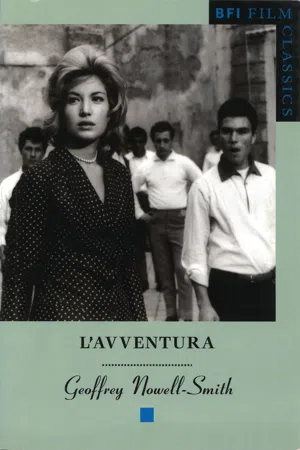
L'avventura
About this book
This study provides a detailed account of the 1960s film, 'L'avventura', arguing that in order to appreciate its greatness it is necessary to understand not only that the film is a classic but also that it represents a revolution in cinema.
Information
1

THE SCANDAL OF 'L'AVVENTURA'
The story of L'avventura is deceptively simple. A group of rich Italians is going for a cruise on a yacht off the coast of Sicily. They stop to visit a deserted volcanic island and when they re-embark on the boat they discover that one of their number, Anna (Lea Massari), is missing. Her lover Sandro (Gabriele Ferzetti) and her best friend Claudia (Monica Vitti) search for her, first on the small island, then on the mainland of Sicily. In the course of the search they fall in love themselves. This new love affair is threatened when Sandro spends a night with a society tart he had previously encountered in the search for Anna. Although distressed, Claudia seems inclined to forgive him.
A story, then, in which various things happen, but more importantly, one in which a particular thing does not happen: Anna does not reappear. Accident, kidnap, suicide, escape, whatever it was, the audience never knows. The thought that she might return casts a shadow over the relationship between Claudia and Sandro and leaves the audience in suspense. This is not positive suspense à la Hitchcock, which mounts to a climax and is then resolved. It is a negative, nagging suspense, an absence in the plot which is never filled.
Not only does the audience never find out what happened to Anna. In all probability the director didn't know either, or, more to the point, didn't care. That is to say, we are not dealing with a piece of information which is artfully withheld, but with one which simply does not exist. There is no resolution to the story of Anna's disappearance; not in the film, nor in any statement made by Antonioni before or after the film was made. The question of what happens to Anna not only is not answered but, more radically, cannot be answered, since there is nowhere to turn for an answer. This is disconcerting, all the more so because this is a fiction, and in fiction one expects answers. In real life, if someone disappeared, then one could say that something had happened to her, even if one didn't know what. But a fictional character who goes missing in this way disappears absolutely, because she has no existence outside the story. The first challenge posed by L'avventura is how to cope with the radical nature of this absence.
The audience which booed L'avventura at Cannes was not merely bored. It was angry. It was angry because the plot did not do what a plot is supposed to do and answer what it appeared to have set up as its principal question. It was doubly angry because the character who disappeared was played by Lea Massari, a fairly well known and popular actress who most people would have expected to be the star. As the film proceeds centre stage is instead taken by the slightly horse-faced woman who shares the billing on the credits, the unknown Monica Vitti. Deprived of its heroine, the audience (or sections of it) became increasingly restive. The catcalls reached a crescendo at the end when the film reached the nearest thing that it comes to certainty — that the hero would be reconciled to the wrong woman. That was, and is, the public face of the 'scandal' of L'avventura.
Did Antonioni know that this would be the public's first reaction to his film? At one level, he must have done. He knew he was taking a risk. The original producers of the film, who in this respect at least knew their business as purveyors of what the public would expect, wanted the story to end with a resolution. Reluctantly, Antonioni was prepared to offer one: Claudia would learn, near the end of the film, that Anna was dead. This would provide an ending, albeit an unhappy one. It would solve the intellectual expectations of this (or any other) plot, if not the emotional demands of that particular audience. But he had no wish to deliver on his offer and when the film went into production he was planning two versions of the end, one to appease the producers and one to satisfy himself. When the first producers went bankrupt he got agreement from the new producer, Cino Del Duca, that the end should be as he wanted it. The crisis that overcame the film in mid-production was a blessing in disguise. If the film had been finished and shown as the original producers hoped, it would have avoided a scandal, but it would have been a lesser film. In the event, the film was awarded a special prize by the critics at Cannes — 'for its search for a new cinematic language and for the beauty of its images' — and this endorsement was confirmed when it went on to run in Paris for three solid months. Fortified by this endorsement, Antonioni was able, two years later, to push back the boundaries of acceptable film narration even further and to deceive even more boldly the expectations of the audience with the ending of The Eclipse, where only the camera turns up to keep the appointment the characters have made.
The steps that Antonioni would take in the future, or those that other film-makers would take following in his footsteps, could not however have been foreseen in the Palais des Festivaux at Cannes, on the evening of 15 May 1960, when Antonioni fled in tears from the onslaught of the philistines.
2
THE DIRECTOR
At the time of the fateful showing of L'avventura in Cannes Antonioni was forty-six years old. He was born in Ferrara, in the Po Valley, on 29 September 1913. He had a conventional education suited to his bourgeois background, graduating from the University of Bologna in Economics and Commerce in 1935. Over the next four years he wrote regular film criticism for the local Ferrara newspaper, the Corriere Padano. In 1940 he moved to Rome, enrolling at the recently founded state film school, the Centro Nazionale di Cinematografia. There he came into contact with the young dissidents around the magazine Cinema, to which he became a contributor. He wrote or collaborated on a couple of screenplays, including Rossellini's Un pilota ritorna of 1942. In the same year he paid a visit to Nice on behalf of the Italian company Scalera and acted as an assistant on Marcel Carné's Les Visiteurs du soir. Back in Italy, he returned (as he would often do throughout his life) to his home territory near Ferrara with plans to shoot a documentary about the people of the Po Valley. The success of the Allied invasion of Italy in the summer of 1943 meant that shooting had to be interrupted. When he reclaimed his footage after the war, he found that much of it had perished, but he finished the film none the less, under the title Gente del Po, in 1947. It is a remarkable film, in many ways prefiguring his later work.2 He then made a number of other short documentaries, all interesting, but none perhaps quite as striking as his first effort, while awaiting the chance to shoot a feature.
This chance came to him in 1950. The Italian cinema was beginning to recover from the body-blows dealt to it, first by the war and then, even more seriously, by the deluge of American films that flooded the market after the war was over. The gap between the collapse of the Fascist film industry and the gradual resurgence of a post-war commercial industry had been filled by neo-realism, a politico-aesthetic movement which stressed working-class subject matter, shooting in real locations, simplicity of means, and narrative which eschewed the foregone conclusions of melodrama.3 By 1950 the neo-realist movement was on the wane. Antonioni had always stood aloof from neo-realism and even when he agreed with its methods or objectives (the preference for location shooting, for example) he did so for different reasons. Even allowing for this separateness, Antonioni's first feature, Cronaca di un amore ('Story of a love affair'), first shown in October 1950, came as a shock.
Cronaca di un amore is a tale about two former lovers who are brought together again when the woman's millionaire husband hires a private detective to investigate her past. With its film noir plot and its wealthy bourgeois setting, all furs and fast cars, and with its elaborate and self-conscious camera movements, Cronaca di un amore could hardly be further, in style or content, from the world of neo-realism as represented by such films as Visconti's La terra trema or De Sica and Zavattini's Bicycle Thieves.
Nor, however, did Cronaca (or any of Antonioni's subsequent features) fit comfortably into the world of the resurgent commercial industry or the popular marketplace where Italian and American genre films jostled for public attention. The film is neither thrilling nor melodramatic. The plot lacks a climax. The noir atmosphere peters out into vague shades of grey. The lovers' crisis is expressed more as an ill-defined malaise than as cathartic suffering. In short, it lacked any of the qualities that would make it fit with either critical or audience expectations. It was a film literally sui generis — in a genre of its own — and as such little appreciated on first release.4

Massimo Girotti and Lucia Bosè as the guilty lovers in Antonioni's first feature, Cronaca di un amore (1950)

Lucia Bosè in La signora senza camelie (1953)

Valentina Cortese and Madeleine Fisher in Le amiche (1955)

Steve Cochran and Alida Valli in II grido (1957)
After Cronaca, Antonioni was commissioned in 1952 by a producer to direct a film about the 'problem' of juvenile delinquency. The result, I vinti ('The vanquished', also known as These Our Children) was competent, but did little for the director's reputation. Far more important were his next two films, La signora senza camelie ('The lady without camellias', 1953), and Le amiche ('The girl-friends', 1955).
In La signora senza camelie, Lucia Bosè (the lead actress from Cronaca) plays the role of a shop-girl, Clara, precipitated into stardom by a film industry eager for profits and prestige and unceremoniously dumped when she proves not to be up to what is required. Truly the stuff of melodrama — but equally a possible subject for social realism. Antonioni offers neither. Clara's background is not explored in depth, nor are the commercial mechanisms of the industry which uses and abuses her. Clara is not really defined as a character, at least not in the sense of fitting into a repertory of character types. Instead Antonioni creates a set of arabesques around the extraordinarily beautiful figure of Bosè which gradually accumulate until at the end Clara's tragedy is both moving and credible — more so than, for example, that of the Lana Turner character in Minnelli's The Bad and the Beautiful, released the previous year.
The social rise of a working girl is again the theme (or one of the themes) of Le amiche, and again it is not exploited. Le amiche is an adaptation (by Antonioni and two women writers, Suso Cecchi D'Amico and Alba De Cespedes) of Cesare Pavese's novel Tra donne sole. Clelia (played in the film by Eleonora Rossi Drago), who has risen to become the manager of a leading fashion house in Rome, returns to her home city of Turin to open a branch of the company there. She fal...
Table of contents
- Cover Page
- Title Page
- Contents
- Prefatory note
- Introduction
- 1 The scandal of 'L'avventura'
- 2 The director
- 3 The adventure of 'L'avventura'
- 4 A viewing
- 5 The world of 'L'avventura'
- 6 Fortunes
- Appendix: 'Dear Antonioni . . .' by Roland Barthes
- Notes
- Credits
- Bibliography
- eCopyright
Trusted by 375,005 students
Access to over 1.5 million titles for a fair monthly price.
Study more efficiently using our study tools.
Frequently asked questions
Yes, you can cancel anytime from the Subscription tab in your account settings on the Perlego website. Your subscription will stay active until the end of your current billing period. Learn how to cancel your subscription
No, books cannot be downloaded as external files, such as PDFs, for use outside of Perlego. However, you can download books within the Perlego app for offline reading on mobile or tablet. Learn how to download books offline
Perlego offers two plans: Essential and Complete
- Essential is ideal for learners and professionals who enjoy exploring a wide range of subjects. Access the Essential Library with 800,000+ trusted titles and best-sellers across business, personal growth, and the humanities. Includes unlimited reading time and Standard Read Aloud voice.
- Complete: Perfect for advanced learners and researchers needing full, unrestricted access. Unlock 1.5M+ books across hundreds of subjects, including academic and specialized titles. The Complete Plan also includes advanced features like Premium Read Aloud and Research Assistant.
We are an online textbook subscription service, where you can get access to an entire online library for less than the price of a single book per month. With over 1.5 million books across 990+ topics, we’ve got you covered! Learn about our mission
Look out for the read-aloud symbol on your next book to see if you can listen to it. The read-aloud tool reads text aloud for you, highlighting the text as it is being read. You can pause it, speed it up and slow it down. Learn more about Read Aloud
Yes! You can use the Perlego app on both iOS and Android devices to read anytime, anywhere — even offline. Perfect for commutes or when you’re on the go.
Please note we cannot support devices running on iOS 13 and Android 7 or earlier. Learn more about using the app
Please note we cannot support devices running on iOS 13 and Android 7 or earlier. Learn more about using the app
Yes, you can access L'avventura by Geoffrey Nowell-Smith in PDF and/or ePUB format, as well as other popular books in Media & Performing Arts & Film & Video. We have over 1.5 million books available in our catalogue for you to explore.