When the Syrian regime used sarin and other chemical weapons against dissidents in August 2013, an estimated 1729 people were killed including 400 children. President Barack Obama warned that the use of chemical weapons would constitute a "red line", but he refused to take military action. Trump's approach has been even more disengaged and lacking in clarity.
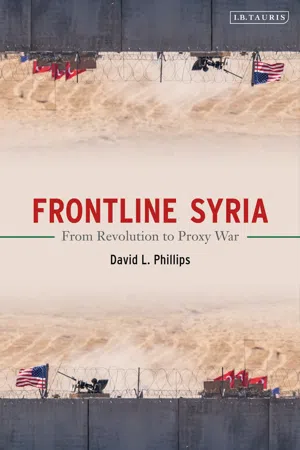
Frontline Syria highlights America's failure to prevent conflict escalation in Syria. Based on interviews with US officials involved in Syria policy, as well as UN personnel, the book draws conclusions about America's role in world affairs and its potential to prevent deadly conflict. It also highlights the role of front-line states in Syria and other countries who engaged in the Syrian conflict to advance their national interests.
Covering key turning points in the Syrian civil war, including the impact of recent decisions by the Trump administration, Frontline Syria critically evaluates America's global power and provides a diplomatic and military history of the conflict. Based on this analysis, the book offers policy recommendations and makes a case for America's future role addressing peace and conflict.
- 328 pages
- English
- ePUB (mobile friendly)
- Available on iOS & Android
eBook - ePub
About this book
Information
Part One
Legacy of Repression
1
Hama Rules
He levelled it, pounding the fundamentalist neighborhood with artillery for days. Once the guns fell silent, he plowed up the rubble and bulldozed it flat, into vast parking lots.1
—Thomas L. Friedman
*****
Hafez al-Assad was born with a chip on his shoulder. He was the ninth of eleven sons, and the fourth from his father’s second marriage. Hafez came from Qardaha, a poor rural village in Latakia Province. He was an Alawite, a minority Islamic sect, which comprised less than 15 percent of Syria’s total population. Qardaha was in a Sunni region where discrimination against Alawites was widespread. Hafez had to struggle to advance in life. He learned survival skills that would serve him well in the rough and tumble world of the Syrian military and Baath Party.
Hafez al-Assad enlisted in the air force; he became an air force pilot and air force commander after the Baathists took power in 1963. Hafez and a group of officers launched a coup against the Baathist civilian leadership in 1966. After the coup, Hafez was appointed defense minister. Hafez earned a reputation for cunning and ruthlessness. He was notorious for arresting, torturing, and executing opponents. Hafez even turned on his mentor, chief of the armed forces Salah al-Jadid, blaming him for Syria’s botched effort to support Palestinians fighting King Hussein in Jordan. Jadid was arrested and given a life sentence. With Jadid out of the way, the path to political leadership swung wide open for Hafez. He became prime minister in November 1970 and president the following year.
Hafez made many enemies, not only domestically but also regionally. Hafez was committed to Israel’s destruction, using his support for the Palestinian national movement to burnish his credentials with the Arab League. However, he was humiliated when Syrian troops were driven from the Golan Heights during the Six-Day War with Israel in June 1967. He loathed Egyptian president Anwar al-Sadat for kowtowing to the West, criticizing Syria’s defeat in the Yom Kippur War of October 1973, and making peace with the “Zionist entity.” Heads of the Baath parties in Syria and Iraq, Hafez al-Assad and President Saddam Hussein, respectively, vied for leadership of the Baath movement. As an Alawite, Hafez had affinities for Iran, which he supported in the Iran–Iraq War from 1980 to 1988.
Syria used terrorism to advance its strategic objectives in the region. It established a network of jihadist groups, including Al-Saiqa in 1966. Al-Saiqa was an extremist Palestinian group that targeted Israel and more moderate Palestinian factions such as Yasser Arafat’s Fatah Organization. Syria developed close ties with several other militant Palestinian organizations, which posed a threat to Israel such as the Islamic Jihad Organization, the Islamic Movement in Palestine, the Popular Front for the Liberation of Palestine, and Hamas. Consistent with his use of militant groups to advance foreign policy goals, Assad sponsored the Kurdistan Workers’ Party (PKK) as a vehicle for pressuring Turkey. He supported Hezbollah to leverage Syria’s role in Lebanon’s civil war. In addition to working through proxies, Assad deployed Syrian forces and secured a permanent presence in the Beqaa Valley.
The Syrian chapter of the Muslim Brotherhood was outlawed following the 1963 Baathist coup and subsequently scorned by the sectarian Syrian regime. Banning the Brotherhood contributed to its radicalization, leading to a series of strikes and mass protests. Under pressure from the regime, the Brotherhood went underground. It divided into two factions in 1972. Issam Attar led the more moderate Damascus faction, and Abdu-l-Fattaah Aboo Ghuddah led hardliners in Aleppo and Hama where Sunnis are traditionally more conservative and militant.
Marwan Hadeed, an agricultural entrepreneur from Hama, tried to reconcile the Brotherhood movement. He established an independent organization named the Fighting Vanguard (Al-Talia Al-Muqatila), which attracted support from both sides and functioned as the armed wing of the Brotherhood. Hadeed was arrested in 1975 and killed by Syrian security forces.
On May 31, 1976, Syrian armed forces intervened in Lebanon’s civil war at the request of its Christian Maronite-led government. Assad acted in the national interest. He believed that events in Lebanon were a direct risk to Syria. Assad feared that sectarian strife could spill over the border, exacerbating Syria’s own Christian–Muslim tensions. A civil war could also provide a pretense for Israel’s intervention, directly challenging Syria’s role in the region. Victory by the Lebanese National Movement risked turning Lebanon into a radical, left-wing Muslim state. Assad sent Syrian forces into Lebanon in order to stabilize the situation. He intervened to prevent what happened in Lebanon from happening in Syria.2
Despite Assad’s efforts, the Islamic uprising was launched in Syria with clandestine operations. It came out of the shadows in the spring of 1979, when an artillery school was attacked, killing eighty-three cadets. Government buildings, police stations, and Baath Party institutions were attacked in June of that year. The Fighting Vanguard also tried to assassinate senior Baath Party officials, including Hafez al-Assad. Assad viewed the Fighting Vanguard, which became the Syrian branch of the Muslim Brotherhood, as the most serious security threat to his rule. He tried to suppress it, arresting and killing thousands of Brothers and sympathizers.3
*****
No incident defined Hafez al-Assad more than his annihilation of Hama in 1982. Hama, which had become the Muslim Brotherhood’s stronghold, is Syria’s fourth-largest city, behind Aleppo, Damascus, and Homs. According to the 2009 census, the Hama Governorate had a population of 854,000, of which about one-third lived in the Hama municipality.4 Like Hama, Syria is a country composed of diverse ethnic and religious groups. Syria is made up of 85 percent Arabs, including some 500,000 Palestinians. Kurds represent 10 percent. Ethnic minorities such as the Turkmen, Armenians, Circassians, and Assyrians are about 5 percent. Approximately 87 percent of Syrians are Muslims. Of these, 74 percent are Sunnis and 13 percent are Shiites, Alawi, and Ismaili. Christians are 10 percent and Druze are 3 percent of the total population. Yazidis and Jews also live in Syria.5 Assad’s tyranny maintained some semblance of national unity between Syria’s disparate groups.
Hama sits along a scenic stretch of the River Orontes about 300 kilometers north of the capital, Damascus. The vast majority of Hama residents are socially conservative Sunni Muslims and tribal members.6 Hama has a rich history. It was settled in the Neolithic Age on the edge of the Syrian Desert and became a commercial center for nomadic people and nearby villagers. Hama is known for its wooden waterwheels (norias), which are up to 10 meters in diameter. The norias were built in the fourteenth century to lift water from the Orontes to aqueducts. The water was used for human and livestock consumption, as well as irrigating farmlands. Water from the Orontes also supplied the gardens of Hama, which date back to 1100 bc.
Hama had long been an abundant agricultural market, producing cotton, cereals, fruit, and vegetables. Small-scale manufacturing and agricultural processing were also predominant in Hama.7 Other economic activities included leather working, tobacco processing, sugar refining, flour milling, wool and textile weaving, tanning, and cement manufacturing. In the 1970s census, 31.5 percent of the population of Hama identified as self-employed.8
Mosques adorn Hama’s landscape, as places of worship for the pious. Hama was also a tourist destination, celebrated for its architecture and historical sites. Hama’s main Christian church was turned into a great mosque after Hama was captured by the Arabs in ad 637.9 Built by Nur al-Din, the al-Nuri mosque was finished in 1163. The eighth century Great Mosque, Mamluk al-Izzi mosque, built in the fifteenth century, the Abu al-Fida mausoleum and mosque, built in 1326, the Al-Hasanain mosque, finished in 1163, and the Azm Palace, built in 1742, were spectacular architectural specimens. Ruins at Apamea, the former ancient Greek and Roman capital, with its vast amphitheater able to seat twenty thousand, date back to 300 bc. Mosques are a measure of devotion by Hama’s Sunni Arab majority.
Other architectural sites include the Great Colonnade of Apamea, built in the second century ad, which is almost 2 kilometers long. The Masyaf Castle is the former center of Syrian Assassin sect. It protected trade routes to Banyas and cities further inland. Artifacts from the fifth millennium bc, the Syro-Hittite Kingdom, and the second millennium of the Byzantine period were found in the citadel and displayed in the Hama museum.
Hama has a tradition of resistance. It was the hub of opposition to the French administration during the rebellion of 1925–7. Beginning in 1964, Hama was the center of a countrywide protest by the Sunni majority against the secular and socialist policies of the Baath Party. The Baathists had taken over in a coup the previous year amid demands for democratic reforms and the rule of law.10 When tensions intensified in the 1970s, Assad tried soft power and conciliatory gestures to quell the rebellion. The Syrian government increased the salaries of civil servants and took steps to crack down on corruption. It also offered food subsidies, reducing the cost of bread and other staples.
Assad supported political reforms and a new constitution in 1973. However, confidence-building measures failed to mollify the Sunnis grievances against Assad’s Alawite administration. Not only did the constitution fail to decentralize power to different groups in Syria, it also infuriated the Sunni majority by specifically allowing an Alawite to serve as head of state. Sunnis preferred representation in government by one of their own. In response, Assad arranged for a prominent Shiite jurist to issue an edict (fatwa), asserting that Alawites were Shiite Muslims and not heretics. Sunnis were enraged, especially in Hama. In October 1980, the Brotherhood announced the formation of the Islamic Front in Syria, an umbrella organization for all of the Islamic groups working to “defend Islam.”11
While paying lip service to Sunni demands, Assad took steps to consolidate his power and enshrine the authority of Alawites. His Baath Party adopted a secular-nationalist ideology, which further alienated the Brotherhood, Sunni elites, and members of the urban middle class. Sunnis openly opposed Assad’s proposed social, economic, political and cultural reforms. They also opposed Hafez’s su...
Table of contents
- Cover
- Half-title Page
- Dedication Page
- Title Page
- Contents
- Abbreviations
- Timeline of Critical Events in Syria
- About the Author
- Preface
- Part One: Legacy of Repression
- Part Two: Radicalization
- Part Three: International Stakeholders
- Part Four: Minorities and Women
- Part Five: Grinding War
- Epilogue
- Notes
- Glossary of Personalities
- Further Reading
- Index
- Copyright Page
Trusted by 375,005 students
Access to over 1.5 million titles for a fair monthly price.
Study more efficiently using our study tools.
Frequently asked questions
Yes, you can cancel anytime from the Subscription tab in your account settings on the Perlego website. Your subscription will stay active until the end of your current billing period. Learn how to cancel your subscription
No, books cannot be downloaded as external files, such as PDFs, for use outside of Perlego. However, you can download books within the Perlego app for offline reading on mobile or tablet. Learn how to download books offline
Perlego offers two plans: Essential and Complete
- Essential is ideal for learners and professionals who enjoy exploring a wide range of subjects. Access the Essential Library with 800,000+ trusted titles and best-sellers across business, personal growth, and the humanities. Includes unlimited reading time and Standard Read Aloud voice.
- Complete: Perfect for advanced learners and researchers needing full, unrestricted access. Unlock 1.5M+ books across hundreds of subjects, including academic and specialized titles. The Complete Plan also includes advanced features like Premium Read Aloud and Research Assistant.
We are an online textbook subscription service, where you can get access to an entire online library for less than the price of a single book per month. With over 1.5 million books across 990+ topics, we’ve got you covered! Learn about our mission
Look out for the read-aloud symbol on your next book to see if you can listen to it. The read-aloud tool reads text aloud for you, highlighting the text as it is being read. You can pause it, speed it up and slow it down. Learn more about Read Aloud
Yes! You can use the Perlego app on both iOS and Android devices to read anytime, anywhere — even offline. Perfect for commutes or when you’re on the go.
Please note we cannot support devices running on iOS 13 and Android 7 or earlier. Learn more about using the app
Please note we cannot support devices running on iOS 13 and Android 7 or earlier. Learn more about using the app
Yes, you can access Frontline Syria by David L. Phillips in PDF and/or ePUB format, as well as other popular books in History & Middle Eastern History. We have over 1.5 million books available in our catalogue for you to explore.