- 256 pages
- English
- ePUB (mobile friendly)
- Available on iOS & Android
eBook - ePub
About this book
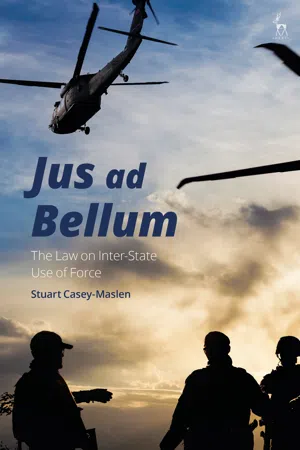
This work expounds, for those in practice and beyond, the rules of international law governing the inter-state use of force. Jus ad bellum determines when a state - or group of states - may lawfully use force against, or on the territory of, another state, and when such action violates international law. The bedrock of the law is found in the Charter of the United Nations, but the interpretation and application of many of the rules codified in the Charter, particularly by the International Court of Justice, are contested. Accordingly, the book clarifies the law as it stands today, explaining its many complexities and controversies, such as when non-state actors may be attacked in another state and when consent is validly given to foreign intervention. The interrelationships between jus ad bellum and the law of armed conflict/international humanitarian law, the law of neutrality, and international human rights law are also illuminated, along with important concepts such as the 'responsibility to protect' and humanitarian intervention.
Information
1
The General Prohibition on the Use of Force
I.Introduction
In the preamble to the 1945 Charter of the United Nations1 (UN Charter), the peoples of the United Nations agreed ‘to ensure, by the acceptance of principles and the institution of methods, that armed force shall not be used, save in the common interest’.2 The bedrock of what is occasionally termed the ‘Universal Security System’3 is thus a general prohibition on the use of force by one state against another. This prohibition, which was instituted under Article 2(4) of the UN Charter, was, at the time, a progressive development of jus ad bellum. It reads in full as follows:
All Members shall refrain in their international relations from the threat or use of force against the territorial integrity or political independence of any state, or in any other manner inconsistent with the Purposes of the United Nations.
Within ‘the most solemn pact of peace in history’,4 Article 2(4) is the cornerstone of contemporary jus ad bellum. Robert Kolb describes the emergence of the prohibition on the use of force as the ‘beginning of modern international law’, though he traces it back to the League of Nations.5 The sweeping prohibition of the use or threat of force by one state against another is underpinned by the duty of non-intervention. This principle of international law dictates that no state shall interfere in the affairs of another, in particular (but not only) through the medium of armed intervention.6 As expressed in the 1970 Declaration on the Principles of International Law:
No State or group of States has the right to intervene, directly or indirectly, for any reason whatever, in the internal or external affairs of any other State. Consequently, armed intervention and all other forms of interference or attempted threats against the personality of the State or against its political, economic, and cultural elements, are in violation of international law.7
Citing the 1970 Declaration in its 1986 judgment on the merits in the Nicaragua case, the International Court of Justice (ICJ) considered that the principle of non-intervention is ‘part and parcel of customary international law’.8 This is so even though, as the Court acknowledged, ‘examples of trespass against this principle are not infrequent’.9 These instances of trespass include non-forcible interference in other states. For example, if it is true that Russia hacked into the Democratic Party computer systems during the 2016 US presidential election with a view to influencing the outcome of that election,10 this would amount to unlawful intervention in the US political system.11 It would not, though, be an instance of unlawful use of force.
II.The Status of the Prohibition under International Law
Before addressing their content in detail, the legal status of the two core prohibitions ad bellum is considered in turn. First, the international legal significance of the prohibition of interstate use of force is determined. Then the normative value of the prohibition on the threat of force by one state against another is assessed. The former – the general outlawing of interstate use of force – is a peremptory norm of international law. The prohibition on the threat of force may also be a customary norm, but it does not similarly enjoy the status of jus cogens.
A.The International Legal Status of the Prohibition on the Use of Force
First and foremost, the general prohibition on the interstate use of force is a rule that applies in toto as a matter to treaty law to all UN member states. The substantive terms of the prohibition in Article 2(4) of the UN Charter are also reflected in the 1982 UN Convention on the Law of the Sea.12 The prohibition is further reaffirmed in the preamble to the 1998 Rome Statute of the International Criminal Court.13 These two global treaties, wherein no reservations are possible to the relevant provisions,14 have been widely ratified by states.15
In its judgment on the merits in the Nicaragua case, the ICJ held that the prohibition on the use of force set out in Article 2(4) of the UN Charter had already become a rule of customary international law prior to 1986.16 It adduced as evidence the practice of states in adopting without a vote the 1970 Declaration on Principles of International Law.17 In their pleadings in the Nicaragua case, both Nicaragua and the United States asserted that the prohibition was of a customary nature. The customary status of the prohibition is accepted by other states and only exceptionally does any publicist contest this.18 Moreover, in proclaiming the general prohibition on use of force as a ‘principle’ of international law, Principle 1 of the 1970 Declaration on the Principles of International Law broadens its scope to encompass the actions of all states, not merely those of UN members.
But such is the fundamental nature of the general prohibition on the use of force, it is also widely considered to be a jus cogens norm. In the 1969 Vienna Convention on the Law of Treaties, a jus cogens norm is described as one that is ‘accepted and recognized by the international community of States as a whole as a norm from which no derogation is permitted and which can be modified only by a subsequent norm of general international law having the same character’.19 A peremptory norm ‘enjoys a higher rank in the international hierarchy than treaty law and even “ordinary” customary rules’, as the International Criminal Tribunal for the former Yugoslavia (ICTY) has since remarked.20
That the prohibition is indeed a peremptory norm of international law appears, implicitly, to be the position of the ICJ. In its judgment in the Nicaragua case, the Court cited the view of the International Law Commission (ILC), in the course of the ILC’s work on the codification of the law of treaties, that ‘the law of the Charter concerning the prohibition of the use of force in itself constitutes a conspicuous example of a rule in international law having the character of jus cogens’.21 This was also the position of the two litigants in the Nicaragua case: Nicaragua and the United States.22 It is also the overt position of most leading publicists.23
One of the consequences of a customary norm having the character of jus cogens is that any treaty which, at the time of the treaty’s conclusion, conflicts with such a norm is void.24 Thus, for instance, states could not contract under a military alliance to use armed force against any state that instituted a trade embargo against one of its members. Such a treaty would be void ab initio. In addition, the ILC’s 2001 ‘Draft Articles on the Law of State Responsibility for Internationally Wrongful Acts’ stipulates that countermeasures shall not affect the ‘obligation to refrain from the threat or use of force as embodied in the Charter of the United Nations’.25 As a rule of customary international law, this precludes a state that is the object of a use of force by another state, where that does not amount to an armed attack, from itself using force in response. A lawful countermeasure must be either pacific in nature or of such limited extent as to not violate the tenets of Article 2(4).26
B.The International Legal Status of the Prohibition on the Threat of Force
Whether the prohibition on the interstate threat of force is a customary rule is not settled, but it is assuredly not a peremptory norm of international law. Indeed, a number of leading publicists have argued that the threat of force may even play a valuable role in the settlement of disputes.27
The ICJ has not explicitly affirmed that the treaty prohibition on the threat of force is of a customary nature, though at one point in its judgment in 1986 in the Nicaragua case it implied that this might be the case.28 There is, though, relatively little evidence of threats by one state to use force against another being treated as breaches of a customary rule of international law, especially in recent years.29 That said, the ICJ also noted its judgment in the Nicaragua case that it
does not consider that, for a rule to be established as customary, the corresponding practice must be in absolutely rigorous conformity with the rule. In order to deduce the existence of customary rules, the Court deems it sufficient that the conduct of States should, in general, be consistent with such rules, and that instances of State conduct inconsistent with a given rule should generally have been treated as breaches of that rule, not as indications of the recognition of a new rule.30
In fact, to the extent that, under the UN Charter at least, threats to use unlawful force are illegal, the prohibition appears to be widely flouted and rarely decried.31 Over the last few years, for example, the United States and the Democratic People’s Republic of Korea (DPRK) have traded threats to use nuclear weapons against each other in circumstances that are unlawful, but without subsequent legal or political censure. In March 2016, in reaction to the initiation of a US–South Korean military exercise, the DPRK threatened a ‘pre-emptive nuclear strike of justice’ and to turn Washington and Seoul into ‘flames and ashes’.32 Such a use of force would amount to the commission of a number of international crimes, including but not only aggression. In August 2017, US President Donald Trump contended that the DPRK ‘best not make any more threats to the United States’, adding that if it does so it ‘will be met with fire and fury and frankly power, the likes of which this world has never seen before’.33 This statement can be interpreted as the United States threatening to use nuclear and conventional weapons against the DPRK in the absence of a prior armed attack. Another threatening statement by the DPRK in 2017, announced via the government news agency, called for the ‘four islands’ of the Japanese archipelago to be ‘sunken into the sea by the nuclear bomb of Juche’.34
In its 2007 Award in the Arbitration between Guyana and Suriname,35 a case...
Table of contents
- Cover
- Title Page
- Table of Contents
- Table of Cases
- Table of Treaties Etc
- Table of National Instruments
- Introduction
- 1. The General Prohibition on the Use of Force
- 2. Consenting to a Use of Force by Another State
- 3. Use of Force in Self-defence
- 4. United Nations Security Council Authorisation to Use Force
- 5. Use of Force and the Law of Neutrality
- 6. The Legality of Humanitarian Intervention
- 7. Responsibility for Aggression
- 8. Use of Force in United Nations Peacekeeping Operations
- 9. Rights and Obligations of Non-state Actors ad Bellum and in Bello
- 10. The Interrelationship between Jus ad Bellum and Jus in Bello
- 11. The Interrelationship between International Human Rights Law and Jus ad Bellum
- Bibliography
- Index
- Copyright Page
Trusted by 375,005 students
Access to over 1.5 million titles for a fair monthly price.
Study more efficiently using our study tools.
Frequently asked questions
Yes, you can cancel anytime from the Subscription tab in your account settings on the Perlego website. Your subscription will stay active until the end of your current billing period. Learn how to cancel your subscription
No, books cannot be downloaded as external files, such as PDFs, for use outside of Perlego. However, you can download books within the Perlego app for offline reading on mobile or tablet. Learn how to download books offline
Perlego offers two plans: Essential and Complete
- Essential is ideal for learners and professionals who enjoy exploring a wide range of subjects. Access the Essential Library with 800,000+ trusted titles and best-sellers across business, personal growth, and the humanities. Includes unlimited reading time and Standard Read Aloud voice.
- Complete: Perfect for advanced learners and researchers needing full, unrestricted access. Unlock 1.5M+ books across hundreds of subjects, including academic and specialized titles. The Complete Plan also includes advanced features like Premium Read Aloud and Research Assistant.
We are an online textbook subscription service, where you can get access to an entire online library for less than the price of a single book per month. With over 1.5 million books across 990+ topics, we’ve got you covered! Learn about our mission
Look out for the read-aloud symbol on your next book to see if you can listen to it. The read-aloud tool reads text aloud for you, highlighting the text as it is being read. You can pause it, speed it up and slow it down. Learn more about Read Aloud
Yes! You can use the Perlego app on both iOS and Android devices to read anytime, anywhere — even offline. Perfect for commutes or when you’re on the go.
Please note we cannot support devices running on iOS 13 and Android 7 or earlier. Learn more about using the app
Please note we cannot support devices running on iOS 13 and Android 7 or earlier. Learn more about using the app
Yes, you can access Jus ad Bellum by Stuart Casey-Maslen in PDF and/or ePUB format, as well as other popular books in Law & International Law. We have over 1.5 million books available in our catalogue for you to explore.